History of Heather

Heather

Heather just became a bit less mysterious. We now know why she came here to work as a mouser, and protect fruits and vegetables from rodents. A neighbor, prior to relocation to Hawaii, left her and a few other kitties with another neighbor who intended to find new homes for them. Another kitty who already lived at the second home was so inhospitable to her that she stayed outside most of the time, and eventually disappeared. She was assumed to have been a victim of coyotes. All but one of the relocated kitties, who happens to be Heather’s mother, were assigned to new homes. Heather’s mother and the original kitty of the household then relocated a few miles away. It is impossible to know where Heather was between leaving her previous temporary home and arriving here. She could have been here longer than anyone was aware of. Because we knew nothing about her when she arrived, she likely got more vaccines than she needed. She was already spayed, although not provided with a chip. Ultimately, she seems to be happy here, and has been very proficient with dissuading rodents. I am pleased that she is happy and decided to stay.

Heather’s Mother

Six on Saturday: Madness

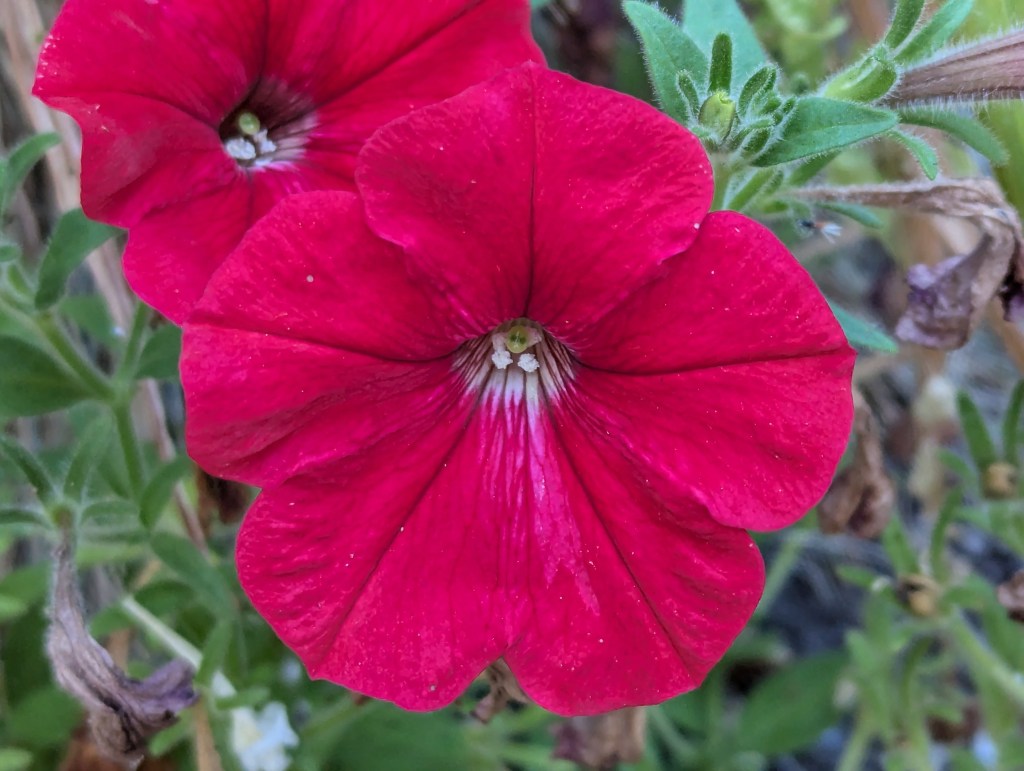
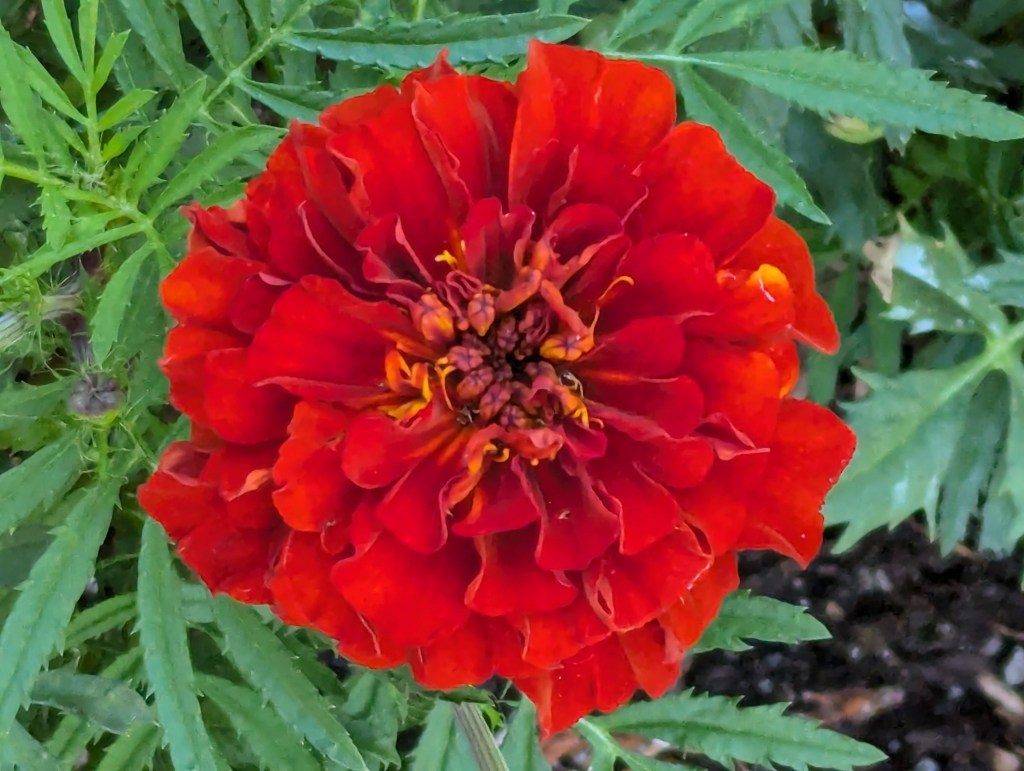
Cool season annuals are beginning to replace warm season annuals not because weather is beginning to cool for late summer, but because warm season annuals are beginning to deteriorate after their long and warm summer. Deterioration of remaining petunias was accelerated by warm weather today. It was warmer than a hundred degrees. Fortunately, marigolds are the first and only cool season annuals that were added into the landscapes already and they tolerate such warmth. I believe that they are varieties of ‘Durango’. I do not know what the petunias that they are replacing are, but they resemble old fashioned red, white and blue varieties of ‘Madness’ that were too popular during the Bicentennial Summer of 1976, although a comparable white variety is notably lacking.

1. ‘Madness – Blue Vein’, if I remember accurately, looks something like this. Its name is not as appealing as its color, and might have been less appealing in the summer of 1976.

2. ‘Madness – Blue’, which looks like this, was one of the three most popular varieties for the summer of 1976, with ‘Madness – Red’ and ‘Madness – White’, but is almost purplish.

3. ‘Madness – Red’ is more convincingly red, very much like this, and just like ‘Madness – Blue’ and ‘Madness – White’, was very popular in profusion through the summer of 1976.

4. ‘Durango – Gold’ is not very different from marigolds that were overly popular during the 1970s, when ‘Madness’ petunias were popular. I do not know when it was developed.

5. ‘Durango – Orange’ is just as familiar as ‘Durango – Gold’ because of its similarity with old fashioned varieties. Only a few specimens of ‘Durango – Flame’ are blooming nearby.

6. ‘Durango – Red’ is the only of these Six that, to me, does not seem to resemble the sort of varieties that were popular in the 1970s likely because red bloom was developed later.

This is the link for Six on Saturday, for anyone else who would like to participate: https://thepropagatorblog.wordpress.com/2017/09/18/six-on-saturday-a-participant-guide/

Donation

Heather thinks that she just found a new house with a view.

Donations can be annoying. At the farm, neighbors sometimes left random pots and cans from their home gardening at the gate on the road. Sometimes, they left other bits of gardening supplies, such as short pieces of PVC pipe, a pound or so of lawn fertilizer, or perhaps a broken rake. Only very few of the standardized cans could be added to the huge pile of recycled black vinyl cans that the horticultural commodities were grown in. The majority of what was left was merely more junk that we then needed to dispose of. If I found such items while driving a sedan, I needed to move them out of the way of the gate and return with a pickup to retrieve them. The gate is directly in front of the very well kept home of a nextdoor neighbor, which made such piles of junk even more inappropriate. The same happens here. Neighbors leave all sorts of useless random gardening paraphernalia and deteriorating houseplants. Because we do not grow acres of horticultural commodities in thousands of cans, the few random cans that I get here can actually be useful. Some of the houseplants recover in the nursery, and get recycled into landscapes or shared with neighbors. Perhaps such donations are not so annoying. I did happen to find this small home garden ‘greenhouse’ contraption to be quite annoying though. It was left in my parking space as if it were important. I would never actually purchase such an item. I am accustomed to working in real greenhouses. This thing is for those who enjoy gardening in small urban gardens, not professionals. I wanted to find who left it so that I could return it. Then, it occurred to me that the small banana plugs might appreciate it this winter. Oops.

Seven Weeks

July 12 & August 30

What a difference seven weeks can make! Updates regarding the Memorial Tree in Felton Covered Bridge Park are typically posted annually about the twelfth of July. Growth is obvious after a year. I did not expect it to be so obvious after less than two months between the twelfth of July and the thirtieth of August. I suppose that I should not be surprised. Even after most growth occurs through spring, some growth continues through late summer, and perhaps as late as the beginning of autumn, immediately prior to the slow initiation of dormancy for winter. Specimens of this species, valley oak, Quercus lobata, are innately vigorous and grow faster and more vertically while young. Growth decelerates and redirects itself laterally as trees mature and age. Otherwise, if they continued to grow as vigorously as they do while young, they would collapse from their own weight before they get to be as old as elderly trees get. Some live for more than six centuries, so their technique is obviously effective. Four nearby California black oaks, Quercus kelloggii, are not likely to get to be five centuries old, and are more likely to live for only one or two centuries. Unfortunately, two of them are not in comparably exemplary condition. One must be pruned for removal of major necrosis, and direction of new growth. Another requires major structure pruning. All four should be pruned for clearance above the surrounding parking lot. Perhaps I should be more concerned with these four California black oaks now that the Memorial Tree will need nothing for quite a while. Perhaps I should investigate the condition of the Monterey cypress Memorial Trees within the nearby Memorial Grove, which are growing well enough that surrounding box elders should be pruned away to relinquish more space for them.

August 30 zoomed out

See Anemone

Anemone hupehensis

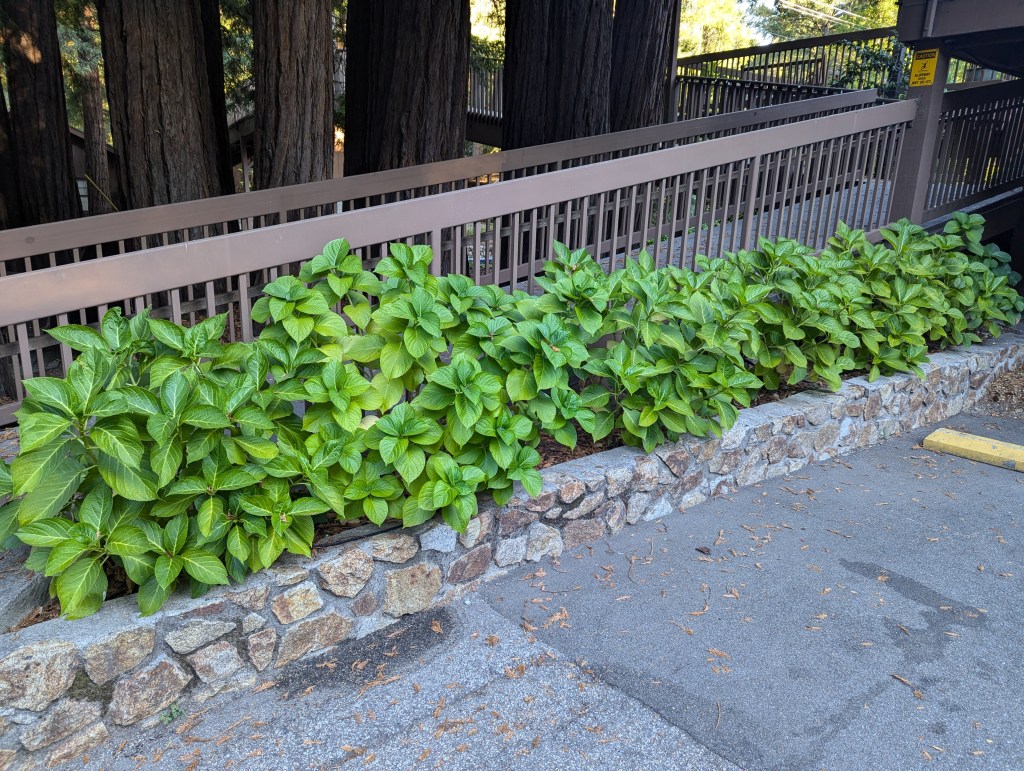
Japanese anemone, Anemone hupehensis, which is now Eriocapitella hupehensis, is one of several species that I had been wanting to grow for a very long time. Like peony, goldenrod, Joe Pye weed, Indian paintbrush, beautyberry and fancy hybrids of clematis, they are prominent features of fancier gardens in other regions. Some of such species do not perform well here. Others are merely unpopular, but might perform well here if they get the chance. I see them all only in pictures, so can not distinguish what their respective situations are. The only anemones that I had ever encountered while young were sea anemones on nearby beaches. In college, I met poppy anemones, which we know merely as anemone, but found that they are not as reliably perennial as they are purported to be. Japanese anemone had been elusive, until I met a very established and perhaps invasive colony of it in an old landscape near Oakland less than fifteen years ago. I figured that if it can be as happy as it was in a relatively coastal climate, it could be happier here with a bit more chill during winter. Until then, I assumed that minimal chill was a limiting factor to their performance here. ‘Honorine Jobert’ seemed to be the epitome of single white Japanese anemone, but I had not seen any white cultivars, even those with double flowers, that were not alluring. Then, I discovered an unidentified cultivar of Japanese anemone on the edge of a rose garden here. It survives as a remnant of a preceding perennial garden, but does not perform well now that redwood roots have become so aggressive. Furthermore, its floral color is unimpressive. It is not white, but is not quite pink either. Heck, it is not even white blushed with pink. I do not know how to describe it. Initially, it seemed to be only slightly pinkish pale gray. Ick! This year, it seems to be slightly more pinkish than it had been, which makes it slightly less disappointing. However, now that I know it is here, I will not try any other Japanese anemone until I at least try to grow this one well. I am confident that if I relocate bits of it to a garden where it does not need to compete with other vegetation, it will bloom with a more appealing shade of pink. I will not mind that it is not white if it does that much. Then, if it can perform well, I will know that I can grow a white cultivar of anemone also. There is no rush though. Although white happens to be my favorite color, and Japanese anemone happens to excel at white, pink can be appealing also. This is my very first Japanese anemone, and regardless of how unimpressive it is now, I am pleased with it.

Six on Saturday: Too Much or Not Enough

Propagation without adequate propagation infrastructure can be disappointing. It might alternatively be a bit too rewarding. I prefer to propagate excessively, to compensate for expected losses. Consequently, I generate surplus much more often than I encounter any disappointment. One of the disappointments this week is actually the result of a surplus that occurred too late within the growing season of that particular species. I managed to find three other disappointments for half of these Six, but they are relatively minor, and should eventually be resolved prior to autumn. Even then, because these three particular species are vulnerable to chill while young, I intend to shelter them through winter. The surplus can eventually be shared with neighbors. It all works out.

1. Passiflora racemosa, red passion flower vine pruning debris was processed into a flat of thirty-six cuttings. I suspected that only a few would survive, but I was wrong. Oh my!

2. Citrus paradisi ‘Marsh’ grapefruit cuttings were initially about as numerous, but very few survived. They defoliated, and are still vulnerably dinky. They are ungrafted anyway.

3. Mentha spicata, mint is still going. There was already too much months ago, but I still plug its trimmings as cuttings. I should stop now. I should have stopped before I started.

4. Vanilla planifolia, vanilla is still doing nothing. Only this one of five cuttings survives. Its single exposed bud has been inactive for months. Perhaps a lower bud is doing more.

5. Borago officinalis, borage grew unexpectedly from expired seed that got tossed. These thirty-six, which are now in a filled flat, are too many at the end of their growing season.

6. Musa acuminata ‘Popo’Ulu’ banana is the eighteenth of twenty cultivars here, but this is its first new leaf since its arrival. It must grow more prior to autumn to survive winter.

This is the link for Six on Saturday, for anyone else who would like to participate: https://thepropagatorblog.wordpress.com/2017/09/18/six-on-saturday-a-participant-guide/

Horridculture – Hackers (again)

Is it really too much work to not leave such stubs while destroying a hedge?!

It has been quite a while since I posted anything that qualifies for the theme of ‘Horridculture’. Such topics are not only unpleasant, but have become redundant and passe. They are annoyingly frequent reminders of how several of the horticultural industries attract too many of those who either lack practical experience or simply do not care about their work. I can not even remember how many times I wrote about hackers, which is why I did not assign a number to this title. I can see that I addressed this issue as recently as February. Nonetheless, because this particular incident involves a Prunus laurocerasus, cherry laurel hedge that we have been renovating for a few years, it is difficult to ignore. The formerly severely overgrown hedge had been responding somewhat slowly but otherwise adequately to its renovation, all behind a reasonably presentable facade. Actually, until recently, the facade had become tidier and denser than it had ever been before. Then, a tree service was hired to clear some adjacent unmanaged vegetation. The objective was to remove vegetation from an area that is to be paved for dumpsters. There was no concern for the quality of the work, since remnants of such vegetation can be managed or removed later. The problem is that those who performed the task also removed a significant portion of the facade of the hedge beyond the area from which unmanaged vegetation needed to be removed. What is worse is that it was done so horridly. I do not remember seeing any proper cuts. All involved stems were stubbed and gashed. I can only guess that whoever did this expected the hedge to be removed later. I can not be certain of that, since complete removal within one process would have been less work than such thorough disfigurement. I mean that someone put a great deal of effort into disfiguring the hedge this severely. Fortunately, the hedge will eventually recover. I removed the stubs and neatened what remains, and will try not to look at it for the next several months. The tree service that did this actually removes unwanted trees for us efficiently and safely. Their arborists are quite experienced and qualified for what they do. I just do not want them to do anything else.

Someone put a great deal of effort into this degree of damage.

Out with the new, in with the old

Canna ‘Cannova Mango’

Canna ‘Cannova Mango’ is a relatively recent introduction to the landscapes here. I inadvertently brought it back from Southern California about two and a half years ago, without realizing that it is exactly the sort of modern cultivar that I am not at all keen on. It is new. It is improved. It blooms with a strange but trendy color. The problem is that it performs too well to not be an asset to the landscapes. Because it is so short and compact, it starts blooming early, while old fashioned Canna are still only foliar. Because it replaces older stalks with newer stalks so efficiently, it is rarely without bloom until frost. Other cultivars of the series bloom yellow, lemon (which is implied to be distinct from yellow), orange shades (?), red golden flame (?!), rose, scarlet with bronze foliage or orange with bronze foliage. The tallest are less than five feet tall. Regardless of my disdain for modern cultivars, I do not doubt that all of them perform as impressively as ‘Cannova Mango’. Nonetheless, I prefer the older and formerly common sort. A relatively compact cultivar that stays less than about four feet tall with simple green foliage and billowy but simple red bloom has been relocated through a few landscapes here since the early 1980s. Although not many rhizomes survive, I intend to grow more of it, even if not so much within the landscapes at work. Its bloom begins a bit later, and is neither as profuse nor as continuous as that of ‘Cannova Mango’, but it has history here. Besides, its more relaxed foliar texture and bloom somehow seem to be more compatible with the surrounding forested setting than the almost too refined modern cultivars, with their perfectly compact form, overly profuse bloom, and strangely modern floral color.

Unidentified old fashioned red Canna with green foliage.

Yucca whipplei Seed

Yucca whipplei seed is likely more rare in cultivation than in the wild.

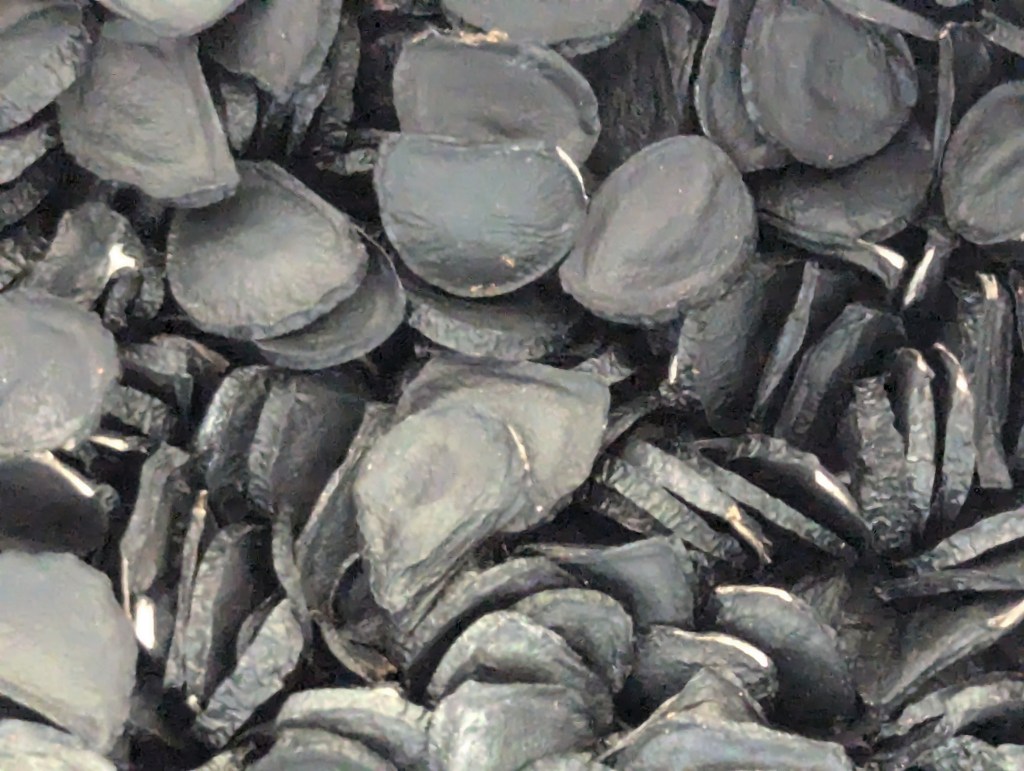
Yucca whipplei, which is now known as Hesperoyucca whipplei, should not be so difficult to procure. It is the most common species of the genus within the next few hundred miles south of here, and was quite common in the hills around San Luis Obispo, where Brent and I studied horticulture at California Polytechnic State University (Cal Poly). I should have taken pups from wild specimens within the region, but I know of no one with wild specimens within their gardens. I can only see them from a distance, and, although within view, they are far enough away to necessitate quite a hike to get to. I never bothered to procure pups from specimens that I encounter directly in the Santa Monica Mountains north of Beverly Hills because they might be a different variety, or related to such a variety. Contrary to dramatic bloom, seed of the species is supposedly rare because the larvae of its very specialized pollinating moth devour almost all of the seed that develops from successful pollination. (The moth pollinates a flower only to provide seed for its larvae to eat.) Seed should be even more rare here because the specialized pollinating moth has no business so far from the natural range of its sustaining species. Somehow, a specimen that bloomed at work produced these few seed capsules. Someone else besides the specialized pollinating moth apparently took interest in its bloom. Although I have no idea what variety of Yucca whipplei the particular specimen is, I am pleased with the seed, and will try to grow them if they are viable when their capsules dry. (I hope that removal from their deteriorating stalk does not compromise their development.) Furthermore, I will get at least one pup from the original parent now that it will generate a litter after its monocarpic bloom. It is likely the variety that I want and am most familiar with anyway, because that particular variety happens to be the most common. Of course, I will procure a pup from a wild specimen within the region of San Luis Obispo if I ever get the opportunity to do so, just in case it is any different from what is growing and now blooming here.

Six on Saturday: Off Color

Perennial pea, lily of the Nile and dahlia displayed aberration of color earlier and started a trend.

1. Eriocapitella hupehensis, Japanese anemone is enviable in other gardens. I neglect to remember that a minor bit of it survives in one of our landscapes. I ignore it because it is such a grungy almost grayish white without enough blush to be pink. I should see how it blooms now and then relocate it to a better situation where it might develop better color.

2. Hypoestes phyllostachya, polka dot plant is typically spotty with either white or pink. Two of seventy-two cell pack plugs exhibited this darker pinkish red. I got copies of it to perhaps grow as houseplants, at least until they will be happy in the garden next spring.

3. Chrysanthemum X morifolium, florist’s chrysanthemum seems to change color like a dahlia that I got a picture of last week. I thought that it bloomed orange last year, which was a surprise after it bloomed rusty red two years ago. I must not remember accurately.

4. Phlox paniculata, garden phlox has bloomed exclusively white since it arrived here by unknown means a few years ago. Although I have been very pleased with its white color, and white happens to be my favorite color, I am also pleased with this new pink variant.

5. Amaryllis belladonna, naked lady did the opposite. It had always bloomed exclusively bright pink. Then, I found and isolated a few bulbs of a white blooming variant last year. An associate found two more in the same location this year. I like it much more in white!

6. Rhody is canine so lacks perception of red, which is the basis of these off colors. Most have more than they should, and one has none. Rhody sees them only as shades of gray.

This is the link for Six on Saturday, for anyone else who would like to participate: https://thepropagatorblog.wordpress.com/2017/09/18/six-on-saturday-a-participant-guide/