Six on Saturday: Mostly Flowers

Simply, these are six varieties of flowers. All but one bloomed last week. Half are hybrid cultivars of the same genus with two in the same picture. Six pictures of flowers with two varieties in one picture should include seven varieties of flowers. But of course, “mostly” indicates something that is not exclusive. Anyway, I should have gotten more pictures at work, since it was a rather fun week. Irrigation is getting more demanding, though, now that the weather is getting warmer. Because we need to delay renovation of a prominent landscape, we installed potted Canna onto the site. They are potted to facilitate removal when renovation resumes, but will be rad!

1. Lantana camara, which is known here simply as ‘lantana’, is too colorful to not share. Actually though, it is from three weeks ago, and west of Phoenix. Ours is more yellowish.

2. Rosa ‘Iceberg’ and ‘Burgundy Iceberg’ are grafted together on two old rose trees in the rose garden. I find multiple grafts to be annoying, but guests find them to be intriguing.
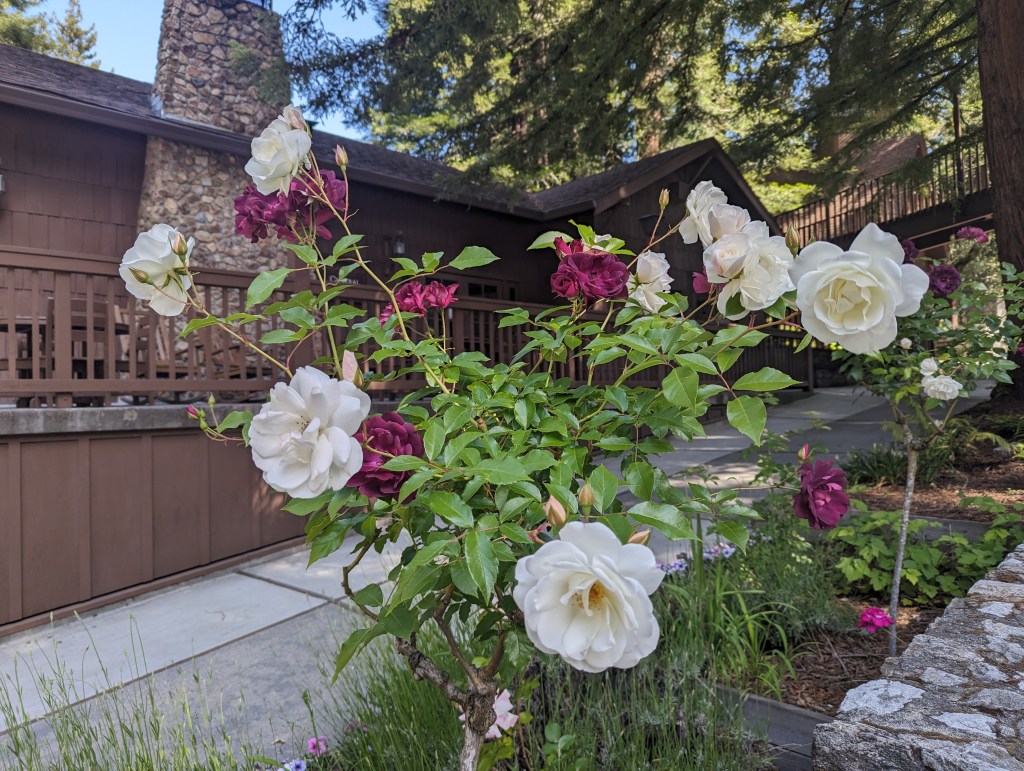
3. Rosa of an unidentified cultivar blooms better with better exposure, and also without the other cultivar that it was originally grafted with, but that was crowded out years ago.

4. Alstroemeria peruviana, Peruvian lily will not die. We removed large colonies at least twice from this location, but some always survive. They are yellow, orange, pink and red.

5. Lilium, which seems to be some sort of fancy Asiatic lily, was a gift from a neighbor. I did not expect them to perform so well, but after only four years, they should be divided.

6. Rhody is the only one of these six who is not a flower, although another type of flower is named after him. Morgan, his F250 who identifies as a Mercury, wants to get washed.

This is the link for Six on Saturday, for anyone else who would like to participate: https://thepropagatorblog.wordpress.com/2017/09/18/six-on-saturday-a-participant-guide/
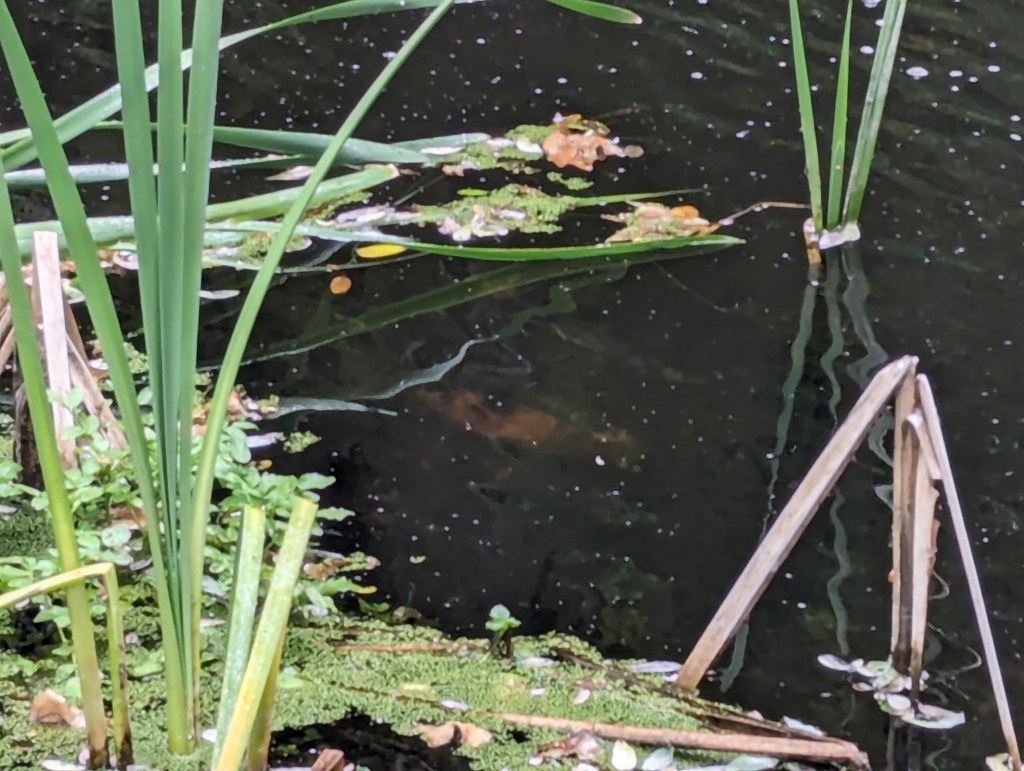
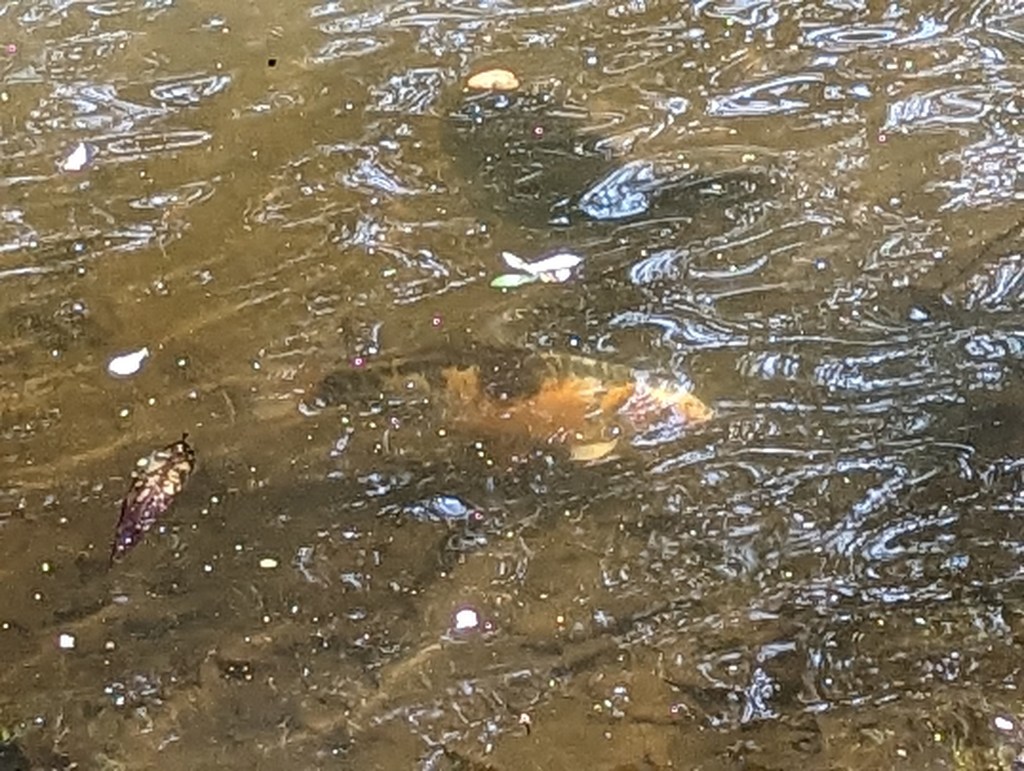
Coy Koi

The larger of two koi is difficult to see at the center of this picture. The other is rarely seen.

Attempts to tame the recently discovered but still unidentified pair of koi within the drainage pond have been futile so far. Both remain elusive. Although the larger of the two is almost as big as Rhody, we still are not certain if they are actually a koi. We just do not know what else they could be. I try to get them to accept koi food, but the food floats on the surface of the water until a pair of ducks eats it. I should try to feed them some sort of food that sinks, at least until they respond to food, if they ever respond.

The larger and more visible of the pair is typically referred to as “Cheeto”, although not yet formally named. Cheeto happens to resemble, and could potentially be, one of the original koi who was also known as such. Its associate is known merely as its “Associate”. Even well trained koi do not respond to names. Nonetheless, we should probably assign them names, just in case they ever become tame. These are some of the options, besides Cheeto, for either of them.

Jaws

Nemo

Kraken

Moby

Sashimi

Gill

Charlie (Tuna)

Nessie (because of their elusiveness)

Roy (don’t need to be koi)

Blinky (of the Simpsons)

Wanda (a fish called Wanda)

I hope that whomever they are, they help to limit the proliferation of aquatic vegetation, particularly duckweed, within the pond, although I doubt that they can consume enough to make a noticeable difference. Also, I hope that they become friendly enough to amuse visitors. Neither are brightly colorful enough to be prominent if they remain elusive at a distance. We intend to add a bit more vegetation to somewhat mitigate erosion on the edge of the pond, as well as to displace other shabbier vegetation.

This is an older but better picture.

Going Bananas!

‘Double Mahoi’ is not even a fraction of a single yet, but can grow fast.

This is not banana territory. The soil is good, and water is readily available; but the climate is a limiting factor. The weather does not get very warm for very long. When it rarely gets almost unpleasantly warm during the day, it generally gets tolerably cooler overnight. Bananas are none too keen on such comfortable weather. They want sustained warmth, with less fluctuation of temperature between night and day.

This is precisely why I should not have acquired as many as fourteen cultivars of banana. Some may never do more than generate appealingly lush foliage here. Those that produce fruit will unlikely produce fruit that is much more than marginally palatable. One of the cultivars is the oem, which is the largest banana ‘tree’ in the World. I have NO idea of how to manage it. ‘Mekong Giant’ also grows quite large and heavy. Two cultivars are unidentified, so could possibly be copies of others. ‘Kokopo Patupi’ may not have survived last winter, as it has not begun to regenerate yet. Four other cultivars were given away, but then generated pups that are now returning! I do not remember how many cultivars are here now, but I know that there are too many.

Oem is resuming growth faster than the others, but with small leaves from within pseudostems that produced larger leaves last year. ‘Double Mahoi’ is likewise regenerating dinky and pale leaves that are actually dinkier than those that emerged earlier from a shriveled carcass of a dinky pup that got frosted last winter.

I want all of the cultivars of banana to survive and thrive, but I should have planned for them better. Now, I should plan to find homes for most of them instead. Even if I could manage them all, I can not justify doing so.

Oem is the biggest banana ‘tree’ in the World!

Six on Saturday: While You Were Out

My vacation was in two halves of two weeks each, with two weeks in between. It seemed to be six weeks collectively. Quite a bit happens within the landscapes during that much time at this time of year. The first of my Six is from Arizona, and happens to be the State Flower of Arizona. The others are some of what I returned to, including the State Flower of Colorado, and a relative of the State Flower of Hawaii. One is German from Monterey. One is Algerian from the Canary Islands. One is European from Washington. Oh, this is all such confusing nonsense and false trivia. California poppy, which is the State Flower of California, is blooming, but I got no pictures of it for this week.

1. Carnegiea gigantea, saguaro was a species that I should have gotten more pictures of before leaving Arizona. This is one of only two pictures. It is the State Flower of Arizona.

2. Persicaria bistorta ‘Superba’ snakeroot came from Tangly Cottage Gardening not too long ago, but is already blooming splendidly among watercress on the edge of the pond.

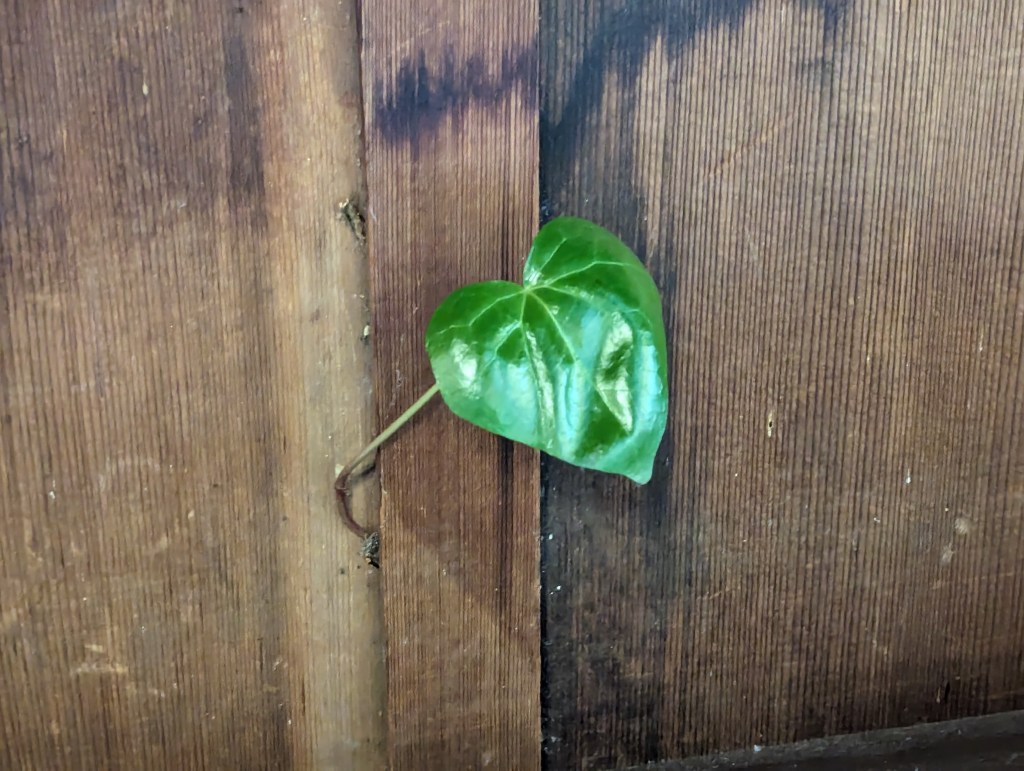
3. Hedera canariensis, Algerian ivy clings to the exteriors of several buildings at work if not pruned back frequently. This vine is getting even more aggressive by coming inside!

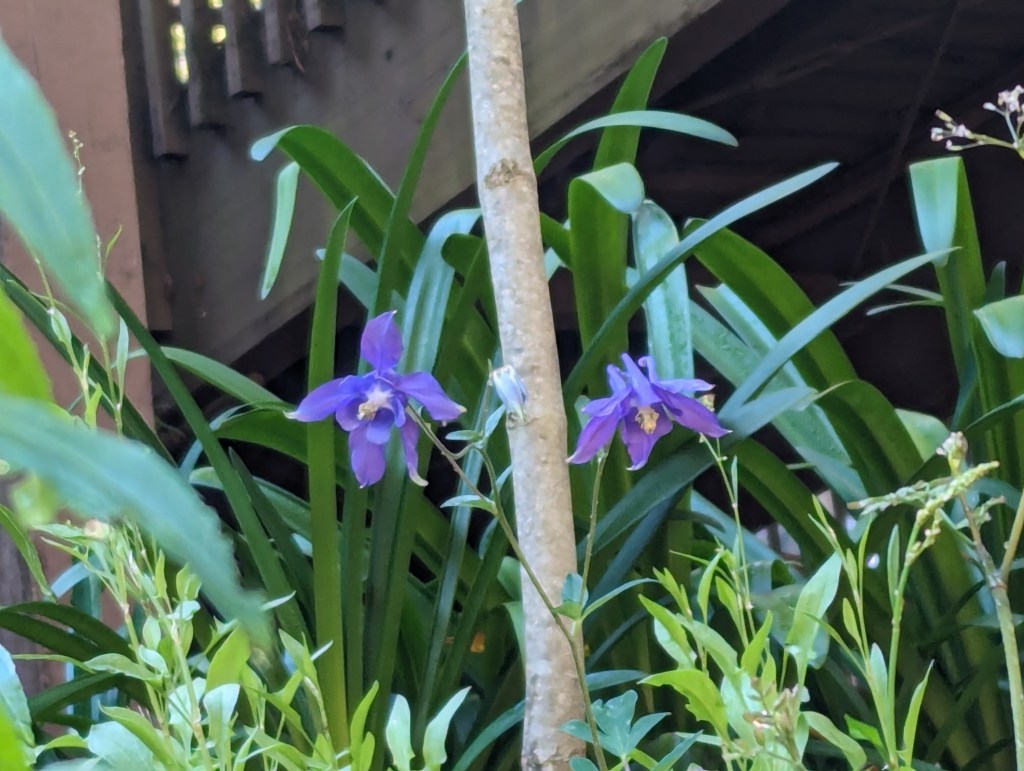
4. Aquilegia X hybrida, columbine refuses to grow where planted, but tosses seed before it dies. Its feral seed then grows in random situations. It is the State Flower of Colorado.

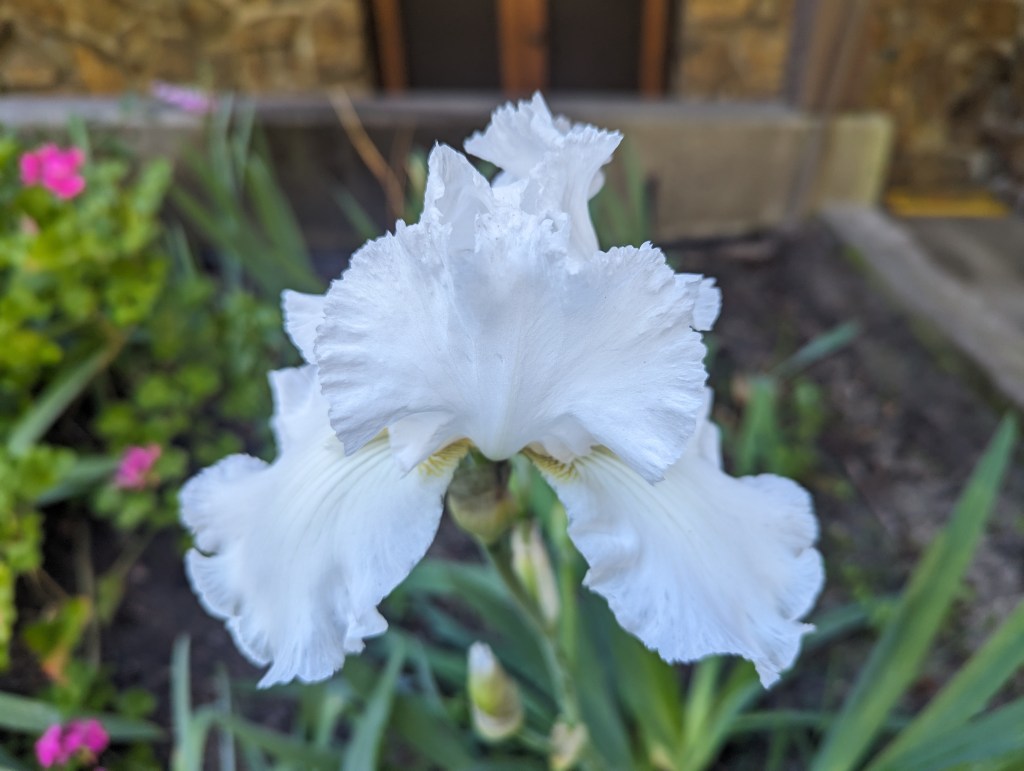
5. Iris X germanica, bearded iris bloom is finishing about now. I earlier mentioned that this cultivar seemed weirdly pale. It might be feral. However, it seems bright white now.

6. Hibiscus rosa-sinensis, tropical hibiscus is blooming as vibrantly here as it was in Los Angeles and Phoenix. It is related to Hibiscus brackenridgei, the State Flower of Hawaii.

This is the link for Six on Saturday, for anyone else who would like to participate: https://thepropagatorblog.wordpress.com/2017/09/18/six-on-saturday-a-participant-guide/

There’s No Place Like Home.

Desert ecosystems are fascinating, but so are local ecosystems.

Vacation was excellent! I do not get out much, but when I do, I feel as if I enjoy it more than those who travel regularly. The simplicity of my travel allows me to enjoy it more intimately than those who travel more elaborately and put more effort into enjoying what they should probably just enjoy more effortlessly. Anyway, I went to the Pacific Northwest for two weeks, returned for two weeks, and went to the Southwest for two weeks. Actually though, my trip to the Pacific Northwest was limited to Western Oregon and Western Washington, and my trip to the Southwest was limited to the area between Los Angeles and Phoenix. Regardless, it was excellent, and I encountered several climates and ecosystems that are very different from what I am accustomed to. I drove through dense rainforests dominated by massive Douglas firs as well as sparsely forested deserts dominated by sporadic saguaro cacti. Winters are much cooler in some regions than here. Summers are much warmer in some regions than here. It was all so fascinating. I encountered so much vegetation that I would like to grow here, and brought a bit of it back, but can not grow everything that I find intriguing within other regions. However, as excellent as it all was, it also reminds me that I prefer to be here, within the climates and ecosystems that I am most comfortable with. Winters do not get too cool. Summers do not get too warm. I may not be able to grow all the cultivars of apples that prefer a bit more chill in Washington, or all the cacti that prefer more arid warmth in Arizona, but realistically, even if I could work in the garden constantly, I could not possibly grow everything that performs well here.

Our Lord’s Candle

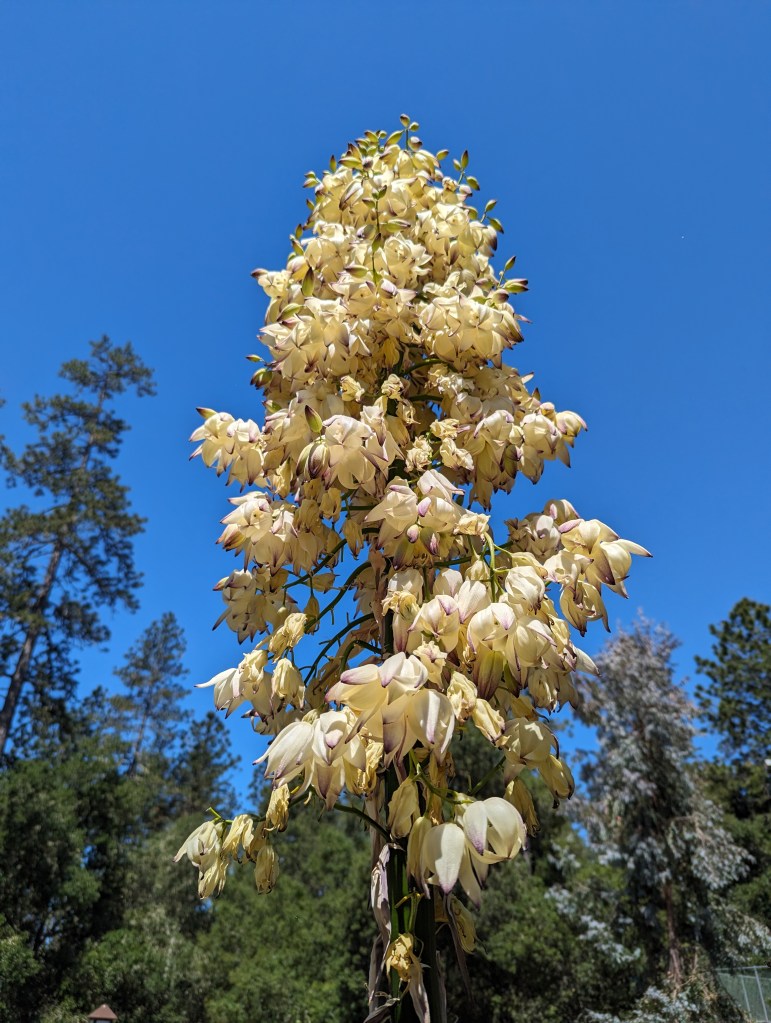
(Hespero)Yucca whipplei – our Lord’s candle

(Hespero)Yucca whipplei has an identity crisis. My contemporaries and I learned it as Yucca whipplei. Botanists now insist that it identifies as Hesperoyucca whipplei, although, like any and all other species of Yucca, it can hybridize with any and all other species of Yucca. (If it is a different species of the same genus, such hybrids would be interspecific hybrids. If it is a different genus, such hybrids would be intergeneric hybrids, which is even weirder.) Also, my contemporaries and I learned its common name as Spanish bayonet. Botanists prefer to designate it as chaparral yucca. It is alternately known as foothill yucca, Quixote yucca or our Lord’s candle. Because it was the only species of the genus that was locally native, we typically referred to it merely as yucca. Later, I learned that Spanish bayonet is a general designation for a few arboriform species of Yucca, which develop trunks and perhaps limbs, such as Yucca aloifolia, and that Spanish dagger is actually more commonly a generic designation for a few species that lack significant trunks or limbs, such as this particular species. Anyway, regardless of all this nonsense, I had been wanting to grow this species since encountering it while studying horticulture at California Polytechnic State University in San Luis Obispo, but could not find an appropriate situation in which to do so. It is too wickedly spiny for most landscapes. I was told that a specimen inhabited one of the landscapes at work, but because it did not look familiar, I was sceptical. It adapts so efficiently to whatever situation that it grows into, that its foliage here is somewhat different from how it develops in the wild around San Luis Obispo. Its impressively tall bloom is very familiar though, and is very distinctive of the species.

Sculpture

Eucalyptus citriodora – lemon gum

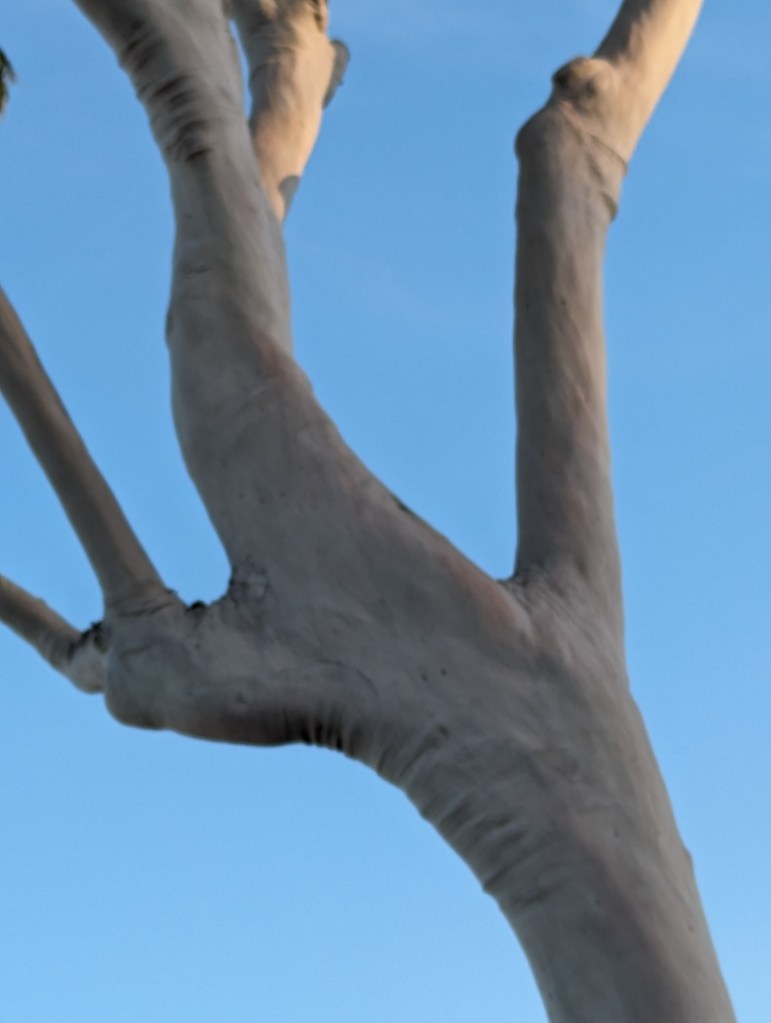
Eucalyptus citriodora, lemon gum, is one of several species that I miss from the more southern portion of the Central Coast and Southern California. San Luis Obispo, where Brent and I studied horticulture at Cal Poly, and where I learned to appreciate this particular species, is technically within the same climate zone as Los Gatos. Nonetheless, many species that are popular in Southern California are more popular there than here, perhaps because of the proximity to Southern California. I got this picture on the inland edge of Highway 101 in Carpinteria on the return trip from Los Angeles. It demonstrates how sculptural the elegantly slender, smooth and pallid trunks and limbs of lemon gum are. The airy foliage is delightfully aromatic, but is too high to reach among trees that are sufficiently mature to be so sculptural. A few other eucalypti are similarly but distinctly sculptural. Some develop heftier trunks and limbs. Some develop blotched or uniformly coarse bark. Also, several other genera, such as coast live oak, camphor and ‘Marina’ madrone, develop sculptural form. Such form should be more of a consideration for modern landscape design, as it was until about the late 1970s, when trees like European white birch and the last of the complaisant eucalypti slowly became passe. It is actually gratifying to notice that a few daring horticulturists are experimenting with some of the smaller species of eucalypti that could have become popular years ago, as well as a few that had not yet been introduced. Where lemon gum might eventually grow too large, smaller species, such as Eucalyptus caesia, gungurru, might be more proportionate. Of the more than seven hundred species of Eucalyptus available, more than a few must be appropriate to refined home gardens, and more than a few of such are likely sculptural.

Six on Saturday: Blooms With a View

Blooms With a View Spring Garden Tour of View Park and Ladera Heights happened to be on the day after I arrived late in Los Angeles. That is why I stayed another day late to help exhibit one of Brent’s three landscapes that were featured in the Tour. I did nothing more than answer a few questions, discuss random horticultural trivia, and share copies of a list of some of the other easily visible neighborhood landscapes that Brent designed.

1. Phoenix canariensis, Canary Island date palm is, as its common name indicates, from the Canary Islands, rather than, as its botanical name suggests, from Phoenix in Arizona that I left only last Saturday. Years ago, it was the second most common palm in the Los Angeles regions. Now, in this garden, it was the second most popular topic of questions.

2. Solandra maxima, cup of gold vine was the third most popular topic of questions as a result of this single bloom. It was about six inches wide. I wanted to get a better picture. Eriobotrya japonica, loquat was the most popular topic of questions. I took no pictures.

3. Aeonium arboreum ‘Albovariegatum’, variegated common houseleek is precisely what it sounds like. Most cultivars of common houseleek are as different in form as in foliage.

4. Salvia longispicata X farinacea ‘Mystic Spires’ is like the heftier version of mealycup sage. It provides splendid blue color, and is more reliably perennial than mealycup sage.

5. Bougainvillea X buttiana ‘Barbara Karst’ frames this arched parlor window colorfully. Anigozanthos rufus ‘Big Red’ kangaroo paw below tries to not obscure the outside view.

6. After all, this view is why this is View Park. Los Angeles has certainly grown up since I first saw it in about 1986, and it has grown much more since the old residence was built.

This is the link for Six on Saturday, for anyone else who would like to participate: https://thepropagatorblog.wordpress.com/2017/09/18/six-on-saturday-a-participant-guide/

Timeout

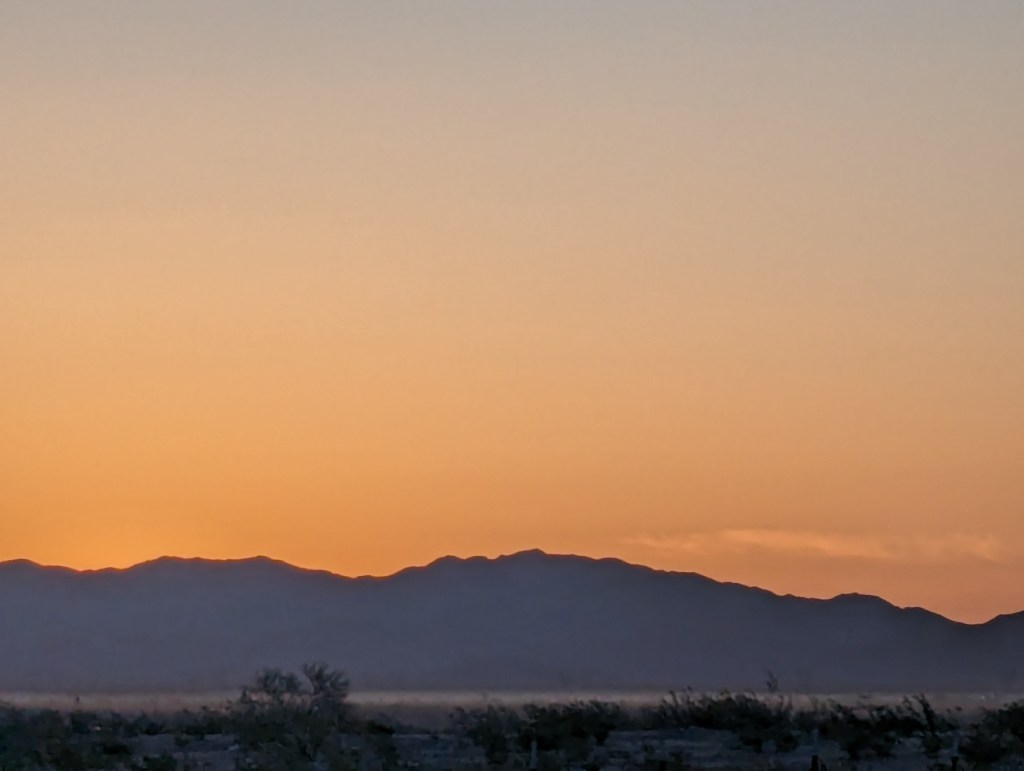
A moment before sunrise over Phoenix.

Apologies for my absence.

Perhaps no one noticed. Most of my posts were automated prior to my departure, and I managed to compose a few brief articles for what was not automated; so ultimately, there was no lapse of posting. I may have only been negligent with response to comments for the last two weeks.

Realistically though, I have been intending to discontinue blogging and recycling old articles, and to post only my weekly gardening column, in two parts, on Mondays and Tuesdays. I merely have not done so yet.

Anyway, my trip, although very different from how it was planned, was totally excellent! Just a short distance from the turnoff for the southbound San Diego Freeway towards my primary destination in Los Angeles, I was diverted to my secondary destination northwest of Phoenix. I missed the desert scenery as I drove all night to arrive shortly before four in the morning, and began my vacation exhausted. Although I missed out on some of my plans in Los Angeles, I got more time in Arizona. The weather was weirdly excellent, with a weirdly torrential thunderstorm right in the middle of it. It was too early in the year to collect the seed that I wanted, but I really was not expecting to find any anyway. I did happen to procure a hedgehog cactus of some sort. I decided that, since my return was already delayed by a day, that I may as well delay it for two days. (I had brought some of my work with me, so was able to tend to it prior to my return rather than after.) Therefore, I came to my original primary destination in Los Angeles secondarily, stayed to help Brent with the View Park Garden Tour on Sunday, and returned home on Monday.

Simple Species

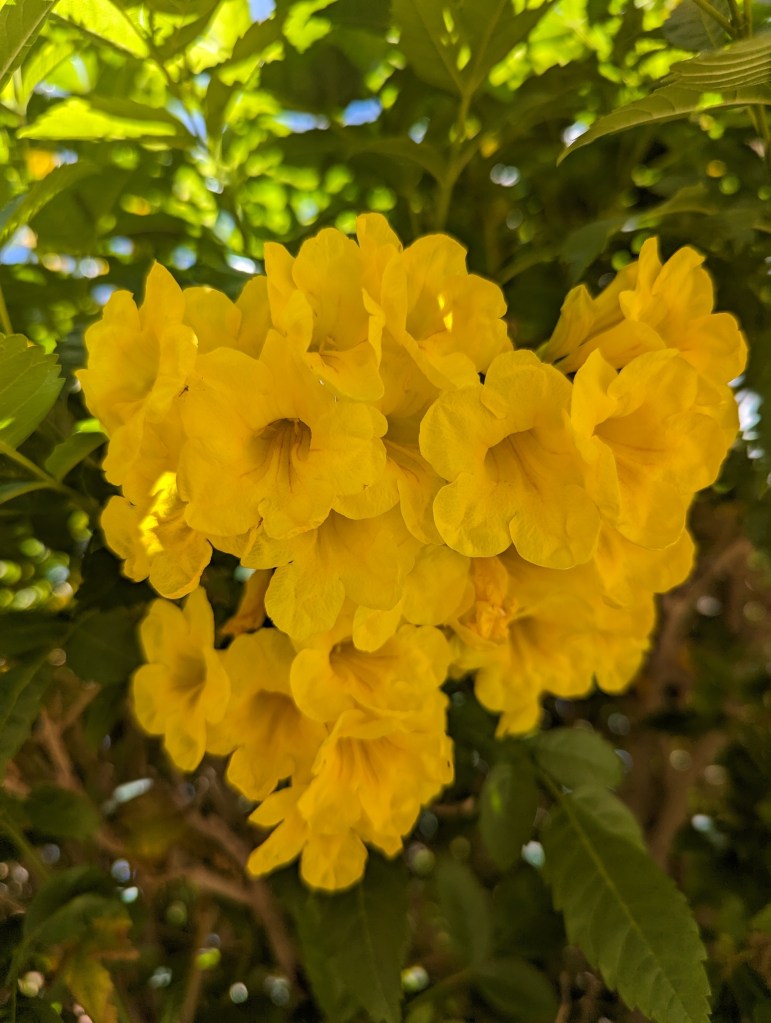
Unidentified cultivar of Tecoma stans

Tecoma stans is somewhat popular within the neighborhood where I stayed while in Arizona. It is available in nurseries also. I suppose that I could have purchased one or more for my garden. I had wanted to grow it for a long time. I refrained. I can explain.

The Tecoma stans that I can get from nurseries is an improved cultivar, or actually, about three cultivars. They are not the simple species, as it would be found growing wild. I realize that improved cultivars are known as ‘improved’ for a reason, but ultimately, I want to grow the simple species.

Crazy Green Thumbs sent me the seed for the simple species of Tecoma stans that I want to grow. That is all I need. Other colleagues have sent me seed, seedlings or cuttings for simple species of American beautyberry, American holly, American persimmon, pawpaw, red mulberry, red elderberry and perhaps too many other species to list briefly. In the future, I suppose that I could try cultivars of some of these species. I would like to get acquainted with them first though.

For most species, I suppose that I prefer cultivars. I want to grow the same ‘Moorpark’ and ‘Blenheim’ apricots that I grew up with. Eventually, I want to grow ‘John F. Kennedy’ rose. Cultivars serve a purpose also.

There are a few reasons why I want simple species rather than cultivars of some species. For American beautyberry, American holly and red elderberry, I want to grow what most other garden enthusiasts within the native ranges of these species grow merely because such species appear uninvited in their gardens. For American persimmon, pawpaw and red mulberry, I want to grow a few of the fruits that people enjoyed for culinary application prior to the development of relatively modern cultivars.