
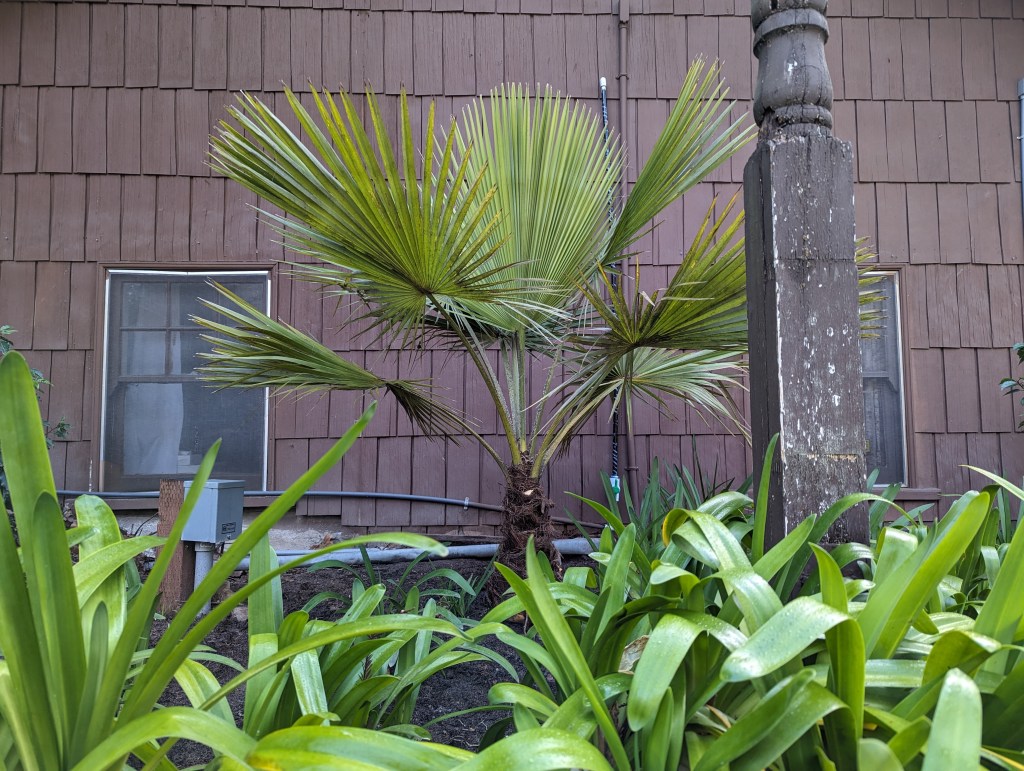
Mexican fan palm, Washingtonia robusta, is the most familiar palm throughout most of California. It is most typically groomed to remove deteriorated leaves without removing the associated toughly fibrous petiole bases that form a neat lattice-like sweater of stubble around its trunks. Some are groomed to also remove the stubble, leaving a clean shaven and leaner looking trunk. Some are shaven only part way up, with a sweater higher up. Without grooming, or if grooming discontinues, some accumulate beards of deteriorated leaves. Although generally harmless, such beards are combustible and can be infested with rats. On rare occasion, they become dislodged from their trunks and fall. They are dangerously heavy and very messy. This silly looking Mexican fan palm was groomed part way up, and then neglected long enough to accumulate a significant beard. The beard then fell, leaving the bare trunk exposed. Only the few lowest of the old leaves remain below where the beard was. A new beard is now forming above.
Queen palm, Arecastrum romanzoffianum, was an uncommon palm until it suddenly became very popular and almost too common through the 1990s. By that time, selective breeding produced the standardized modern variety, which is a bit greener, fluffier and more vigorous than most old specimens. Although it is a bit more genetically conformative than old specimens, it still exhibits genetic variability. Unless some are cloned by tissue culture, all are grown from seed. Some grow slower, so stay shorter. Some develop unusually plump trunks. Some are unusually floppy. This one is just weird. Its foliar canopy is so strictly narrow that it resembles the locally rare Andean wax palm, Ceroxylon quindiuense. Perhaps it actually is an Andean wax palm! A pindo palm, Butia capitata, lives in the associated front garden, and it is not exactly common.








 Tony Tomeo