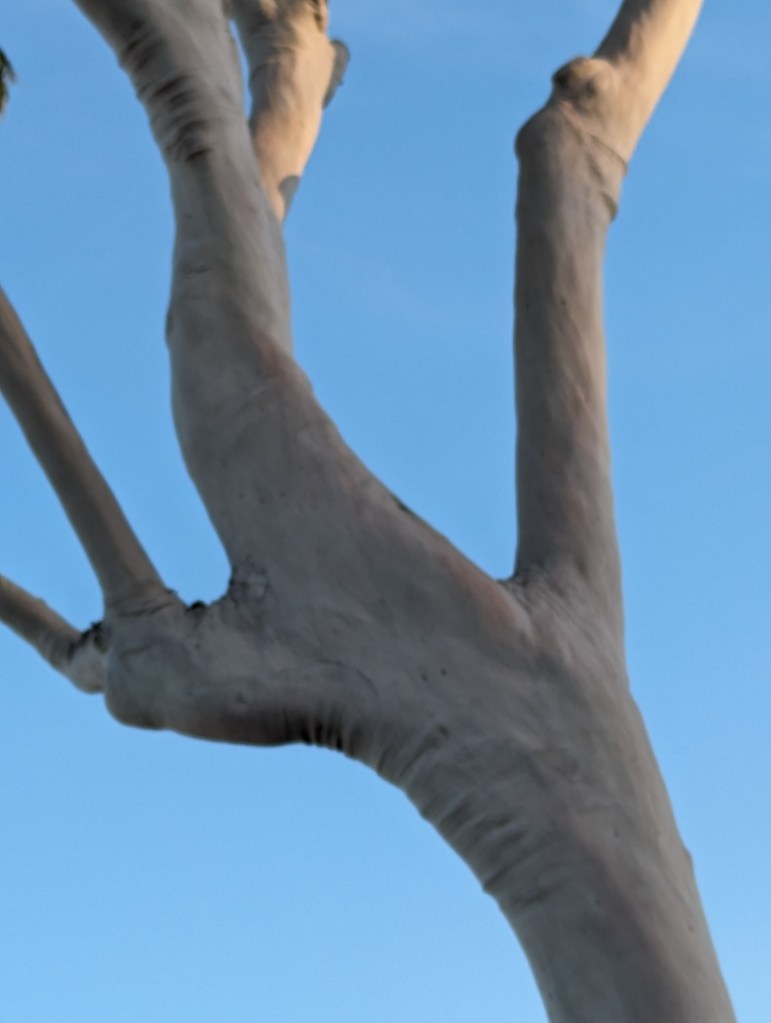
Eucalyptus citriodora, lemon gum, is one of several species that I miss from the more southern portion of the Central Coast and Southern California. San Luis Obispo, where Brent and I studied horticulture at Cal Poly, and where I learned to appreciate this particular species, is technically within the same climate zone as Los Gatos. Nonetheless, many species that are popular in Southern California are more popular there than here, perhaps because of the proximity to Southern California. I got this picture on the inland edge of Highway 101 in Carpinteria on the return trip from Los Angeles. It demonstrates how sculptural the elegantly slender, smooth and pallid trunks and limbs of lemon gum are. The airy foliage is delightfully aromatic, but is too high to reach among trees that are sufficiently mature to be so sculptural. A few other eucalypti are similarly but distinctly sculptural. Some develop heftier trunks and limbs. Some develop blotched or uniformly coarse bark. Also, several other genera, such as coast live oak, camphor and ‘Marina’ madrone, develop sculptural form. Such form should be more of a consideration for modern landscape design, as it was until about the late 1970s, when trees like European white birch and the last of the complaisant eucalypti slowly became passe. It is actually gratifying to notice that a few daring horticulturists are experimenting with some of the smaller species of eucalypti that could have become popular years ago, as well as a few that had not yet been introduced. Where lemon gum might eventually grow too large, smaller species, such as Eucalyptus caesia, gungurru, might be more proportionate. Of the more than seven hundred species of Eucalyptus available, more than a few must be appropriate to refined home gardens, and more than a few of such are likely sculptural.
Blooms With a View Spring Garden Tour of View Park and Ladera Heights happened to be on the day after I arrived late in Los Angeles. That is why I stayed another day late to help exhibit one of Brent’s three landscapes that were featured in the Tour. I did nothing more than answer a few questions, discuss random horticultural trivia, and share copies of a list of some of the other easily visible neighborhood landscapes that Brent designed.
1. Phoenix canariensis, Canary Island date palm is, as its common name indicates, from the Canary Islands, rather than, as its botanical name suggests, from Phoenix in Arizona that I left only last Saturday. Years ago, it was the second most common palm in the Los Angeles regions. Now, in this garden, it was the second most popular topic of questions.
2. Solandra maxima, cup of gold vine was the third most popular topic of questions as a result of this single bloom. It was about six inches wide. I wanted to get a better picture. Eriobotrya japonica, loquat was the most popular topic of questions. I took no pictures.
3. Aeonium arboreum ‘Albovariegatum’, variegated common houseleek is precisely what it sounds like. Most cultivars of common houseleek are as different in form as in foliage.
4. Salvia longispicata X farinacea ‘Mystic Spires’ is like the heftier version of mealycup sage. It provides splendid blue color, and is more reliably perennial than mealycup sage.
5. Bougainvillea X buttiana ‘Barbara Karst’ frames this arched parlor window colorfully. Anigozanthos rufus ‘Big Red’ kangaroo paw below tries to not obscure the outside view.
6. After all, this view is why this is View Park. Los Angeles has certainly grown up since I first saw it in about 1986, and it has grown much more since the old residence was built.
Perhaps no one noticed. Most of my posts were automated prior to my departure, and I managed to compose a few brief articles for what was not automated; so ultimately, there was no lapse of posting. I may have only been negligent with response to comments for the last two weeks.
Realistically though, I have been intending to discontinue blogging and recycling old articles, and to post only my weekly gardening column, in two parts, on Mondays and Tuesdays. I merely have not done so yet.
Anyway, my trip, although very different from how it was planned, was totally excellent! Just a short distance from the turnoff for the southbound San Diego Freeway towards my primary destination in Los Angeles, I was diverted to my secondary destination northwest of Phoenix. I missed the desert scenery as I drove all night to arrive shortly before four in the morning, and began my vacation exhausted. Although I missed out on some of my plans in Los Angeles, I got more time in Arizona. The weather was weirdly excellent, with a weirdly torrential thunderstorm right in the middle of it. It was too early in the year to collect the seed that I wanted, but I really was not expecting to find any anyway. I did happen to procure a hedgehog cactus of some sort. I decided that, since my return was already delayed by a day, that I may as well delay it for two days. (I had brought some of my work with me, so was able to tend to it prior to my return rather than after.) Therefore, I came to my original primary destination in Los Angeles secondarily, stayed to help Brent with the View Park Garden Tour on Sunday, and returned home on Monday.
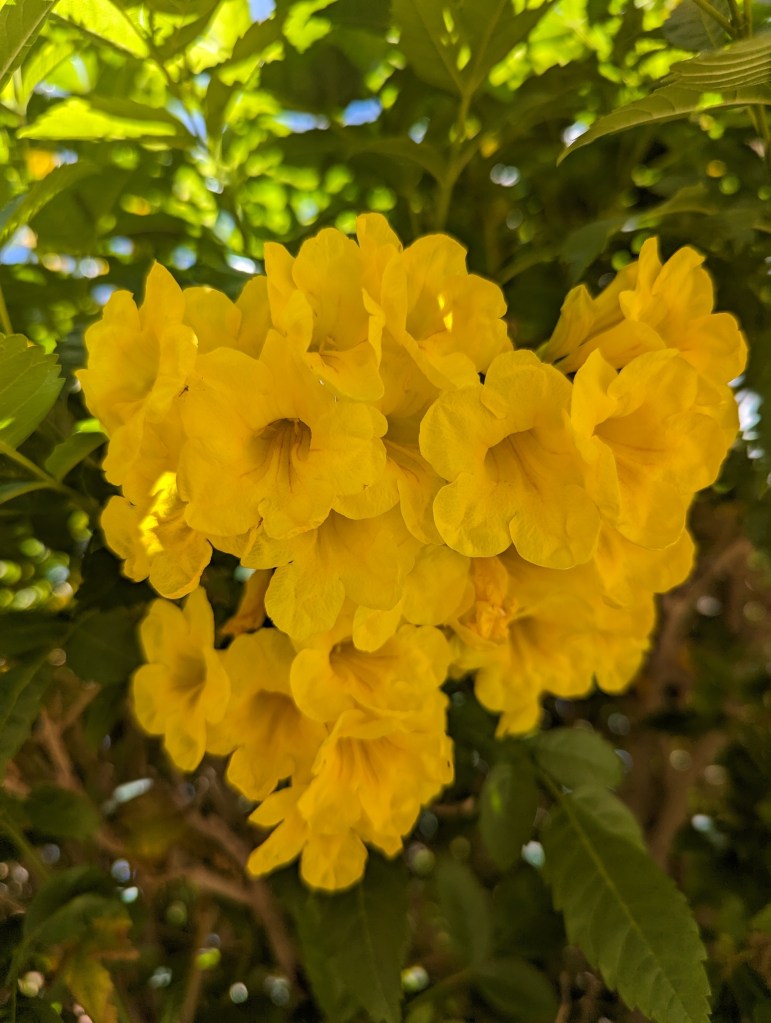
Tecoma stans is somewhat popular within the neighborhood where I stayed while in Arizona. It is available in nurseries also. I suppose that I could have purchased one or more for my garden. I had wanted to grow it for a long time. I refrained. I can explain.
The Tecoma stans that I can get from nurseries is an improved cultivar, or actually, about three cultivars. They are not the simple species, as it would be found growing wild. I realize that improved cultivars are known as ‘improved’ for a reason, but ultimately, I want to grow the simple species.
Crazy Green Thumbs sent me the seed for the simple species of Tecoma stans that I want to grow. That is all I need. Other colleagues have sent me seed, seedlings or cuttings for simple species of American beautyberry, American holly, American persimmon, pawpaw, red mulberry, red elderberry and perhaps too many other species to list briefly. In the future, I suppose that I could try cultivars of some of these species. I would like to get acquainted with them first though.
For most species, I suppose that I prefer cultivars. I want to grow the same ‘Moorpark’ and ‘Blenheim’ apricots that I grew up with. Eventually, I want to grow ‘John F. Kennedy’ rose. Cultivars serve a purpose also.
There are a few reasons why I want simple species rather than cultivars of some species. For American beautyberry, American holly and red elderberry, I want to grow what most other garden enthusiasts within the native ranges of these species grow merely because such species appear uninvited in their gardens. For American persimmon, pawpaw and red mulberry, I want to grow a few of the fruits that people enjoyed for culinary application prior to the development of relatively modern cultivars.
Giant redwood, Sequoiadendron giganteum, is famously the largest tree in the World. Although not quite as tall as the coastal redwood, Sequoiadendron sempervirens, it is bulkier. It grows taller than three hundred feet, with trunks wider than thirty feet, to weigh more than six hundred thirty tons.
Yet, like many species, it has at least one cultivar. ‘Pendulum’, which is the weeping giant redwood, is nothing like the simple species. It might grow forty feet tall, if it is able to support itself at such a height. It’s canopy might grow a few feet wide, but it really cascades more than it reaches outward. It really is weird. It looks more like a relative of Mr. Snuffleupagus of Sesame Street than like a relative of giant redwood.
Of course, its weirdness is what makes it so appealing. It is sculptural. It is bold. It really makes one wonder what planet it is from.
I got this picture in Kitsap County in Washington, hundreds of miles from the native range of the simple species within the Sierra Nevada. Actually, I see more of this cultivar in the Pacific Northwest than here. It likely performs better there because of the colder winter weather. Furthermore, this weird cultivar is more popular than the simple species, partly because it is so distinctive, and partly because it is more proportionate to home gardens. Simple giant redwoods only fit into very spacious landscapes.
Weeping giant redwood may not be good for anything more than its weirdness, but at least it excels at that. Otherwise, it provides no significant shade. It does not bloom conspicuously. It provides no fruit. It does not even make good firewood. Fortunately, weirdness has certain appeal. Within our home gardens, we can grow what we like, even if merely for its weirdness.
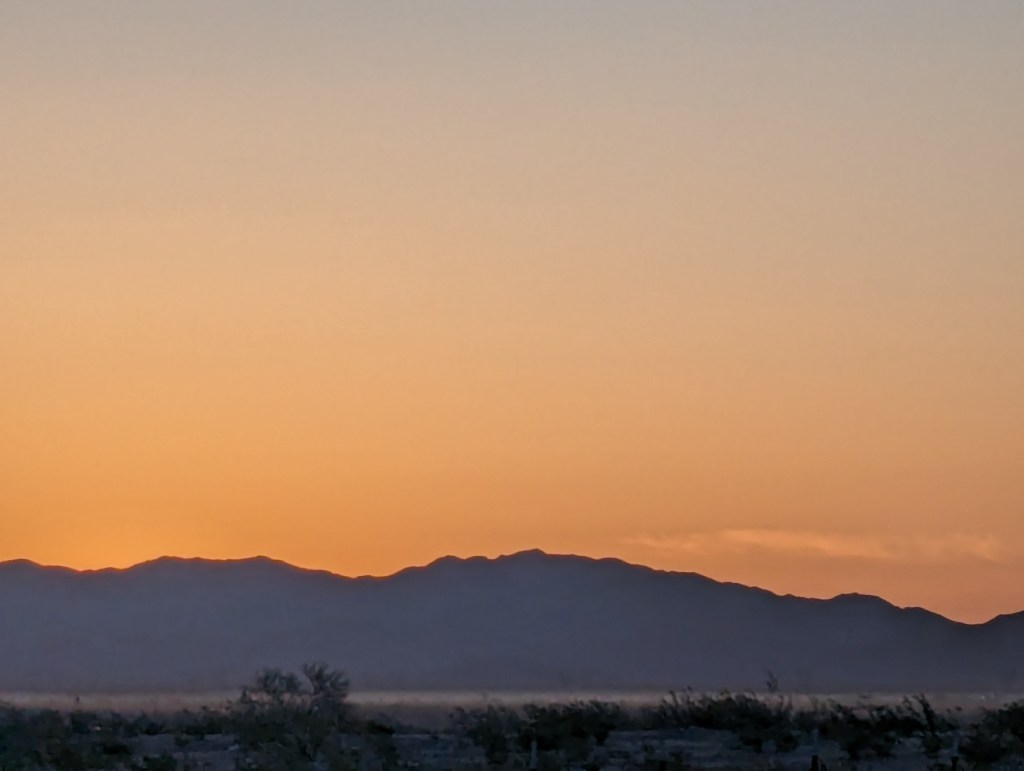
Arizona will be in the rear view mirror shortly after this episode of Six on Saturday posts at midnight on Saturday morning. I got a few pictures this time though. They are not too colorful only because I found the diverse cacti to be more compelling than the abundant desert bloom. Palo verde, esperanza, ocotillo, caliandra, oleander, bougainvillea, lantana and a few other flowers that I did not identify were all in bloom. A few others will bloom soon. We should be in Los Angeles by about noon, and at the View Park Garden Tour on Sunday. This is not how I planned this excursion, but it is working out rather splendidly.
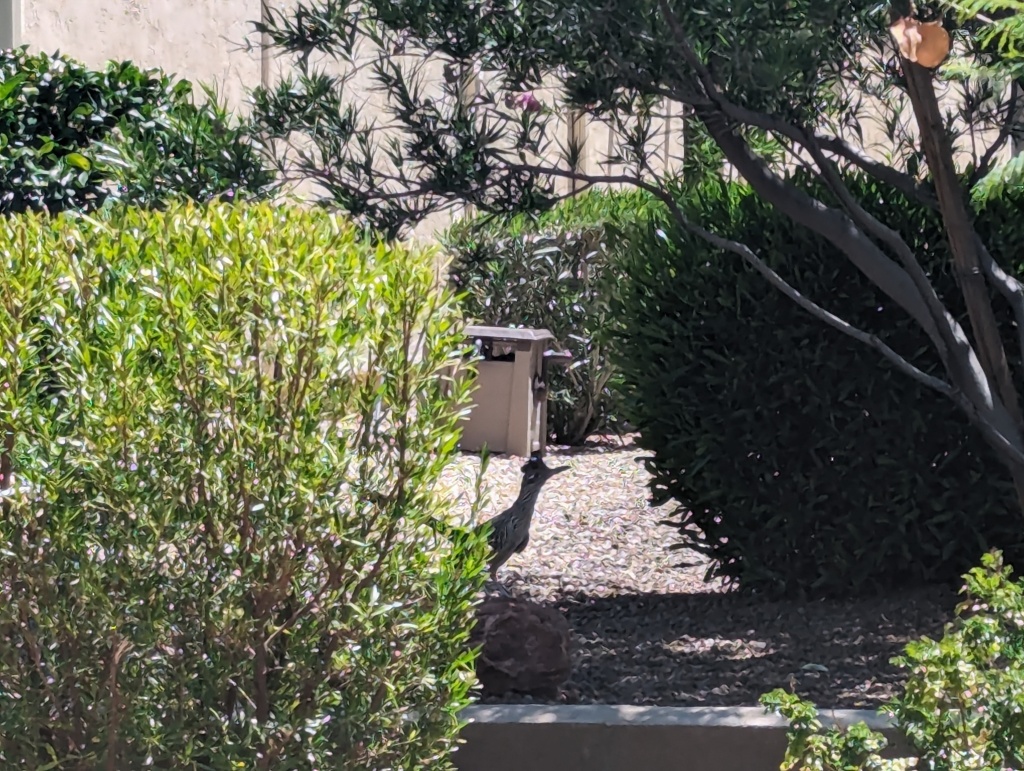
1. Wile E. Coyote, of whom I posted a picture last week, may have been requesting a ride to visit his old colleague, the Road Runner, here in Arizona. I neglected to consider that.
2. Cacti are obviously popular in Arizona, likely because they perform so reliably and are so striking. This and the next two are field grown nursery stock. I can not identify them.
3. This cactus developed a rather wide colony. Many impressively big cacti get relocated. However, I doubt that this entire colony can be relocated intact. It will likely be divided.
4. This unidentified lumpy cactus seems to be quite tame. The few that I have noticed in my neighborhood grow less than three feet high. They grow almost twenty feet tall here.
5. Hesperaloe parviflora, red yucca is difficult to get a good picture of. Its grassy texture and grayish color can look shabby. Its pink bloom is nice against a clear blue sky though.
6. Carnegiea gigantea, saguaro is the State Flower of Arizona, and what tourists like me expect to see in Arizona. I pulled over outside of town to take this picture from the road.
These coastal redwoods are very distinct from giant redwoods.
“Hidden giants: how the UK’s 500,000 redwoods put California in the shade” was published in the Guardian more than a month ago. It was amended to specify that it is about giant redwoods rather than all redwoods, as if that is a distinction that is easily omitted. Incidentally, it later mentions that, “For millions of years, the world’s tallest trees have graced California peaks and coastlines,” which is a reference to coastal redwoods, which are a different genus from giant redwoods.
What is worse is the claim that, “Researchers found that the Victorians brought so many seeds and saplings to Britain that experts say the giant redwoods now outnumber those in their US homeland.” More specifically, it continues to explain that, “The Victorians were so impressed that they brought seeds and seedlings from the US in such large numbers that there are now approximately 500,000 in Britain, according to a Forestry Commission estimate that includes coastal redwoods and dawn redwoods (a separate Chinese species) as well as the giant redwoods. Experts at Kew think most of the UK trees are giant sequoias, the official name for giant redwoods. California has about 80,000 giant redwoods, as well as also having coastal redwoods and a few ornamental dawn redwoods imported from China.”
Essentially, the article claims that this data demonstrates that there are more redwoods in the United Kingdom than there are here. Apparently, approximately half a million redwoods live there, and “experts” “think” that most are giant redwoods. Also apparently, only about eighty thousand giant redwoods live here.
Response to this is no easy task. It is a comparison of all redwoods in the United Kingdom to a very slim minority of redwoods here. About eighty thousand mature specimens of giant redwood live in the wild alone. Countless more immature specimens, including abundant seedlings that are only a few years old, live with them. Countless more giant redwoods have been installed into landscapes throughout areas of California that are collectively almost as large as all of Britain. Such trees have been getting planted here at least as long as they have been getting planted there. It is impossible to estimate how many giant redwoods are here, but there are many more than merely half a million. Furthermore, regardless of how the article was revised, the half a million redwoods of the United Kingdom includes coastal redwoods and dawn redwoods. There may be as many dawn redwoods here as there are there. More importantly, there are more than two million acres of wild coastal redwood forest here. In other words, for every redwood of any species there, there are at least four acres of wild coastal redwoods here. Many redwoods inhabit each acre of redwood forest. Also, many millions of coastal redwoods are planted into landscapes here.
Incidentally, the three species of redwood are actually three distinct genera, and the official name of giant redwood really is giant redwood. It is Sequoidendron, not Sequoia.
The article continues to say with complicated grammar, “Spurred by the climate crisis, devastating droughts and scorching temperatures have added new stressors for the redwood, particularly the famous giant sequoias, which now struggle to bounce back after big wildfires.” However, there is no climate crisis with devastating droughts or scorching temperatures here. Summers here are naturally dry and warm. That is simply how the climate here is. Most forests here burn at least every century or so. Therefore, redwoods that are thousands of years old have survived many fires. Now that some forests are allowed to burn as they naturally should, fires will not likely be so unusually lethal to younger redwoods in the future. Another claim that, “Vulnerable trees are also increasingly under attack from native bark beetles, insects that feed on their spongy red trunks until they topple.” is likewise inaccurate. Bark beetles rarely damage redwoods, and are no more likely to damage them now that they ever had been.
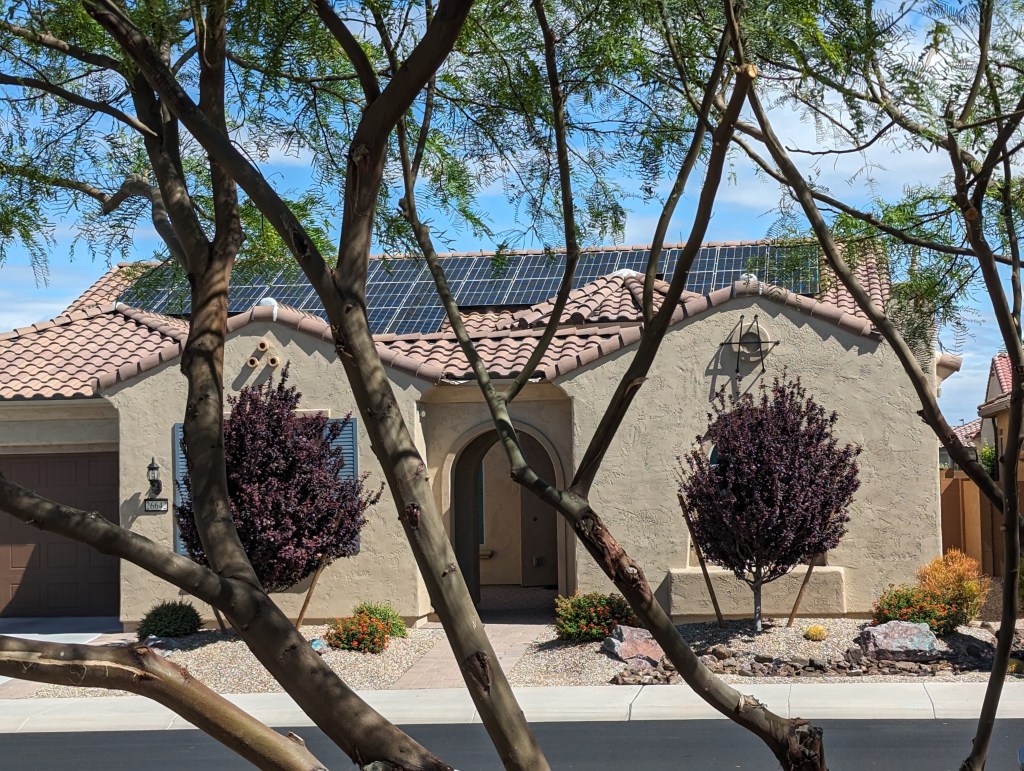
The landscape in front of the home across the road from where I am staying in Arizona is weird. Like many of the landscapes here, it is simple, with only a few small shrubs and stone surrounded by gravel, but also includes this silly pair of purple leaf plum trees. They are pruned into symmetrically round form. The pruning keeps their canopies nicely dense with strikingly bronzed foliage. What makes them so weird is their location. Within the climate here, shade is an asset. However, these trees are not allowed to make much shade. The natural form of these small trees could frame the facade of this house nicely. However, they clash with it defiantly. With their profuse spring bloom and rich foliar color, these trees might enhance the scenery from within the windows. However, they subjugate it and exclude any other scenery, and likely exclude a bit too much sunlight without providing significant cooling shade through summer. I am certainly no landscape designer, but in my opinion, this landscape looks odd. The vegetation is of good quality and quite healthy. The stone and gravel is neatly arranged. The facade of the home is quite appealing. The problem is that the assemblage of the landscape relative to the home is awkward. The tree in the foreground is one of the first three mesquite trees that I ever met when I pruned them up for clearance last year. It and the specimen next to it are also awkwardly placed in front of their home, although the third is in a better situation next to the garage. That is precisely why these three trees were pruned up for clearance, and why they will be pruned higher as they grow. They already provide a bit of shade, and will provide more as they grow.
Eight columns arranged in a semicircle behind the High Place garden at Filoli were found by excavation for the foundation of a skyscraper in San Francisco. The stone from which they were carved is European, but no one knows how or why they were buried under San Francisco. They could have been recycled into one of many buildings that were destroyed by the Great Earthquake and associated fire of 1906, and subsequently buried within landfill with tons of other debis. They were more likely recycled as ballast for a European ship that, as it deteriorated or became obsolete, was dismantled and buried within landfill in San Francisco. It is a mystery. They are in a formal landscape at Filoli now, and will likely remain there for a very long time.
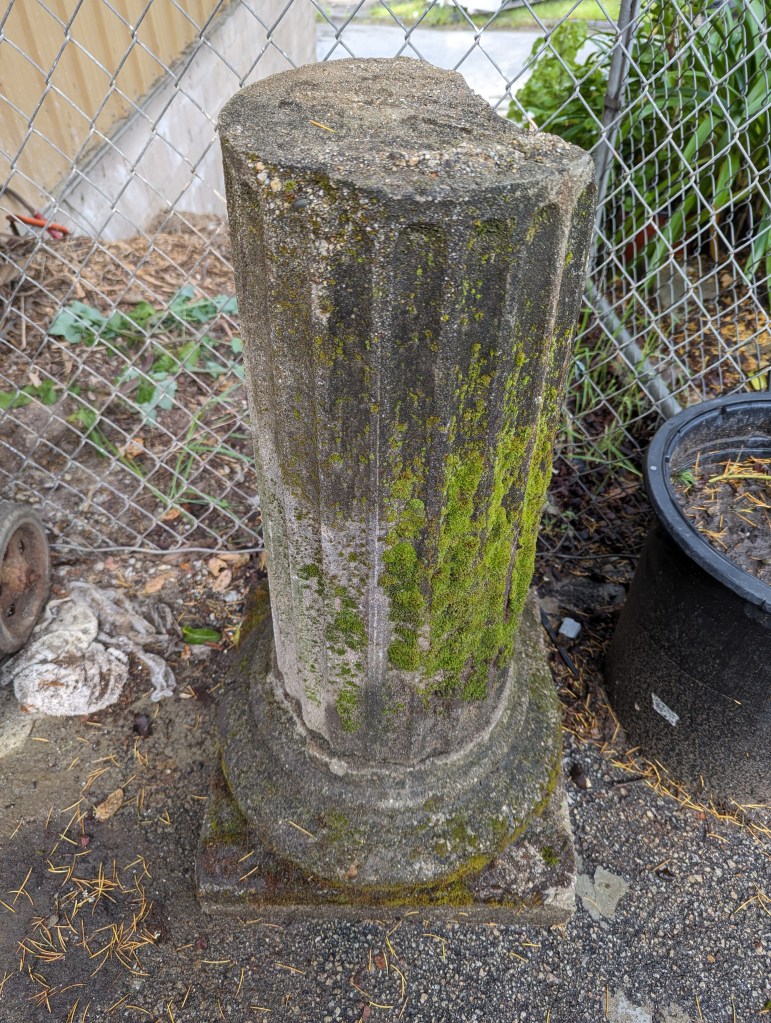
Within a dumpster of recyclable broken concrete, I noticed this old concrete column. With a bit of investigation, I also found the base. Each component is very heavy. I have no idea what they were, but I suspect that they were the base of an elaborate birdbath. I did not find any associate basin within the dumpster. In order to identify their origin, I inquired about these items with those who disposed of them. At the location, I found a small portion of the column that fits between the base and the larger portion of the column, as well as another column that is identical to the original with the smaller portion attached, but no other base. Nor did I find any basin or other features that might have been supported by the columns. They are either already disposed of, or buried by earlier excavation. It is such a waste. Regardless, these items are here now, and will hopefully be incorporated into the landscapes, although I have no idea how.
As expected, the second half of my vacation was delayed. Then, very unexpectedly, all of our delays worked out. Rhody, Carson and I left exactly on time. Then, as unexpectedly, and just an hour from our first destination at Brent’s Jungalow, we were diverted to our final destination near Buckeye near Phoenix in Arizona. The explanation is as tedious as the additional six hour drive, at night and partially through Los Angeles style traffic. We are here now but got almost no pictures yet. We stopped only briefly in San Luis Obispo, where Brent and I were in school from 1985 to 1990, and where a few of our friends live.
1. From his shelf in back, through the dirty windshield, and through the dirty window of a cafe, Rhody stared impatiently at me as I tried to enjoy a bit of coffee the day before we left. ‘Hot Lips’ Salvia microphylla to the left is the only vegetation visible in this picture.
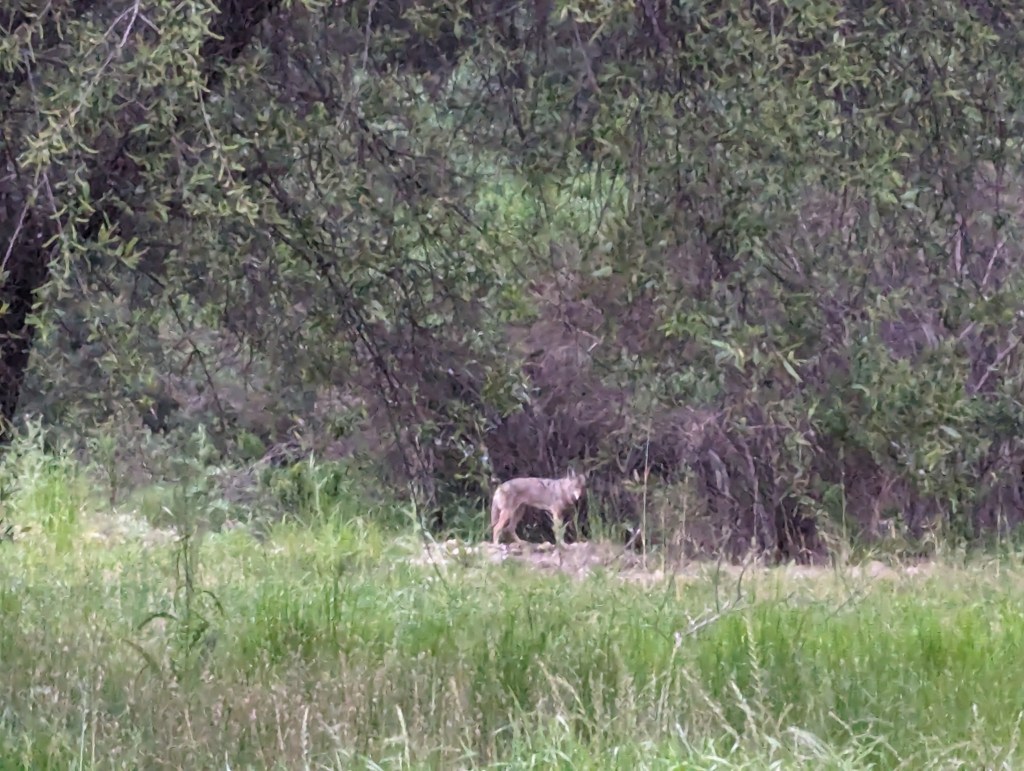
2. Wile E. Coyote also stared at me impatiently, at the end of the same day, as I finished a last task prior to leaving. I can not identify the vegetation that is visible in this picture. I suspect that the tree to the left and above is a common Pacific willow, Salix lasiandra.
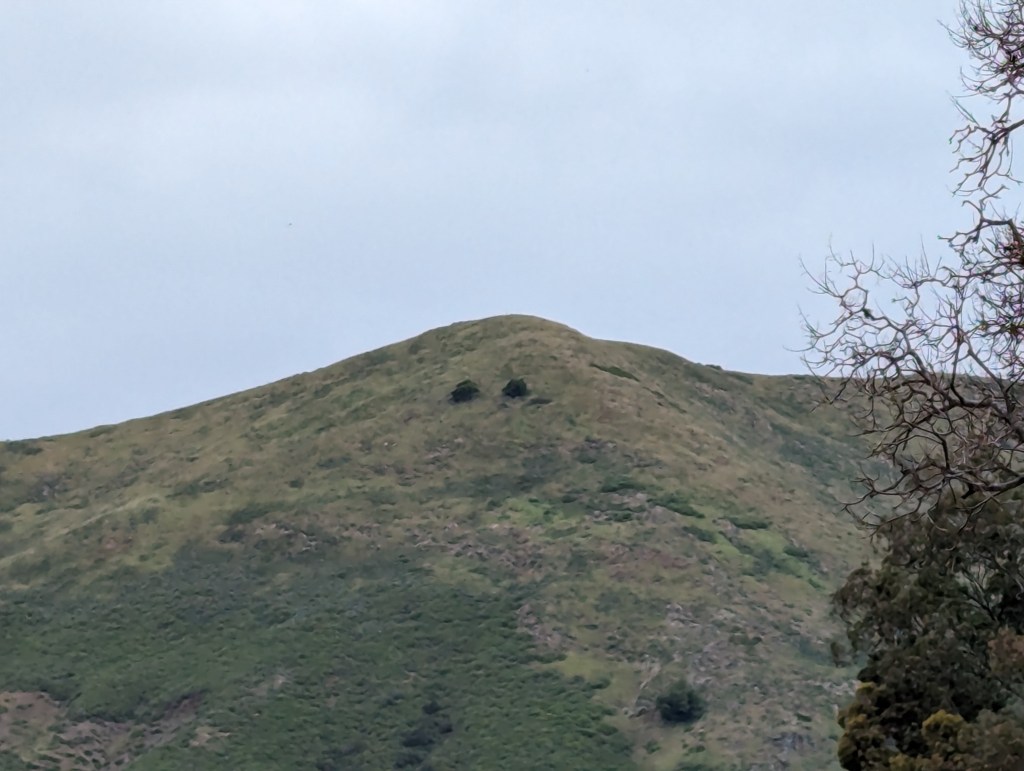
3. The hills have eyes. I have no idea what the pair of shrubs at the center of this picture are. I only know that they have not changed since I arrived at Cal Poly in 1985. I got this picture right outside of my classmate’s office in the Alan A. Erhart Agriculture Building.
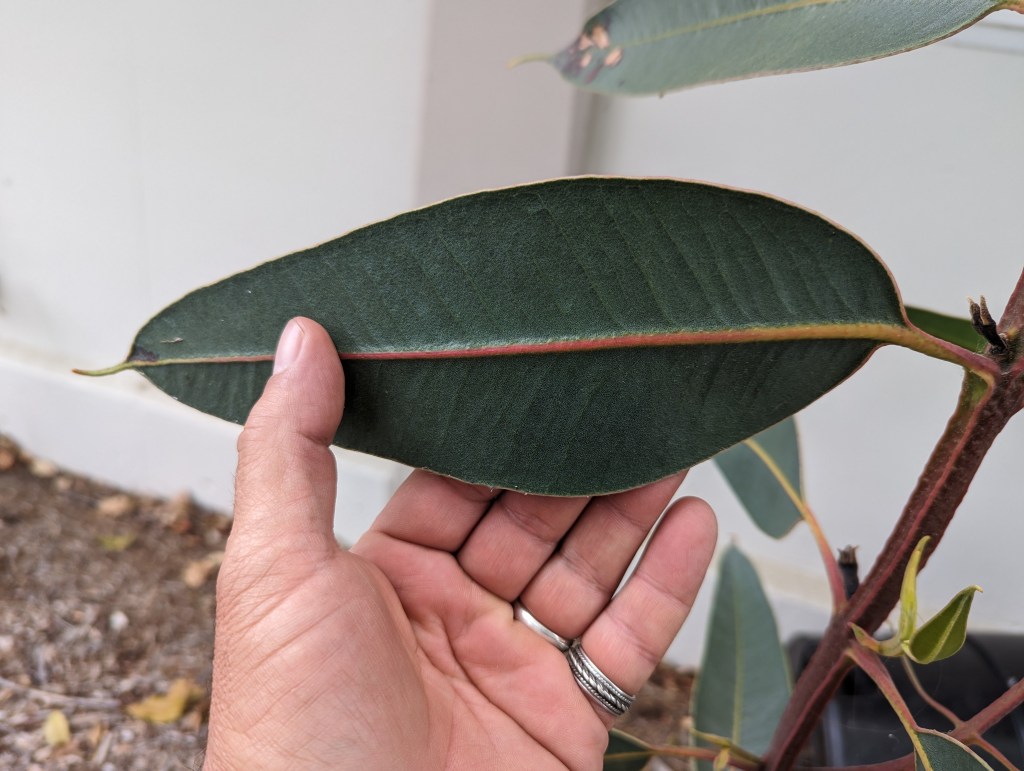
4. Also right outside of my classmate’s office, several specimens of unidentified eucalypti were recently installed. I recognize none of them. This specimen exhibits remarkably big leaves for the genus. These trees are very close to where I first met Eucalyptus torquata.
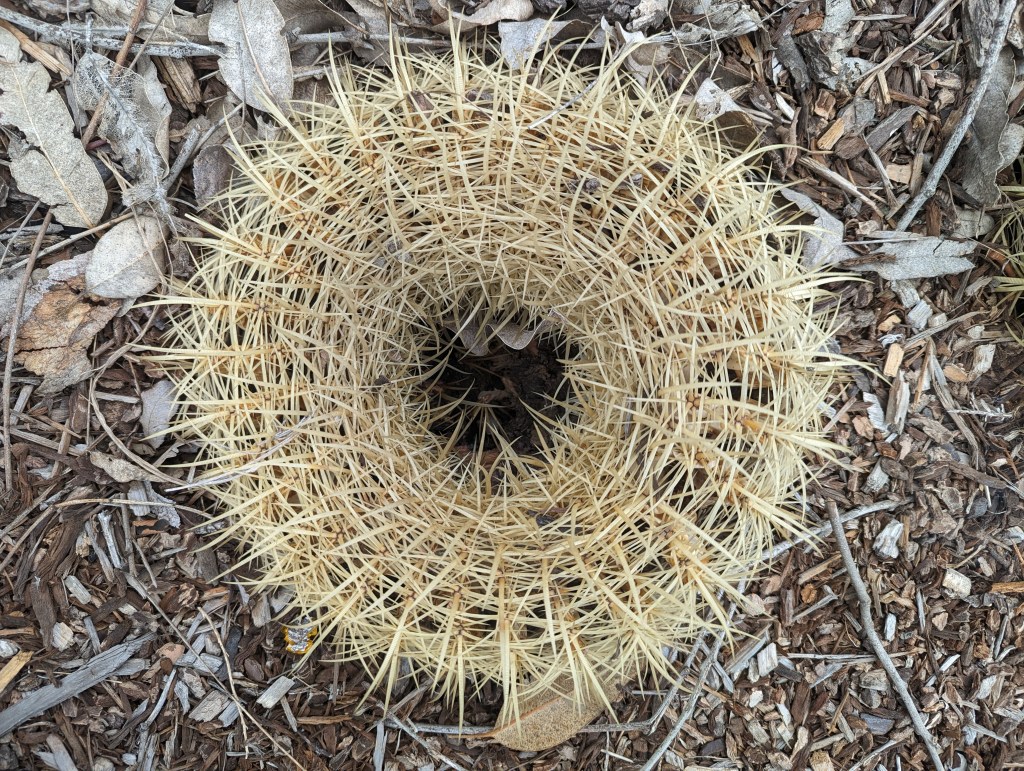
5. Barrel cactus, Echinocactus grusonii, dies ugly. It looks like something out of a horror movie, or like it consumed a horror movie. I suspect that this and several other similarly imploded carcasses decayed because of automated irrigation that is intolerably frequent.
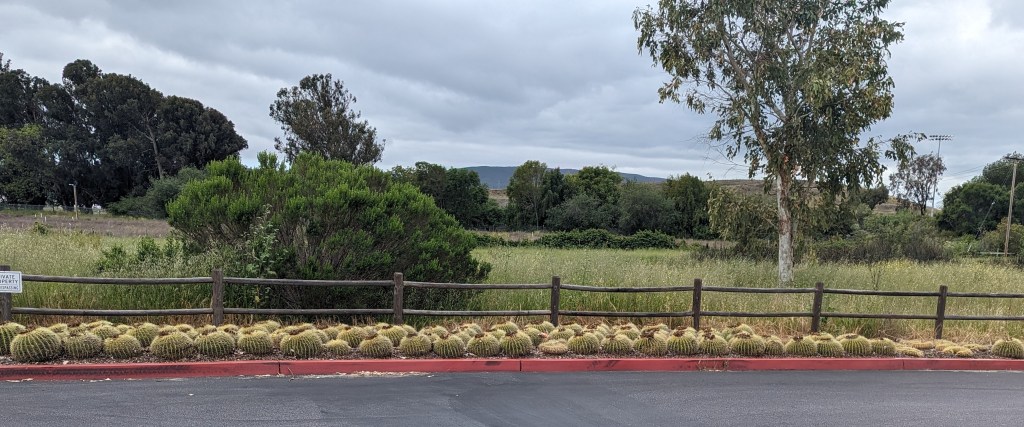
6. Is this good or bad landscape design? I typically prefer uniformity and symmetry, but this seems to be excessive. Several rotting specimens, mostly to the right, are disrupting the symmetry, but also leaving voids. I got this random picture as I left San Luis Obispo.