Volunteer Days at the Arizona Garden of Stanford

Green waste from the Arizona Garden is fair game for volunteers.

(This article is from 2010, so contains irrelevantly outdated information.)

Some gardens are native gardens. Some are wildflower gardens. Others are vegetable gardens, white gardens or rose gardens. There are really all sorts of gardens. Mine though is the only garden that I am aware that is described by some as a ‘felony garden’.

This less than appealing distinction originates from my habit of ‘recycling’ green waste from other gardens. From the bits and pieces of debris generated by normal maintenance, I like to propagate copies of plants that I like for my own garden. Sometimes, I get large volumes of material, such as clumps of New Zealand flax or African iris. Sometimes, I just get small bits of pelargonium or English ivy. Sometimes, the small bits are not exactly generated by maintenance.

On March 20, I really scored big! I procured a pick up full of large canes of a somewhat uncommon species of yucca, along with more than a wheelbarrow full of pieces of various cacti, agaves, aloes and succulents! I suppose that I should feel guilty; but I was helping to dispose of the green waste generated by the volunteers at the Arizona Garden at Stanford University.

The historic Arizona Garden could actually use the help of more volunteers during their Volunteer Days every third Saturday of each month. Most of us were pulling weeds last month, and will likely be pulling more this month. Although there is not always booty to be had, (and no one scores like I did!) volunteers are welcome to the debris they generate from any needed grooming and pruning.

The next Volunteer Days will be on April 17, May 15 and June 19. Volunteers can arrive at any time after 9:00 a.m., and should bring heavy gloves since almost everything in the Arizona Garden is equipped with nasty thorns or spines. Some who stay through noon like to bring bag lunches. New volunteers should contact Arizona Garden Coordinator, Christy Smith at 650 – 723 7459 or christy.smith@stanford.edu before attending a Volunteer Day to get any other necessary information and specific directions to access the Garden.

On April 18, the day after the next Volunteer Day at the Arizona Garden, the Going Native Garden Tour will be visiting more than 65 gardens throughout the Santa Clara Valley and the Peninsula from 10:00 a.m. to 4:00 p.m.. The gardens range from newly planted to established, from townhome lots to acre parcels, but all feature native plants. Some gardens feature talks about native plant gardening. A few gardens will have native plants available for purchase.

It is not possible to see all the gardens within this self guided tour, so guests can choose which gardens to visit. Admission is free, but limited; so early registration is recommended. Registration is required prior to noon on the day of the Tour. Registration can be arranged, and more information about the Going Native Garden Tour and about volunteering can be found at www.gngt.org.

Parasite

Mistletoe, Phoradendron leucarpum

Mistletoe, Phoradendron leucarpum, suddenly and inexplicably disappeared from local ecosystems several years ago. Although it was unlikely completely gone, no one could find any. Carcasas of deceased specimens deteriorated and fell slowly in pieces from their host trees. Regeneration has been a very slow process, and in some local ecosystems, does not seem to be happening at all.

If botanists are aware of what happened to the mistletoe, they are not sharing what they know. Arborists are amazed by such sudden death of mistletoe that they had been unable to eliminate from infested trees. Some believe that it was the result of distress of host trees. However, it is unlikely that all host trees, including many within cultivated and irrigated landscapes, could have been so similarly distressed at the same time. Disease could be the primary culprit. There is even a possibility that mistletoe, the most familiar plant parasite, succumbed to another parasite.

Similar die off of various species of mistletoe has been observed within various other ecosystems, at various times, and with various rates of recovery. Perhaps several factors are involved, either individually or in any variety of combination. Because mistletoe is generally considered to be undesirable, investigation of such die off is minimal.

I noticed this particular mistletoe within the same Oregon white oaks in Oregon that I wrote about yesterday. It seems to be adequately healthy and unaffected by whatever killed mistletoe here. I do not remember if it had died off previously, and is now recovering. For all I know, it could be in the process of dying off right now. Mistletoe might be more efficiently controlled or even eliminated from infested trees within cultivated landscapes if someone could identify what kills it naturally. After all, it is a famously persistent and potentially very distressing parasite.

Oakland

Oregon white oak, Quercus garryana

Oakland, fifty miles north of here, was named for the oaks that formerly inhabited it. Imagine that! Although valley oak, Quercus lobata, is native, and assumed to be the origin of the regional name, coast live oak, Quercus agrifolia, was likely more abundant there at the time.

Of the many other towns in California with horticultural names, a few are also named for unspecified oaks, including del Rey Oaks, Oakdale, Oakley and Thousand Oaks. Encinitas, Live Oak and the Encino neighborhood of Los Angeles are named more specifically for coast live oak. Paso Robles is named more specifically for valley oak.

Oakland and Oakridge are the only two towns that I could find in Oregon that are named for Oaks. I suspect that Oakland is named for Oregon white oak, Quercus garryana, only because that is the most prominent species of oak there. It is also native here, although I am not aware if I have ever encountered it locally. It resembles small specimens of valley oak, which, incidentally, is also known as California white oak.

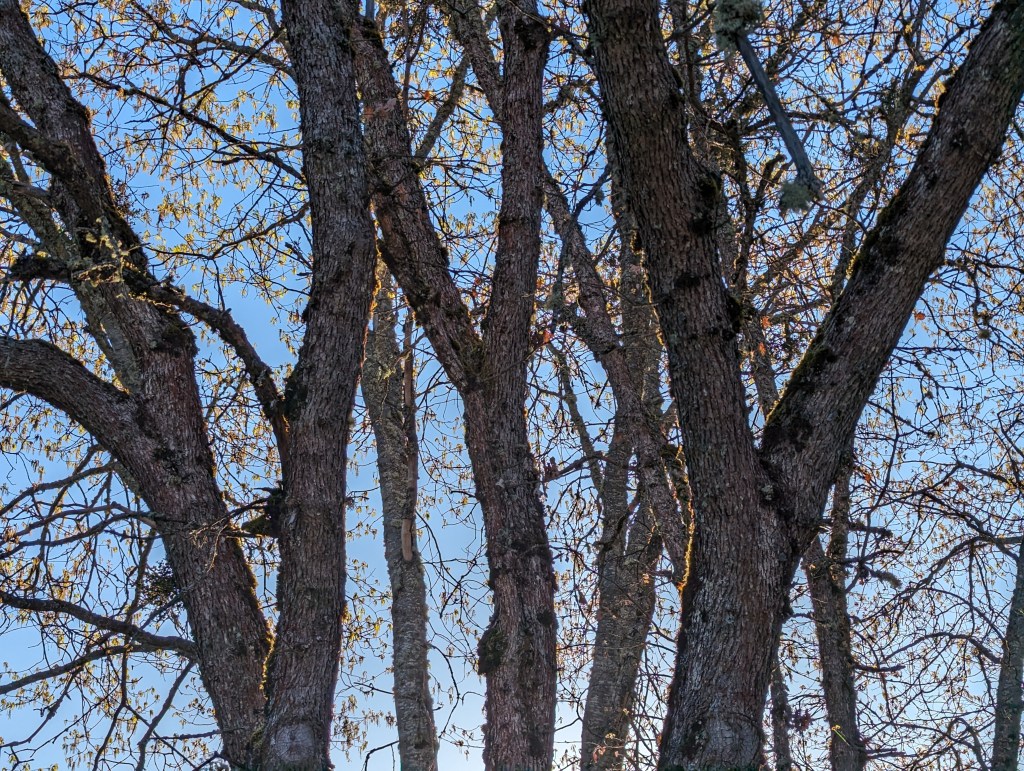
This picture of a few main limbs of an exemplary specimen of Oregon white oak is from Cabin Creek Rest Stop on Southbound Highway 5, just north of Oakland in Oregon. To me, it looks sort of Californian, like something that, a long time ago, was more prominent in Oakland here in California, on ‘the Bright Side of the Bay’.

Six on Saturday: Double Whammy!

Rhody, Carson and I are back from vacation. Now I see that I did not get many pictures

1. If this looks like the same major stockpile of vegetation from Skooter’s Garden (Tangly Cottage Gardening) that I posted a picture of last week, it is because it is. The difference is that it is here at home now. Goodness, it will be a busy week of division and plugging.

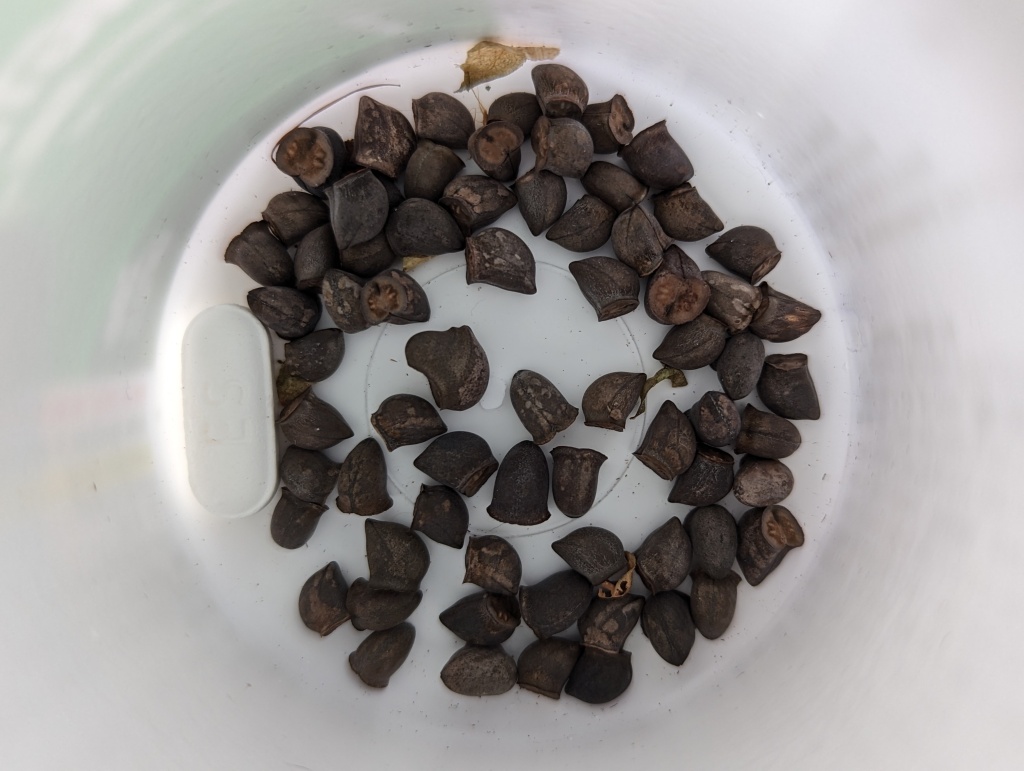
2. Cerinthe seed are in the pill bottle to the lower right of the previous picture. So is that obstinate pill to the left. I should have tried cerinthe by now, and this is my justification.

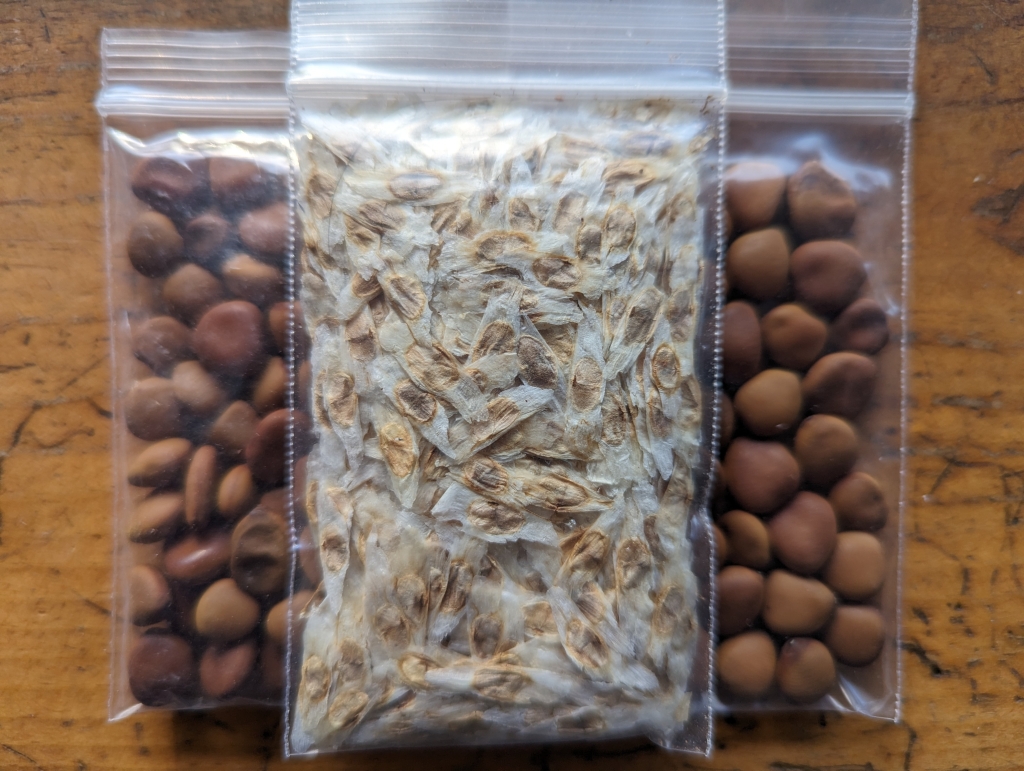
3. Poinciana and esperanza seed from Crazy Green Thumbs are the second of my double whammy! They were likely in my mail before we left on vacation, but we left town before the Post Office was open. Shamefully, they will be my second attempt for both species. It is a long and embarrassing story. This particular poinciana is more commonly known as dwarf poinciana, Caesalpinia pulcherrima. This particular esperanza is more commonly known as yellow bells, Tecoma stans. ‘Esperanza’ means ‘hope’, which I have enough of.

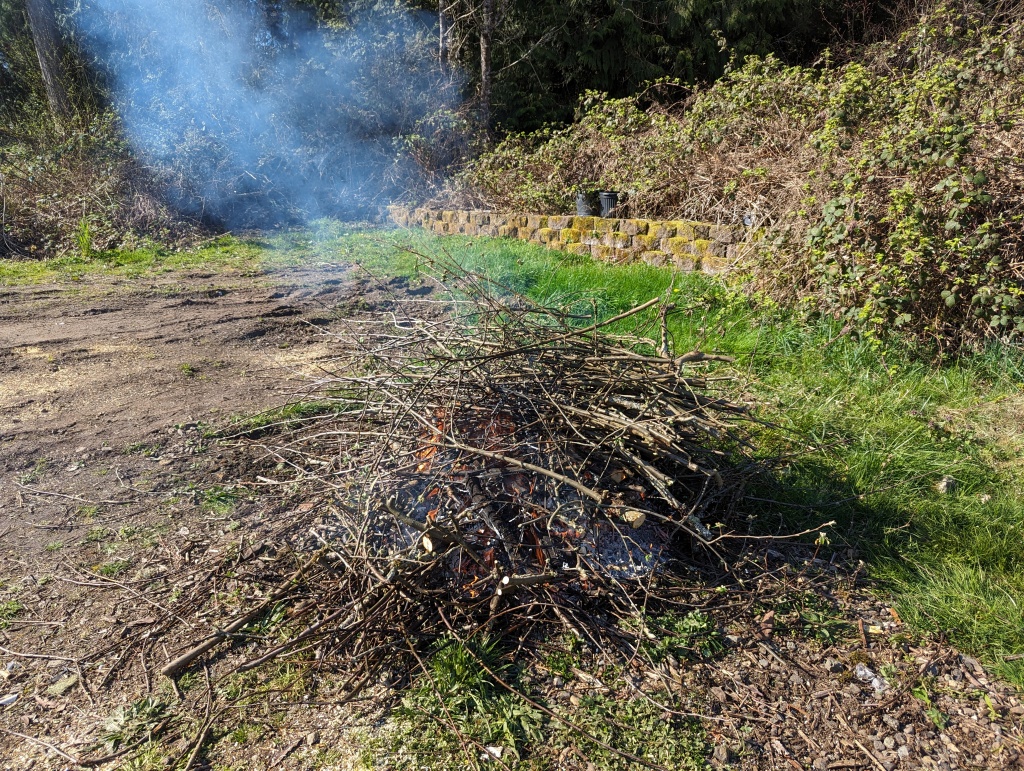
4. My vacation was scheduled to be as late in winter as possible but prior to the bloom of apple trees because I intended to prune eleven apple trees while still dormant. All eleven trees are pruned, and their formerly fresh detritus is gone. Sweet Brown would approve.

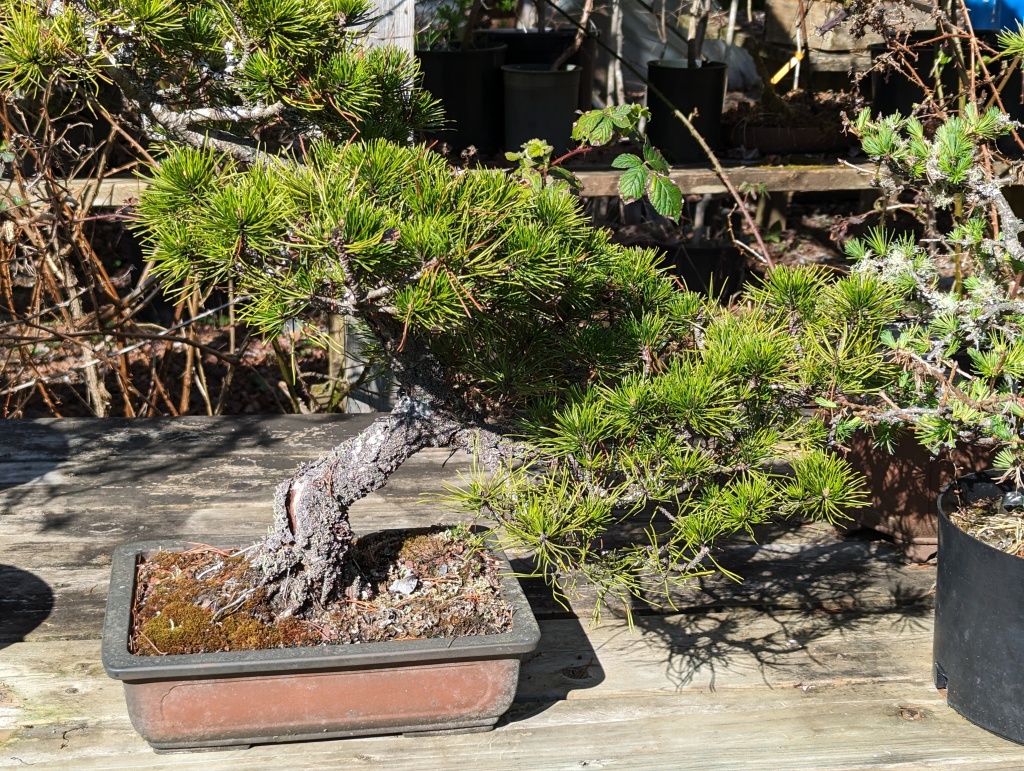
5. Bonsai stock is what my Pa grows on his farm where the pruned apple trees and other old fruit trees live. Goodness, I really should have stayed later, and taken more pictures.

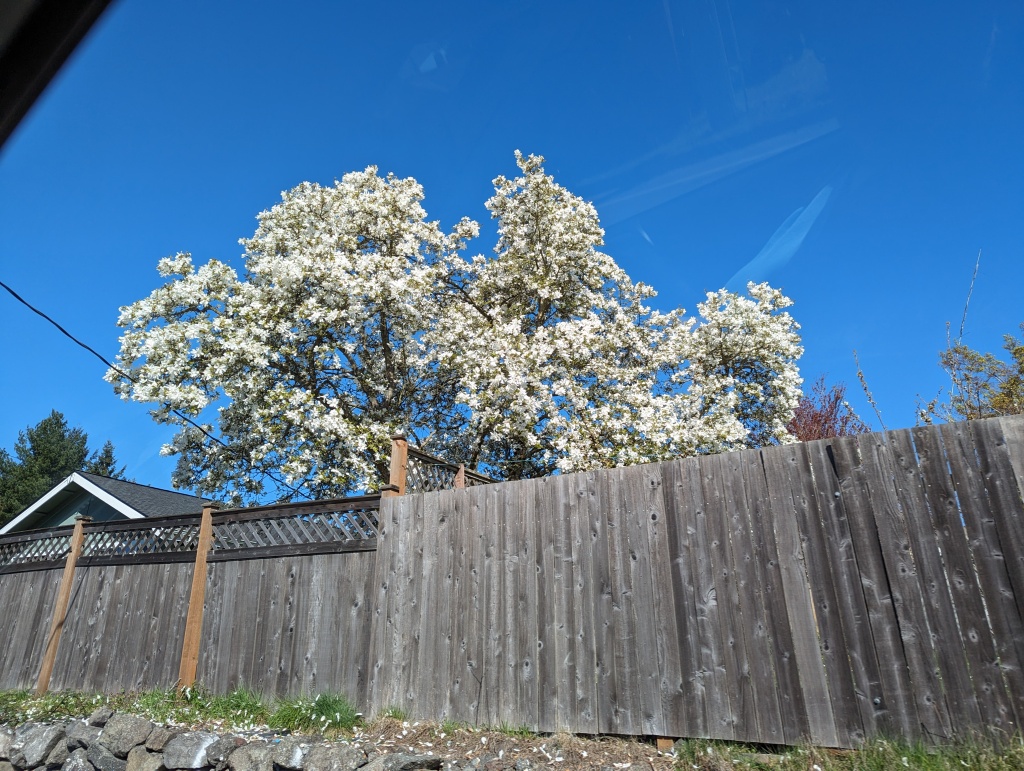
6. Star magnolia performs very well in the Pacific Northwest. I rarely see them any more than five feet tall locally. This is an awkward picture because I took it from a moving car.

This is the link for Six on Saturday, for anyone else who would like to participate: https://thepropagatorblog.wordpress.com/2017/09/18/six-on-saturday-a-participant-guide/

R & R

Rhody in Skooter’s Garden

Rhody is very proficient with Rest & Relaxation. He has been doing quite a bit of it since we left on vacation at midnight last Monday morning. He rode about eight hundred seventy miles mostly on the rear deck so that others on the road with us could observe him doing so. Since arrival in Western Washington, he has been snuggling with others whom he encounters while also engaging in similar activities. This illustrations demonstrates how expertly he engaged in rest & relaxation in Skooter’s Garden.

Although not as proficient as Rhody is, I also have been engaging in a significant rest & relaxation. This is why I have not written as much as I typically write about horticultural topics during the past several days. Although I am aware that I must compose my gardening column by Wednesday, I have deferred most other writing. If it seems otherwise, it is only because my gardening column posts in two sections on both Mondays and Tuesdays, and old articles are recycled for both Thursdays and Fridays. My negligence is more apparent only on Wednesdays and weekends. I should return from vacation on Thursday or Friday, so might resume more typical blogging before too many notice.

Six on Saturday: Vacation

Rhody, Carson and I are finally on vacation in Western Washington. As usual, departure was delayed. Now that we are here, and not at work, I have not been taking pictures like I should have been. Consequently, I am deficient of pictures for Six on Saturday. Four of these six, or two thirds, are not even relevant to horticulture.

1. Sasquatch, who is also known as Bigfoot, is a celebrity of the Pacific Northwest; and is a species that is commonly considered an individual. This was in Canyonville in Oregon.

2. Portland in Oregon is the City Of Roses. This is its South Waterfront district, south of Downtown. Incidentally, most roses prefer the climates of San Jose to those of Portland.

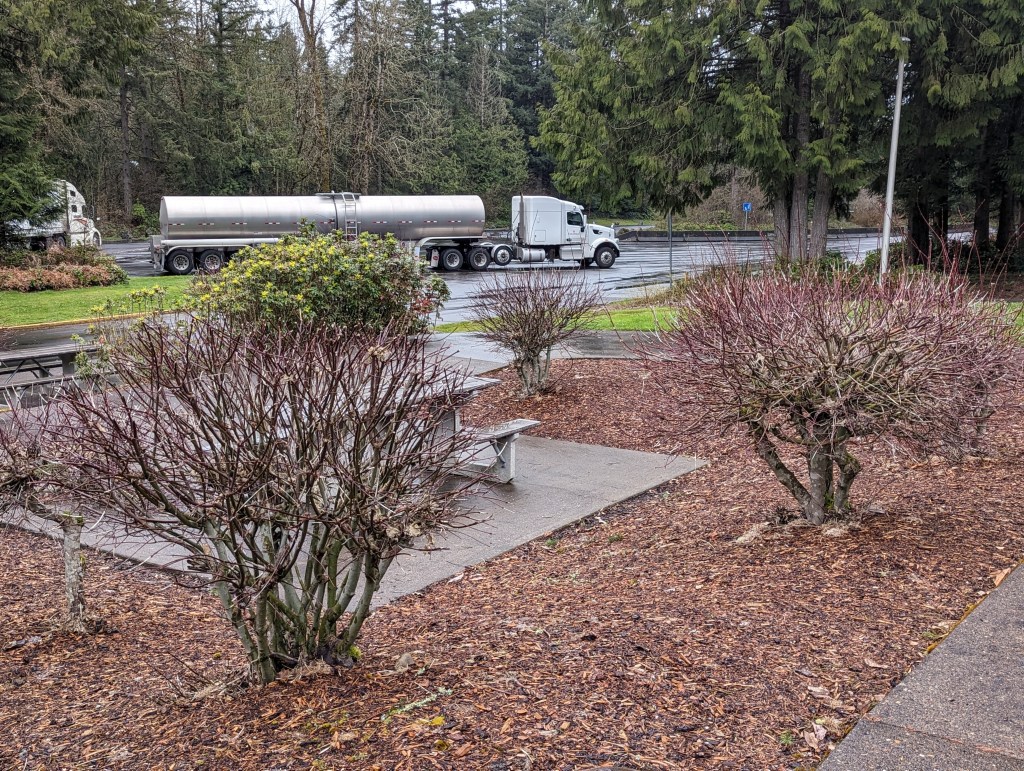
3. Rhody enjoys rest stops. They allow him to renew his ownership of Oregon. This is the Toutle River Rest Area, on northbound Highway 5, north of Castle Rock in Washington.

4. Ferns are common within the coastal climates of the Pacific Northwest. I do not know what this fern is. The pine may be a Japanese red pine. It is in Raymond in Washington.

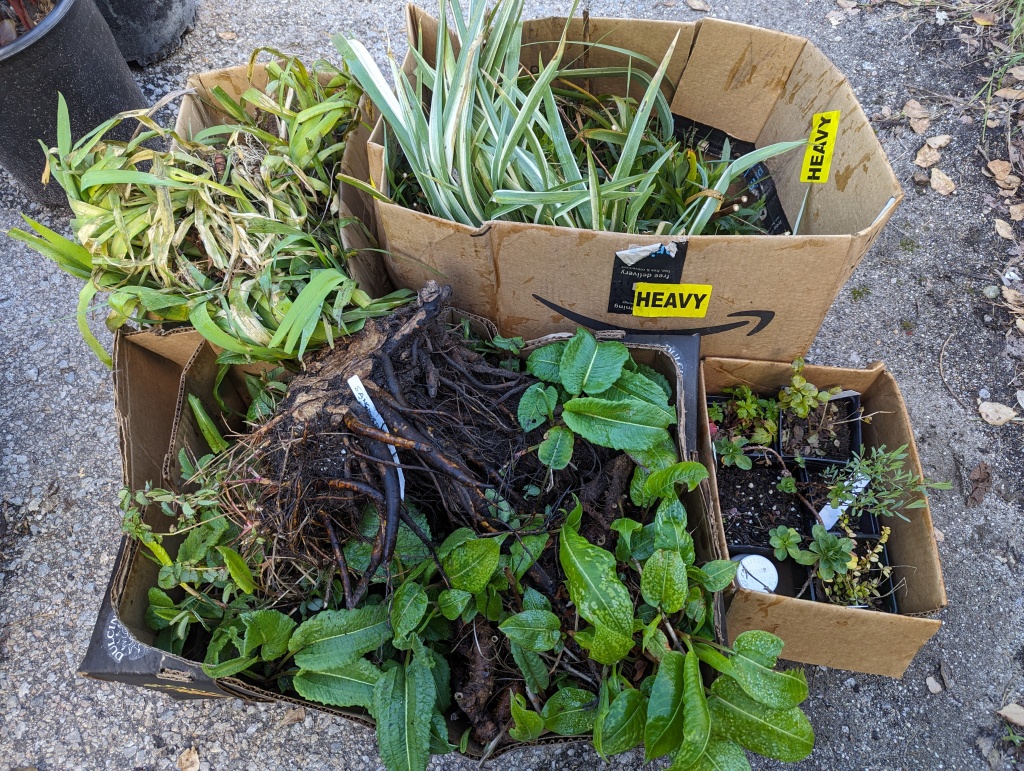
5. ‘Black Gamecock’ Louisiana iris is to the left within the big box to the right. It was the priority, to replace what the gophers ate last year. There is more now than then! The rest of this vegetation is a dozen or so additional perennials from Tangly Cottage Gardening! I will get individual pictures of some of them as I process them when I get back to work. The unidentified variegated foliage to the far right seems to be variegated Japanese iris.

6. Skooter approves of my exploitation of his garden. He must know that I intend to take better care of his Louisiana iris than I did last year. He was on a sunny porch at the time.

This is the link for Six on Saturday, for anyone else who would like to participate: https://thepropagatorblog.wordpress.com/2017/09/18/six-on-saturday-a-participant-guide/

Dual Citizenship

As brightly colorful as Persian buttercup is, I still prefer white.

French peony Persian buttercup was added to one of our landscapes last year. They are not two different perennials, such as French peony and Persian buttercup. They are a group of cultivars of one species, Ranunculus asiaticus ‘French Peony’. Ranunculus asiaticus is the species of Persian buttercup. ‘French Peony’ is its cultivar.

So, is it French or Persian? Well, yes.

Ranunculus asiaticus, Persian buttercup is native to Southwestern Asia, Southeastern Europe, Northeastern Africa and elsewhere within the Mediterranean Region. This range could potentially include the Southern Coast of France within the Mediterranean Region, but much more likely includes Persia within Southwestern Asia. My guess would be that Persian buttercup is as Persian as its name says it is.

‘French Peony’ is a group of cultivars that could have been developed anywhere and given an appealing name that promotes its marketability, but was most likely developed in France, where most breeding of this particular species was done. My guess would be that ‘French Peony’ is as French as its name says it is.

Of course, French peony Persian buttercup could have been developed anywhere, even Persia, and merely given its appealing French name without actually being French. Alternatively, it could have been developed completely in France, from Ranunculus asiaticus from the Southern Coast of France, without actually being Persian. For that matter, it could have been developed in Greece from Greek stock.

To me, French peony Persian buttercup seems to be chicly cosmopolitan. I remember it as popular for urban window boxes within the greatest cities of the World, such as San Jose, Oakland and San Francisco. If I had not seen that it is also popular in Reno and Portland, I would consider it to be as Californian as so many other exotic species and varieties that are popular here.

These would be nice for Ronald McDonald’s garden.

Design and Implementation

This exposed urn looks like a koala tummy.

This is so silly that I sort of like it. I mean, I found it to be sufficiently amusing to get a picture of it to send to Brent. It is a nice large urn, with an Aeonium arboreum that is a bit bolder than any of mine, and delightfully blue Senecio mandraliscae. It has nothing else going for it, but perhaps its simplicity is an asset. It might look junky if it contained any other well planned but comparably maintained material.

My only personal criticism of its design is that it is located on otherwise useful pavement, where pedestrian traffic must divert around it; but I am merely a horticulturist, not a landscape designer. For all I know, it could be there to intentionally soften the expansiveness of all that useful pavement, without occupying too much of it. I would also say that the urn should be outfitted with species that are more tolerant of the partial shade of its particular exposure, but obviously, these two simple species are reasonably happy there.

My more realistic criticism is of its implementation. Is it really too difficult for so-called maintenance ‘gardeners’ to maintain this as the landscape designer who designed it thought they should be able to? Must landscape designers design their landscapes with the expectation that their work will not be maintained as expected? Although it is delightfully silly, it might be more visually appealing if the Senecio mandraliscae cascaded a bit more over the edge. Alternatively, it could be confined to the upper surface of the urn if a third perennial were allowed to cascade somewhat over the edge; but again, I am no landscape designer. The urn is nice, but might be nicer with a bit of foliar color, form and texture over some of its exterior.

Six on Saturday: 6 X

Rhody, Carson and I are still here. We should be in Washington now. We were supposed to leave at about midnight between last Tuesday and Wednesday. Now, we plan to leave at about midnight between Sunday and Monday, and stay in the Pacific Northwest for as long as initially planned. I wrote about the delay earlier. It is why I posted no pictures of our trip yet. Instead, there are three ‘X’s and three eXotics, although the last might really be an undocumented native species. The first three ‘X’s are between generic and specific names of three interspecific hybrids. By next week, I should get six pictures from Oregon and Washington. Incidentally, the Official State Flower of Washington was nicely named after Rhody.

1. Prunus X subhirtella, winter flowering cherry was featured for the garden column last week, or later in some papers. This picture was not used. I did not want it to go to waste.

2. Pelargonium X hortorum, zonal geranium is nothing special, but I happen to like this red too much to discard it after it was clobbered by a car. I can only hope it was a Buick.

3. Freesia X hybrids, freesia is likewise nothing special, but got my attention just after I mentioned feral freesia in the garden column. It is misplaced but too colorful to be feral.

4. Vinca major, greater periwinkle is an aggressively invasive naturalized exotic species. Less pretty aggressively invasive naturalized exotic species would replace what I remove.

5. Allium triquetrum, wild onion is supposedly another aggressively invasive naturalized exotic species. It is so established that I had always considered it to be a native species.

6. Thuja plicata, Western red cedar is supposedly a naturalized species, but could be an undocumented native species. No one seems to know; but it is not aggressively invasive.

This is the link for Six on Saturday, for anyone else who would like to participate: https://thepropagatorblog.wordpress.com/2017/09/18/six-on-saturday-a-participant-guide/

Horridculture – Traditional Delay

Rhody and his Roady, . . . still waiting to leave.

This article is scheduled to post at midnight between March 19 and March 20, which is precisely when we were scheduled to leave for the Pacific Northwest. We were supposed to arrive on the Kitsap Peninsula late in the afternoon, and likely continue to the coast the following morning. Now, we will not leave until midnight between Sunday, March 24 and Monday, March 25. I know that it is only five days later, but it changes the entire schedule. I should still be there in time to prune the apple trees prior to bloom. I do not know when we will return now, but it will likely be about Thursday, April 4.

Then, two and a half weeks later, we leave again for eleven days in Beverly Hills in Los Angeles County, and Buckeye near Phoenix in Arizona. That would involve leaving Wednesday, April 24, and returning on Saturday, May 4. That should be before the weather gets too warm in Arizona to prune the mesquite trees there comfortably. I suppose that the second trip does not necessarily need to be delayed just because the first trip was. We could still leave on Wednesday, April 17 and return on Saturday, April 27 as originally planned, even if that leaves less time between the two trips. Perhaps I should not worry about this until we return from the first trip!

This seems to happen annually. Regardless of how intent I am on leaving on time, we encounter a delay of some sort of another. Ultimately, we leave at about the same time annually, but only after planning to leave about a week earlier, just as we planned for the previous few years. I can not complain, of course, since the delay is justified, but that is another topic for another post.