Heather

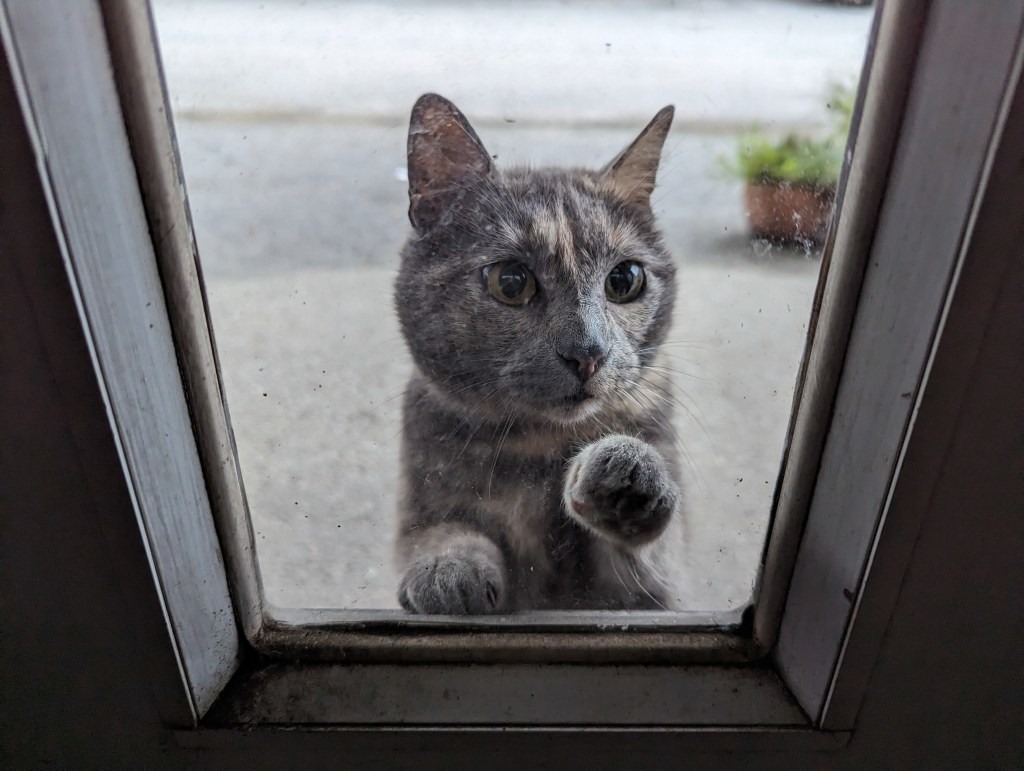
Heather is not related to Calluna vulgaris. She is feline, since she is a kitty, who is employed here as the only mouser within the maintenance shops. We did not hire her as such. She merely assumed the job. At the time, after Darla retired, we were in desperate need of a mouser. We do not know where Heather came from, and she can not tell us. She seems pleased to remain employed here. We are pleased to be without rodents.

Her technique is as mysterious as her origin. No one knows how she prevents rodent infestation. She does not seem to catch any. Instead, she seems to passively repel them, as if rodents vacated and will not return because of here presence. Skunks, opossums and raccoons are also notably absent since her arrival, and the raccoons were vicious.

Heather temporarily lived within the nursery when she first arrived and decided to stay. Shortly afterward, and after being named, she decided that she preferred the automotive shop across the road. If she had settled there originally, she might have gotten a lame name, such as Lexus, Tesla or Mercedes. Now, she is quite established here, and lives in a luxurious penthouse in the automotive shop mezzanine above the locksmith shop. She does not seem to venture away from the safety of the shop buildings or the surrounding fenced yard. She has several friends here, including Rhody.

Fortunately, Heather does not seem to need anything more than she can figure out on her own. I know nothing about providing for a kitty. She does not seem to mind at all. Actually, she seems quite happy here, and purrs when petted. She seems to enjoy looking cute for those whom she meets for the first time, and for pictures such as this.
Safety First

OUCH!

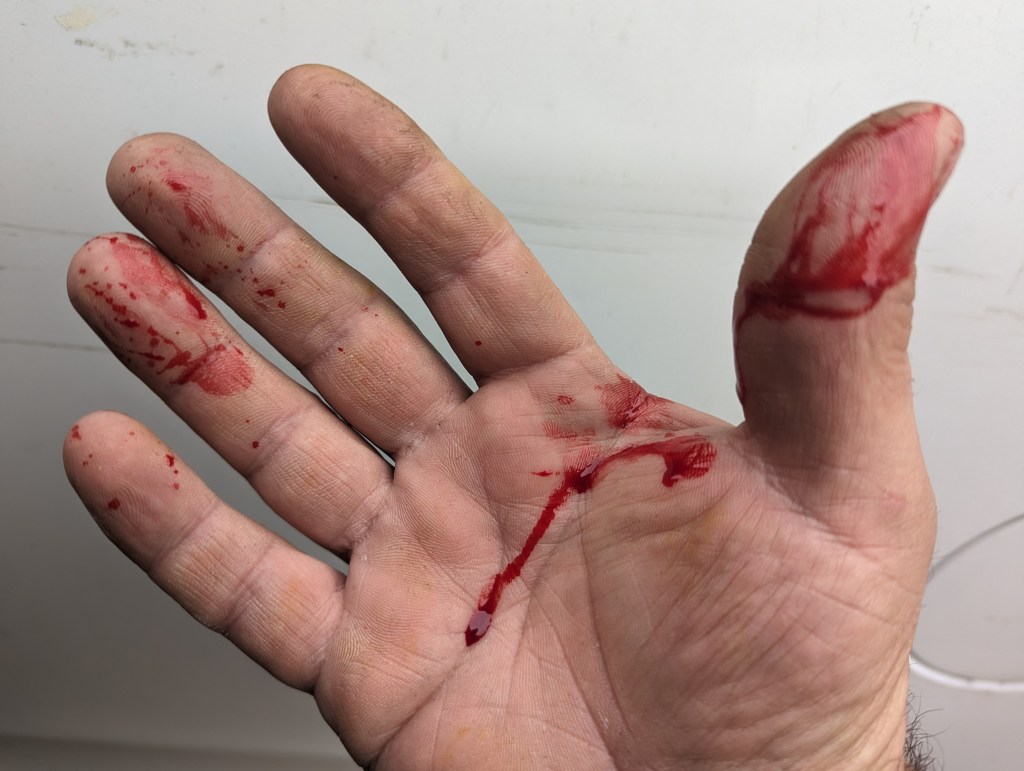
You should have seen the other guy.

Actually, this blood was not contributed by someone else. No one else was involved. Perhaps that was the problem.

I can not sharpen blades. I tried for a long time years ago, before eventually realizing that it would be best to rely on someone else to sharpen my blades. Those who know how to do it make it seem so easy. I have no idea how they do it so well, but I know that they do because it is how my blades get sharpened. It is an enviable ability.

Well, I neglected to get someone to sharpen my blades for a very long time. Naturally, my overused and worn pruning shears are beyond mildly dull. As most of us know, “A dull blade is more dangerous than a sharp blade.”.

The blade did not cause this damage directly. As I wrestled with the dull shears, they unexpectedly slipped past the stem that I was cutting so suddenly that I bashed my thumb against the accordingly damaged latch on the opposing handle. The injury was not bad; but I was too annoyed by it to stop what I was doing, which is why the blood continued to get messy.

I only took this picture so that I could later brag about rescuing a school bus full of Girl Scouts from an attacking polar bear, or something like that. I just have not gotten around to doing so yet. It might have been a grizzly bear.

Because these particular pruning shears are so worn, with a broken latch and a chipped blade, they really should be replaced rather than sharpened. They are the cheapie sort that can not be repaired. The blade can not be replaced. They performed exemplarily longer than they should have.

Six on Saturday: Shabby Spring

This should have been done earlier. While most who participate in Six on Saturday have been posting pictures of early spring bloom, I have been posting less colorful pictures of dormant corms, their barely visible new spring growth, some windmill palm foliage and a sliced weirdly yellow beet. Some of the few flowers that I posted pictures of were oddly pallid, which was sort of why I thought they might be interesting. Now that I am posting floral pictures, early spring flowers are beginning to deteriorate. The first two are rather shabby. The third has not been quite right for a few months. I should have found fresher flowers.

1. Eucalyptus cinerea or pulverulenta, florist silver dollar got an identity crisis. I learned it as cinerea. I am now told that it is pulverulenta. Regardless of its name, bees enjoy it. We thought we added another tree of the same species nearby, but it is the other species.

2. Tecomaria capensis, cape honeysuckle really was prettier earlier. Its bloom is not too profuse, but it is distinctly orange. Goodness, I really should have taken a better picture.

3. Rosmarinus officinalis, rosemary is badly infested with mites, but blooms regardless. It is right across the road from the silver dollar, and just as popular with the honeybees.

4. Lavandula stoechas, Spanish lavender is the only lavender that self sows here. It does not become invasive though. Its bloom may be blue, pink, white or, obviously, lavender.

5. Tulbaghia violacea, society garlic is one of my least favorite of perennials. It stinks! It is not so much to look at either. It has been here for many years though, and will not die.

6. Grevillea rosmarinifolia, rosemary grevillea seems as popular with hummingbirds as rosemary and silver dollar is with bees. Hummingbirds are prettier than this odd bloom.

This is the link for Six on Saturday, for anyone else who would like to participate: https://thepropagatorblog.wordpress.com/2017/09/18/six-on-saturday-a-participant-guide/

Horridculture – White

White bloom brightens a shady landscape.

White is my favorite color. Do not argue with me about it. I do not need to hear that it is not truly a color or that it is the absence of color. Technically, it is either or both the complete absence of color or the complete saturation of all color. In that regard, it has either or both the same or opposite definition as black.

A prism demonstrates the colorfulness of white light by separating it into all other colors that it contains. Nothing is lacking.

Other colors can be mixed with a bit of white to become a tint, but retain their identity. They can be mixed with a bit of black to become a shade, but retain their identity. They can be mixed with other colors for various hues. Only white and black lose their identities with the addition of another color. No matter how pale, white becomes a tint of the additional color. No matter how dark, black becomes a shade of the additional color.

Pink is not really a color, but it is somehow more acceptable as such than white is. It is merely a tint of red. In other words, it is red with white.

Furthermore, brown is not really a color, but is somehow more acceptable as such than white is. It is merely a shade of orange. In other words, it is orange with black.

Gray is either or both a tint of black or a shade of white, but only if either or both black or white is considered to be the color that it is. Goodness, this is getting complicated.

Ultimately, such analysis is irrelevant to my predilection for white. Brent says that I am a white supremacist. That is rude. I just know that my favorite color is white.

More Palm Silliness

Mexican fan palm, Washingtonia robusta

Mexican fan palm, Washingtonia robusta, is the most familiar palm throughout most of California. It is most typically groomed to remove deteriorated leaves without removing the associated toughly fibrous petiole bases that form a neat lattice-like sweater of stubble around its trunks. Some are groomed to also remove the stubble, leaving a clean shaven and leaner looking trunk. Some are shaven only part way up, with a sweater higher up. Without grooming, or if grooming discontinues, some accumulate beards of deteriorated leaves. Although generally harmless, such beards are combustible and can be infested with rats. On rare occasion, they become dislodged from their trunks and fall. They are dangerously heavy and very messy. This silly looking Mexican fan palm was groomed part way up, and then neglected long enough to accumulate a significant beard. The beard then fell, leaving the bare trunk exposed. Only the few lowest of the old leaves remain below where the beard was. A new beard is now forming above.

Queen palm, Arecastrum romanzoffianum, was an uncommon palm until it suddenly became very popular and almost too common through the 1990s. By that time, selective breeding produced the standardized modern variety, which is a bit greener, fluffier and more vigorous than most old specimens. Although it is a bit more genetically conformative than old specimens, it still exhibits genetic variability. Unless some are cloned by tissue culture, all are grown from seed. Some grow slower, so stay shorter. Some develop unusually plump trunks. Some are unusually floppy. This one is just weird. Its foliar canopy is so strictly narrow that it resembles the locally rare Andean wax palm, Ceroxylon quindiuense. Perhaps it actually is an Andean wax palm! A pindo palm, Butia capitata, lives in the associated front garden, and it is not exactly common.

queen palm, Arecastrum romanzoffianum or Andean wax palm, Ceroxylon quindiuense or something else?

Palm Ignorance

Bismarckia nobilis

Many years ago and before I started writing my gardening column in response to all the horticultural misinformation that I had been observing in the San Jose Mercury News, I heard some of the most idiotic commentary I have ever heard about palms on the radio. I do not remember what radio station it was broadcast from, but it was likely in San Jose. The commentator was expressing his disapproval of the many mature palms that were being incorporated into public landscapes there at the time. He started by stating that, “There are two kinds of palms . . . ” Well, that certainly got my attention. He continued to say, ” . . . the tall skinny kind and the short fat kind.” Wow, I can not forget a comment like that. I knew that he was referring to Mexican fan palm and Canary Island date palm, which were and probably still are the most common palms in San Jose. Also, they were the two species that were so commonly installed into public landscapes at the time. There was no mention of queen palm, windmill palm, Mediterranean fan palm or California fan palm, all of which also inhabit San Jose. Since then, queen palm and the formerly rare pygmy date palm have become more common than they had been. Hesper palm remains rare. I brought three distinct species of bamboo palm from Los Angeles, and would like to bring a few more of the palms that perform well there, even if they do not perform so well here. I happen to be fond of the few types of king palm. I very much want to procure Bismarck palm like this one. Although still uncommon in Los Angeles, it is not completely rare. No one knows how well it performs here because no one has tried it yet.

Six on Saturday: Winter to Spring

Spring is beginning to express itself. Only one of my six thinks that it is still winter. After a mild winter, I expected this sooner.

1. Colocasia gigantea ‘Thailand Giant’ elephant ear is the only one of these six to remain dormant. I still must determine if two will go directly into a landscape or get canned like the other two next week. I actually purchased these corms, but do not feel guilty about it.

2. Alocasia macrorrhiza ‘Borneo Giant’ elephant ear is another guiltless purchase. It has a very similar name and is from a similar region as the ‘Thailand Giant’ elephant ear, but grows from smaller rhizomes rather than fat corms. It is already generating new growth.

3. Musa acuminata ‘Double Mahoi’ banana was one of several items that I brought back from Los Angeles last year. After taking several small pups from it, I gave the original to a neighbor. Then, all the pups seemed to die! Now I am pleased that they are recovering.

4. Actinidia deliciosa, fuzzy kiwifruit cuttings are generating foliage. I hope that they are also generating roots. They are a male pollinator for a female cultivar that grew last year from a single pruning scrap that an associate here neglected to remove from his pickup.

5. Platycerium bifurcatum, staghorn fern looks weird as it extends new foliage. Actually, it always looks weird, which is its primary allure. I am concerned that such fresh foliage can be damaged by cold rain. It likes rain and humidity but in conjunction with warmth.

6. Viburnum tinus, laurustinus is the only floral feature of these six. I am not so keen on it, but am learning to appreciate it because its early spring bloom is popular where harsh weather through winter inhibits other bloom. It is simple white, without any pink blush.

This is the link for Six on Saturday, for anyone else who would like to participate: https://thepropagatorblog.wordpress.com/2017/09/18/six-on-saturday-a-participant-guide/

Horridculture (deferred from Wednesday) – Bad Garden Tour

The Jungalow, as I wrote six years ago, is Brent’s home and associated gardens. It is an overgrown mess of lush foliage. I perceive it to be a frivolous waste of very limited space. Everyone else perceives it to be a phenomenally luxuriant urban oasis.

The house next door is more my style. It is a compact and simple home with simple bisymmetric architecture and an even simpler landscape. If Brent had not installed a symmetrical pair of tipu trees at the curb, a symmetrical pair of Tolleson’s weeping junipers flanking the porch and a foundation planting of star jasmine, it would have no landscape at all. It might be my favorite house in the neighborhood. Brent hates it.

More specifically, he hates that it is right next door. He would prefer it to be a bit farther away, so that a home with a landscape that is more compatible with his could be next door instead.

Anyway, sadly, a back bedroom of the house next door that I am so fond of burned a few days ago. Fortunately, Brent was in his office behind his home when it happened. He noticed a red glow and heard a window break. When he investigated, he could see the fire and smoke through the hedge between the backyards, so called 911. A fire crew arrived within only a few minutes to extinguish the fire before it ruined more of the home.

Brent sent this brief and blurry video of the situation shortly after the fire was extinguished. It resembles a hasty video garden tour, but speeds past some of the more interesting features of the garden, including my homeless camp, before turning back to show smoke rising from the house next door. It is a saddening situation for the next door neighbor.

Hard Hat

This is a harsh reminder.

This is why arborists wear hard hats. It is more than eight feet tall. I do not know how much of it extends into the wet sand. Nor do I know how much it weighs. It might have fallen from about twenty-five feet up. I do not know how far the pole saw that it was plucked down with was extended. Even with a hard hat, this would have been potentially very dangerous. I am glad that it is now on the ground, or will be when it falls over.

Nature is naturally hazardous. We try to make some of it safer. We can not eliminate all hazards though. Some, like this one before it fell, are not obviously hazardous. Some are not visible from the ground. As frequently as some hazards are eliminated, others are developing. Trees are always growing and shedding limbs that get shaded out. Old trees are always dying and deteriorating. It never ends.

The alder that dropped this necrotic limb took quite a beating when the creek flooded last winter. Water was higher than this broken limb now stands. Massive trunks of trees that fell upstream floated through here, battering any tree trunks that they encountered, including the trunk of the tree that dropped this limb, which is now at the edge of the water at its current depth. Such pummelling should have dislodged such decayed limbs. Perhaps this limb was not so decayed last winter, and therefore more firmly attached.

The intention of the minor tree work that was done in this area was merely to neaten the scenery a bit. Hazards such as this were not a consideration, since the trees appeared to be reasonably safe, and because they are located on the bank of a creek where no one else goes.

Mycology

I have no idea what fungi this is.

Mycology was a topic that we horticulture students did not study much in school. We learned about some of the more important fungal diseases of vegetation, but that was about all. We could not take the time to study it any more extensively than mycologists could take the time to study horticulture or even botany.

Yet, horticulturists are often expected to know more about mycology than we should be expected to know. Perhaps it is because fungal organisms seem to grow sort of like botanical organisms grow. In ancient history, mycology actually was more closely related to botany, but needed to become a separate discipline as more was learned about each of the two. Perhaps that was at a time when entomology still included arachnids, myriapods and crustaceans. Heck, there was a time when earth, air, water and fire were considered to be the only four primary elements.

I have no idea what this mushroom is. It got my attention because it is so weird. It is such a weird mix of pastel purple, gray and white, with such a distinctly flat top. It was solitary. Not only did I see no others like it, but I noticed no other terrestrial mushrooms of any sort nearby. It appeared amongst blackberry bramble and naturalized English ivy, on the bank of a creek, under bay trees, with bigleaf maples, white alders, red alders and a deceased Douglas fir nearby. The area was quite damp from all the rainy weather this winter. Large and likely old rusty ruddy brown basidiocarps extend from the rotting bases of some of the bay trees. Smaller and likely younger brown and white basidiocarps extend from the rotting trunk of the deceased Douglas fir. All of this is irrelevant, since I still have no idea what this is.