Mojave

Joshua trees seem to be scarce near Joshua Tree.

About a quarter of California is desert. Most of that desert is part of the Mojave Desert. Much of it is very sparsely populated. All of it is fascinating to those who appreciate it.

Not many people live in the desert because the climate is so harsh, and because there is not much reason for many people to be there. Not far north of Los Angeles, which is the second most populous city in America, is one of the most sparsely populated regions of America within the Mojave Desert. It is unpleasantly hot and dry there all summer. It is certainly not the sort of place that should be appealing to horticulturists, although it is.

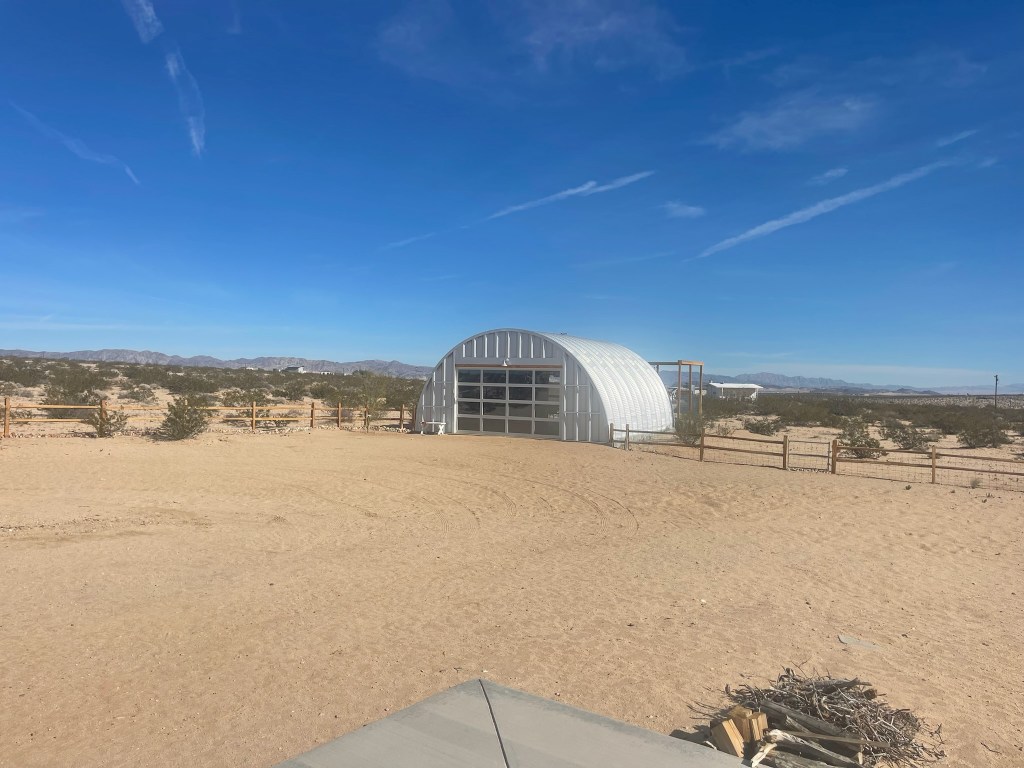
Brent sent me this picture from a place where he vacations near Joshua Tree. If there are Joshua trees near Joshua Tree, they are not visible within this picture. Actually, no trees are visible within this region where shade must be very important. The vegetation that is visible does not seem to be substantial. Vegetation is completely lacking within the fenced area. That small pile of firewood must have been brought from somewhere else. (Although nights are pleasant or warm between hot days, they can get very cold between cool days of winter.) I do not know what that building is. Without substantial vegetation, neighboring residences are visible in the distance.

Part of the allure of deserts for horticulturists is the very distinctive vegetation that lives only there. Part of the allure is the minimalism of such vegetation. Although many species live there, they are not very distinctive. Many resemble each other. In other words, much of the vegetation of the desert is easy to ignore. It is less distracting than that of other ecosystems that are more popular with those who are not horticulturists.

Ginger Ail

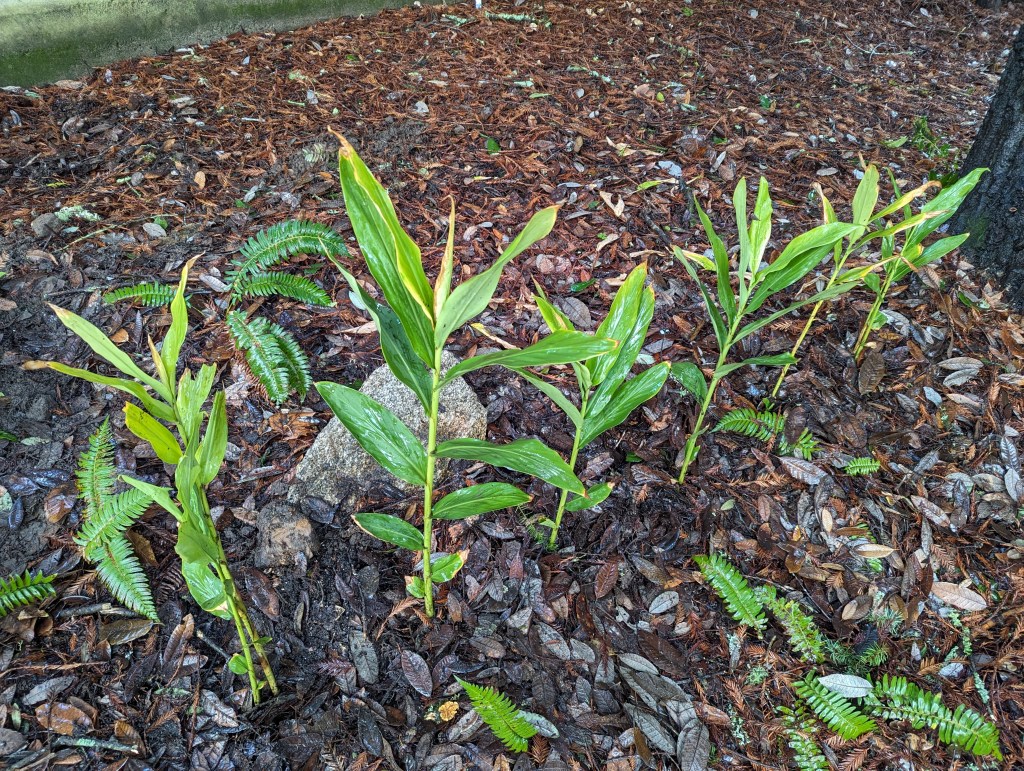
White butterfly ginger is still green.

At least seven gingers live here. Five are ornamental. Two are culinary. None have yet died back as they should for winter.

Now that it is time to divide them, I do not know what to do with their intact foliage. For this white butterfly ginger from Forest Garden, I divided the rhizomes and installed them into the landscape with their healthy foliage still attached. I do not want to cut it back until it succumbs to frost. I suppose that it can remain as long as it is healthy. It is likely promoting healthier secondary growth. Because none of the gingers are crowded yet, it should not be difficult to selectively groom out older growth as new growth develops. I doubt that older foliage absolutely must be pruned away during winter. If it were that important, the rhizomes would shed it naturally, with or without frost.

This is a mild climate, with very mild frost; but gingers should still die back for winter regardless. Cannas certainly do, even without significant frost. Even some of the banana trees were somewhat unhappy about the chill.

Actually, the banana trees seem to be bothered more by chill than the gingers. Is this normal? Angel’s trumpet, cup of gold vine and blue ginger (which is not related to ginger) also expressed more displeasure than the gingers.

I really should have sheltered some of these species better. Actually, I probably should not be growing so many species that are so sensitive to chill and frost. I will be going to Southern California again in about April, so could bring back even more tropical species. It is a bad habit.

Technically, the average last frost date is about a month and a half from now. Technically, a bit of frost is possible even after that.

Six on Saturday: Palm Springs

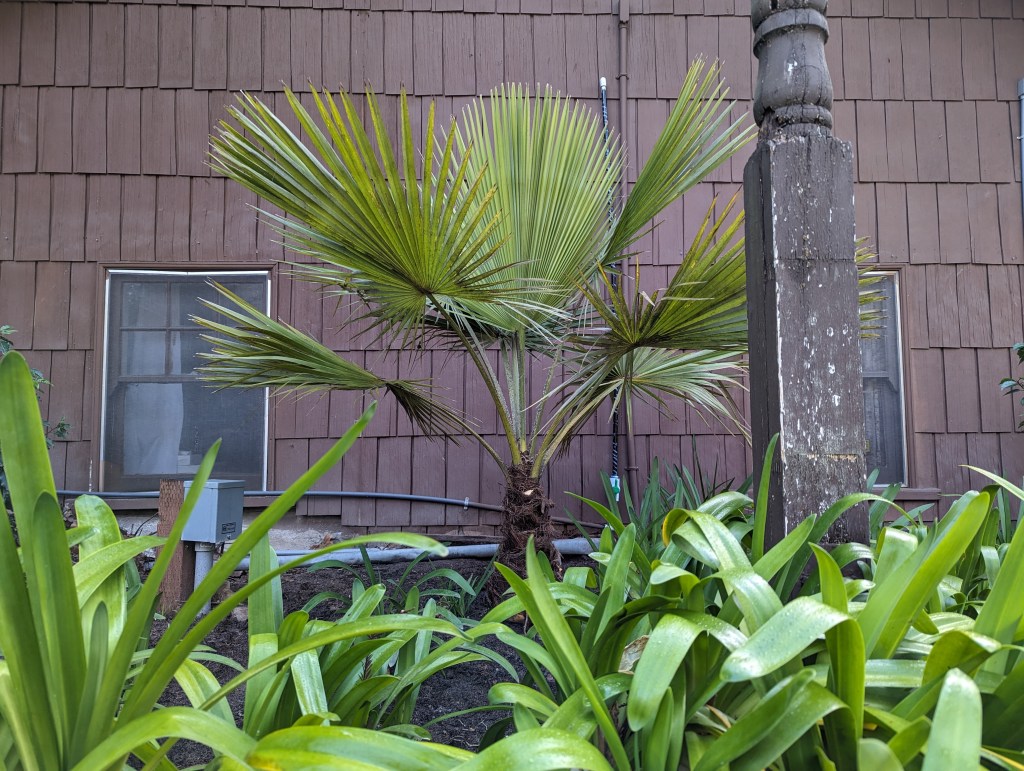
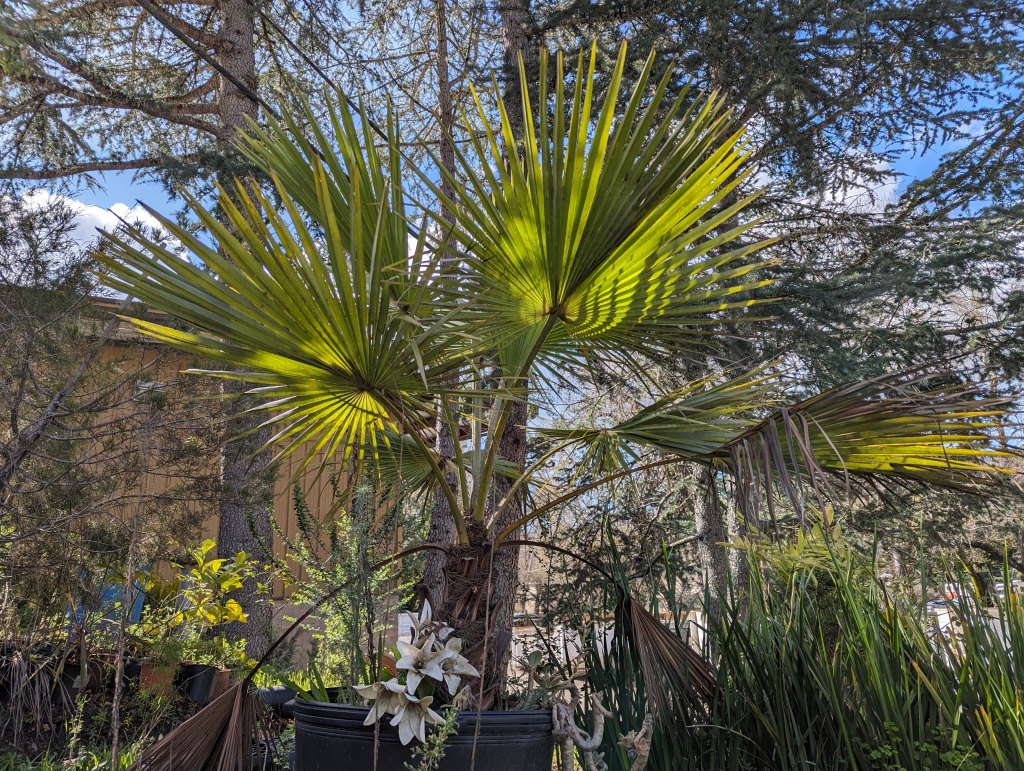
Palms spring up anywhere they want to. Only the fourth and sixth of my Six on Saturday are not feral. Incidentally, the last three are not my pictures; and Brent sent the last two. His curbside Mexican fan palm is at least one of the parents of my pair of seedlings here.

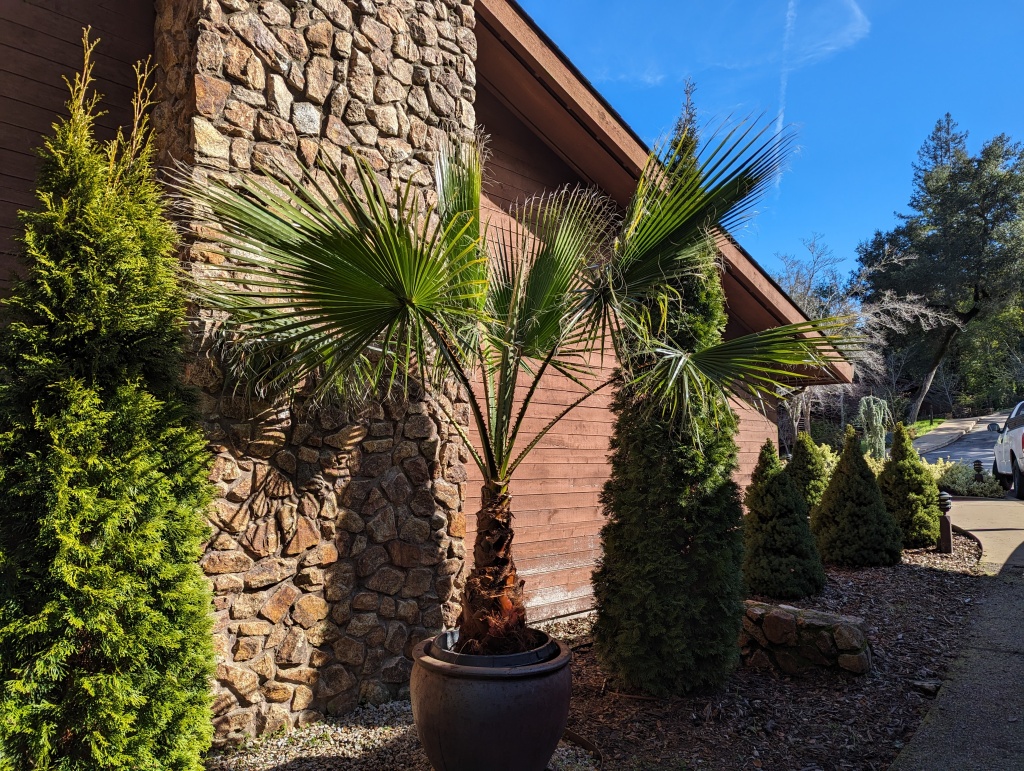
1. Washingtonia robusta, Mexican fan palm, which I wrote about earlier, was too pretty to stay in the recovery nursery where no one can see it. We put it here temporarily, until a pup from the Agave ovatifolia, whale’s tongue agave that bloomed and died here, gets large enough to replace it. It is canned within the big pot for ‘efficient’ removal, but is so heavy that I have no idea of how to get the can out of its pot. It will be a bit heavier later.

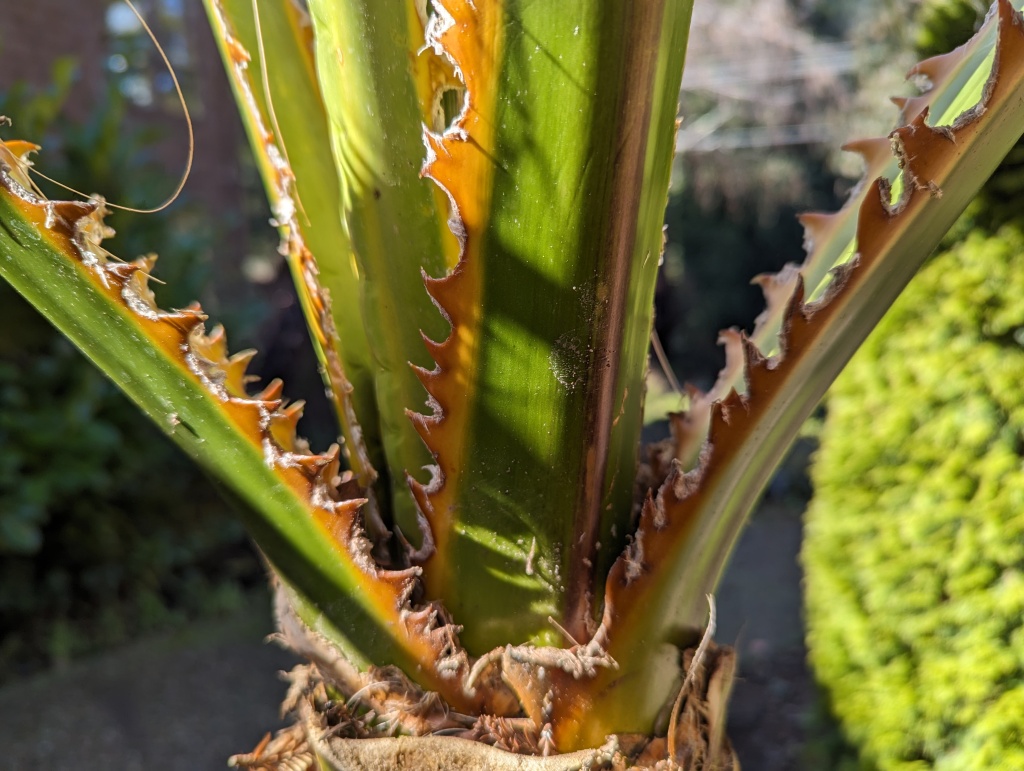
2. Wicked spines on its petioles contribute to the difficulty of relocating this heavy palm.

3. Trachycarpus fortunei, windmill palm is also too pretty to stay unseen in the nursery. It will also get groomed and relocated temporarily to a landscape next week. This young palm grew in the garden of the mother of childhood friends, so I am very protective of it.

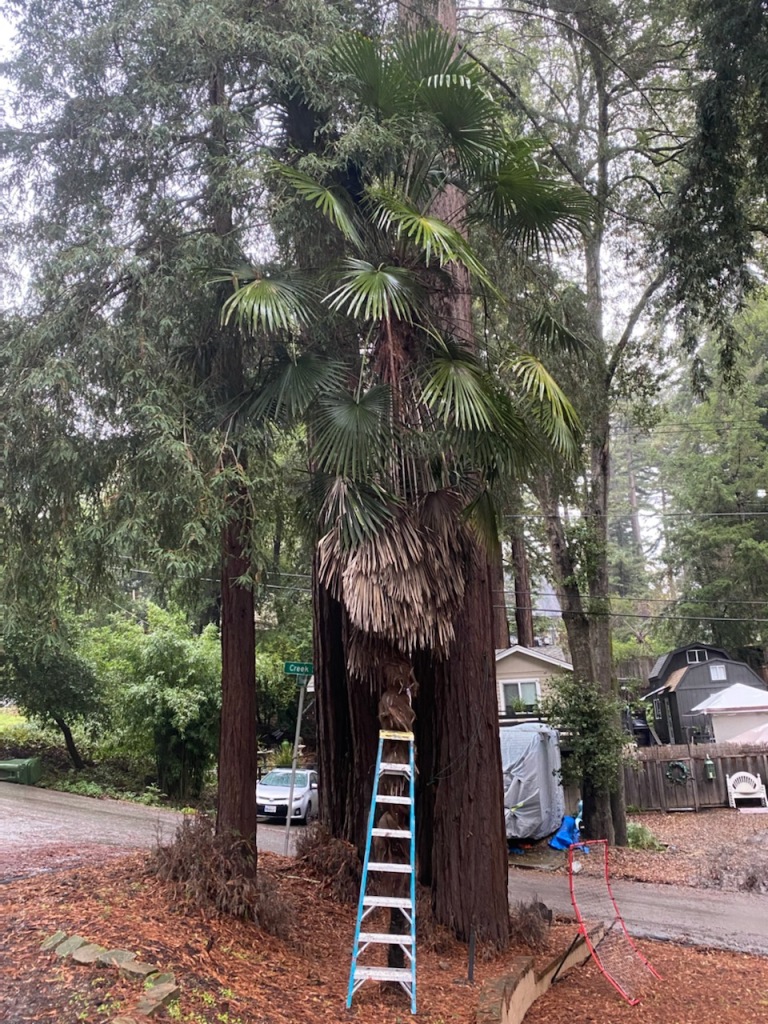
4. Palms and redwoods do not mix well. A colleague wants this windmill palm gone. It is about twenty four feet tall. That ladder is eight feet tall. It will be difficult to relocate, but I do not want it cut down and killed. Like the others, I have no idea of what to do with it.

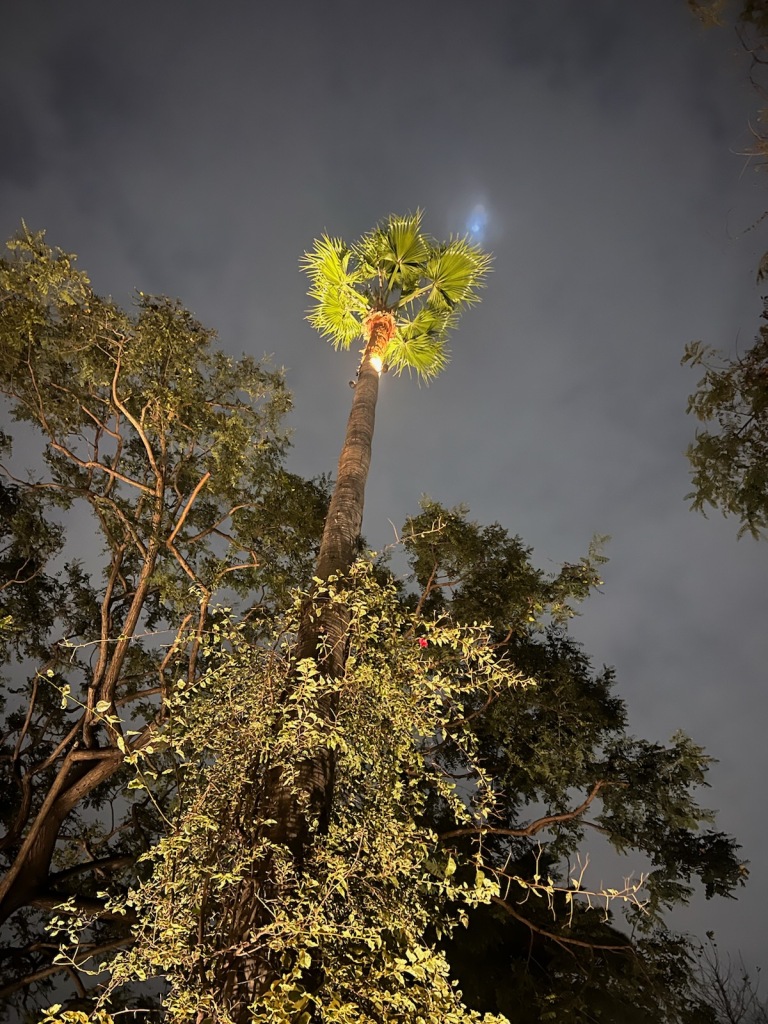
5. Brent’s curbside Mexican fan palm looks embarrassed with its silly uplighting. That is the moon above. This palm, which is a Memorial Tree for Brent’s brother, was about ten feet tall when relocated here because it grew under electrical cables several blocks away.

6. Bedford Drive, nearer to the original location of Brent’s curbside Mexican fan palm, is flanked by very old and alternating Mexican fan palms and Phoenix canariensis, Canary Island date palms. They were grandly uniform until the Canary Island date palms began to succumb to pink rot during the 1980s. The Beverly Hillbillies started their shows with a scene of their arrival in town on a similarly flanked street three blocks to the northeast.

This is the link for Six on Saturday, for anyone else who would like to participate: https://thepropagatorblog.wordpress.com/2017/09/18/six-on-saturday-a-participant-guide/

Horridculture – Weather

So close to ripening!

The weather here made national news on Sunday night. It was apparently quite a storm, with unusually windy wind. A few trees fell in the neighborhood. The roads were messy with debris. The electricity at home was disrupted. Otherwise, to me, it did not seem like a particularly bad storm. After all, this is winter.

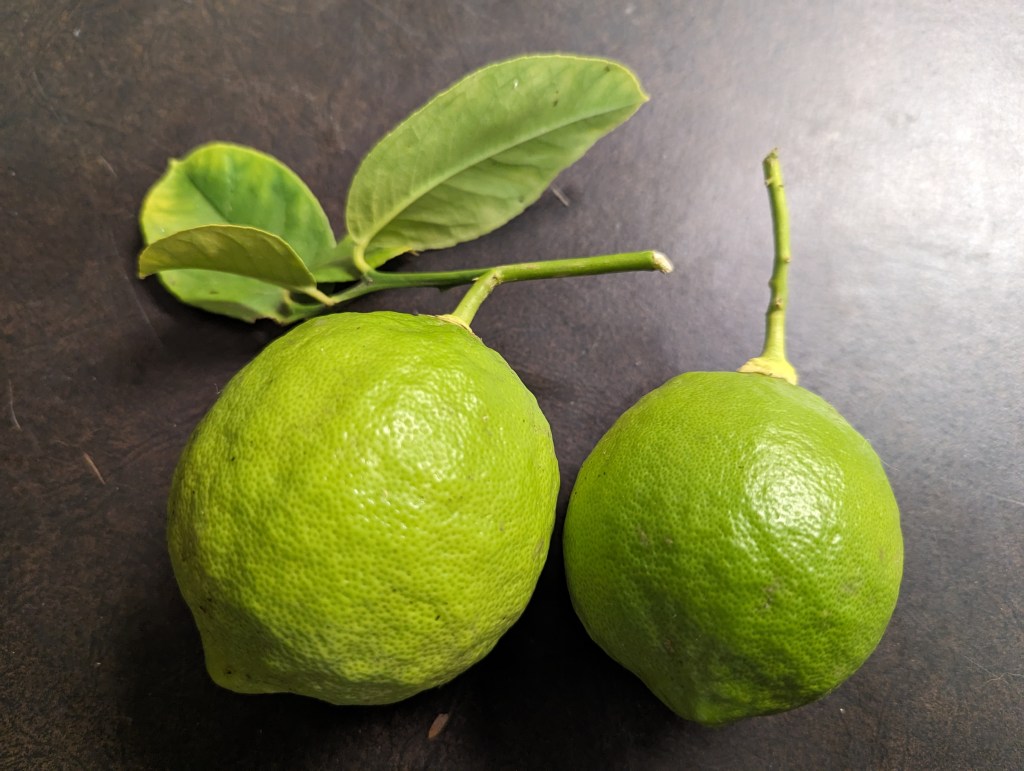
HOWEVER, on Saturday, even before the worst of the weather on Sunday, the wind knocked over my small ‘Ponderosa’ lemon, only a few hours after I posted a picture of one of its two developing fruit. It is a dinky tree in a #1 can, but its lemons are disproportionately large. As I mentioned on Saturday, I should have removed the lemons to divert resources to vegetative growth, but wanted to see if they would develop and ripen. The weather did it for me.

Now I am annoyed. I do not like to be one who complains about the weather. There is not much to complain about in that regard here. This is a pleasantly mild climate that lacks the sort of severe weather that other climates must contend with. The gust that blew over the small lemon tree was not nearly as strong as those that blew over trees within the surrounding forests and neighborhoods. I am just annoyed that after letting the lemons grow as much as they did, their effort will now be wasted.

The two lemons did not develop as they should have, but are still bigger than average ‘Eureka’ or ‘Lisbon’ lemons. I put them aside to ripen if they can. I doubt that they will. I can prune the small tree to remove the stems that had previously supported the two lemons, and make cuttings of them, to grow more small trees. Actually, I should have done this anyway.

1986

Since 1986 (or so)

This is no ordinary daffodil. I realize that it looks just like the daffodils that I posted a picture of two Saturdays ago, and it could actually be the same variety, but it is quite distinct. I acquired this particular daffodil in about summer of 1986. It could have been a year or two earlier or later, and might not have been summer. The foliage was not completely shriveled as it should have been during summer, but it lasts longer in the coastal climate that I took it from. I really do not remember when I acquired it, but I know that it was a long time ago, about the summer of 1986.

Although we have not been acquainted for as long as I have been acquainted with my paternal paternal great grandfather’s rhubarb and my maternal maternal great grandmother’s Dalmatian iris, both of which I acquired prior to kindergarten, we have significant mutual history.

I ‘borrowed’ several large clumps of bulbs from an abandoned flower field to the east of my Pa’s home in Montara. The clumps were very overgrown and very crowded, but still in their original rows, as they had been arranged for cut flower production many years prior. Shortly afterward, all of the other bulbs were somehow and seemingly pointlessly removed from the field by an excavator. A monster home was built on the highest part of the field, with a view of the field, which remained completely uncultivated afterward. No one knows how or why all the daffodil bulbs were removed so completely, but none were ever seen again. The naturalized field of daffodils seemed like it would have been an attribute to the home.

Over many years, the bulbs grew at most of the homes that I lived in, until the last few years, after I left the last of them at a former home in town. Then, after bringing a few roses here from my old rose garden at a previous home, I noticed that a few bulbs came with them. I thought that they were fancier daffodils, but now that this one bloomed, it is obvious that they are the familiar daffodils from Montara.

Ponderosa

‘Ponderosa’ for the Ponderosa

Citrus ripen through winter. This ‘Ponderosa’ lemon is taking its time, probably because it is still growing. Individual ‘Ponderosa’ lemons commonly weigh two pounds, and can potentially get a bit heavier than five pounds. That is heavier than some of Rhody’s chihuahua friends. I doubt that this particular lemon will get much larger than it is now, but it is already bigger than an average ‘Eureka’ lemon. It is about as big as a baseball.

The problem with this fruit is that it is on a tiny lemon tree in a #1 can. It is one of two fruits. I should not have allowed them to develop as much as they have. I should have removed them when they first appeared in order to divert resources into vegetative growth, rather than fruit development. Now that they grew this much, I sort of want them to finish ripening. It would be a waste to remove them now. After they ripen, I can prune their stems from the tiny tree, and process them as cuttings to grow more new trees.

I would like to install this little ‘Ponderosa’ lemon tree into a landscape at Ponderosa Lodge. Not only is its name appropriate, but the weirdly huge fruit might be interesting to the children who come to ‘Outdoor Science’ school there. Contrary to the huge size of its fruits, ‘Ponderosa’ lemon trees do not grow very large or very fast. However, a mature ‘Eureka’ lemon already inhabits the garden there, and we recently installed a ‘Bearss’ lime. Another lemon tree would redundant. We would prefer to grow a more edible citrus within the limited space that is available, such as a sweet orange, Mandarin orange or kumquat. For now, we will just enjoy this tiny lemon tree with its huge lemons right here.

Six on Saturday: Tree Circus

‘Crazy Great Ideas From Crazy Green Thumbs 6’ featured four sculptural tree specimens that had been relocated to Gilroy Gardens, which was formerly Bonfante Gardens, from the now defunct Lost World, which was formerly Tree Circus. While getting gasoline for Morgan in Scotts Valley, I stopped at the former site of Tree Circus for these six pictures. Not much remains to suggest that Tree Circus was ever there. Of these six pictures, only one shows real vegetation, which is a single London plane, Platanus X acerifolia, with a pair of trunks, which form an arch. (Incidentally, Crazy Green Thumbs sent me seed for poinciana and esperanza, which I featured for Six on Saturday almost two years earlier.)

1. Tree Circus Center now occupies the former location of Tree Circus, and subsequently, the Lost World. Progress can be so trivializing. Notice the emblem at the top of this sign.

2. The emblem depicts this last tree of the Tree Circus, which was a pair of trees that got grafted together and separated and grafted together. Notice the plaques to the lower left.

3. This upper plaque very briefly explains the history of Tree Circus and the Lost World, although without mention of what happened afterwards. Notice the other plaque below.

4. This lower plaque features illustrations of a few of the many sculpted trees of the Tree Circus, although woefully weathered. Notice the illustrations to the far right and far left.

5. This illustration to the far right shows the only other tree of the Tree Circus to remain at the site, although it is now gone. Notice the caption, ‘Protected for future generations’.

6. This illustration to the far left shows one of the Tree Circus trees that was exhibited in the context of ‘Crazy Great Ideas From Crazy Green Thumbs 6’ by Crazy Green Thumbs.

This is the link for Six on Saturday, for anyone else who would like to participate: https://thepropagatorblog.wordpress.com/2017/09/18/six-on-saturday-a-participant-guide/

Inner Beauty

This is an exemplary specimen of Juniperus chinensis ‘Kaizuka’, Hollywood juniper

Juniperus chinensis ‘Kaizuka’, Hollywood juniper is one of my favorite junipers. The few North American junipers that I prefer more are not as appealing for prominent positions within refined landscapes. Hollywood juniper is distinctly sculptural with its strikingly gnarly form. The dense, finely textured and deep green foliage contrasts stylishly with the more coarsely textured and rusty reddish brown bark. Whether a large shrub or a small tree, properly groomed Hollywood juniper can be an elegant trophy tree.

The illustration above is from my ‘Six on Saturday’ post from two weeks ago. It shows one of the largest specimens of Hollywood juniper that I have ever worked with. Initially, I pruned it for clearance from the roof and parking spaces that it extends its canopy over. I also thinned it somewhat. I intended to elevate and thin it a bit more this year or next.

Instead, it became firewood. Sadly, it grew too big and obtrusive for its situation. One of its large roots was displacing the asphalt pavement of the parking spaces in front of it. Another was beginning to do the same. It was very saddening to see it dismembered and processed, as the foliar canopy was discarded to compost into the forest, and the trunk and limbs were taken to a woodpile.

Even as firewood, it retained unique beauty. The illustration below shows the contrast of the red heartwood and blond younger wood within the interior of the gnarly trunk. If it resembles the interior of a cedar chest, it is because it is related to the Juniperus virginiana, Eastern redcedar, which is the cedar within cedar chests (but is not actually a real cedar). Although not visible within the illustration, the woodsy aroma of the exposed wood is very similar to that of a cedar chest.

Even its firewood is appealing.

Proof of Seasons

Daffodil bloom here as if they were in the Pacific Northwest.

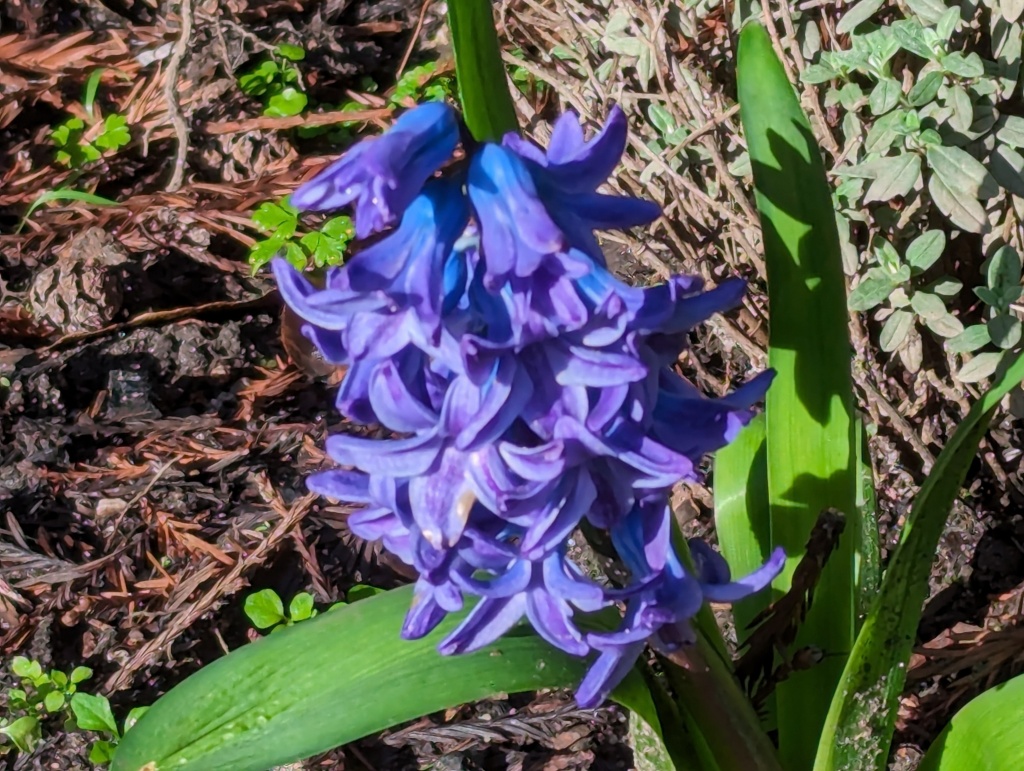
Narcissus make me wonder. Both paperwhite and common daffodil, as well as a few fancier daffodil, bloom here as if they were in a climate that is more conducive to such performance. The happiest naturalize and slowly multiply. Not many bulbs do so where winter weather is so mild. That is why I do not bother with tulip or hyacinth, although a few hyacinth have also been performing reliably here for many years.

Peony is very marginal here. I know that they perform inexplicably well for some neighbors, but none have ever done well for me. I really do believe that they prefer more chill than they experience here. Realistically, winter weather is relatively mild here.

Yet, I am not convinced that it is as mild as I have always believed it to be. Some who are unfamiliar with California believe that we experience only two seasons, which are summer, and a few days annually that are not summer. I know better. No one argues that the warm and dry summers here last longer than elsewhere. Prior to summer though, spring is likely comparably to spring within other climates. After summer, autumn, although mild, is cool enough to initiate autumn foliar color. Then, winter is cool. Really, it is cool enough for deciduous species to defoliate, and for mild frost. It may not get as cold as it does in other climates, but how cold does it need to be to qualify as winter?

I am satisfied with the winters here. I can grow all of the deciduous fruit trees that I want to grow. This is one of the best climates in the World for roses. These daffodils seem to be quite satisfied as well. In fact, they sometimes stay dormant later here than in climates with cooler winters!

Six on Saturday: Plugging Along

Agapanthus orientalis, lily of the Nile and Osteospermum ecklonis, African daisy are all there is to my Six for this Saturday. Lily of the Nile is in the first three. African daisy is in all but the first. Both are in the second and third. Both are from South Africa. Both have been getting recycled from where they are migrating a bit too much, and getting plugged into more appropriate situations. It is nursery production directly within the landscapes where the finished products are desired. Processing African daisy cuttings and lily of the Nile shoots takes time, but is still less expensive than purchasing nursery stock. They are byproducts of our normal landscape maintenance.

1. Gophers are killing fewer lily of the Nile than they killed last year. I must plug some of the spare shoots from last Saturday here though. Gophers ate the thick rhizomes below.

2. African daisy is performing as well as the majority of lily of the Nile in this landscape. It migrates nicely, but also encroaches somewhat into the adjacent row of lily of the Nile.

3. Edging is now necessary to separate the African daisy from the lily of the Nile. The lily of the Nile should grow to become too dense for the African daisy to encroach next year.

4. Some of the pruning scraps of the African daisy had already developed roots, as if they belong there. Their roots can be useful somewhere else. These scraps became cuttings.

5. Remaining stems are generating axillary growth for this year. We should apply a layer of compost over the stems to hold some against the soil so that they can develop roots.

6. Pruning debris from the African daisy was processed into unrooted cuttings that were plugged wherever we wanted more African daisy. They will develop roots prior to spring.

This is the link for Six on Saturday, for anyone else who would like to participate: https://thepropagatorblog.wordpress.com/2017/09/18/six-on-saturday-a-participant-guide/