Silver Lining

P00614-1
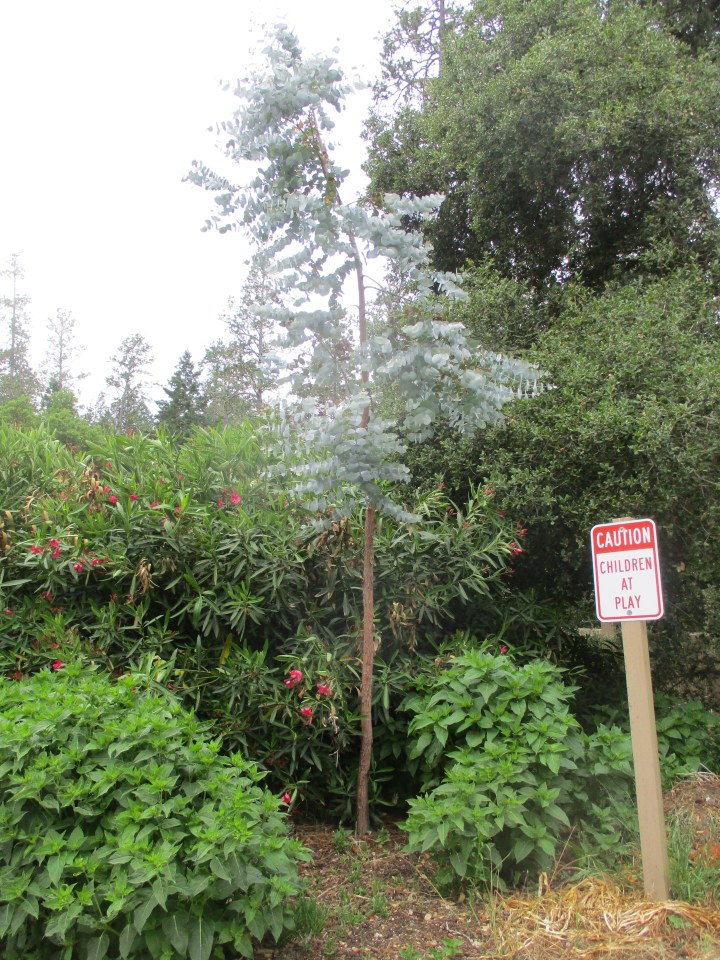
This little silver dollar tree did well with a second chance.

Among the more than seven hundred species of Eucalyptus, nomenclature gets confusing. It certainly does not help that some species have multiple common names. Eucalyptus cinerea is a rather distinctive species with at least two equally distinctive common names. The problem with these names is that, although sensible in Australian, they are not so sensible to Californians.

‘Mealy stringybark’ is a name that must describe something of the physical characteristics of the species. The bark is rather stringy, but no more stringy than that of so many other species. The glaucous foliage might be described as mealy in Australian English. ‘Argyle apple’ is a weirder name. Again, it must make sense in Australian culture. I just know it as ‘silver dollar tree’.

A few years ago, I acquired a severely disfigured and overgrown #5 (5 gallon) specimen of silver dollar tree, along with three comparable specimens of dwarf blue gum, Eucalyptus globulus ‘Compacta’. They were about to be discarded from the nursery where I found them. They got canned into #15 cans, and coppiced back to their distended lignotubers. All regenerated nicely.

Two of the blue gums found appropriate homes. One remains here, and was coppiced again last year. The silver dollar tree stayed late too, but happened to get planted into a landscape last autumn. It is developing into such an appealing tree that one would not guess that it had experienced such neglect and subsequent trauma. The exemplary silvery gray foliage is so healthy.

As it regenerated after getting coppiced, the strongest of the new stems was bound to a stake to form a single straight trunk. All smaller basal stems were pruned away after the first season. The little tree cooperated through the process, and now lives happily ever after. I still do not know its name.

P00614-2
Silver dollar tree produces strikingly silvery foliage.

Wasps!

P00613K
Dead wasps are the best wasps.

Wasps, hornets and yellow jackets that get established within landscapes or buildings are a serious problem. They are not so easily avoided like those out in the wild are. They are aggressive to people and pets who get too close to their nests, and attack with painful stings. Such behavior is unacceptable within the publicly accessible landscapes at work.

There are a few species of wasp, hornet or yellow jacket here. We do not get sufficiently acquainted with any of them to actually identify them. Our priority is eliminating as many of them as possible from the landscapes. Some get trapped. Others get evicted from the few nests that we locate. It is unpleasant work, but it is better than others getting stung.

Wasps, hornets, yellow jackets, or whatever they are, become more of a problem later in summer. They are just getting started for now. We were surprised to find two subterranean nests in a landscape that is in the process of being cleared for renovation. More surprisingly, they were only eight feet apart. Whomever they were, they should have been more territorial than that.

Since they are just getting started, there were not very many to get aggressive when we got too close to them. There were scarcely enough to follow as they entered and emerged from their nests. They were surprisingly easy to kill. The first nest was quite small. The second nest was a bit more concerning. We dug both out as the last few visible insects were dying.

The picture above shows a few waffle-like layers of the larger nest. Empty cells were likely left by the adult insects that were flying about and trying to defend the nest. Other cells are full of larvae that would have matured to many more of the same!

Six on Saturday: Bark


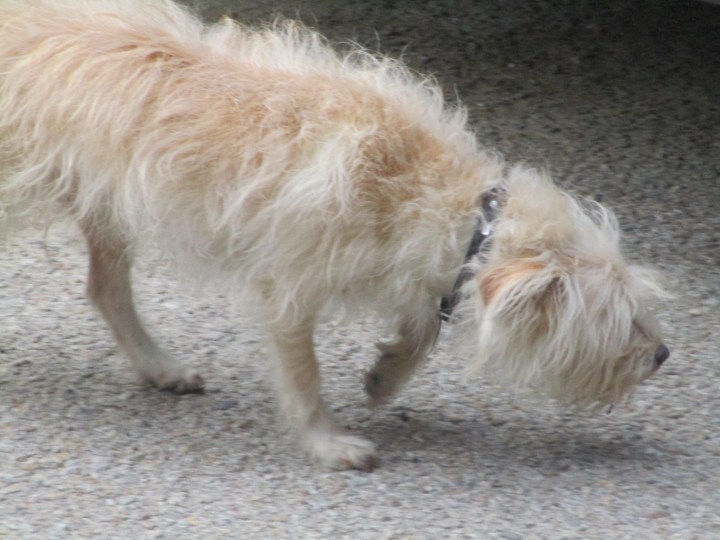
Rhody said, “Cornus florida bark is rough.” He likely intended to say, “Dog would bark, ‘ruff!’.”

This is not about Rhody though. It is about these six pictures of bark of some of the more significant trees that I work with. All are native here. Only the sycamore was installed intentionally into a landscape. All of the others grew wild. There are so many interesting trees here that it was not easy to limit these pictures to just six. I actually took more pictures that were omitted.

Furthermore, a picture of Rhody is not included.

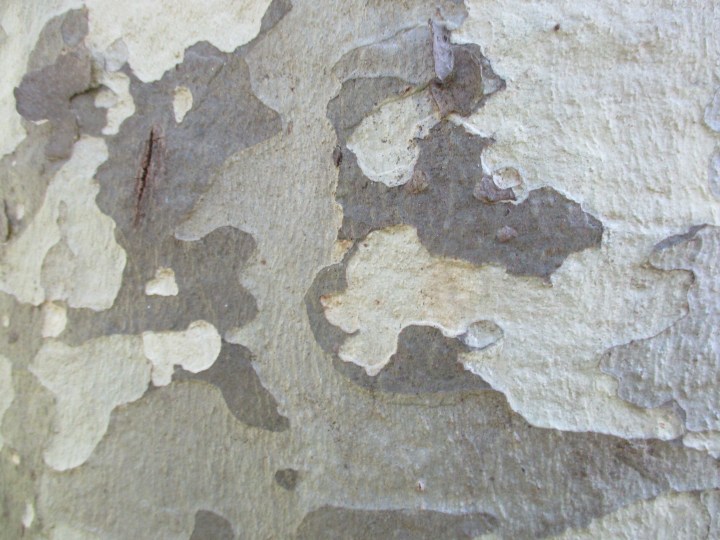
1. Platanus racemosa – California sycamore is bigger and bolder than other American sycamore. Trunks of mature trees are massive and gnarled, with this distinctively blotchy gray bark.P00613-1

2. Pinus ponderosa – Ponderosa pine is the grandest of pines. The massive trunks seem to be comparable to those of Douglas fir. Bark often flakes in bits that resemble jigsaw puzzle pieces.P00613-2

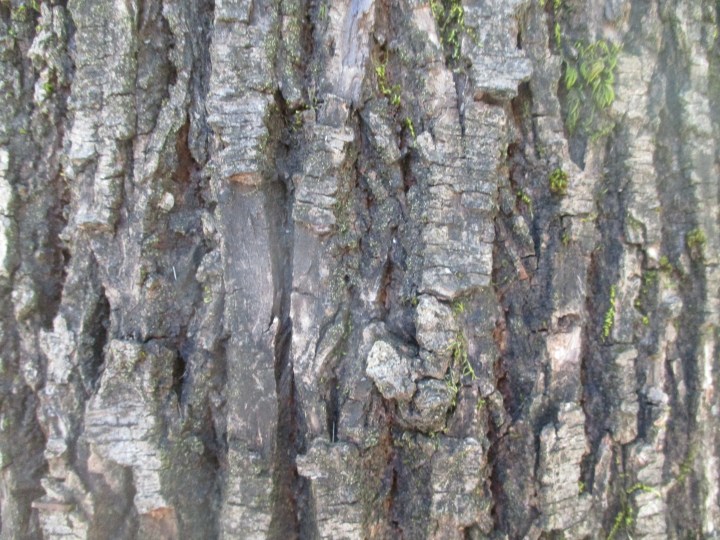
3. Quercus agrifolia – Coast live oak is second only to valley oak in regard to grandeur. Unlike valley oak, it is evergreen. Smooth gray young bark eventually becomes darker and furrowed.P00613-3

4. Pseudotsuga menziesii – Douglas fir is the majestic State Tree of Oregon, and a main timber crop there. Locally, it mixes with various ecosystems. Corky bark is rather finely furrowed.P00613-4

5. Acer macrophyllum – Bigleaf maple is the most imposing maple of the West. As the name implies, the leaves are bigger than those of any other maple. Bark gets sort of checked with age.P00613-5

6. Sequoia sempervirens – Coastal redwood is the grandest of all, and it happens to be the tallest tree in the World. Also, it is the state tree of California. The ruddy bark is distinctly fibrous.P00613-6

This is the link for Six on Saturday, for anyone else who would like to participate:

https://thepropagatorblog.wordpress.com/2017/09/18/six-on-saturday-a-participant-guide/

Post Script: For the first time, I am violating the recommended limit of six pictures to include this extra (but unnumbered) picture of Rhody for those who would be otherwise disappointed.P00613-7

Horridculture – Spruce Up

P00610
Even Charlie Brown would reject this little blue spruce.

No one wants to cut down this little blue spruce. What is worse is that no one wants anyone else to cut it down either. We all know it is ugly. We all know that it can not be salvaged. We all know that it really should relinquish its space to the healthy and well structured coast live oak next to it, in the lower left of the picture. Yet, it remains.

It was planted amongst a herd of gold junipers in about 1980 or 1981, shortly after the construction of the adjacent buildings. An abandoned irrigation system indicates that it was likely irrigated for some time afterward, although it is impossible to know for how long. Otherwise, it and the junipers were completely ignored for the last four decades.

When the vegetable garden was installed nearby, brambles, weeds and trash that had been accumulating for forty years was removed from the area. A few of the most decrepit junipers that were not worth salvaging were removed too. The young and feral coast live oak that grew next to the spruce should have been removed as well, but is actually in very good condition.

Furthermore, the coast live oak is a better tree for the particular application. It is native, so does not mind neglect. The spruce was never really happy there, which is why it is so puny and disfigured now, with the lower two thirds of the trunk bare of limbs and foliage. Obviously, the spruce should be removed so that the oak can continue to develop as it should.

We just like the spruce too much to remove it directly. Even though it would look silly if the bare trunk were exposed by the removal of the oak, the bit of foliage on top is so pretty and blue and familiar. I mean, it looks like we have a spruce in the yard; and everyone likes a spruce!

The plan is to subordinate it to the oak. As the oak grows upward and outward, the lower limbs of the spruce will be pruned away to maintain clearance. Eventually, the spruce will look so silly that the landscape would look better without it, and we will not mind cutting it down so much. It will be unpleasant, but it will be better than interfering with the development of the oak.

Dago Wisteria

P00607
All this bloom will eventually be fruit.

My colleague down south and I have completely different gardening style. He is a renowned landscape designer, so his home garden is as elaborate as the landscapes he designs for his clients. I am primarily a farmer of horticultural commodities, so my home garden is very strictly utilitarian, with few items that are grown just because they are pretty.

My colleague’s garden is outfitted with a very well built pergola over the patio at the rear of the home. Six common Chinese wisteria were installed to climb the six supporting post and sprawl above. Their cascading spring bloom is both spectacular and alluringly fragrant.

Of course, when I saw that pergola while the wisteria were still young, I thought that it would be ideal for Dago wisteria, which most of us know simply as grapes. They climb like Chinese wisteria. They bloom with somewhat pendulous floral trusses that . . . sort of resemble wisteria bloom. Although they lack color and fragrance, they provide an abundance of fruit.

Now I get to work with some real Dago wisteria. It was planted years ago by someone who did not stay to maintain it. It got rather overgrown and gnarly before I pruned it into submission. Without a pergola, I extended vines from the rail fence that the main vines climb, over to a banister on the upper floor of an adjacent building. It works something like a pergola.

Because I do not know what cultivar of grape the vine is, I do not know what pruning technique it prefers. I happened to leave long canes last winter, just because they reached the banister on the opposite side so well. Now, the bloom is so profuse that I am concerned about the weight of the subsequent fruit pulling the rail fence over!

Hieroglyphs

P00606K
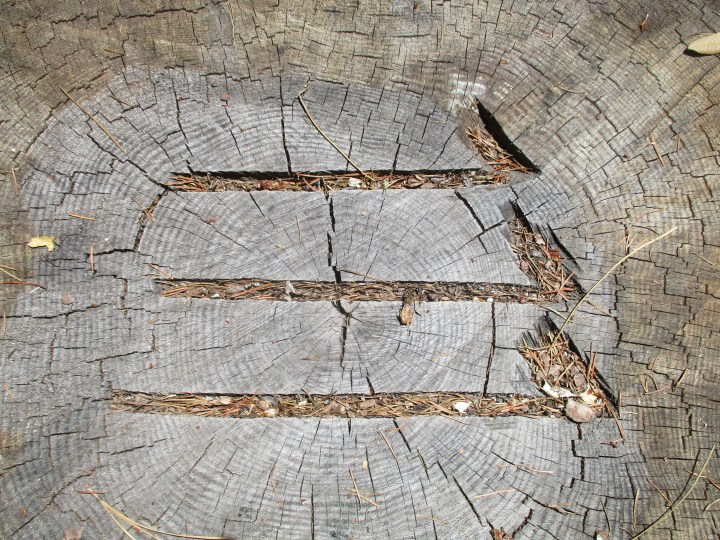
“111”? . . . “777”? . . . “TTT”? . . . “LLL”?

What does this mean? Is it ‘111’ deprived of the lower serifs? Is it ‘777’ with abbreviated arms? . . . ‘TTT’ lacking right arms? . . . ‘LLL’ with abbreviated legs? Is it pointing toward something important? Is a hieroglyph from an ancient language . . . or a language that has yet to be invented?! Is it like a miniature crop circle pattern cut into wood by Sasquatch or extraterrestrials?!

The arborist who left it here after cutting down the deceased ponderosa pine that formerly stood where this large stump remains might be amused to read that I contemplated it so intently. Actually, I did not really contemplate it so much. I only wrote about it as if I did because it is amusing to do so. I have no idea what this hieroglyph represents. I know that it is not important.

I have worked with enough respectable arborists to know that some of them prefer to leave their distinctive marks on the stumps of some of the impressively large trees that they cut down. In many of the suburban regions in which I work, most of such stumps get ground out shortly afterward. In the forested rural area here, such stumps remain until they rot and disintegrate.

On rare occasion, I encounter a familiar hieroglyph or the initials of a respected colleague. Now that we are as old as we are, familiar hieroglyphs are increasingly rare. Arboriculture is for the young. I sometime wonder about those who leave unfamiliar hieroglyphs. To me, the continuation of the tradition seems to indicate that they enjoy their work as much as my colleagues did.

That is important in horticultural industries. There are few in society who understand the appeal. We do what we do because it is what we enjoy.

Six on Saturday: Leftovers


It is not easy to discard seedlings and cuttings that have potential. We are supposed to sow several seed for vegetable plants where we ultimately want only a few, which typically produces a few extra. Feral seedlings for other types of plants commonly appear in the garden. I happened to grow a few seed that were marginally old, but that I did not want to discard. Nor do I want to discard deteriorating but lingering cool season annuals from last winter.

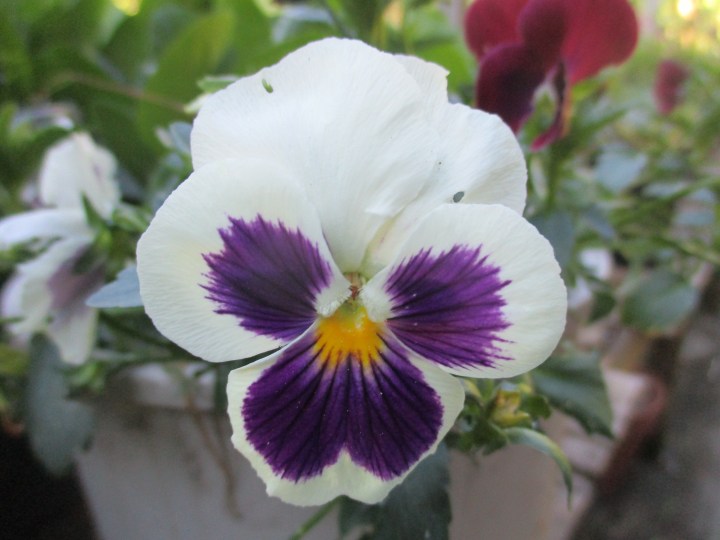
1. Since no new warm season bedding plants are going into the landscapes, cool season bedding plants are lingering until they succumb to the warmth. This pansy is not ready to give up yet.P00606-1

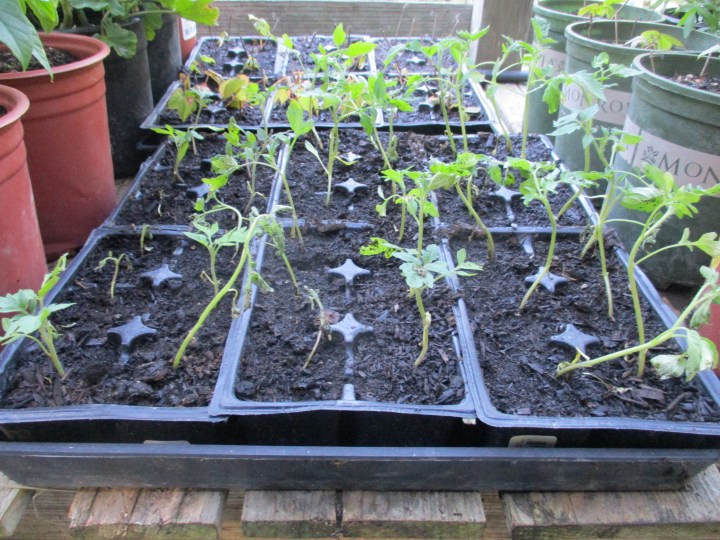
2. ‘Roma’ tomato seedlings that got plucked to favor stronger seedlings got plugged in cells for later. They got sown very late, and plugged even later, but might become a nice second phase.P00606-2

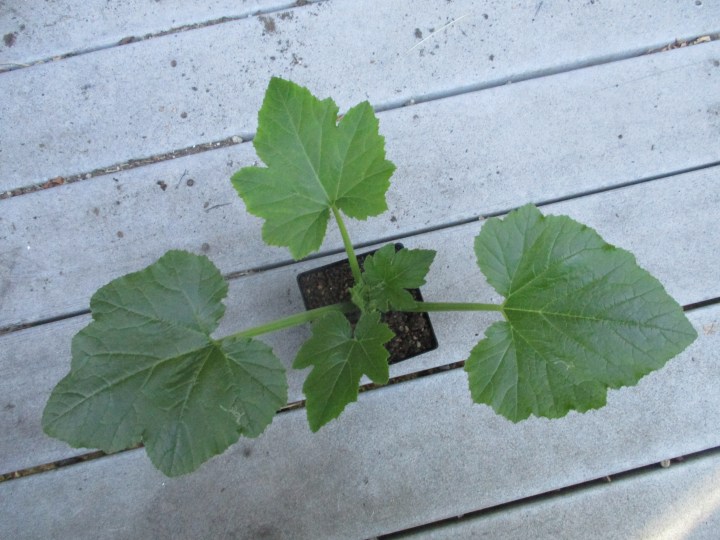
3. Extra summer squash seedling were also too good to discard. The main plants are producing now. This one should find a home quick. Since it can produce all season, no phasing is needed.P00606-3

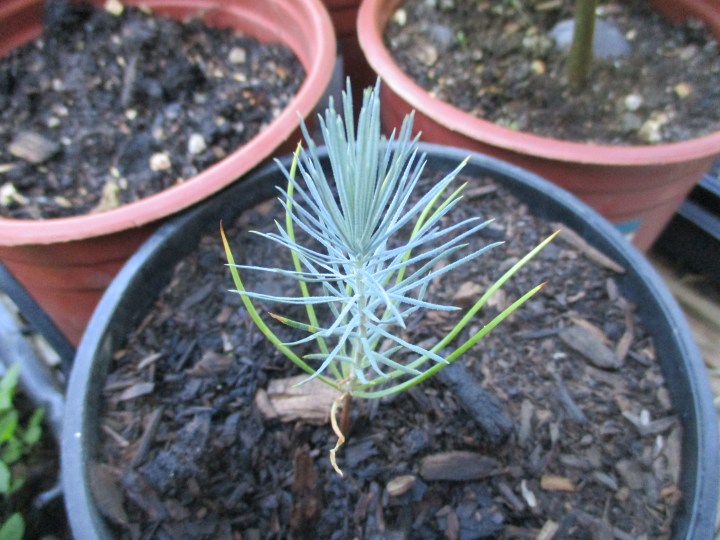
4. Ponderosa pines make extras too. This seedling got plucked along with other weeds, but was too exemplary to discard. (For the record, someone else salvaged it; so I can not be blamed.)P00606-4

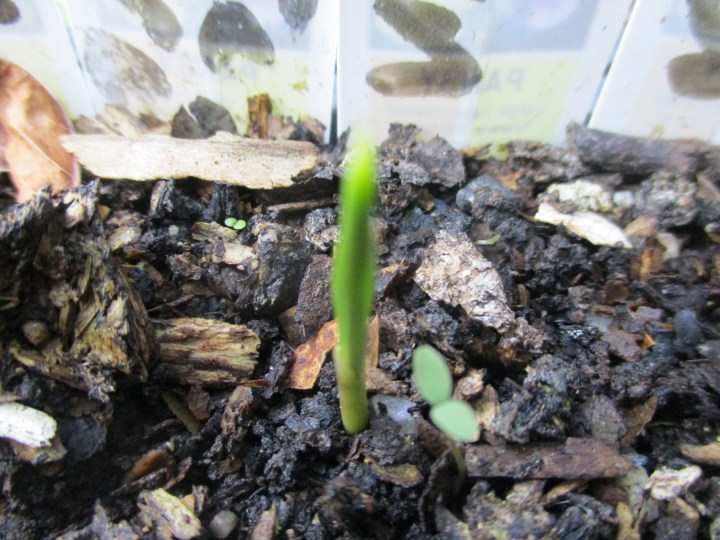
5. This is too blurry and dinky to look like much, but is a seedling of California fan palm. The seed was so old that I doubted its viability. I am very pleased with it, even if is the only survivor.P00606-5

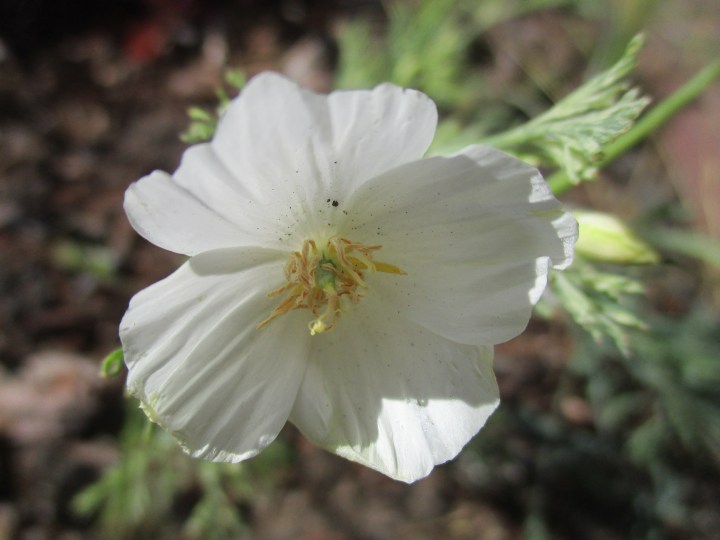
6. White California poppies are rare in nature. This one was left in the landscape while many of the orange poppies were removed along with weeds. There is another only a few yards away.P00606-6

This is the link for Six on Saturday, for anyone else who would like to participate:

https://thepropagatorblog.wordpress.com/2017/09/18/six-on-saturday-a-participant-guide/

Horridculture – Neglected Seedling

P00603-1
They are so cute when they are young.

This was not planned very well. Actually, it was not planned at all. While sorting through the seed for a vegetable garden, I found a can of seed for winter squash that was a few years old. They might be close to five years old. I really do not remember. I did not expect them to be viable, but did not want to discard them without at least trying to test them for viability.

Rather than just put them in damp rag for a few days, I plugged a few seed into a spider plant on a windowsill, and forgot about them. I really did not expect to see them again. When the first one emerged, I though it was a weed, so plucked it out. When I realized what it was, and that it came out intact, I felt badly for it, and like the original seed, could not discard it.

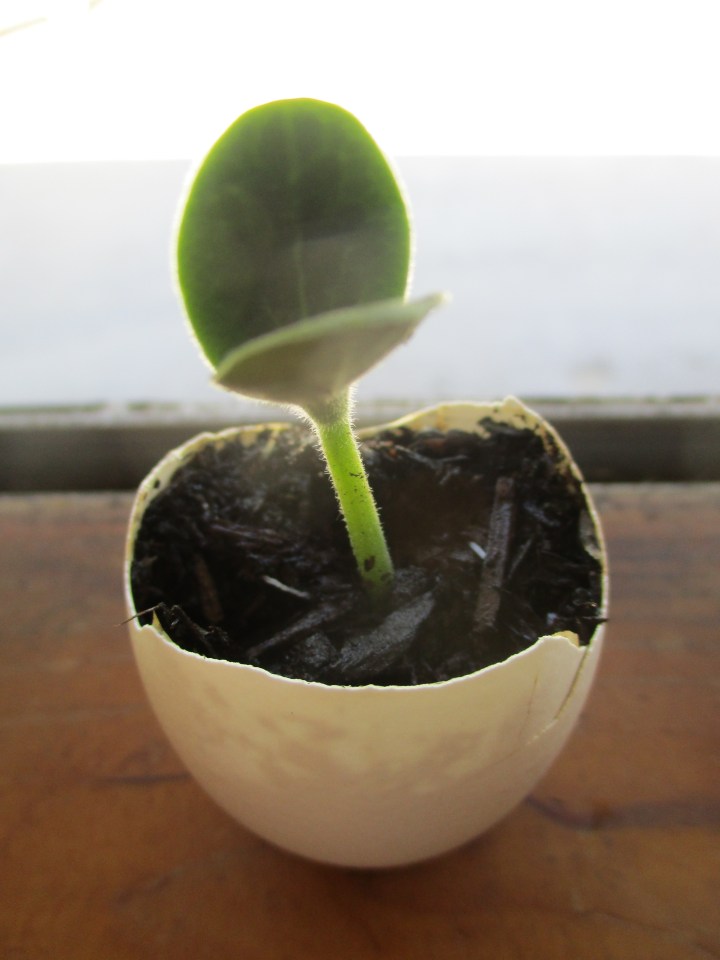
I do not remember why, but at the time, I did not want to go out to can it in a real pot. Nor did I want to plug it into the garden while I was still getting other seed situated. I therefore planted into an empty eggshell from those drying for coffee. I scraped a bit of medium from a potted bromeliad. It was happy on the windowsill for maybe a few weeks.

The other seed germinated too, but were more carefully removed and plugged into the garden. Since the seed was still viable, I sowed more around the junipers outside. Somehow, in the process, I neglected to put the little seedling in the eggshell out into the garden with them. It has not been happy in here, so has not grown much at all.

Now that the winter squash are already growing well outside, and the summer squash are already producing, this unfortunate seedling still needs to go out to join them.

If I were to grow seedlings inside again, I would do so in some of the cell packs that we recycle from work. They are more efficient, less wobbly, and they do not look so ridiculous.

P00603-2
Now it wants out!

Riots

P80204
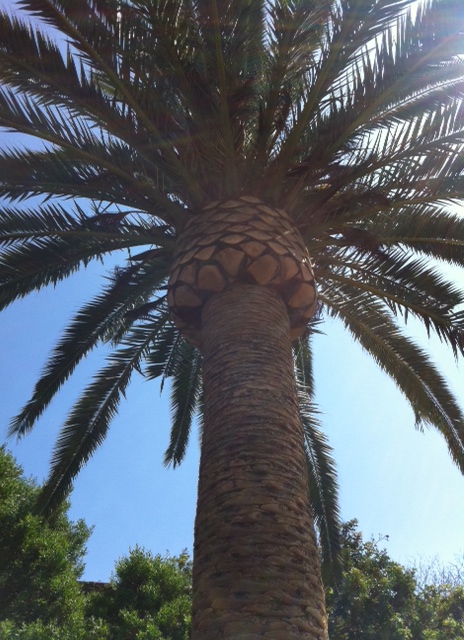
This is one of the several Canary Island date palms that Brent Green saved from poachers on the embankment of the Santa Monica Freeway.

Since I began posting my gardening column articles here, and supplementing with blog posts, I have deviated from horticultural topics only a few times. I will now do it again. I had earlier selected a horticultural topic for this post. It will wait for now.

Brent Green, my colleague down south, called me on the telephone to tell me to watch the news. I did so, but only briefly. It was just too crazy. So far, I have made a point of saying nothing about Coronavirus. I said nothing about those who protest the violation of their right to spread disease that will kill others. I mentioned nothing about the racist murderers in Minneapolis.

Now I see that people are senselessly rioting and looting in several cities in America.

The office building of the Canyon News, one of the newspapers that I write for, was clearly visible in the background as police helicopters showed looting of stores on the historic Rodeo Drive in Downtown Beverly Hills, in the region of Los Angeles. Police cars and palm trees were burning. From three hundred and fifty miles away, I can see it online.

This is not demonstration or protest. It is looting. It is mere opportunistic thievery. Those involved are not at all concerned about social justice, their own Communities, or that Black Lives Matter. They are exploiting an already bad situation to plunder what they can get away with.

This is happening in the Community where Brent Green has been planting his Birthday Trees (in quantities that corresponds to his age at the time) in public spaces for the past twenty two years. This is near where Brent Green saved several Canary Island date palms on the Santa Monica Freeway from poachers. This is a region that many people care about.

Six on Saturday: Timber! II


Horticulture is not all flowery. It includes arboriculture, which is the horticulture of trees. As both a horticulturist and arborist, I get t0 work with it all. Not only do I work with arboriculture, but I get to work part of the time in forests of coastal redwoods, which are the tallest trees in the World. Compared to these redwoods, Douglas firs are rather average.

1. At about noon on May 7, this big Douglas fir fell unexpectedly. Since it was not cut down intentionally, no one actually yelled “Timber!”. This picture is recycled from a post from May 10.P00510-1

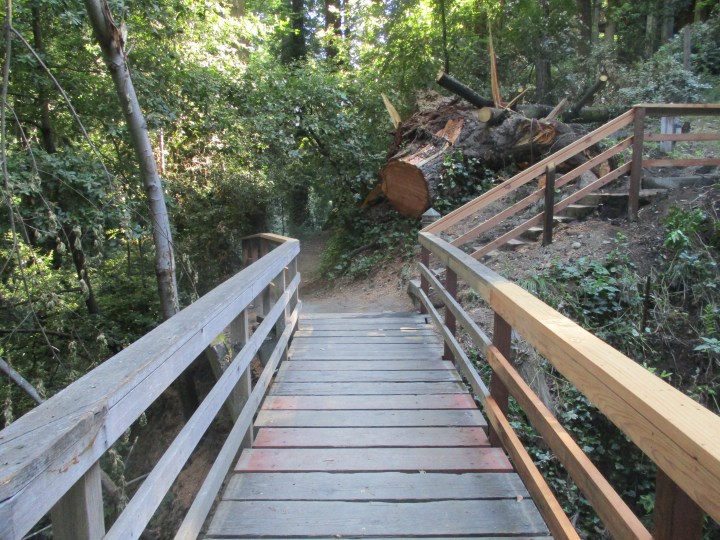
2. This is what it looks like now. Even though a bay tree fell on top of the Douglas fir and bridge after the picture above was taken, damage was minimal. Parts of the banister were replaced.P00530-2

3. The Douglas fir was less than eighty years old. It started growing here in the early 1940s. My grandparents might have met it when it was a baby. By the way, I did not count all the rings.P00530-3

4. The carcass of the Douglas fir is now more than twenty feet below. The light brown chips to the upper left are from the top of the tree that needed to be cleared from an adjacent roadway.P00530-4

5. This unfortunate maple really was an exemplary young specimen before it got clobbered by the big Douglas fir and bay tree. Not only are the limbs stripped off, but the trunk is fractured.P00530-5

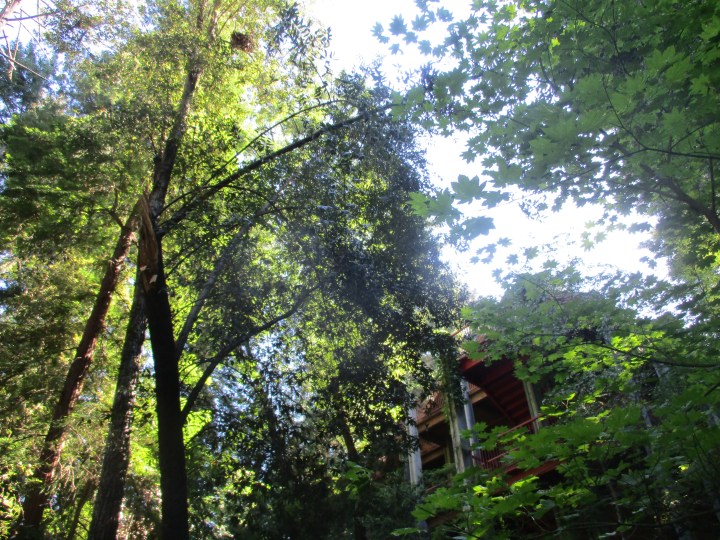
6. The third trunk from the left is what remains of the bay tree that was leaning on the Douglas fir, and then fell on top of it. The top limb extending to the right is now about to break too.P00530-6

This is the link for Six on Saturday, for anyone else who would like to participate:

https://thepropagatorblog.wordpress.com/2017/09/18/six-on-saturday-a-participant-guide/