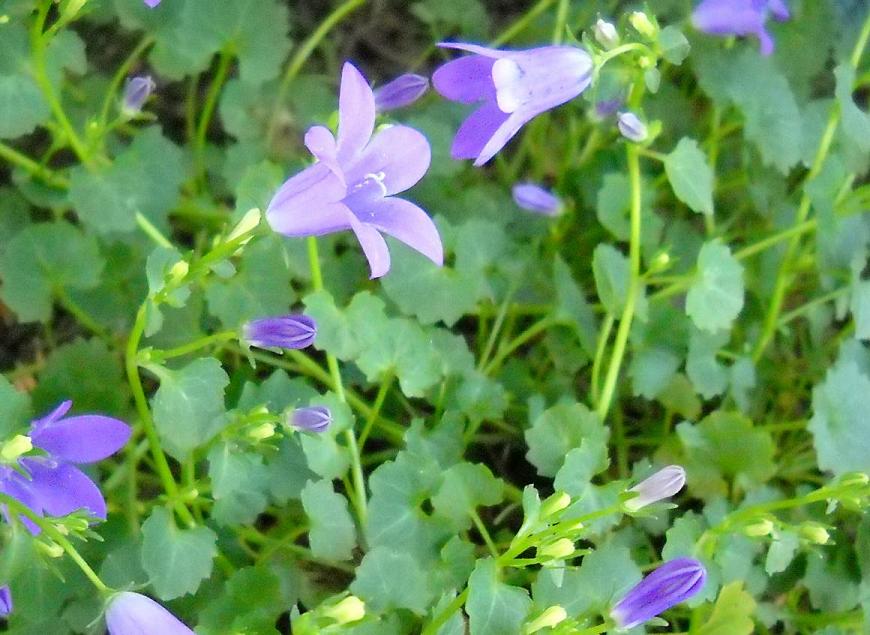
Many home garden Campanula are easier to identify by cultivar name than by species.
Of the hundreds of varied Campanula (Campanula spp.) that can be found in the wild, almost all of the few grown in gardens are small scale ground covers or creeping perennials, with blue or white bell or star shaped flowers. Most campanula fill in nicely between clumping perennials, and will spread wherever they have other plants or features to shelter them, although they are rarely reliable as ground cover for exposed areas. Campanula can be grown from seed, but is easiest to propagate by division. Pieces trimmed off from around the edges or pulled out of shrubbery also root very easily.
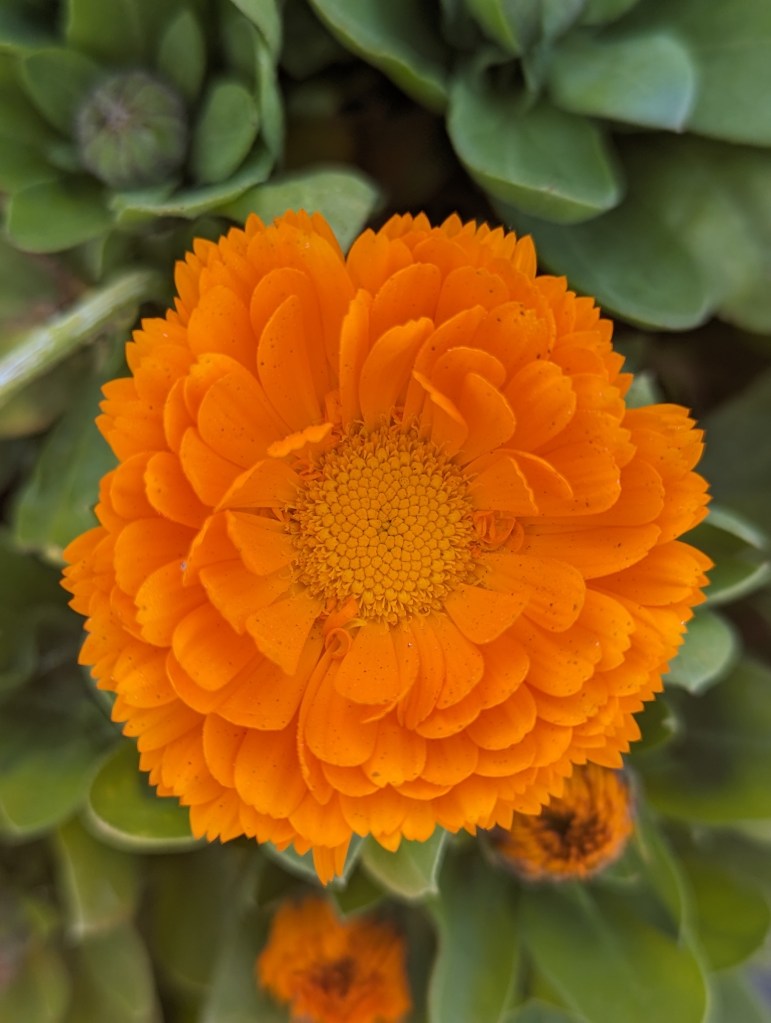
French marigold is one of the most popular annuals of autumn. Pot marigold, Calendula officinalis, provides similar color with daisy like flowers. Most are bright orange or yellow. They lack only the warm burnished red of French marigold. They compensate with more variety of their pastel ranges. Their single or double blooms are two to three inches wide.
Within cooler climates, pot marigold blooms between spring and late autumn frost. Here, it blooms better through mild winters, with only minor pauses for any mild frost. It is more likely to dislike summer warmth. Like many seasonal annuals, it can technically grow as a short term perennial. However, also like others, it performs best for a particular season.
During their season, taller varieties may grow a bit higher than two feet. Most are shorter. Their oblong and slightly fuzzy leaves are mostly between two to five inches long. Some develop wavy margins. Mildew is sometimes a problem. Deadheading promotes bloom. However, a few deteriorating flowers can remain to provide seed for another generation. Subsequent generations eventually revert to simple and single yellow or orange bloom.
Japanese aralia is both prehistoric and futuristic.
The popularity of Japanese aralia, Fatsia japonica, has spanned more than just a few decades. The big, glossy leaves of this lush foliar plant adorned the home of the Flintstones in Bedrock many thousands of years ago, as well as the office of Mr. Spacely of Spacely Sprockets, where George Jetson works, some time in the future! It is just as happy in most types of soil as it was in the front yard at the Flintstone Residence, and is just as happy in large containers as in Mr. Spacely’s office. As long as it is protected from harsh exposure or reflected glare (like it might get from large lightly colored walls or tinted windows), Japanese aralia does well in full sun, or can be just as happy in the shade of larger trees.
Although it does not grow too rapidly, Japanese aralia eventually gets nearly eight feet high and wide, and commands a bold presence. Their deeply and symmetrically lobed leaves can get as broad as a foot and a half, on long petioles (stalks). The foliage of ‘Vairegata’ emerges with a yellow border that turns pale white. ‘Moseri’ stays quite compact.
Plants grown for their foliage can be maintained by cutting oldest stems to the ground as they deteriorate, so that newer stems can replace them. Excessive basal watersprouts can be cut or ‘peeled’ off if they get too crowded. Alternatively, lower growth can be pruned away as it develops to elevate the canopy and expose interior stems. However, individual stems do not last indefinitely, and will eventually need to be replaced by any convenient watersprout. The most deteriorated plants can be rejuvenated by getting cut to the ground just before spring.
Dahlias are as variable as related chrysanthemums. Rare tree dahlias can grow ten feet tall from the ground annually. Most popular dahlias grow less than half as high with more lavish bloom. Bedding dahlias are less than a foot and a half tall with smaller but profuse flowers. They are popular as warm season annuals, but can be perennial like the others.
Bedding dahlias are neither as ornate nor as diverse as those that are better cut flowers. They compensate with foliar density and floral profusion. Their flowers are less than five inches wide, and could be about half as wide. Their floral color range is limited to yellow, orange, red, pink and white. Floral variegation can add another color of the same range.
Bloom continues through summer and autumn, until frost. Deadheading promotes better bloom. Dormant tubers may remain in their gardens through winters here. They could rot, though, while their soil remains cool and damp. If dug and stored for winter, they prefer to return to their gardens prior to spring warmth. Dormant tubers propagate well by division.
Not many flowers are as blue as blue marguerite is.
Like all sorts of daisies, gazanias, ice plants and so many of the familiar flowers in the Compositae family, blue marguerite, Felicia amelloides, is endemic to South Africa. Their flowers are the colors of the flag of Sweden though, with clear blue petals around bright yellow centers. These inch wide or slightly wider flowers bloom on well groomed plants most of the time, except during cool weather. Plants that do not get dead headed (groomed of deteriorating flowers) take breaks between bloom phases. The simple inch long leaves seem to be glossy, but almost have the texture of a cat’s tongue.
Mature plants may be taller than a foot and broader than four feet. Their somewhat woody stems are not as substantial as they should be, so can break easily, leaving awkward holes in otherwise well rounded shrubs. Unfortunately, the healthiest plants may live for only a few years. Distressed plants actually last a bit longer. Aggressive pruning at the end of summer or just before spring can restore old deteriorating plants for a while.
Blue marguerite likes well drained soil, good sun exposure and somewhat regular watering. It is most often used as a colorful and shapely perennial, but is colorful enough for pots and urns of mixed perennials or annuals.
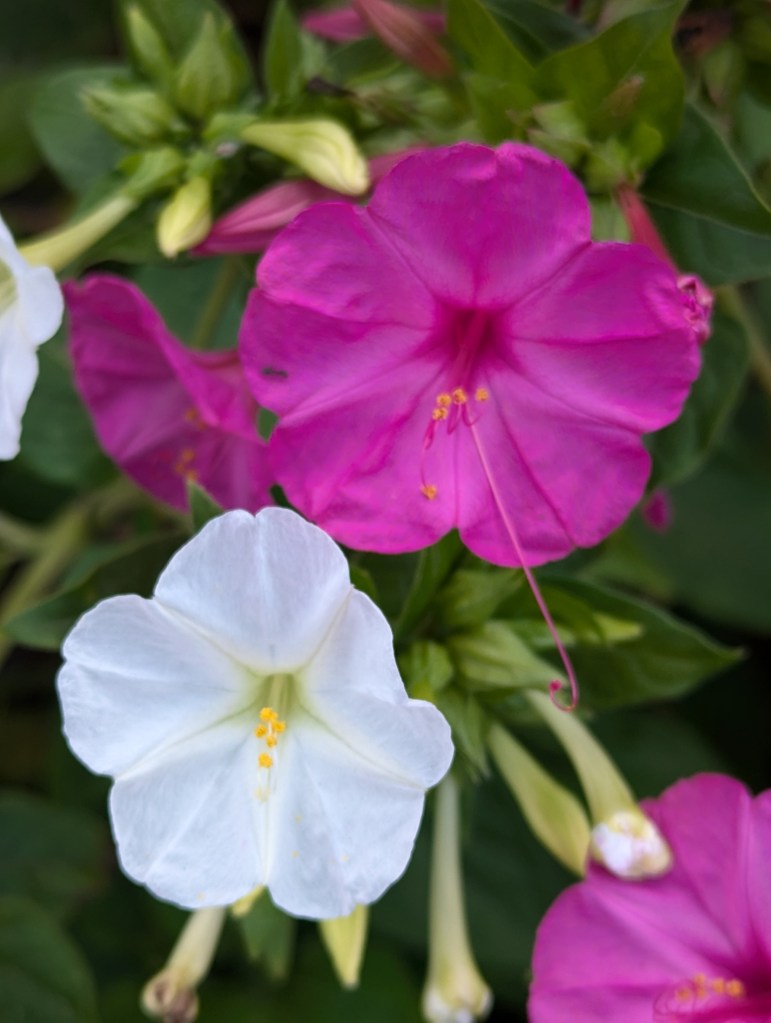
Punctuality is not one of its primary attributes. Four o’clock, Mirabilis jalapa, is supposed to unfurl its flowers about four o’clock. It is more likely to do so a bit later here because of aridity. Flowers can remain open and mildly fragrant all night, but might close after about noon. Four o’clock grows vigorously with summer warmth, but also appreciates humidity.
Floral color ranges through various hues of pink, red, orange, yellow and white. Flowers commonly exhibit stripes, spots or patches of other color within this range. Flowers with completely different colors can bloom on the same stems. Simple bright pink flowers are typically the most fragrant. Other colors and mixed colors may lack fragrance completely.
Most four o’clock grow in their gardens without invitation. They sneak in as seed, but are too pretty to be weeds. They grow tuberous roots to overwinter as their foliage and stems later succumb to chill. Stems do not stand much more than three feet tall, but may sprawl twice as wide. Below their lush foliage, these lanky stems are vulnerable to disturbance and wind.
Billbergia sanderiana is like a larger version of Billbergia nutans.
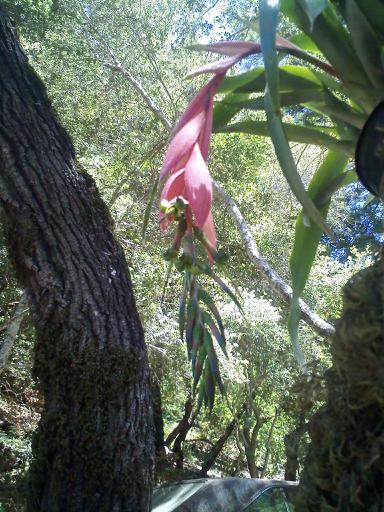
To many of us, Billbergia sanderiana is really just a coarser version of the related and more common queen’s tears bromeliad, Billbergia nutans. The somewhat stiff leaves of the former are substantially wider but are actually shorter than those of the latter, less than a foot long. Billbergia sanderiana foliage has minute teeth for lightly snagging against flannel sleeves, and is sometimes spotted with white. The dense basal rosettes of foliage are always producing pups that can be divided to propagate copies for friends and neighbors.
Their nearly foot long flower spikes look like bunches of perch hanging from jigs on fishing poles. The small weird flowers buds are tipped with almost navy blue, with lime flavored Pez green at the base. These flower buds hang upside down, with their blue tips pointing downward at first. Their petals curl back and upward as they open. The bright pink bracts that wrap the stems that suspend these bunches of flowers puff out as bloom progresses. By the time the lemony yellow pollen laden stamens emerge, the most memorable colors of 1985 are represented.
All specie of Billbergia are naturally epiphytic (grow within the canopies of large trees) so their wiry roots are rather minimal and seem to cling to the inside of their pots while ignoring potting media (potting soil) within. They like to be watered regularly but not excessively while weather is warm, but do not need much at all through the cooler time of year. Their media should be very loose and drain well.
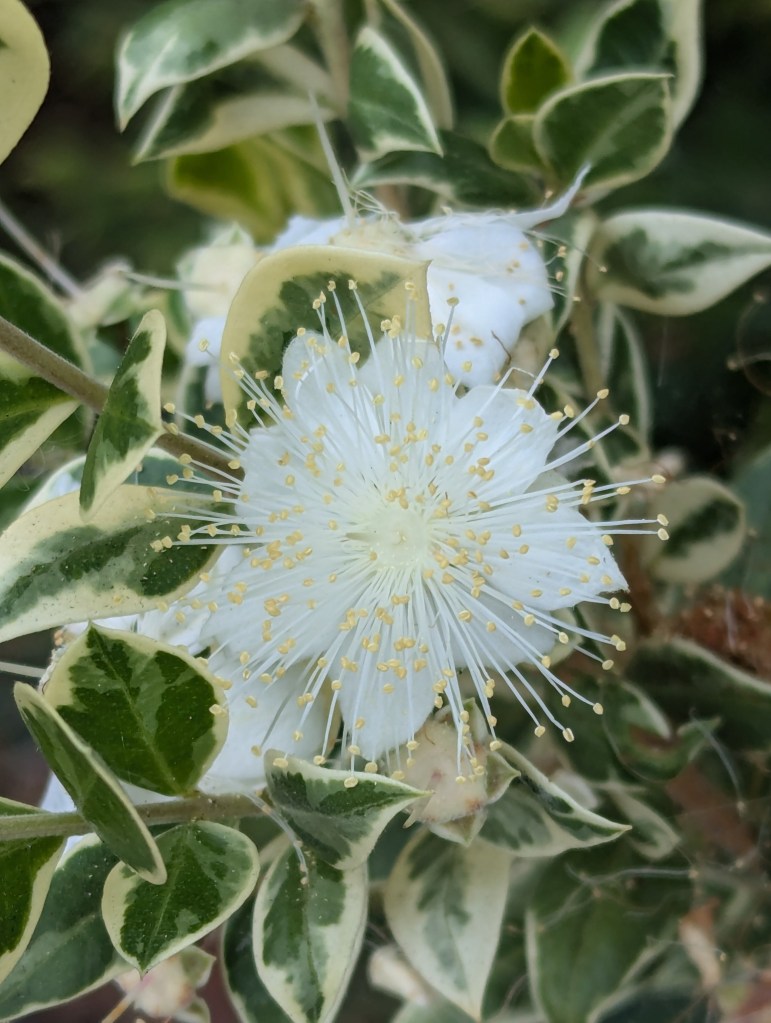
Old landscapes of the Victorian Era may still include myrtle, Myrtus communis. It is quite a survivor. It had been popular for centuries because of its resiliency. It is very conducive to the sort of formal hedging that was popular during that time. As formal hedges became old fashioned, so did myrtle. Yet, it is still more sustainable than more popular shrubbery.
Besides, myrtle is not limited to refined shorn hedges. It can just as efficiently become an unshorn and informal hedge or screen. It can grow as tall as fifteen feet, but rarely grows higher than first floor eaves. Without pruning, it typically grows about half as wide as it is high. Selective pruning rather than shearing limits its size without ruining its natural form.
Myrtle foliage is densely evergreen and pungently aromatic. Individual leaves are merely an inch or two long. Small white flowers with prominent stamens may not be very showy. Small and darkly bluish black berries are sparse. ‘Compacta’ grows only about three feet high and wide. ‘Compacta Variegata’ is slightly more compact and variegated with white.
Garden verbena sort of resembles lantana, with more variety of color.
When I first saw ‘Peaches ‘N Cream’ garden verbena, Verbena X hybrida, that was trendy in the early 1990’s, I thought that the variable shades of pale pink and nearly white of its flowers were too dull. Then I saw the flashy bright red, purple, blue and fluorescent pink of other modern varieties at the time, and gained a new appreciation for the more subdued color range, including white and more ‘normal’ pink. The flower color range may not be very extensive, but it is diverse.
Even though it is commonly grown as an annual, garden verbena is actually a short term perennial. It is a traditional component of mixed flower urns and planter boxes, but does not necessarily need to be replaced along with other annuals. Like English ivy and ferns that are so often planted with annuals, garden verbena can be salvaged, at least for a few seasons, as annuals come and go. It looks good in hanging pots or large urns where its slightly cascading form can be appreciated. In good soil, garden verbena can become a colorful small scale ground cover.
Mature plants do not get much more than six inches deep or two feet wide. Their coarsely dentate leaves are about two inches long. Their flat, two inch wide trusses of small flowers bloom mostly in summer. Hard pruning at the end of winter helps restore plants in spring, and keeps plants healthy longer. Mildew can become a problem in humid areas, particularly if air circulation is inhibited by crowded foliage.
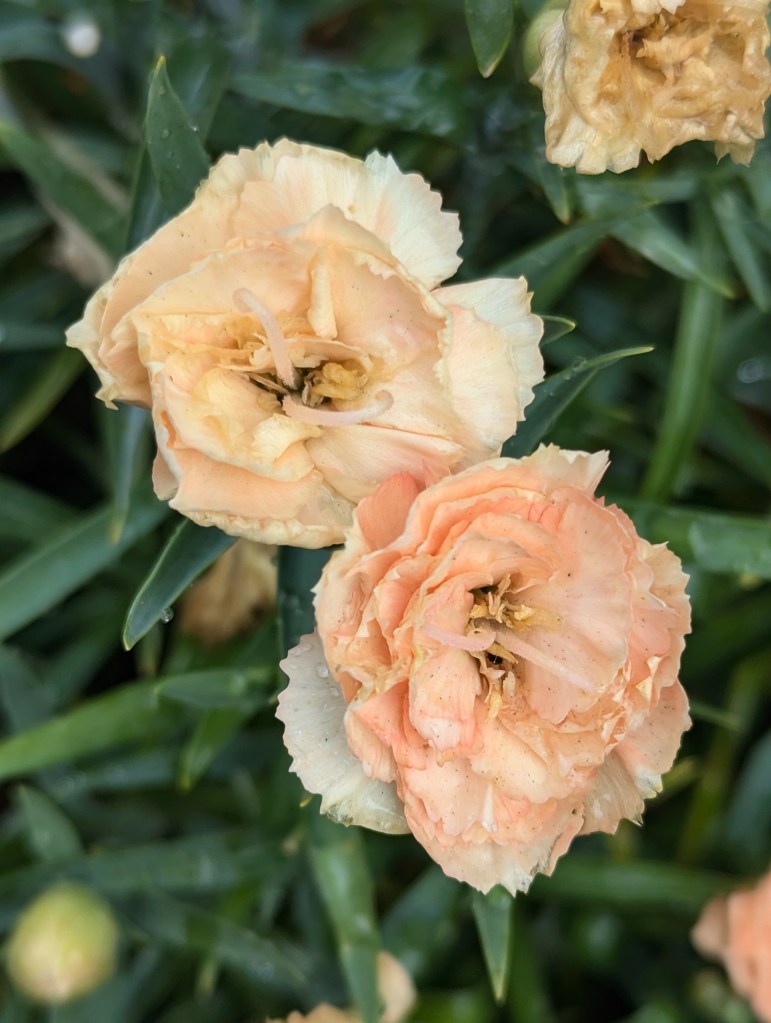
Florist carnation, Dianthus caryophyllus, is not originally as colorful as it seems. It can be red, pink, pastel yellow, pastel orange or nearly purple. Most for the floriculture industries begin as white though. White carnations are conducive to dying with any color that might be in demand. They are therefore more versatile than those with a different natural color.
Furthermore, their natural floral color range is not as natural as it seems. It is the result of extensive breeding of several species. Consequently, several popular types of carnation lack species designation. This includes a few compact cultivars that are more popular as annuals than cut flowers. Within locally mild climates, they can be short term perennials.
Border carnations grow only a few inches tall and less than a foot wide. Eventually, very old specimens may grow more than a foot tall. Such big specimens are very rare though. Border carnation foliage is glaucous bluish gray. The short and very narrow leaves are in opposing pairs. Flowers are less than two inches wide, with delightfully spicy fragrance of clove.



 Tony Tomeo