Cosmos

Cosmos has potential to almost naturalize.

For the past few years, I have really been overly indulgent with the seed catalogues from Renee’s Garden. I wanted to try more varieties of classic annual cosmos, Cosmos bipinnatus, than I could fit in my garden. I recently grew ‘White Seashells’ with tubular ray flowers, and colorful ‘Double Click’ with ruffled semi-double and double flowers, and even the ‘Dancing Petticoats’ mix, which includes several varieties! By now, I have probably grown all but a few of the many offerings.

After trying so many though, I still can not tell you which are my favorites. It would not matter much anyway, since I did not deadhead them to deprive them of their abundant seeds. Their self sown progeny are now mixed and beginning to bloom in random shades of pink ranging from pale pink to nearly red to nearly purple, with a few white.

Naturalized cosmos eventually reverts to bloom with more genetically basic single flowers in simpler shades of pink and white, on stems about three or four feet tall. They can even get taller than six feet and wider than two feet. Most of the popular garden varieties that I started out with though stay less than three feet tall. ‘Sonata’ is a popular strain that stays even shorter, so is among the most practical and proportionate for refined gardens.

Seed can be sown or new plants can be planted now to bloom through summer. Naturalized plants are already blooming only because they get an earlier start. Regardless of color or form, all cosmos flowers are about three inches wide, with yellow centers. Their finely textured pale green foliage is quite delicate and airy. 

New Zealand Flax

New Zealand flax provides colorful foliage.

Old fashioned New Zealand flax, Phormium tenax, is becoming increasingly uncommon. It is simply too big for compact modern gardens. Even without upright stems, its vertical and olive drab leaves can reach ten feet tall. They can flare outwardly as wide as fifteen feet. One cultivar is bronzed. Another is variegated. Both are somewhat more compact.

Most modern cultivars are either Phormium colensoi or hybrids of the two species. They are more compact and more colorful. ‘Jack Spratt’ grows only about a foot and a half tall, with chocolaty bronze foliage. ‘Yellow Wave’ gets about three or four feet tall with arching foliage with yellow stripes. Others are bronzed or striped with yellow, brown, red or pink.

New Zealand flax is remarkably resilient. The evergreen foliage is so very fibrous that it can be difficult to cut. Tough rhizomes that migrate where they are not wanted propagate easily by division. Some cultivars can revert by generating less colorful mutant growth. Since it is greener, such growth is more vigorous. It can overwhelm and displace more colorful foliage.

Tam

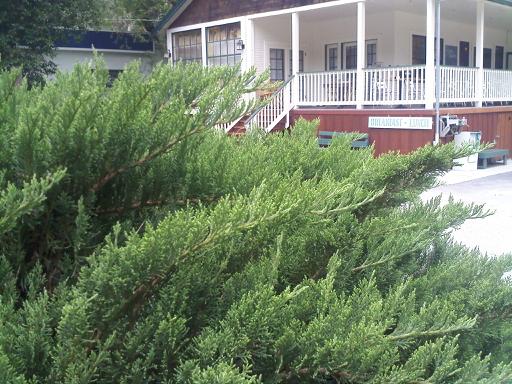
The juniper that gives other junipers a bad name.

As much as I like junipers, even I have my limits. The tamarix juniper or tam, Juniperus sabina ‘Tamariscifolia’, is the juniper that gave junipers a bad name decades ago by being too common in too many of the wrong situations, and remains one of the most commonly planted junipers. What I do not like about it is that it is classified as a ‘ground cover’ juniper and can sprawl more than eight feet wide, but actually piles up more than two feet deep! However, I have noticed that it can be practical for certain situations as a ‘sprawling shrub’ instead.

Even without the foliar color or sculptural branch structure of other shrubby junipers, the dense dark green foliage and compact branch structure give the tam its own appeal and practicality. It can be shorn into low informal hedges as frequently as annually. It readily recovers its feathery texture if shorn as the weather starts to get warm in spring. All it wants is sunlight and infrequent but deep watering in summer. 

Dusty Miller

Dusty miller is strikingly silvery gray.

Of the few unrelated species of dusty miller, the most common here is Senecio cineraria. Like other dusty miller species, its foliage is remarkably silvery white. Its foliar tomentum can be so thick that it resembles fine felt. Individual leaves exhibit intricately deep lobes. They are about two to five inches long, but are smaller and simpler on upper floral stems.

Dusty miller blooms with floppy clusters of tiny but bright yellow daisy flowers. However, because the colorful foliage is more appealing, bloom might not be a priority. Removal of floral stems prior to bloom promotes denser and neater foliar texture. Within more severe climates, dusty miller is a warm season annual. It is a resilient shrubby perennial locally.

Mature specimens of dusty miller can get a bit taller than three feet with bloom. They are shorter with grooming and pruning to maintain compact form without bloom. If necessary, they are conducive to pruning to limit their height to about a foot and a half. This species tolerates a bit more partial shade than other dusty miller. Ideally, it prefers sunny warmth.

Lilac

Lilac is splendidly fragrant!

‘French Hybrids’ are not fuel efficient European cars. (However, if there were a French equivalent to the old Japanese Datsun ‘Z’ that was instead named the ‘S’, we could really see the ‘S car go!’) ‘French Hybrids’ are varieties of lilac with single or double flowers in various shades of lavender, pink, pale blue, pinkish red, purple and white. Some have flowers that are two-toned. ‘Primrose’ is an interesting shade of pale yellow. All are strongly but elegantly fragrant. 

Even though ‘French Hybrids’ have the advantage of being better adapted to mild winters, the original species of common lilac, Syringa vulgaris, and its older varieties seem to do just fine locally, and actually seem to be more fragrant. The only disadvantage is that almost all bloom with lavender flowers. ‘Alba’, with white flower, is rare. ‘Descanso Hybrids’ were developed for even milder winters.  

The individual tubular flowers are actually very small, but bloom in dense conical trusses that are typically about three or four inches long, and possibly twice as long. Trusses develop on year old stems, so pruning should be done right after bloom only, although dead-heading (removing deteriorating trusses) without pruning can be done at any time. The soft and sometimes light green leaves are about three inches long. Mature plants are often eight feet tall and nearly as broad, and can get twice as large.

Unlike most plants that get suckers that need to be removed, most lilacs should instead be pruned to remove older canes and to promote healthier growth of suckers. This process of ‘alternating canes’ continually replaces less productive deteriorating stems with vigorous new stems. Old fashioned grafted plants are the only lilacs that should have their suckers removed; but they are uncommon, and do not sucker as much anyway.

Azalea

Azalea bloom can almost obscure foliage.

Azaleas, which are species of Rhododendron, have been in cultivation for centuries. At least ten thousand cultivars are documentable. Most are interspecific hybrids. Only a few are selections or breeds of simple species. Most of their ancestral species are native to Asia, Europe or North America. Almost all cultivars that are available here are evergreen.

Azaleas can bloom profusely enough during April or May to almost obscure their foliage. Bloom may last for more than two weeks. Floral color ranges between white and red with many tints of pink, salmon and magenta. The most profuse flowers are as narrow as half an inch. Larger flowers may be three inches wide. Rare deciduous azaleas are fragrant.

Azaleas do not grow fast, but can eventually sprawl more than five feet wide. Some can grow nearly twice as wide. Although most do not grow much taller than three feet, some can grow twice as tall. Azaleas are naturally understory species, so can tolerate a bit of partial shade. They should not crave fertilizer. If they do, they prefer acidifying fertilizer.

Flowering Crabapple

Flowering crabapple is more colorful than crabapples that are grown more for fruit.

This picture resembles flowering cherry, but is actually a flowering crabapple, Malus spp.. Both provide impressively abundant spring bloom before foliation in spring. Both may have single, semidouble or double flowers in various shades ranging from white to rich pink. Some flowering crabapples though have nearly red flowers. Flowering crabapples get slightly larger, more than twenty feet tall and broad; but some stay as short as five feet, and others get taller than thirty feet! Some have bronzy or purplish foliage through summer. The half inch to nearly two inch wide yellow, orange or red fruit can be colorful into autumn, and some makes good jelly; but it can also be messy. The main advantage of flowering crabapples is that they are somewhat less susceptible to rot than flowering cherries are in dense slowly draining soil.

Andromeda

Andromeda can be somewhat shade tolerant.

Andromeda might be more familiar by its Latin name of Pieris. A few of its seven species, and a few of their hybrids, are popular for home gardens. All are evergreen shrubs. A few do not grow much taller and wider than three feet. Few can grow a bit more than ten feet tall and wide. In the wild, some might grow as small trees that are almost twenty feet tall.

Andromeda has glossy evergreen foliage. Individual leaves are lanceolate, perhaps with serrated margins. They are between one and three inches long, and half to an inch wide. New growth of most cultivars is as rich cinnamony red as that of photinia. A few cultivars have more pinkish or simple green new growth. A few cultivars are variegated with white.

Andromeda blooms with somewhat pendulous racemes of tiny pendulous flowers. Floral racemes are between two and four inches long. Individual flowers are between a quarter and half an inch long. Most are white. Some are pink. Most have green rachi. Some have pink rachi. Bloom is abundant for the middle of spring. Andromeda prefers partial shade.

Flowering Cherry

Flowering cherry is the fruitless counterpart of fruiting cherry.

Like camellias and chrysanthemums, the many different varieties of flowering cherries, Prunus spp., have been developed by horticulturists in Japan for centuries. There are now almost too many to choose from. Most stay less than about twenty feet tall and broad, so are proportionate to compact gardens. A few stay even smaller. The classic Yoshino flowering cherry can get somewhat larger. Weeping cherries have pendulous branches. Columnar types are noticeably taller than wide, at least while young. Some flowering cherries have remarkable fall color.

Despite my preference for cherry trees that produce cherries, I can not deny that the spring bloom of the innately non-fruiting flowering cherries is spectacular! Most bloom before any foliage develops. Their flowers can be single, semidouble or double, in various shades of white or pink, including rich rosy pink. They can not be very messy without fruit. Unfortunately though, flowering cherry trees are susceptible to rot in the endemically dense soil, so should not be watered too much.

Saskatoon

Saskatoon prefers significant chill during winter.

Of eighteen species that are native to North America, only two are native to California. Of these two, only one is native locally. However, some of the few nurseries that sell various saskatoons market them as native. Obviously, most are not. A few are hybrids. All of them are species of Amelanchier, and are still rare here. Their common names are numerous.

Serviceberry, sarvisberry or sarvis may be some of the more common of common names. Shadbush, shadwood or shadblow may be less common. Juneberry, chuckley pear, wild plum and sugarplum are likely regional names. They are more familiar where winters are cooler. Some sorts do not perform well locally because they prefer a bit more winter chill.

Saskatoons are locally popular primarily for their fruit, and only among a few enthusiasts. They are more available online than in nurseries. The fruits are pommes like tiny apples, but are only the size of blueberries. They ripen to blackish purple for summer. Their early spring flowers are like wispy apple flowers. Most Saskatoons grow less than ten feet tall. Some rarer types can grow thirty feet tall in favorable climates.