Dracaena Palm

Modern dracaena palms are more compact, more colorful and more user friendly than old fashioned sort.

(This article was deferred from yesterday morning.)

            While hoping to find some of the uncommon yuccas that I still lack, I instead encountered some of their friendlier kin in a local nursery. Even though dracaena palm, Cordyline australis, is an old fashioned plant that was probably considered to be too common until the past few decades, many more colorful modern cultivars are restoring its appeal. Classic dracaena palm has olive drab foliage. The nearly as traditional bronze dracaena, ‘Atropurpurea’, has reddish bronze foliage. The more contemporary ‘Red Star’ though is deeper purplish red. ‘Pink Stripe’ has bronzy green leaves with pink edges. ‘Sundance’ has pink in the middle with green edges.

            Modern cultivars also stay shorter so that their abundant foliage can be appreciated on a more personal level. The individual sword shaped leaves are about three feet long and three inches wide, a bit larger than traditional dracaena palm leaves. However, I actually prefer the traditional dracaena palms that can get taller than twenty feet and spread nearly half as wide, with sculptural bare trunks and high branches.  

            Any dracaena palm that gets too tall can be cut back to a more proportionate height. One of my colleagues recommends cutting about a quarter through trunks a year or more prior to cutting back, to stimulate new shoot growth just below the cut. The new growth prevents the trunks from being bare immediately after getting cut back. Overgrown heavily branched trees should first be thinned to decrease their weight before cutting partly through their trunks. Young plants can be cut back to the ground to regenerate with multiple trunks.

            Billowy trusses of tiny pale white flowers add interest at the end of spring, particularly against darker foliage. I am told that the flowers of modern cultivars are slightly fragrant. However, against the olive drab foliage of older dracaena palms, I think that the blooms look rather dusty, and do not smell any better.
Apple

There are countless varieties of apple.

Apples are amazingly diverse. They have been in cultivation for thousands of years. Too many cultivars to document developed during that time. Some ripen as early as summer, while others ripen for late autumn. Some are best for eating fresh, while others are better for cooking, baking or juicing. Some are sugary sweet, while others are impressively tart.

Malus domestica is the general botanical name for most domesticated apples. However, this classification includes countless hybrids of a few species. Some are products of very extensive breeding. Most can grow as large as small shade trees. Grafting onto rootstock limits their size accordingly. Most ‘semi dwarf’ home garden trees are relatively compact.

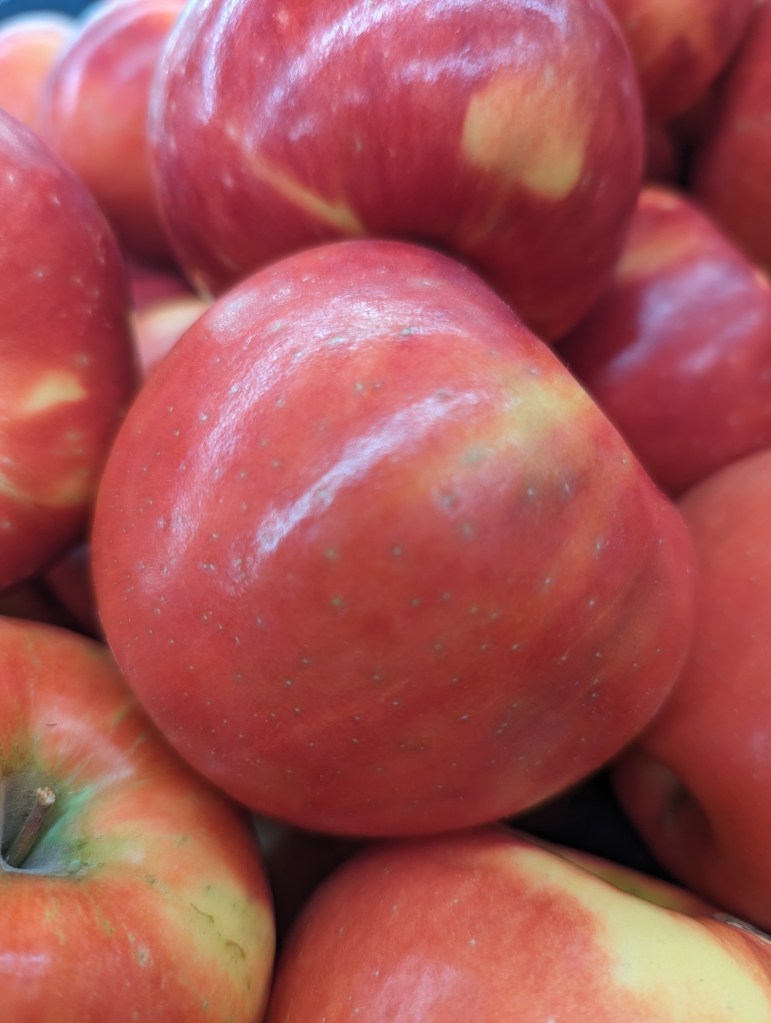
Apple trees bloom with small but profuse and brilliant white flowers for spring. Flowering crabapple trees generally bloom pink or reddish pink, but produce dinky fruit. Otherwise, apples are about as big as baseballs. Some are significantly bigger or smaller. They can be variable shades of red, yellow or green. Some are striped or blushed with two colors. Their deciduous foliage turns yellow through autumn, and defoliates through winter.

Holly-Leaf Osmanthus

Holly-leaf osmanthus resembles both English holly and Euonymus.

English holly happens to be one of my all time favorite plants, even though it rarely produces the abundant berries that are expected of hollies. Its deep rich green foliage is so glossy and distinctively textured. Because English holly does not mind partial shade, the variegated varieties can add a bit of color where it is too dark for most other plants to bloom. I really do not mind that it is so prickly.

For those who do mind, the holly-leaf osmanthus, Osmanthus heterophyllus (or ilicifolius) is a worthy substitute for English holly that is just as happy with partial shade. The foliage is very similar in appearance, but a bit less glossy, and much less irritating. Holly-leaf osmanthus is sometimes mistaken for English holly, but can be distinguished by its opposite leaves. English holly has alternate leaf arrangement.

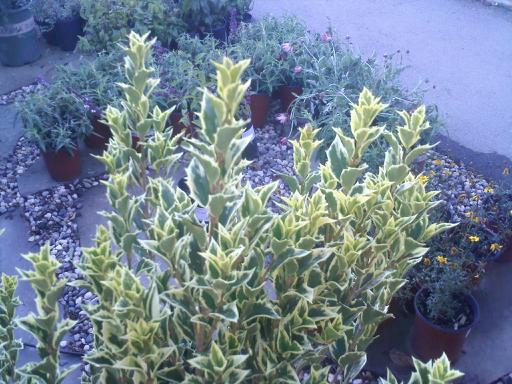
Mature holly-leaf osmanthus can get as large as English holly, but rarely does. It is more often less than 10 feet tall and wide, and is somewhat more adaptable to shearing into hedges. ‘Variegatus’, the most popular variety with pale white leaf margins, grows a bit slower and stays more compact, and actually looks better in partial shade than out where it is too exposed. Holly-leaf osmanthus flowers that bloom about now are not much to look at, but produce a delicate fragrance if the weather gets warm.

Leyland Cypress

Leyland cypress ‘was’ an intergeneric hybrid.

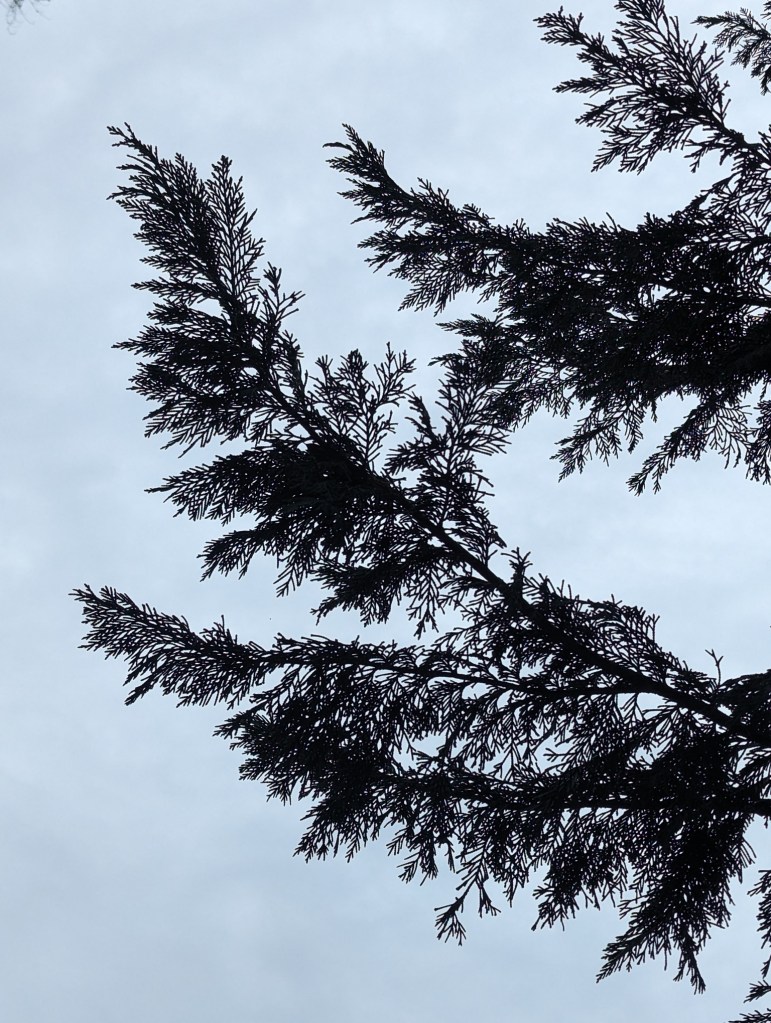
Taxonomy is a mess for Leyland cypress, X Cupressocyparis leylandii. The X preceding its genus name indicates that it is an intergeneric hybrid. Monterey cypress, Cupressus macrocarpa is the paternal parent of the original hybrid. Nootka cypress, Chamaecyparis nootkatensis, is the maternal parent. However, its name is now Cupressus nootkatensis.

Therefore, Leyland cypress is now Cupressus X leylandii, and an interspecific hybrid. It inherited attributes from both parents, as well as innate vulnerabilities. It can grow very vigorously to more than thirty feet tall in fifteen years. However, it may not live for another fifteen years afterward. It is very susceptible to cypress canker and a few other diseases.

This is why Leyland cypress often accompanies more permanent but slower vegetation. By the time it finishes its life cycle, the other vegetation is ready to replace it. Most large specimens are less than forty feet tall, with densely conical form. The evergreen foliage is grayish deep green. Less common cultivars are more grayish, yellowish or variegated.

California Wild Rose

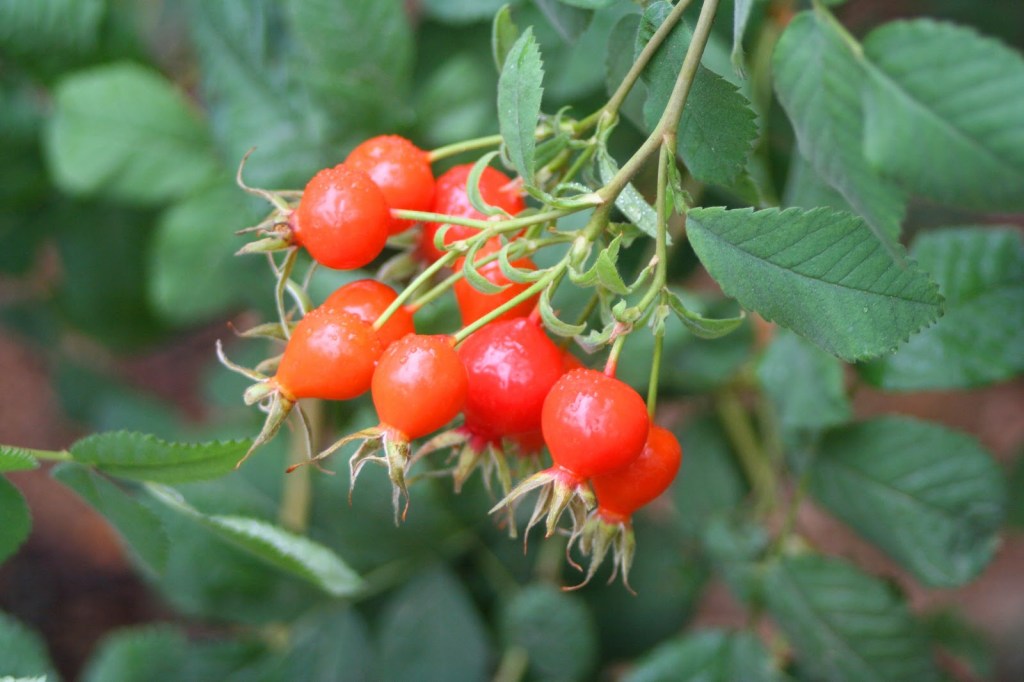
Even if bloom is not much to brag about, the rosehips can be pretty and useful.

Prickly thickets of California wild rose, Rosa californica, are not often much to look at, even while adorned with small and sparse pink roses in spring and summer. The fragrant flowers can actually range in color from white to rich pink, and may have more petals, but are not abundant enough to be very impressive at any one time. In autumn though, all the flowers that bloomed in the previous few months leave bright orange or red fruiting structures known as ‘hips’, that linger on the bare canes through winter.

The rose hips of California wild roses had historically been used to make herbal tea because they contain so much vitamin C and have a pleasant flavor. (California wild rose is a ‘tea’ rose but not a hybrid ‘T’ rose.) They can also be made into jelly or sauce. The only problem is that birds like them too, so often take them before anyone else has a chance to.

Heath

Heath for winter. Heather for summer.

Heaths, which are several species of Erica, derive their name from their natural habitats. They are endemic to shrublands of acidic and seasonally dry soil of inferior quality. Such ecosystems, or heaths, do not sustain many big trees or shrubbery. Species from heaths should be resilient to dry chaparral summers. However, they dislike locally alkaline soils.

This is unfortunately why heaths are quite rare within gardens here. They are popular as blooming potted plants for winter, but become scarce afterward. Within planters of potting media, they may grow and bloom for many years. In the ground though, they are likely to languish without acidifying amendment. They prefer the company of coniferous species.

Heath blooms for winter or very early spring. Heather is a similar relation, but blooms for summer or autumn. Floral color ranges from white to pink to rustic purplish pink. Flowers are dinky but abundant. Comparably dinky evergreen leaves are like soft juniper scales. Almost all available heaths grow less than five feet high. Most grow less than a foot high.

White Alder

White alder is not exactly . . . white.

During the summer, the native white alder, Alnus rhombifolia, is a nice shade tree that looks bigger than it really is. By late winter, the bare deciduous canopy has an appealingly picturesque silhouette. This time of year is actually when white alder is typically less appealing, with dead foliage that provides no interesting fall color, but lingers until knocked down by rain or late frost. Yet, even now, it sometimes surprises with these funny looking floral structures that are interesting both in the early winter landscape, and with cut flowers.

In past decades, white alder was an ´expendable’ tree that was put into landscapes for quick gratification while slower but more desirable trees matured. By the time the desirable trees matured, the alders were removed to make more space for the desirables. This technique was practical because, like many fast growing trees, alders do not live very long, so start to deteriorate after about twenty five years anyway. However, alders often live longer than expected.

Mature alders are usually less than fifty feet tall where they are well exposed. They can get at least twice as tall where shaded by other trees or big buildings. Their plump trunks with mostly smooth silvery gray bark make them seem larger than they really are though. Too much water promotes buttressed roots which can displace pavement.

Ornamental Kale (deferred from yesterday)

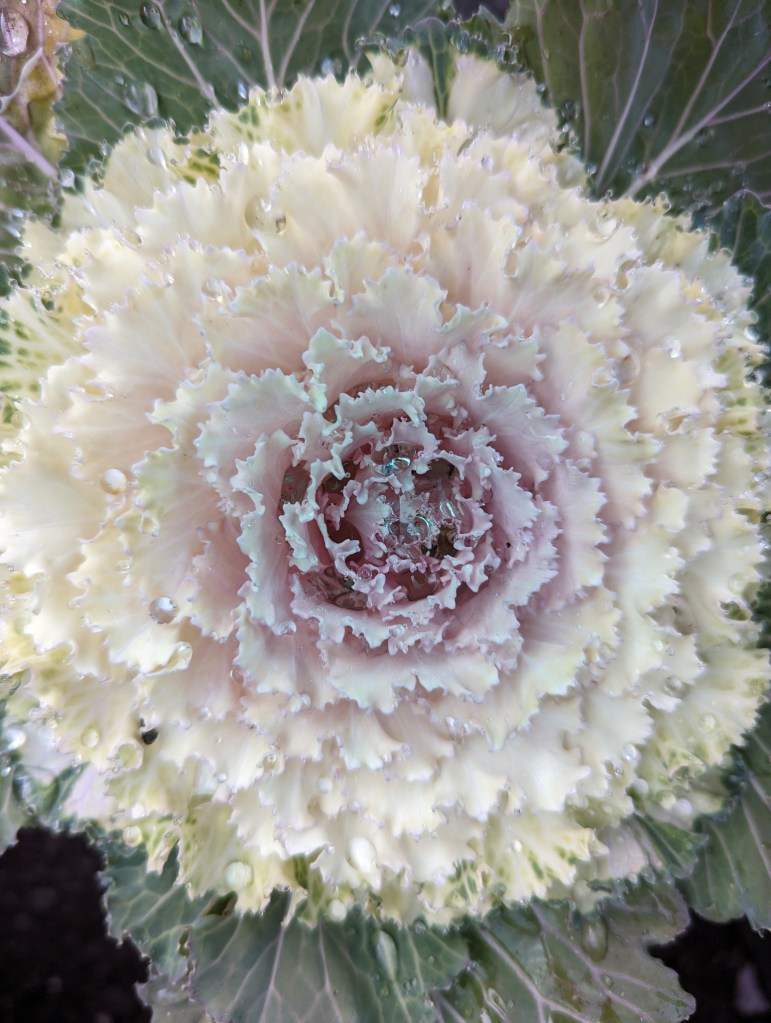
Flowering kale really seems to bloom.

Flowering cherry trees are prettier but fruitless versions of their fruiting counterparts. So are flowering peach trees. It seems only fair that some vegetables could also be prettier than culinarily useful. Gourds are ornamental squash fruit that can qualify as vegetables. Ornamental kale, Brassica oleracea, is an actual vegetable that is primarily ornamental.

Ornamental kale is also known as flowering kale, or ornamental or flowering cabbage. It is more foliar than floral though. Its dense foliar rosettes unfurl like big ruffly roses. Some are very ruffly. Some are intricately lobed. Foliar color can be white, pink, red or purplish. Ornamental kale is as edible as culinary kale, but a bit more bitter. It is a splendid garni.

Like cool season annual flowers, ornamental kale performs between autumn and spring. It grows quite slowly though. Seed that starts in August grows into seedlings for October. Seedlings that start in October only begin to get colorful during November, a month later. Their seemingly floral but foliar display ironically ends as they actually bloom for spring.

Valley Oak

Foggy Oak Morning by Karen Asherah

‘Foggy Oak Morning’ by Karen Asherah, is another example of the local scenery that I miss while not taking a bus or walking. I drove past this scene for years on my way to work outside of San Martin without ever bothering to take a look at it. This happy tree is a native valley oak, Quercus lobata, like those that had been common throughout the Santa Clara Valley until only about two centuries ago. It is not exactly the sort of shade tree that everyone wants in a compact suburban garden, but is grand enough for large spaces like parks.

Mature specimens may not seem to get as tall as oaks in the Appalachian Mountains, but are actually the largest oaks in North America, and live more than five centuries. The tallest trees are mostly less than seventy feet tall, but can get taller. Trunks of the oldest trees are commonly six feet wide or wider. The distinctively and uniformly furrowed bark is as classically ‘oakish’ as the rounded prominent lobes of the deciduous leaves, and the sculpturally irregular branch structure. Odd stem galls, commonly known as ‘oak apples’, are home to the larvae of tiny wasps that rely on valley oaks for everything they need. Incidentally, Paso Robles, or ‘El Paso de los Robles’ is named for the valley oaks in the area, which Spanish immigrants thought resembled the ‘robles’, the European oaks that inhabit Spain.

More information about ‘Foggy Oak Morning’ can be found at the website of Karen Asherah at karenasherah.com.

Holly Olive

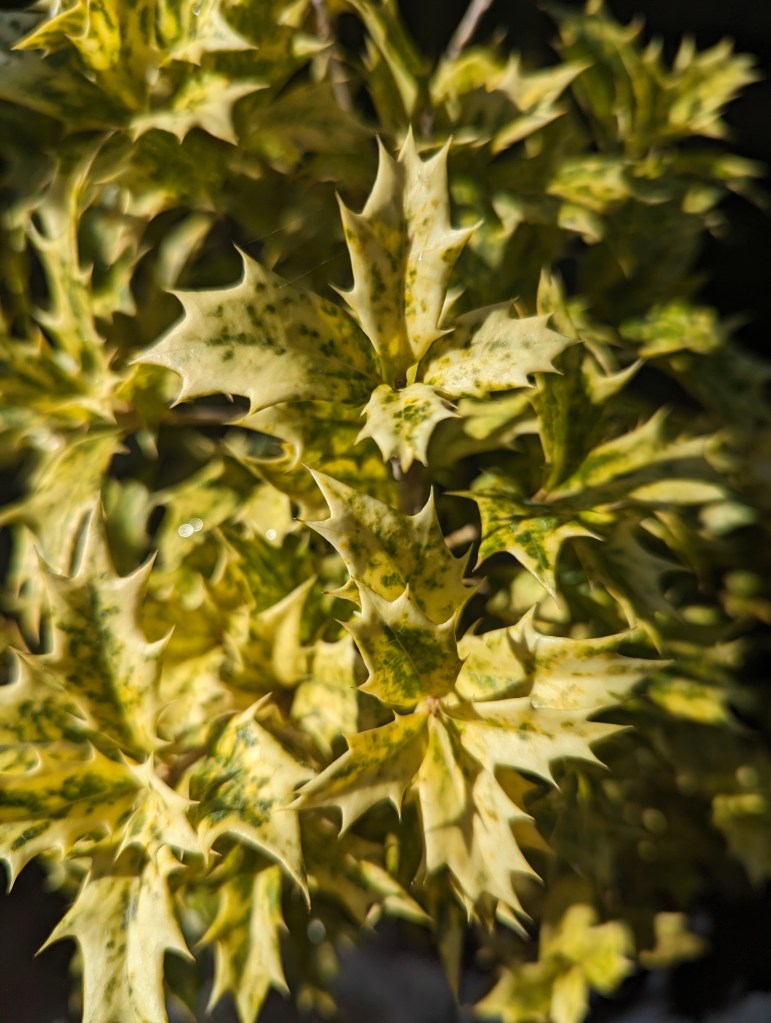
‘Goshiki’ is a popular holly olive.

English holly provides traditional cut foliage, preferably with a few berries, for Christmas. It is annoyingly prickly, though. This is why holly olive, Osmanthus heterophyllus, is now a more docile option. Its foliar texture is very similar, but with slightly dulled foliar spines. It is gentle enough for corsages and boutonnieres. However, it generates no red berries.

Holly olive is popular as small and perhaps decorated potted plants for Christmas decor. Afterwards, it adapts to home gardens more efficiently than typical Holiday potted plants. Such potted plants should not retain any mylar wrapping for too long. It inhibits drainage. Also, any small decorations or fake berries should not remain as stems eventually grow.

Most popular cultivars of holly olive are variegated. ‘Goshiki’, with more yellow or creamy white blotches than green, is the most popular here. Unvariegated holly olive is a classic dark drab green. All cultivars work splendidly as formal hedges. Alternatively, they might slowly grow taller than fifteen feet. The evergreen foliage becomes less spiny higher up. Tiny flowers are sweetly fragrant.