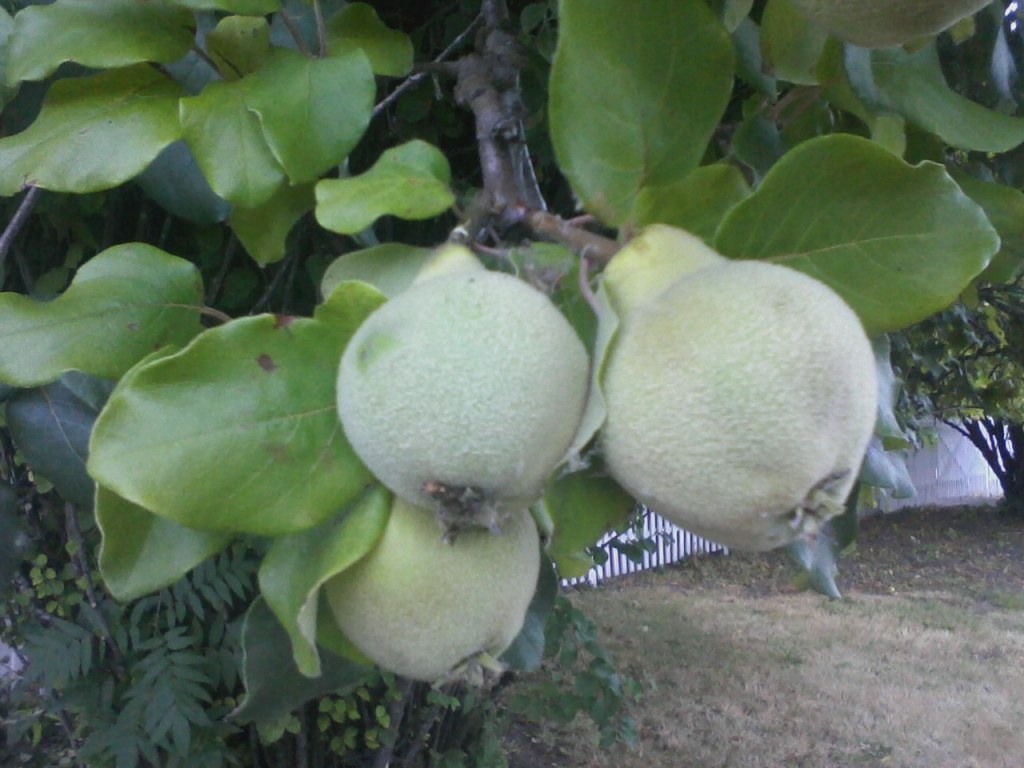
With the many slender arching trunks, quince, Cydonia oblonga, is more like a large deciduous shrub than a fruit tree. Even old trees are not much more than twenty feet tall and broad. Most of the rare trees that can be found are old, because quince is such an old fashioned fruit. The fruit is still immature and covered with white pubescence (fuzz). By late autumn, it will be remarkably aromatic and resemble golden pears, about four inches long and nearly as wide, and so hard that it should be cooked.
California fan palm is the only palm that is actually native to remote regions of California. However, Mexican fan palm, Washingtonia robusta, is much more common. Technically, its native range is not far away. It had been the most popular of palms prior to the 1990s. It is more adaptable to more populous climates. Also, it naturalizes within some regions.
Mexican fan palms grow vigorously while young. Growth decelerates with maturity. Very old trees can grow very slowly without completely stagnating. Wild specimens may have potential to survive for a few centuries with such slow growth. Cultivation and irrigation of home gardens may limit this potential. Few local specimens are more than a century old.
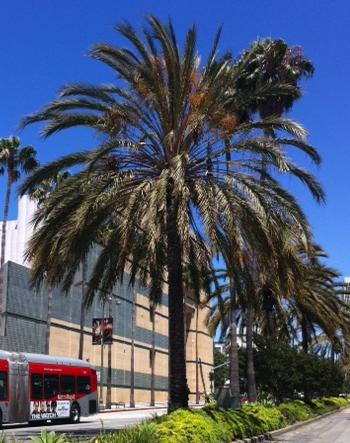
Mexican fan palms are taller and slimmer than California fan palms. Their trunks lean as prevailing wind blows them. They easily grow fifty feet tall, and eventually get a hundred feet tall. Such tall and leaning trunks can suspend their canopies over adjacent gardens. Their pleated and palmate leaves are about three feet wide, on petioles with nasty teeth.
Most black walnuts were not planted intentionally, but grew from the roots of old English walnut trees.
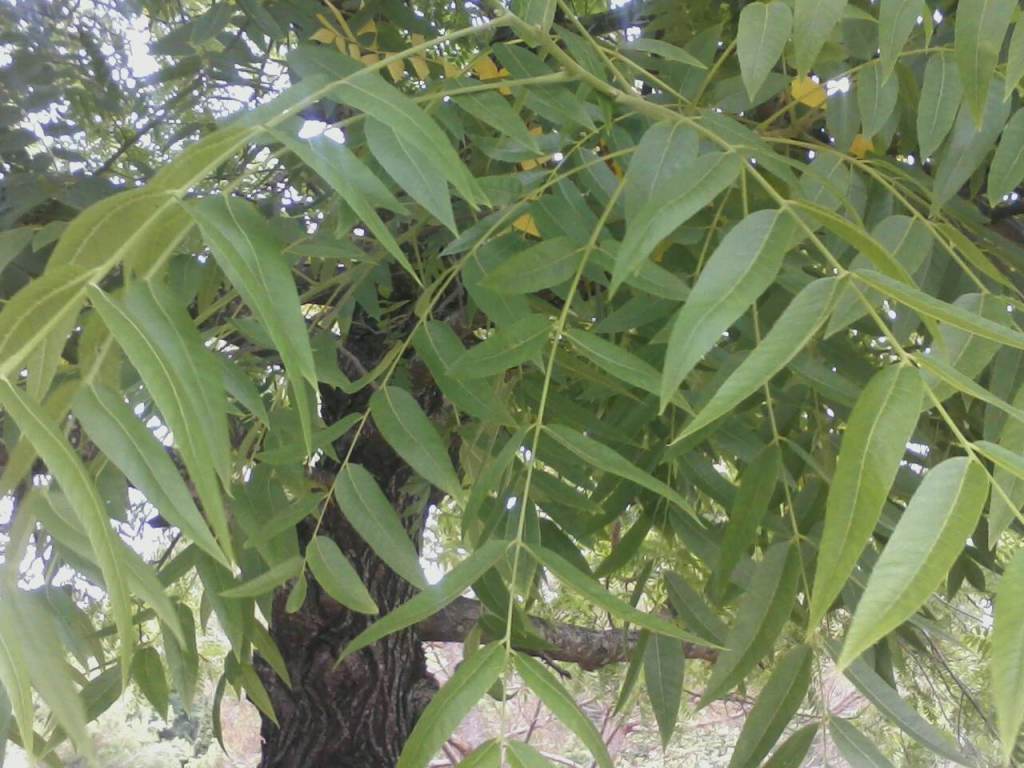
Although native, most local black walnut trees, Juglans hinsdii, are secondary growth from the rootstock of what were once grafted English walnuts, or descendents of such trees. (English walnut trees are grafted onto black walnut understock.) However, the massive old trees that flank the old Monterey Highway south of San Jose were planted as large shade trees nearly a century ago. They are now about sixty feet tall, with lofty broad canopies. Their foot long leaves are pinnately compound, with about eleven to nineteen slightly dentate leaflets that are about three or four inches long. The hard nuts and thick husks are far too messy for refined gardens.
Mount Shasta very rarely lacks its snow. Its summit is almost always white. Shasta daisy, Leucanthemum X superbum, strives for the same. Bright white bloom starts in spring and continues into autumn. Primary spring bloom is the most profuse. Sporadic bloom lingers between subsequent minor bloom phases. Only cooling autumn weather inhibits bloom.
Shasta daisy is a resilient perennial. It develops dense colonies of tough basal rhizomes to survive winter dormancy. From spring to autumn, upright blooming stems grow almost three feet high. Individual composite flowers are of classic daisy form with cheery yellow centers. They are excellent as cut flowers, with simple green foliage. Leaves are serrate.
Shasta daisy prefers systematic watering, but can survive with less. It tolerates only a bit of partial shade. Removal of floral stems after bloom or cutting should leave no tall stubs. Removal of all upright growth as it deteriorates into winter promotes tidier spring growth. During winter dormancy, Shasta daisy is very easy to propagate by division of rhizomes.
Many relocated mature date palms were recycled from date orchards.
It seems that recycled large date palms, Phoenix dactylifera, became trendy in the past few decades while vast date orchards around Las Vegas were displaced by urban sprawl. They are stately trees with airy but bold rounded canopies between twenty and thirty feet wide. Mature trees are more than fifty feet tall on single trunks. Varieties with multiple trunks are shorter and rare. The ten to twenty foot long leaves are pinnately compound with folded foot long leaflets, and nasty basal spines.
Each date palm tree is either male or female (dioecious). Orchards are almost exclusive to fruiting female trees with only a few male trees grown separately for their pollen, which gets applied manually. Without male pollinators, recycled formerly productive female trees are fruitless, and therefore not messy.
Date palms may have been in cultivation for nine thousand years! The Judean date palm was grown from seed that was lost in storage for two thousand years, which (until recently) was the oldest known viable seed!
Mrs. George Washington never grew Martha Washington geranium, Pelargonium X domesticum. It was hybridized in Europe from south African species after she passed away. Although classified as a hybrid species, it is actually a group of distinct hybrids. Most are related to the same pair of primary ancestors. A few other species mingled in the process though.
The largest cultivars do not get much taller than three feet. Some develop rather irregular form. A few grow upward only to fall over. Minor tip pruning can improve awkward form. Stems are woodier than those of common zonal geranium. Consequently, cuttings do not develop roots as efficiently. Old specimens are less likely to recover from major pruning.
Martha Washington geranium may not bloom quite as profusely as zonal geraniums. The flowers are more spectacular though. Floral color can include purple, lavender, pink, red, burgundy or white. Billowy flowers are bordered or blotched with alternate colors. A few flowers bloom together on rounded umbels. Evergreen foliage is light green and ruffly.
Most big China doll trees were formerly docile houseplants.
It is hard to believe that the original variety of the familiar China doll, Radermachera sinica, that grows so slowly to reach an eight foot high ceiling as a houseplant, can actually grow into a substantial fifty foot tall tree with a three foot wide trunk, where protected from frost. Modern varieties with more billowy foliage take even longer to reach the ceiling, and do not go much higher. The finely textured and very glossy foliage is bipinnately compound, which means that each of the half to two foot long leaves are divided into smaller leaflets, which are also divided into even smaller leaflets that are about an inch or so long. Trusses of tubular white flowers that resemble big catalpa flowers are almost never seen among houseplants or modern varieties, but are quite showy on big old trees.
Most trees behave very differently in cultivation than in the wild. Colorado blue spruce, Picea pungens, is naturally a grand tree. It slowly but surely grows almost a hundred feet tall in the Rocky Mountains. Locally, if not competing with taller trees, it rarely gets as tall as thirty feet. Mild winter weather does not stimulate much more than necessary growth.
Furthermore, most home garden Colorado blue spruce are densely compact cultivars. Most are plumply conical. A few are quite rounded or globular. They function more as big shrubbery than trees. They are less conducive to major pruning than shrubbery though. Removal of low limbs for clearance compromises their strict but naturally elegant form.
Foliar color is as appealing as form and foliar texture. Obviously, Colorado blue spruce should be blue. Some are a bit more silvery or grayish. Trees that grow from seed tend to be greener and a bit less dense than cultivars. Such seedlings are sometimes available online. The stiff and prickly needles of Colorado blue spruce are only about an inch long.
Butterfly is like a more softly textured version of African iris, with pale pastel yellow bloom.
What was introduced as a seemingly fancier alternative to the common African iris is now almost as popular. Butterfly iris, Dietes bicolor (or Morea bicolor), is about as easy to grow, and nearly as resilient. Instead of white, the flowers are soft yellow with three prominent purplish brown spots with orange margins. The grassy evergreen leaves are a bit narrower and pliable.
Mature plants may get nearly three feet high and five feet wide. For those who do not mind digging and splitting apart the tough and densely matted rhizomes, large clumps are very conducive to propagation by division in autumn or winter. Deadheading (removal of stems that have finished blooming) promotes continued bloom and limits dispersion of seed that might otherwise grow new plants where they are not wanted. A bit of partial shade or minimal watering are probably nothing to worry about, but may inhibit bloom. Well exposed, well watered and well deadheaded butterfly iris should bloom from early spring until early winter.
As its common name suggests, it is a sprawling relative of common jade plant. Both are different species of the same genus. Carpet jade, Crassula nudicaulis var. platyphylla, grows only about six inches high. It sprawls slowly over the ground without getting much higher or lower. It roots where it sprawls, so can eventually develop significant colonies.
The evergreen foliage of carpet jade is a bit more dense than that of common jade plant. It is also a bit less glossy. Foliar margins blush a bit more through winter. Most popular cultivars become appealingly ruddy. Sun exposure enhances foliar color. However, frost can damage their exposed succulent leaves. Pale white winter bloom is unimpressive.
Carpet jade, like many succulents, is not very discriminating in regard to water or soil. It is likely to be more vigorous with regular irrigation. With less irrigation, it likely develops better ruddy foliar color. It provides appealing contrast to other small succulents with gray foliage. It performs well within pots, and may eventually cascade slightly over the edges.




 Tony Tomeo