Hair Grass

This is one of the more complaisant of ornamental grasses.

A rather sloppy style of the 1970s combined with a weird color of the 1980s might explain the resemblance of hair grass, Muhlenbergia capillaris, to real hair. The lime otter-pop green color of the foliage, which looks so fresh in the garden, is actually quite dated for hair. So is the pleasantly soft texture. The sparse, fuzzy cloud of purplish pink bloom that hovers just above the foliage in autumn is extraordinary, although only slightly more contemporary for hair color. Happy hair grass plants that get plenty of water in sunny spots can get more than two and a half feet tall. Yet, the perennial foliage is so soft that it tends to fill in space between other sturdier plants instead of overwhelming them.
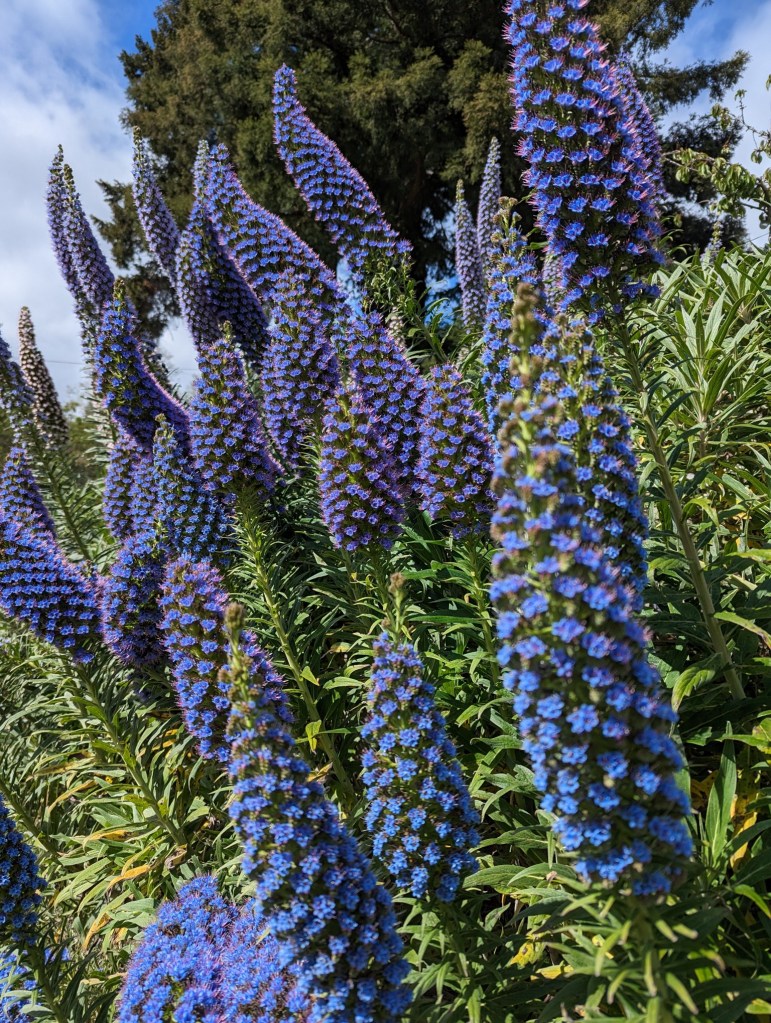
Pride of Madeira

Pride of Madeira blooms through spring.

This is most certainly something to be proud of. Pride of Madeira, Echium candicans (or fastuosum), can bloom perfectly blue. Varieties that bloom white or lighter lavender blue are rare locally. Feral specimens might exhibit such floral color variation though. Bloom occurs only annually, but can last through spring. Butterflies and bees are very fond of it.

Pride of Madeira occasionally self sows, but is not too aggressively invasive. It performs exceptionally well within coastal climates. Feral specimens on inaccessible coastal cliffs are only briefly scruffy after bloom. Deadheading within home gardens is tidier and limits seed dispersion. Moderate watering enhances foliar color. Excessive watering rots roots.

Small new specimens of pride of Madeira grow fast, but perform for only about five years. They generally get about six feet tall and eight feet wide. Cool or foggy coastal weather promotes taller and more vigorous growth. Warm exposure might promote more compact growth. The narrow and grayish leaves are rather raspy. ‘Star of Madeira’ is a variegated and compact cultivar.

Nigella

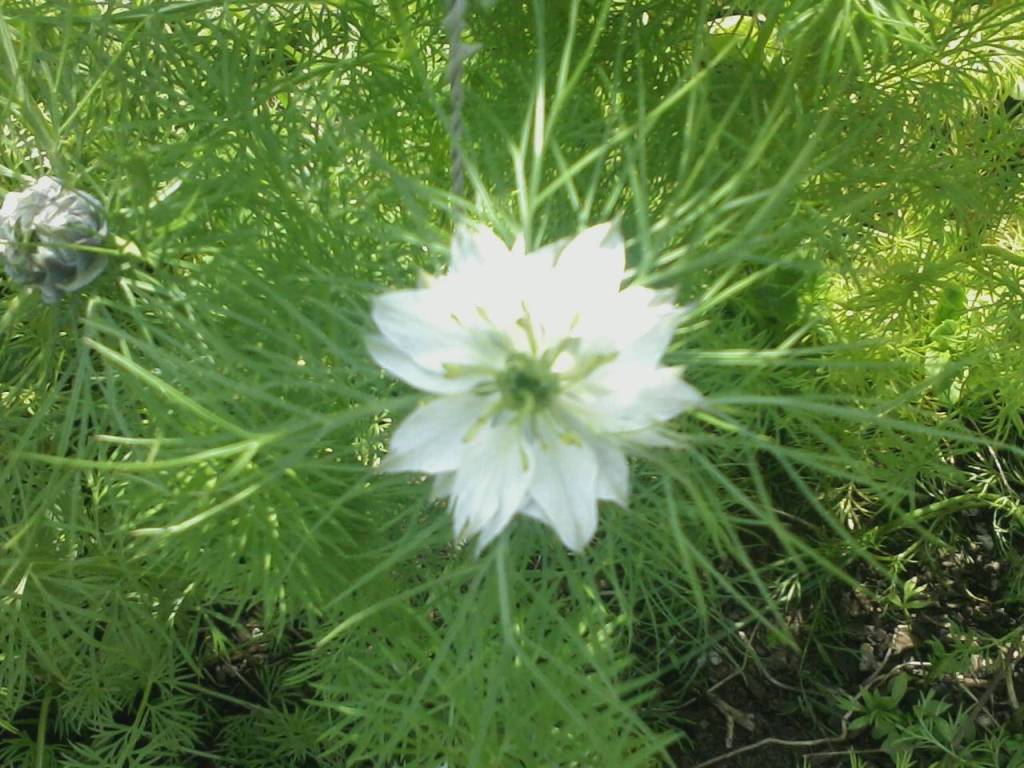
Nigella is more typically blue, but can alternatively bloom white, pink or lavender.

Those who crave blue for the garden probably know nigella, or ‘love-in-a-mist’, Nigella damascena. It blooms in May and June, typically with various shades of pastel blue, or can alternatively bloom pink, lavender or white. The lacy flowers are surrounded by lacier bracts, and suspended on thin stems among delicate pinnately lobed foliage, with very narrow (‘thread-like’) lobes. The plump brown seed capsules that appear over summer after bloom are commonly used as dried flowers. The plants can be half a foot to a foot and a half tall. Although annual, nigella self sows easily, so can grow in the same location for many years if allowed to.

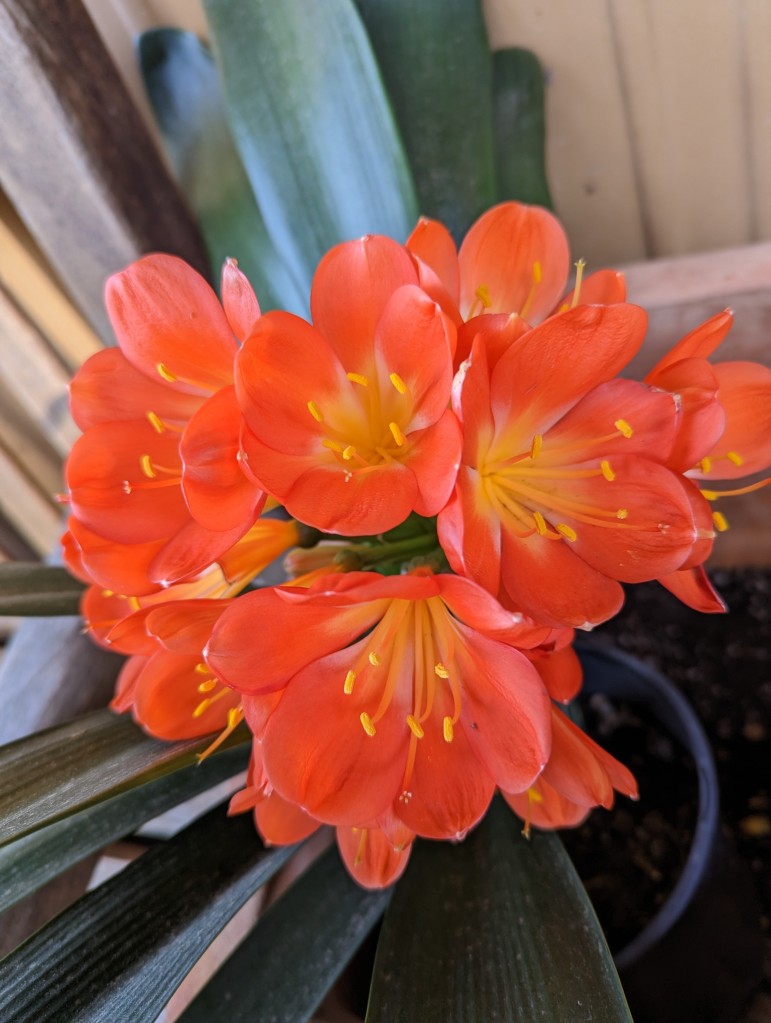
Kaffir Lily

Kaffir lily brightens a shady situation.

Kaffir lily, Clivia miniata, and lily of the Nile seem to be similar but are very different. Both develop densely evergreen mounds of arched strap shaped leaves. Both bloom with many funnel shaped flowers in spherical umbels on upright stems. Even their thick and rubbery rhizomes and roots are similar. However, they are related neither to each other nor to lilies.

Kaffir lily bloom is rich orange, fiery orangish red or yellow. This is opposite of the pastel blue or white floral color range of lily of the Nile. While lily of the Nile requires abundant sunlight, Kaffir lily tolerates significant shade. Kaffir lily leaves and bloom are more stout and less pliable than those of lily of the Nile. Kaffir lily foliage is generally darker green.

Individual leaves of Kaffir lily can be three inches wide and about a foot and a half long. Mounding growth of old colonies can get more than two feet high. Bloom hovers barely above the foliage. A few round and bright red berries can develop after bloom. Individual seeds within each berry may be genetically variable. All parts of Kaffir lily, particularly the rhizomes, are toxic.

Grevillea ‘Canberra’

Most Grevillea are from chaparral climates.

So many similar cultivars of low shrubby grevilleas come and go that it is hard to know what is what. All prefer sunny exposure and good drainage. They really do not like too much watering or fertilizer, particularly fertilizer with phosphorus. Pruning after bloom promotes more bloom, which keeps hummingbirds happy. Some people who are allergic to grevilleas can get a rash from handling the foliage.

Grevillea ‘Canberra’ was probably the most popular grevillea in the early 1990s, but can be hard to find now that other similar grevilleas are more common. It is a mid-sized shrub with dark green foliage that resembles pine needles on arching branches about six feet tall and broad. Small clusters of rosy red flowers bloom along the branches in winter and spring.

Asiatic Lily

Asiatic lily appreciates pronounced winter chill.

Lily is such a generic classification. Kaffir lily, water lily, calla lily, canna lily and many other lilies are not lilies at all. These examples are not even remote relatives. Real lilies are of the genus Lilium. However, even the most familiar of these are hybrids of various species. Asiatic lilies are a group of such hybrids that classify as Lilium asiaticum.

Asiatic lilies go into the garden as dormant bulbs during late autumn or winter. They grow through spring to bloom for early summer. Bulbs require vernalization to bloom, so may not bloom annually within mild climates. Asiatic lilies that are now popular as spring cut flowers grow in greenhouses. Mature bulbs can grow large enough for propagation by division while dormant. Bulbs like rich and evenly moist soil.

Asiatic lily bloom can be white, yellow, orange, red, reddish purple or pink. Many are delightfully monochromatic. Some display spots, stripes or darker centers. Each bulb extends a single stem with a few flowers on top. Each flower extends six flaring tepals in familiar lily form. Unlike most other lilies, Asiatic lilies do not produce enough pollen to be messy. All lilies are toxic to cats.

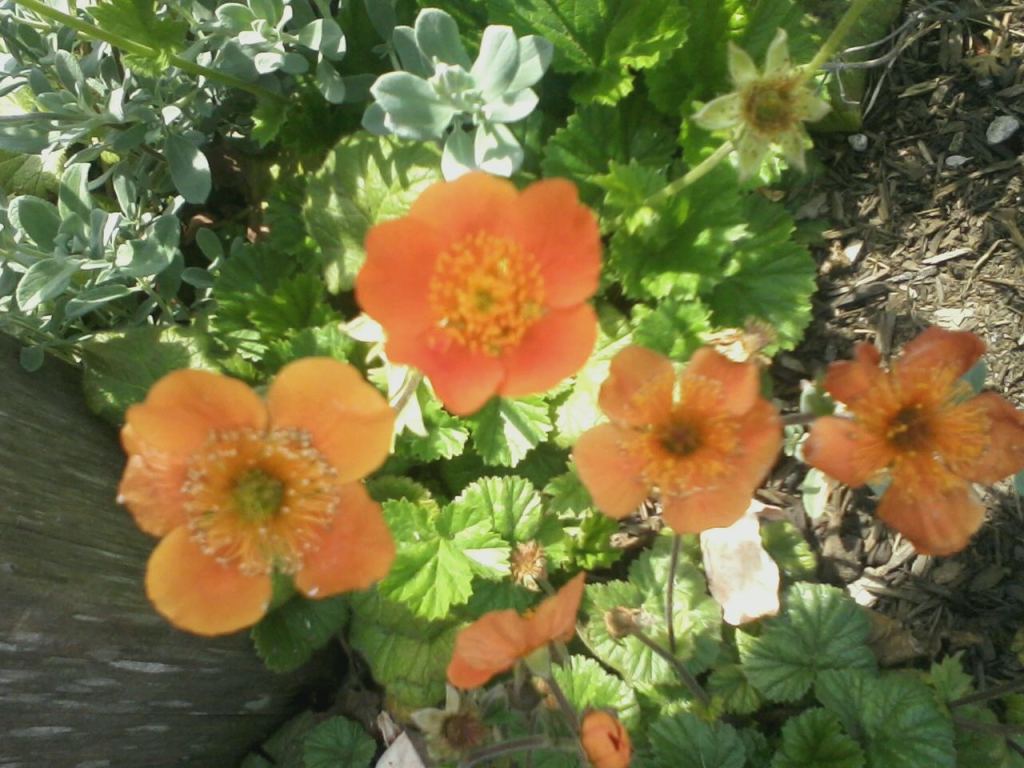
Geum

Geum has rustic appeal.

Old fashioned geum (or ‘avens’), Geum coccineum, was popular in rock gardens of the 1970’s because it clings to stone, and cascades somewhat. In modern gardens, it works just as well in large pots or planters, mixed with other perennials. The fuzzy foliage forms compact mounds about half a foot high and wide. The bright orange flowers with fuzzy yellow centers stand about twice as high, and bloom from spring through summer. Removal of fading flowers promotes continued bloom.

California Lilac

Native California lilac lacks lilac fragrance.

Almost all California lilac that inhabit refined landscapes are cultivars of native species. Ceanothus thyrsiflorus is one of such native species that grows wild near here. It is a bit less adaptable to home gardens than cultivars are. However, it can be splendid within unrefined and wildland landscapes. New plants need irrigation only until they establish their root systems. Wild plants need none.

Wild California lilac can get taller and wider than fifteen feet. That is larger than cultivars, but with more open branch structure. Their evergreen foliage is somewhat glossy. Individual leaves are only about an inch and a half long, with prominent veins. Fluffy floral trusses that bloom in spring are about two or three inches long. Tiny individual flowers are sky blue or pale blue.

Like many chaparral species, California lilac does not respond favorably to pruning. It performs best where it can grow without disruption. Wild specimens perform well for only about ten years. They might then die suddenly. Some may survive for nearly fifteen years. They grow faster with occasional irrigation, but do not survive as long.

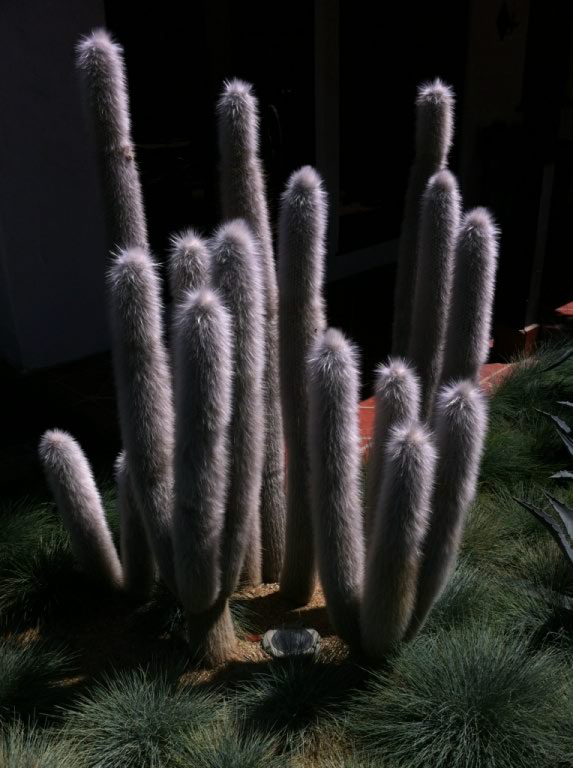
Old Man Cactus

Old man cactus has developed an interesting means with which to shade itself.

The long, white hair of old man cactus, Cephalocereus senilis, that protects it from sun scald in harsh climates is what make it so striking in home gardens. However, the sharp spines concealed by the hair make it more appealing from a safe distance, like in the background behind lower perennials. The white, yellow or red flowers are rarely seen, since they only bloom on old stems that are at least a dozen years old. Such old stems are often cut down to the ground before they bloom because they get too tall and awkward, or because they eventually lose some of their hair as they get too old. There should be plenty of hairier, younger stems emerging from the basal clump to replace the older stems anyway. Individual stems rarely develop branches. Although old man cactus can get quite tall, it is typically kept less than fifteen feet tall.

Coast Live Oak

Coast live oak can get massive!

Valley oak and coast live oak are the two most magnificent oaks of California. Valley oak likely receives more notoriety. It stands taller, and defoliates to expose its sculptural form through winter. Coast live oak, Quercus agrifolia, is almost as grand within its evergreen foliage. It can grow as tall and broad as seventy-five feet, with trunks wider than ten feet.

Coast live oak is notably variable in the wild. Exposed and solitary trees can grow bigger and older than grove trees. They can live for many centuries, and hang their canopies to the ground. Grove trees may not live half as long, and tend to shed shaded lower growth. Solitary trees are likely to survive fire. Grove trees within forests are less likely to survive.

Coast live oak is more appealing in the wild than within home gardens. Regularly messy debris is mildly herbicidal to some delicate plants below. It also stains hardscapes. Trees that matured without irrigation are very susceptible to rot with new irrigation. Landscapes around such trees must therefore demand very little. Roots are very sensitive to damage.