Naked lady

These naked ladies are not shy.

While so many flowers are finishing their bloom and leaving their drying foliage behind, naked lady, Amaryllis belladonna, is just beginning to bloom, naked of any foliage. Clusters of a few to several bright pink flowers stand on bare stems about two feet tall. Individual flowers are about two and a half to three and a half inches long, and resemble lily flowers. Foliage only appears after flowers deteriorate, and lasts only until weather gets warm late in spring. The strap shaped leaves are about a foot to a foot and a half long. Through summer, the two or three inch wide bulbs are dormant and bare, and seem to be dead with their tops visible at the soil surface, but retain fleshy roots below. They should therefore only be dug and divided if they get too crowded or need to be moved.

Saint John’s Wort

Saint John’s wort blooms somewhat late.

Although it shares the same common name, Hypericum beanii is not the same sprawling Saint John’s wort that is now so aggressively naturalized within some local ecosystems. It is shrubbier and much more docile. Mature specimens get no more than three feet high and wide. It should be evergreen here, but can get sparse through cooler winter weather.

Bloom begins in the middle of summer and continues at least to early autumn. Cheerfully bright yellow flowers are two inches wide, with five rounded petals around fuzzy centers. The light green and oblong leaves are about two inches long. Stems are rather wiry, and can eventually get shabby. Coppicing as winter ends stimulates fresher vigorous growth.

Saint John’s wort prefers sunny and warm exposure. It is otherwise not very demanding. Regular watering enhances bloom. Yet, established plants can survive without watering. Where coppicing (cutting back to the ground) in late winter is not a problem, Saint John’s wort performs well as a low hedge, or unshorn border. Frequent shearing inhibits bloom. Rust is a potentially bothersome fungal disease.

Black-Eyed Susan

Black-eyed Susan epitomizes prairie style.

A flower that is so prominent in American culture should have a more appealing name than black-eyed Susan. Even the Latin name, Rudbeckia hirta, sounds bad. Is Becky really so rude? Did she hirt Susan? Well, black-eyed Susan is good enough to be the state flower of Maryland, and is one of the most popular of flowers for prairie style gardens of the Midwest. After all, it naturally grows wild in every state east of Colorado. Here in the West, it is a light-duty perennial that is more often grown as an annual. As a cut flower, it can last more than a week.

In the wild, the three inch wide flowers of black-eyed Susan are rich yellow with dark brown centers, and can stand as high as three feet. The typically smaller but more abundant flowers of modern varieties can be orange, red or brownish orange, on more compact stems. Gloriosa daisies are fancier cultivars, with larger flowers that are often fluffier (double) or patterned with a second color. Individual plants do not get much wider than a foot, with most of their rather raspy foliage close to the ground. All black-eyed Susans bloom late in summer or early in autumn.

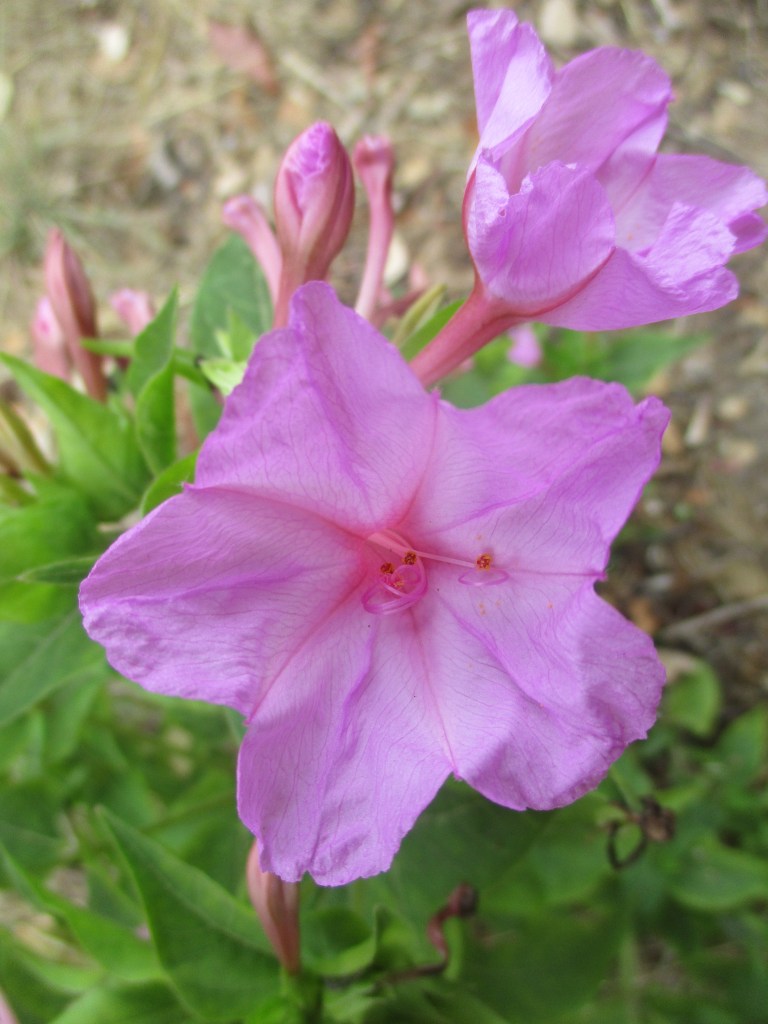
Four O’Clock

Four o’clock is not obsessively punctual.

Most who enjoy four o’clock, Miribilis jalapa, do not grow it intentionally. It tends to sneak into gardens from outside, and then bloom too delightfully to be unwanted. It naturalizes, but not aggressively enough to be a weed. New seedlings develop tuberous roots during their first year. They regenerate to produce abundant seed as early as their second year.

Flowers are supposed to open at 4 o’clock. They may open earlier during warm or humid weather. They remain open through the night, and perhaps for part of the morning. Floral color ranges through white, yellow, orange, red, and many tints of pink. Flowers might be striped or spotted with the other colors. Individual plants might bloom with various colors. 

Mature four o’clock plants do not get much taller than three feet. They might sprawl twice as broad. Rich light green foliage is quite full, and obscures unexpectedly soft and lanky stems with knobby nodes. Bloom continues through most of summer, but decreases with increased seed development late in summer. All growth above ground succumbs to frost.

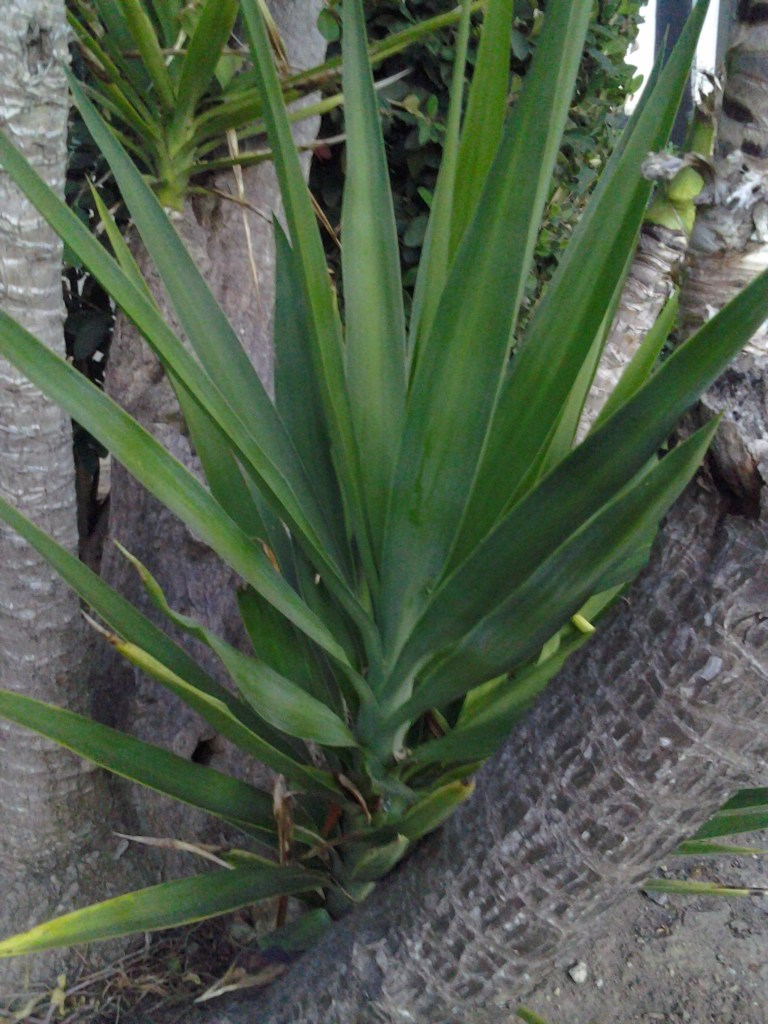
Giant Yucca

Common giant yucca is uncommonly bold.

Like so many of the plants that became too trendy at one time or another, giant yucca, Yucca elephantipes, had gotten a bad reputation. Some people still consider it to be cheap and common. The real problem though, is that some of the countless giant yuccas planted over the years went into situations that can not accommodate their massively distended trunks. Only a few of the largest specimens are taller than a two story house, and not many get broader than tall. However, their several sculptural trunks are remarkably bulky and flared at the ground.

The somewhat rigid and narrowly pointed leaves can get as long as three feet, and as wide as three inches. Foliage is typically slightly yellowish green, or richer green and a bit floppier in partial shade. Spikes of white flowers that bloom in spring are tall enough to stand just above the foliage, but are usually too high up to be too flashy. Individual flowers are actually only about an inch and a half wide. The bold form and texture of giant yucca work will with other bold plants like giant philodendron, various agaves and various cacti. Shoots and stems of any size that need to be pruned away can be stripped of lower leaves and ‘planted’ wherever new plants are wanted. They only need to be watered regularly until they develop roots like really big cuttings.

Catmint

Catmint bloom is like faded denim.

Cats prefer catnip. It makes better tea too. Catmint, Nepeta X faassenii, is prettier though. It sprawls over the ground to get about three feet wide, without getting more than two feet deep. Where well exposed, it may not get much deeper than one foot. The aromatic gray foliage is denser than that of related catnip. Its individual leaves are small and furrowed.

Bloom begins with warming spring weather, and continues until cooling autumn weather. Individual flowers are tiny, and suspended on small floral stems. They just happen to be very abundant. Warmth stimulates phases of exceptionally profuse bloom. Floral color is light or pale blue, like faded denim. Shearing to deadhead enhances profusion of bloom.

Catmint works well as a rustic border or a ground cover for small areas. Alternatively, the blue bloom can be a delightful component of mixed perennials, in beds, planters or pots. Deer generally ignore catmint. Bees most definitely do not. They swarm it! ‘Walker’s Low’ is the most popular cultivar. It may be all that is available in some regions. Catmint is sterile, so generates no seedlings.

Lantana

Lantana sports two colors per bloom.

All flowers that need help with getting pollinated do what they can to attract pollinators. The tiny flowers of lantana, Lantana camara, actually put forth a bit of extra effort to improve the efficiency of their pollinators, by becoming less attractive once pollinated. Within each tightly set flower cluster, pollinated flowers fade to an alternate color to inform pollinators that their services are no longer needed. This prioritizes flowers than still await pollination. Consequently, each small cluster exhibits flowers of two different colors. The choices are red, orange, yellow, pink, purplish pink or white.

The small and aromatic leaves are arranged in alternating pairs on thin stems that do not get much higher or wider than three feet. Established plants can survive with very minimal watering, but bloom better with somewhat regular watering. The summer bloom is very attractive to butterflies.

Trailing lantana, Lantana montevidensis, has limber stems that sprawl a few feet over the ground without getting a foot deep. It cascades nicely over retaining walls or from large planters. Flowers are shades of lavender, or sometimes white.

Coleus

Coleus works both inside and out.

Without bloom, the richly vibrant foliar colors of coleus, Coleus scutellarioides, rival floral color of other warm season annuals. Striking foliar patterns are as exquisite as any floral display. Growth is efficient through the warmth of spring. Foliage might last until autumn. Late in its season, spikes of tiny blue flowers can be trimmed off to promote more foliage. 

With bright ambient sunlight, coleus is more perennial as a houseplant. However, it may get persistent with pesky bloom as it matures. Some who grow it prefer to let bloom, and then prune it back afterward. Recovery from such pruning can be slow. Vegetative stems, without bloom, root easily as cuttings even in water. New cuttings can replace old plants. 

Coleus foliage is intricately variegated with countless combinations of green, chartreuse, yellow, orange, red, burgundy, pink, white and brown. Variegation can be symmetrical or random. Leaf margins may be deeply lobed or just serrate. Modern cultivars might be no better than old fashioned sorts. Mature plants can get as tall and broad as about two feet. Some stay lower.

Creeping Thyme

Creeping thyme is pleasantly aromatic, but not quite as flavorful as culinary thyme.

Trendy landscape designers like to set flagstone walkways slightly out of step to compel visitors to the garden to stroll through a bit slower. Between the stones, it is in style to grow creeping thyme, Thymus spp., as a very shallow groundcover that relinquishes its delightfully herbal aroma with any misstep. It stays too low to trip on, tolerates a bit of trampling, and needs only minor trimming where it creeps a bit too far onto stones or pavement. Creeping thyme can also be plugged into retaining walls of broken concrete or stone. The grayish green foliage is very finely textured. While the weather is warm, minute lavender flowers bloom in subdued phases that come and go slowly. Some varieties have more pinkish flowers, lighter green foliage or exhibit different aromas.

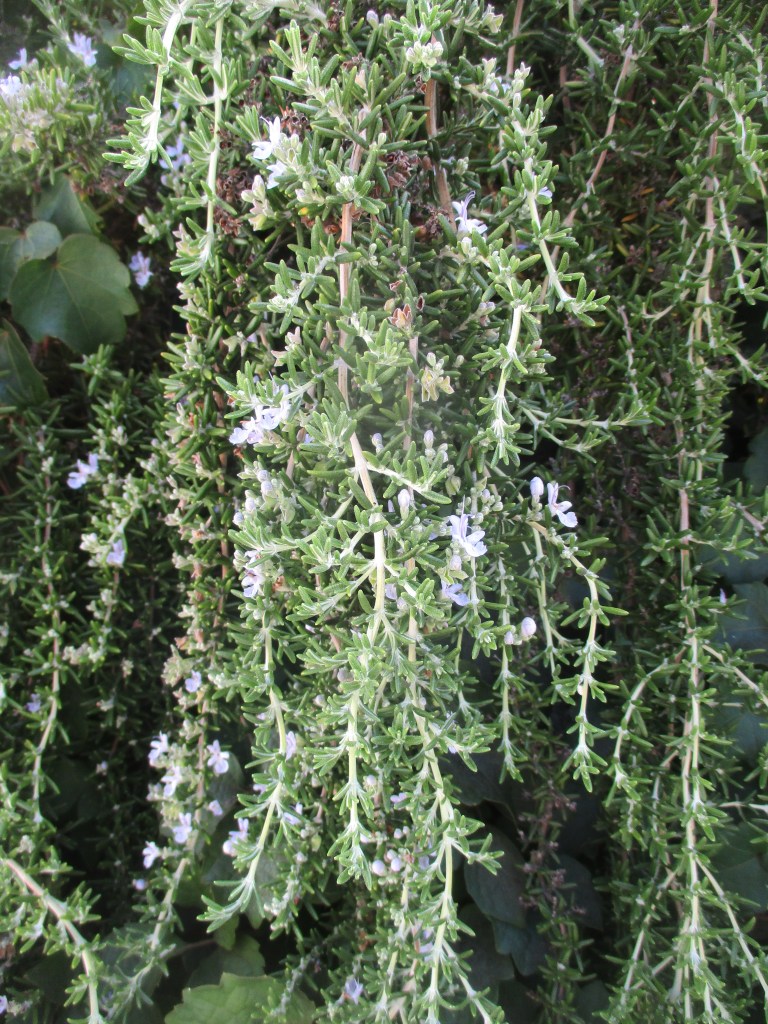
Rosemary

Trailing rosemary cascades over retaining walls.

It is as familiar for culinary application as it is for home gardens, even with its new name. Rosmarinus officinalis is now known as Salvia rosmarinus, but the common name is still just rosemary. Like many Mediterranean culinary herbs, it is a member of the Lamiaceae Family. Since it is native to Mediterranean regions, it is quite happy within local climates. 

While many culinary cultivars of rosemary are shrubby or upright, the most popular home garden cultivars are trailing types. Trailing rosemary disperses its woody stems laterally, but can eventually get deeper than two feet. Shrubbier cultivars get at least twice as high in less time. The finely textured dark green foliage is evergreen and pungently aromatic.

Bloom is generally most profuse from late spring through the middle of summer, but may never really stop. It can continue in sparser sporadic phases whenever the weather gets warm, and even throughout the year. The tiny flowers are various shades of blue. Purple, white and pale pink bloom is very rare. Bloom is appealing to bees and other pollinators, including hummingbirds.