Pittosporum tobira

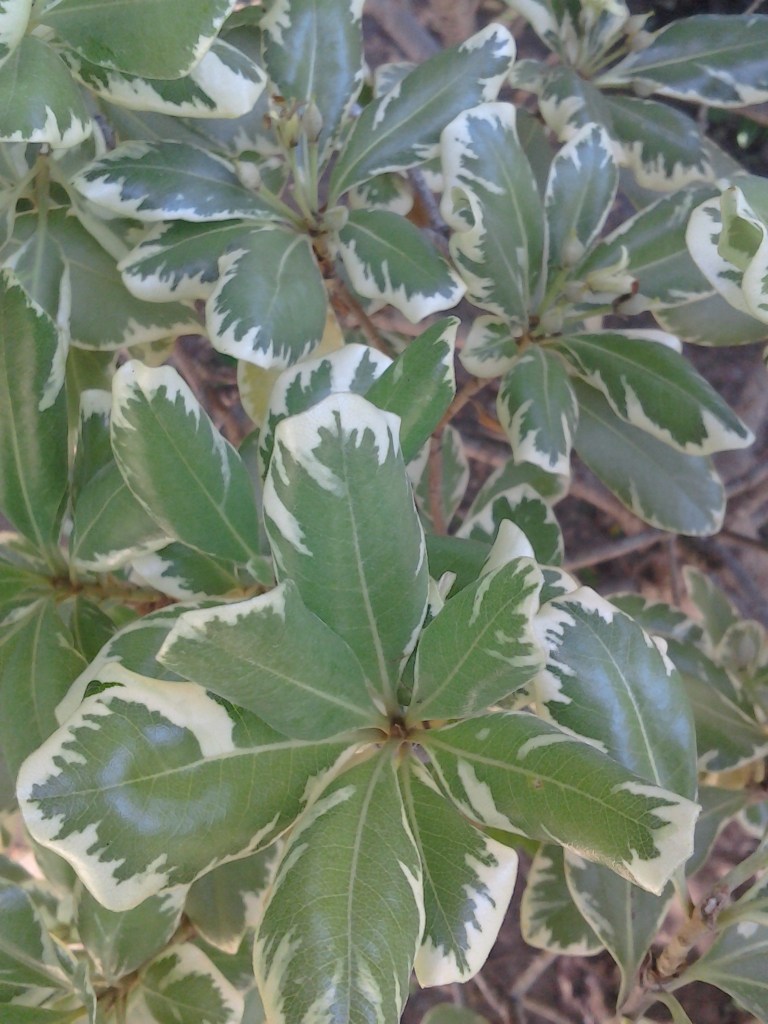
There are too many other plants known as ‘mock orange’ for Pittosporum tobira to still go by that name, which is why it is more commonly known by its Latin name, or simply as ‘tobira’. The pleasantly fragrant flowers do not smell too much like those of orange anyway. The glossy and dark green leaves are like those of some hollies, without the distinctive prickly points. ‘Variegata’ has lighter green foliage variegated with white, but does not bloom as much. Dwarf cultivars, both variegated and unvariegatd, bloom even less. ‘Variegata’ has a tendency to occasionally produce stems of green (unvariegated) foliage that grow more vigorously and can overwhelm the original variegated growth if not pruned out. Common green Pittosporum tobira can grow as a small tree in the partial shade of larger trees, but is more often maintained as dense shrubbery less than ten feet tall. It makes a nice dense hedge in full sun, but unfortunately does not bloom if shorn regularly. All cultivars are resilient to drought once established.
Algerian Ivy

Algerian ivy is big and bold.

Like so many fad plants that were formerly too popular, Algerian ivy, Hedera canariensis, now has a bad reputation. Ironically though, it earned its reputation for doing what it does best. It covers ground rapidly and efficiently. The problem is that it never seems to stop. It creeps anywhere it can, and climbs trees, fences and anything else that it can grab onto.

Aerial roots of climbing vines ruin paint and stucco, and accelerate rot of wooden fences and walls. Vines that get between planks or into cracks between bricks cause significant damage as they expand. Shrubby adult growth that blooms and produces seed develops where climbing vines reach the top of their support, or spontaneously in sunny locations. 

Nonetheless, with diligent edging for strict confinement and to prevent climbing, Algerian ivy works well as a resilient evergreen ground cover for large areas. Once established, it excludes weeds, and tolerates quite a bit of shade. Shrubby adult growth is uncommon if vines can not climb. Climbing vines may be harmless on bare reinforced concrete walls.

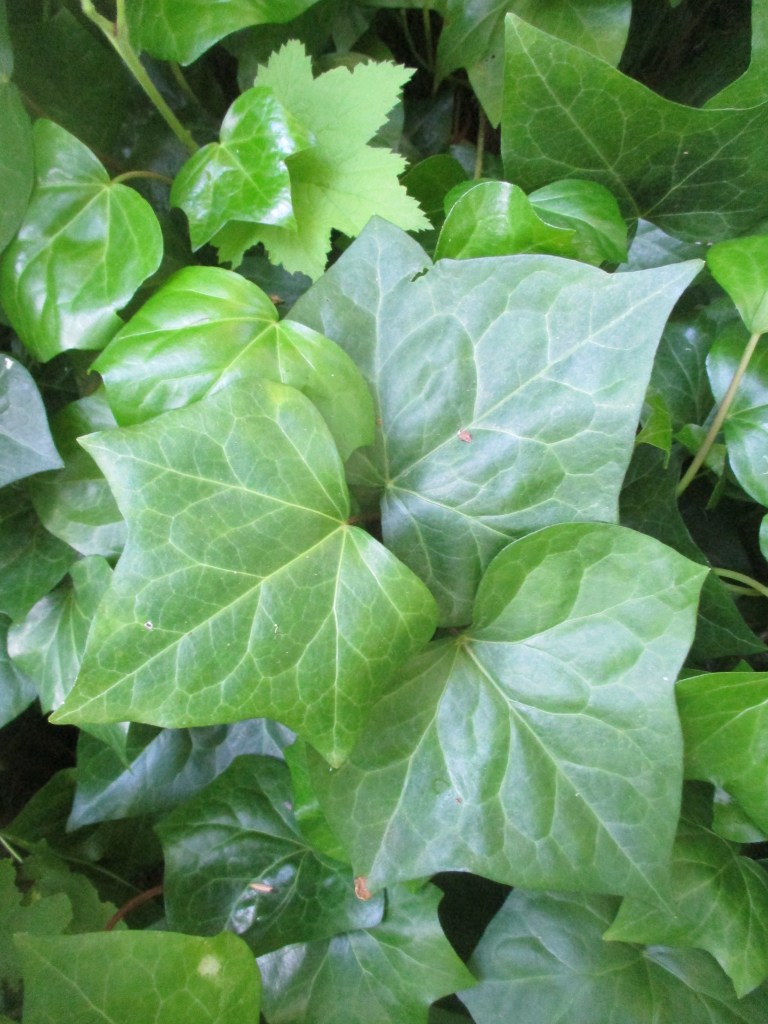
Algerian ivy is neither as finely textured nor as shallow as English ivy. Its broader leaves are about six inches wide, with blunter lobes. They stand higher on longer and distinctly blushed petioles. Algerian ivy is rare in nurseries now, but inhabits old landscapes, from which it sneaks into adjacent landscapes. Variegated cultivars are slightly more passive. 

Box Elder

Box elder is the ‘other’ maple.

No other maple is native to so much of North America as the common box elder, Acer negundo. Yet, because of innate structural deficiency and a general lack of pizazz, it is also one of the least popular. The smaller and more adaptable garden varieties are more often grown for their interestingly colorful foliage. ‘Flamingo’ starts out with pink, white and pale green foliage that turns richer green and white by summer. ‘Violaceum’ has smokey purplish new foliage that fades to rich green. ‘Auratum’ has yellowish foliage that fades to chartreuse green. Any stems that try to revert to a more natural shade of green should be removed before they dominate. Unlike other maples that have distinctively palmate leaves, box elder has compound leaves with three or more leaflets each.

Black Locust

White black locust bloom seems oxymoronic.

The natural ranges of black locust, Robinia pseudoacacia, likely included only the Ozark Mountains, the Ouachita Mountains, and the Appalachian Mountains south of New York. Early American colonists planted it elsewhere before botanists documented its origins. It was notably used for firewood, durable lumber, erosion mitigation, and soil conditioning.

Modern cultivars are less useful for such applications, but are more appropriate for home gardens. Regardless of elegantly lofty form, delightfully finely textured foliage, and richly fragrant white bloom, the species is aggressively invasive and wickedly thorny. Cultivars can bloom pink or rosy pink, lack thorns, and develop more compact and shapely forms.

Bloom resembles that of wisteria, with many small flowers hanging in pendulous trusses. Deciduous foliage, which was absent through winter, appears in conjunction with bloom, but does not obscure it. Individual leaves are pinnately compound, with small leaflets on central rachises (stalks). Most modern cultivars will not get much more than forty feet tall, to make moderate shade.

Peony

Peonies are unusually happy this year.

The fact that peonies do not perform well in such mild climates does not dissuade some of us from growing them. After all, they can sometimes be found in local nurseries and even farmers’ markets as if they belong here. Tubers of more of the countless varieties can be purchased online or from mail order catalogs while dormant in autumn. Unfortunately, without much winter chill, few peonies perform as they should.

Peonies can be white or various shades of pink or red, with considerable variation of flower structure. Tree peonies that bloom yellow are the most likely to be wimpy without winter chill. All peonies are good cut flowers. After spring bloom, the distinctively coarse and rich green foliage stays until autumn dormancy. The more popular herbaceous peonies should not get more than three feet tall and broad. Tree peonies do not actually grow into trees, but develop woody stems that can hold flowers nearly six feet high. Larger flowers may need support.

Because plants get established so slowly, they should not be moved or disturbed. Small new plants can be divided from larger plants while dormant, but take a few years to actually bloom. Peonies like rich soil and regular watering, where they do not get crowded or shaded by other plants.

Periwinkle

Periwinkle is pretty for a weed.

Dwarf periwinkle, which is a vigorous but manageable ground-cover here, is an invasive weed in other regions. Locally, common periwinkle, Vinca major, is the more aggressive sort. It naturalizes in riparian situations and damp parts of unrefined landscapes. Stolons can be difficult to pull completely from the soil. Seed disperses secretively but efficiently.

Periwinkle is almost never available in nurseries nowadays. It tends to infest gardens by sneaking in. Then, the foliage and bloom can be too appealing to eradicate. More plants are easy to divide from established colonies. Growth is tidier if mown at the end of winter. As it regenerates, it gets more relaxed, and finally gets floppy. It looks shabby if trampled. 

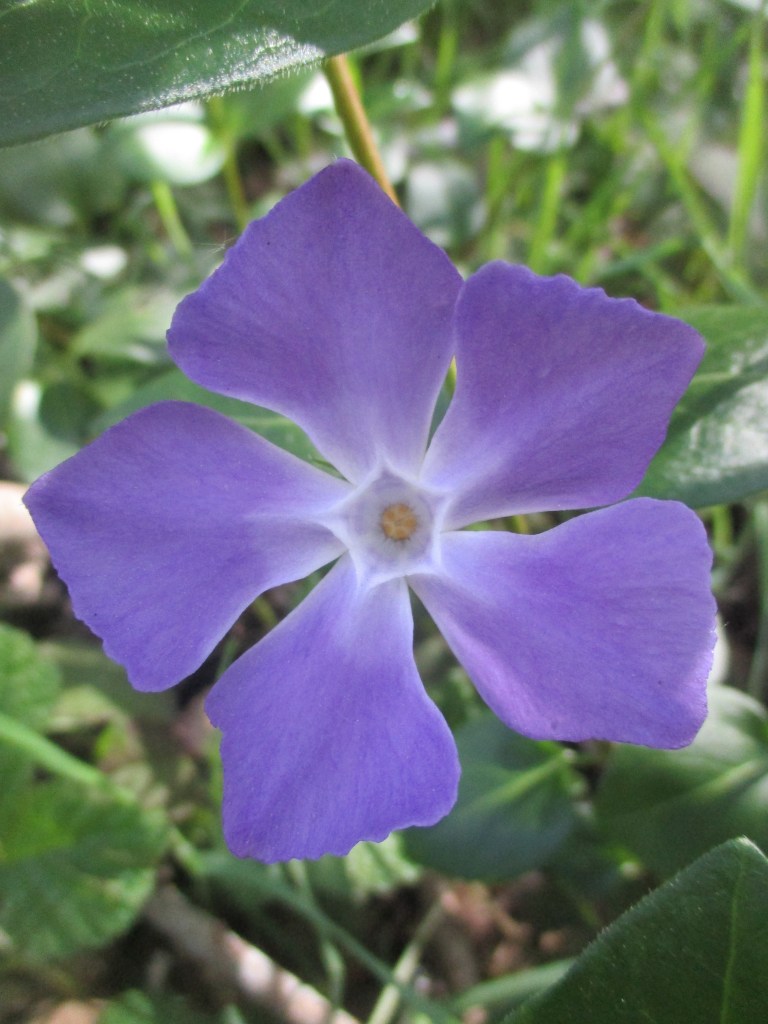
Periwinkle blooms with sporadic but delightfully clear blue bloom. Individual flowers are about an inch and a half wide. The evergreen leaves are an inch or two long. Wiry stems get a foot or two deep. Cultivars with white or purplish blue bloom were available before  

periwinkle naturalized. Periwinkle with foliar variegation still inhabits some old gardens. It is slightly more complaisant.

Rockrose

Harsh exposure is fine for rockrose.

The few rudimentary rockroses that were available years ago have been bred into too many cultivars to keep up with. Some of the traditional types can get a few feet tall, with delightfully irregular growth, and flowers that are almost three inches wide. Most of the modern types are relatively dense, low and mounding, like a deep ground cover, with smaller but more profuse flowers. Most bloom pink. Some bloom white. After the initial spring bloom phase, a few flowers continue to bloom sporadically through summer. The grayish and aromatic foliage is not as impressive as the bloom. Rockroses want well drained soil and good warm exposure.

English Daisy

English daisy or a British Invasion?

Garden varieties with fluffier white, pink or pinkish red flowers, and more mounding foliar growth, are popular annuals. With grooming, they might survive as short term perennials. The more familiar form of English daisy, Bellis perennis, though, is a persistent perennial that commonly infests lawns. Stems stay very low. Flowers are white with yellow centers. 

Some consider English daisy to be a noxious weed in turf. Others like its random drifts of white bloom on otherwise plain lawns. English daisy works nicely as a rustic component of mixed perennials too. The common weedy form is unavailable in nurseries, but is very easy to divide from established colonies. Once established, it is impossible to eradicate.

Bloom is most profuse about now, and can continue in random minor phases until cooler weather late in autumn. Sporadic bloom is possible during winter. Warm and dry weather during summer can inhibit bloom temporarily. English daisy prefers partially shaded sites and steady watering. Flowers are an inch wide. The spatulate leaves are less than two inches long.

Bearded Iris

Pastels are perfected by bearded iris.

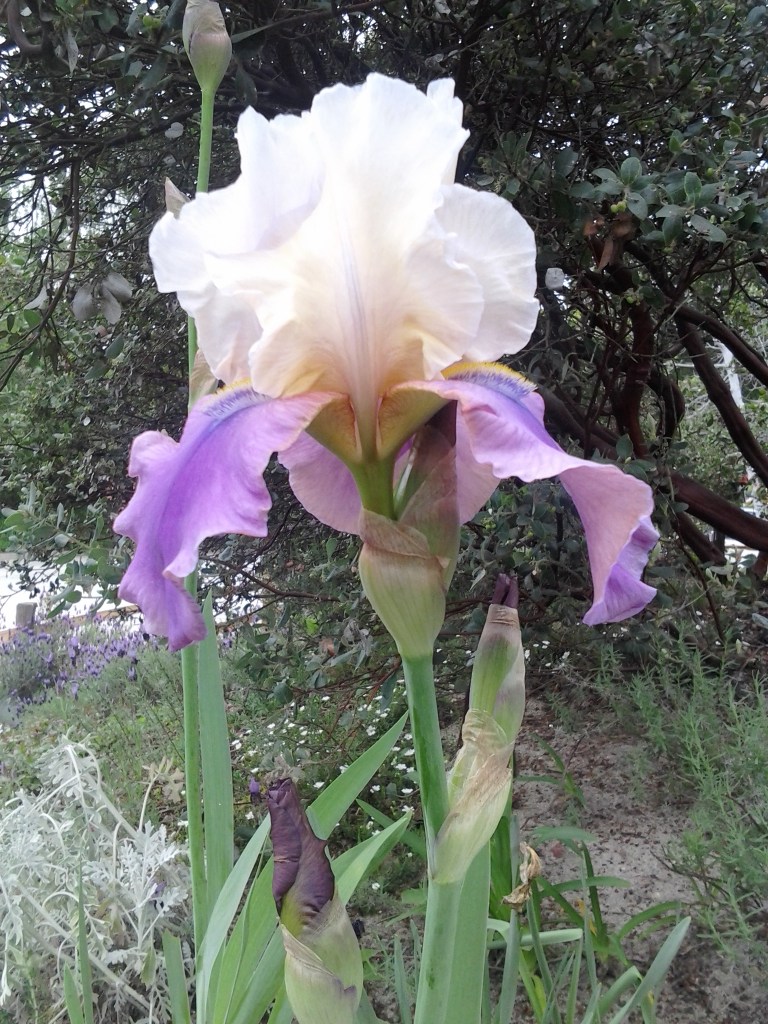
When there is not an app for that, there is probably a bearded iris that will work just fine. Really, there is just about every shade of yellow, blue, purple, orange, pink and almost-red imaginable, ranging from wildly bright to subdued pastel. There are actually several shades of white, and a few rare flavors of dark purplish black.

It seems that the most popular of the bearded iris bloom with two or more colors. The standards may be very different from the falls. Any part of the flower may be striped, spotted, blotched or bordered with another color. Flowers may be relatively simple or garishly ruffled. Many are fragrant.

Bearded Iris bloom between March and May. Some of the modern varieties bloom again in autumn. Flower stems can be as short as a few inches, or as tall as four feet, with only a few to several flowers. The rubbery and somewhat bluish leaves form flat fans that look neater if groomed of deteriorating older leaves. Each fan dies back after bloom, but is efficiently replaced by about two more new fans. Colonies of fans should be divided over summer every few years, or as they get too crowded to bloom well. Bearded iris likes well drained soil and at least six hours of direct sun exposure daily.

Lithodora

Lithodora has more names than colors.

Both the common and botanical names of lithodora are variable. Many know it as purple gromwell. The botanical name can be either Lithodora diffusa or Glandora diffusa. Many of the cultivars lack their species name after one of these two genus names. There might be less variety with the cultivars than with the names! Floral color is the primary variable. 

White blooming ‘Alba’ is uncommon. After all, lithodora is popular for its rich blue bloom, which ranges from light sky blue to indigo. As the name implies, ‘Blue Star’ flowers have a white edge around a blue center. ‘White Star’ flowers have blue around white. Flowers are tiny but profuse in sunny situations. The dense evergreen leaves are likewise small.

Mature plants are generally only a few inches deep and perhaps two feet wide. They can eventually get more than six feet wide by rooting as they migrate. Although they grow too slowly for large scale ground cover, they work nicely in a sunny atrium, around boulders, or with mixed perennials. Lithodora is susceptible to rot in pots or if watered to frequently.