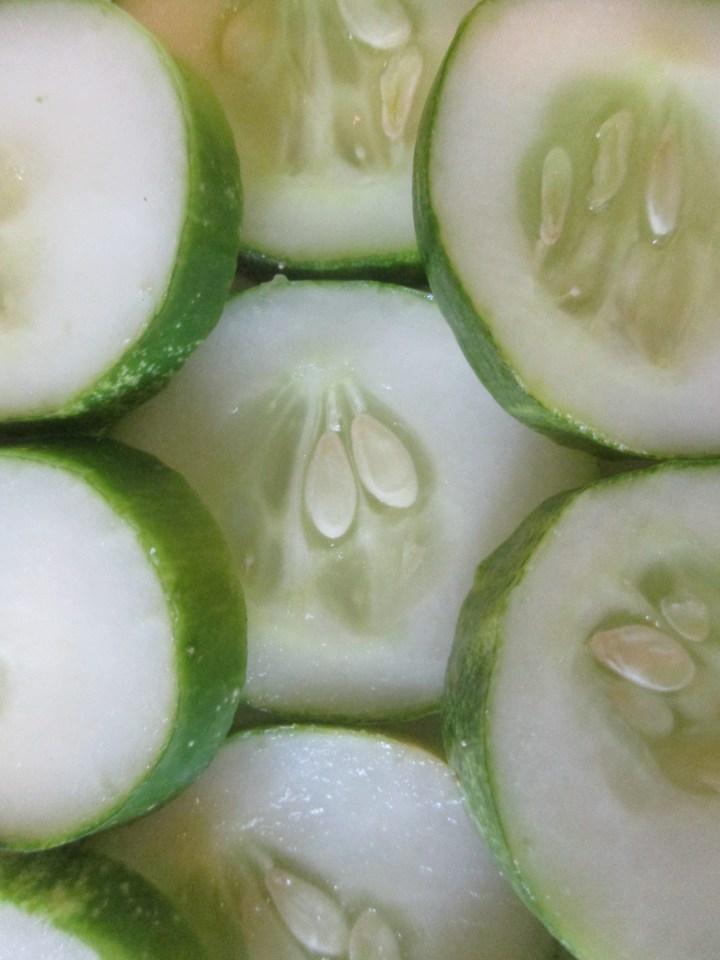
Cucumber

00902
Cucumber can ripen in summer too.

Is it a winter vegetable or a summer vegetable? Technically, like many vegetables, cucumber, Cucumis sativus, is actually a fruit. It dislikes the locally arid warmth of summer, but also is intolerant of winter frost. It performs best through spring and autumn. Seedlings grown as winter ends should be ready for transplant after the last frost. Vines grown now produce a bit more before first frost.

However, in some gardens, some varieties of cucumber can remain productive all summer. Discolored older foliage is more unsightly than detrimental. Newer growth cascading from above might obscure some of it. Vines can climb trellises or over shrubbery. If vines sprawl over soil, the fruit will stay cleaner if set on leaves or newspaper. Regular harvesting promotes continued production.

Most cucumbers are classified as slicing, pickling or seedless cucumbers. There are many varieties within each classification. The most popular are only a few inches long, and harvested before maturity. The largest cucumbers are as long as two feet, and as wide as four inches! Hot weather unfortunately causes cucumbers to be bitter. Rich soil and regular irrigation promote better flavor.

Sea Foam Statice

50819+
Statice flowers last fresh or dried.

Many of us who already grow sea lavender, Limonium perezii, might wonder why it is a topic for August. In the mildest spots, it gets more credit for blooming in winter while most other plants are dormant. Yet, it is actually classified as a summer blooming perennial because it blooms more reliably though summer in most places.

Bluish purple blooms stand more than two feet tall, just above coarse mounds of evergreen basal foliage that gets more than two feet wide. Each billowed bloom contains many tiny flowers. Larger blooms are too heavy to stand upright, so they lay down on the foliage. The weirdly wavy leaves are on such long petioles (leaf stalks) that they may lay down too.

Established plants do not need much attention or water. Faded bloom should be pruned away. It is not practical to remove all of the faded foliage. Every few years or so, old plants can be reinvigorated by getting divided. Newly divided rhizomes will need to be watered regularly until they disperse their roots. Sea foam statice likes full sun exposure.

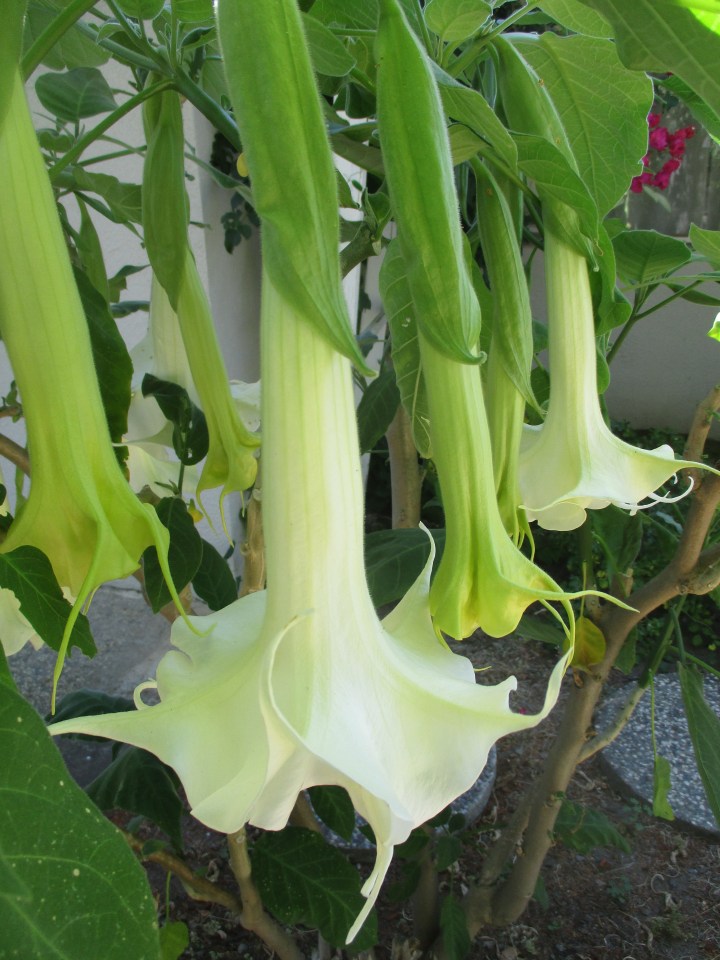
Angel’s Trumpet

00826
Powerful fragrance combines with docile color.

Human intervention has sustained the seven species of angel’s trumpet, Brugmansia, since their prehistoric extinction from the wild. They were likely endemic to tropical regions from Venezuela to Chile, and southeastern Brazil. Their extinction was likely a consequence of the natural extinction of animals that dispersed their seed. Most garden varieties are hybrids of the various species.

Angel’s trumpet is either a big shrub or small tree, with rather herbaceous stems. The more popular cultivars can get more than eight feet tall. Cultivars that might get twice as tall are rare. The soft leaves get about six inches long and half as wide. Leaves might get almost twice as long on vigorous growth. Some cultivars have slightly tomentous (fuzzy) foliage. A few have variegated foliage.

Although generally sporadic, and pastel hues of pink, orange, yellow or white, bloom is impressive. The pendulous trumpet shaped flowers are commonly longer than six inches, and half as wide. Double flowers are frilly. Several cultivars are delightfully fragrant, particularly in the evening. All plant parts are very toxic. Plants damaged by frost in winter are likely to regenerate from their roots.

Plumbago

50812+
Few blooms are this blue.

There are not many flowers as blue as those of plumbago, Ceratostigma plumbaginoides. Individual flowers are not much more than half an inch long, but can be quite abundant until autumn. Each of the many terminal flower clusters is on a rather reliable schedule, so that new flowers begin to open as older flowers begin to fade.

Thin stems stand only about half a foot to a foot above underground rhizomes. Individual plants get about 3-feet wide, but realistically, will slowly spread farther if conditions are right. They do not spread fast enough to be invasive, but can get into some unexpected spots if not controlled. The simple leaves are about two inches long.

The main problem with plumbago is that it is deciduous, so it dies back to the ground in autumn. The weather is too mild here to produce the good fall color seen where autumns are cooler. Plumbago is a popular bulb cover because new growth, although slow to develop, emerges just in time to obscure fading foliage of early spring bulbs like daffodil and tulip.

Plumbago also works well with stone, since the stone is still appealing without the foliage through winter. The wiry stems weave nicely through otherwise bare cobbles, or spill slightly over low stone walls. Even though shade inhibits bloom, plumbago makes a nice informal ground cover under open shrubbery.

Camphor Tree

00819
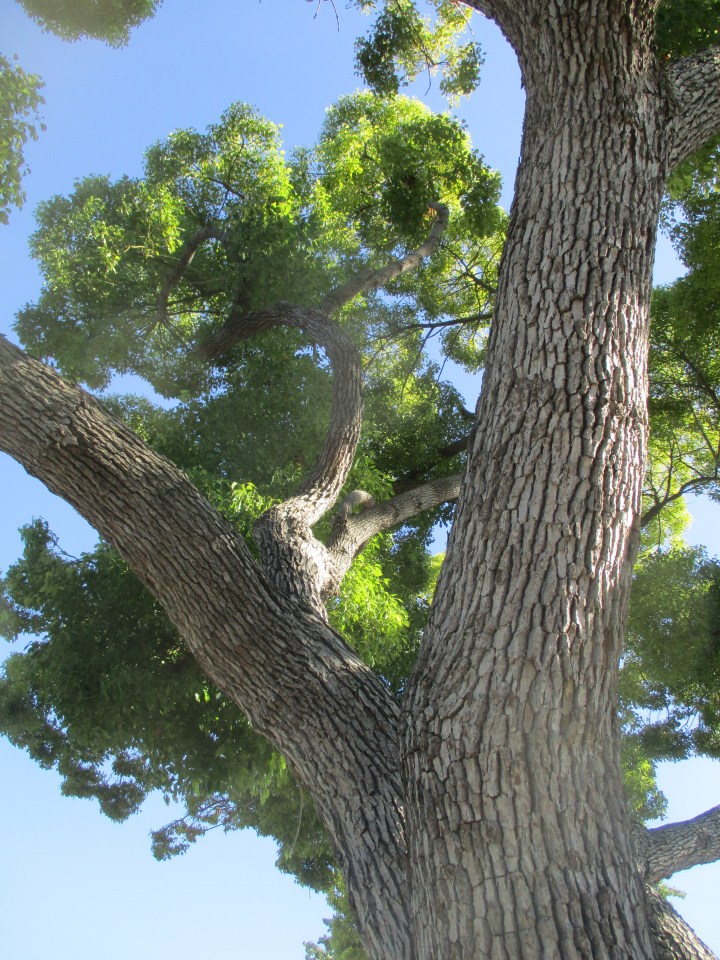
Camphor trees have stout branch structure.

The best camphor trees, Cinnamomum camphora, are in parks and other spacious landscapes. Such trees have sufficient room for their broad canopies. Although they do not grow rapidly, they eventually get quite large, and perhaps too massive for confined urban gardens. Some of the older local trees are nearly fifty feet tall, and nearly as broad. They have potential to get much bigger.

Camphor trees excel as shade trees. Their light green or perhaps yellowish evergreen foliage is quite dense. Shade of groups of trees or large trees with low canopies inhibits the growth of lawn grass. Also, roots are likely to eventually elevate lawn or other features that are close to the trunks. Foliar canopies are billowy, but can be lopsided, especially in windy or partly shaded situations.

Trunks and main limbs of camphor trees are rather stout, and can be rather sculptural. Trees should be pruned for clearance while young. Otherwise, obtrusively low limbs can become prominent components of the canopies. The tan bark is distinctively checkered. It darkens handsomely with rain. All parts of camphor tree are quite aromatic. Frass from spring bloom can be slightly messy.

Himalayan Birch

50805+
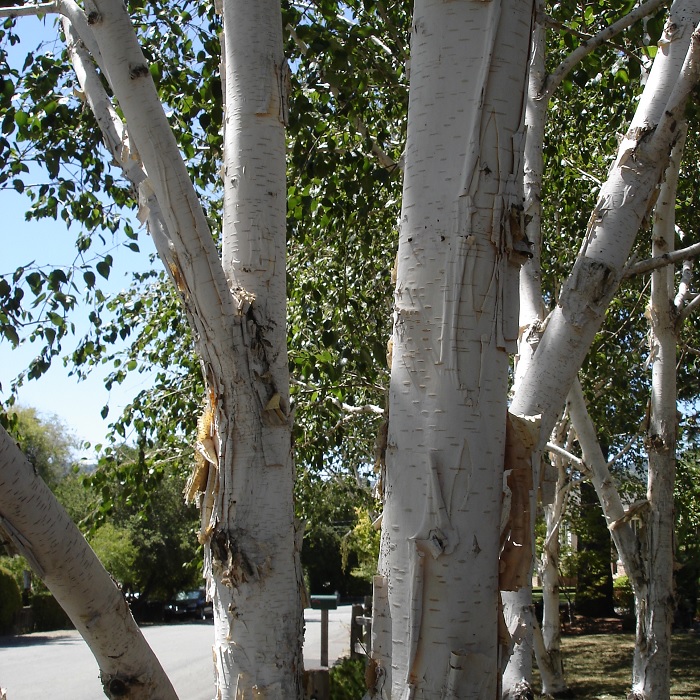
The white bark of Himalayan birch is even more striking that that of European white birch.

Himalayan birch, Betula utilis ‘Jacquemontii’, must not be confused with the more traditional European white birch! If young trees get added to established groves of European white birch, they will never fit in. Their trunks stand vertically rather than lean casually. Their limbs are upright and angular instead of softly pendulous. Their bark is actually whiter.

Mature trees can get taller than thirty feet without getting much more than half as broad, and are relatively symmetrical for birches. The form of any single exposed tree is generally conical, although several trees together adapt to develop as picturesque groves with fewer interior limbs. The shade below is not too dark for lawn or moderately shade tolerant plants.

Maintenance is not exactly minimal. Vigorous young trees should be pruned and groomed annually, or at least every few years. Pruning should not be done in early spring when sap is likely to bleed from pruning wounds. Roots want to be watered somewhat regularly, even through the drought. When they fall in autumn, the two inch long leaves can be difficult to rake from fine gravel or bark.

Bougainvillea

00812
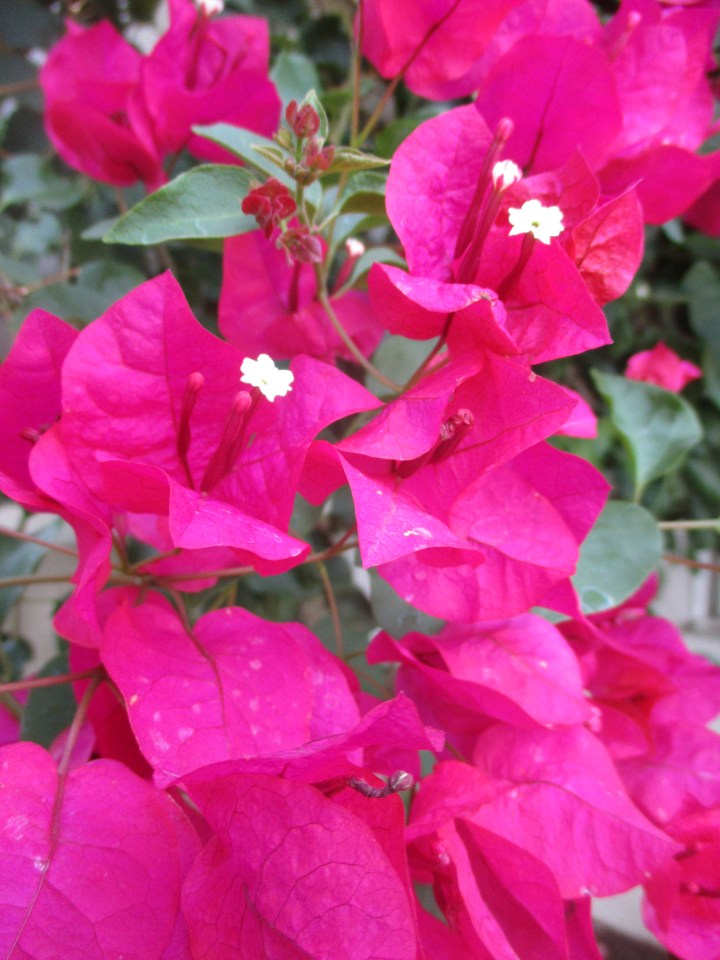
Bougainvillea is profuse and vividly colorful.

No other bloom is comparable to that of bougainvillea. It is often profuse enough to nearly obscure the foliage. The color is remarkably vibrant. Magenta is the most popular color. Purple might be the second most popular color. Other cultivars bloom in delightfully rich hues of pink, red, orange, yellow and white. Some bloom with double flowers. A few dwarf cultivars have variegated foliage.

Bougainvillea is a thorny vine that leans on its support, rather than cling to it. Like climbing roses, it must be tied or woven into trellises. Larger cultivars can mix with the branches of trees and big shrubs to eventually reach more than thirty feet high. Many cultivars stay much lower. Some grow slowly, and do not get more than three feet tall. The lush foliage is evergreen with regular watering.

However, bougainvillea does not want too much water, and actually prefers to get a a bit dry between regular irrigation. Excessive irrigation may promote vegetative growth while inhibiting bloom. Excessive fertilizer does the same. Sunny and warm exposure promotes fuller bloom. In late spring, the first and most profuse of perhaps a few bloom phases can continue for more than a month.

Santa Barbara Daisy

50729-c
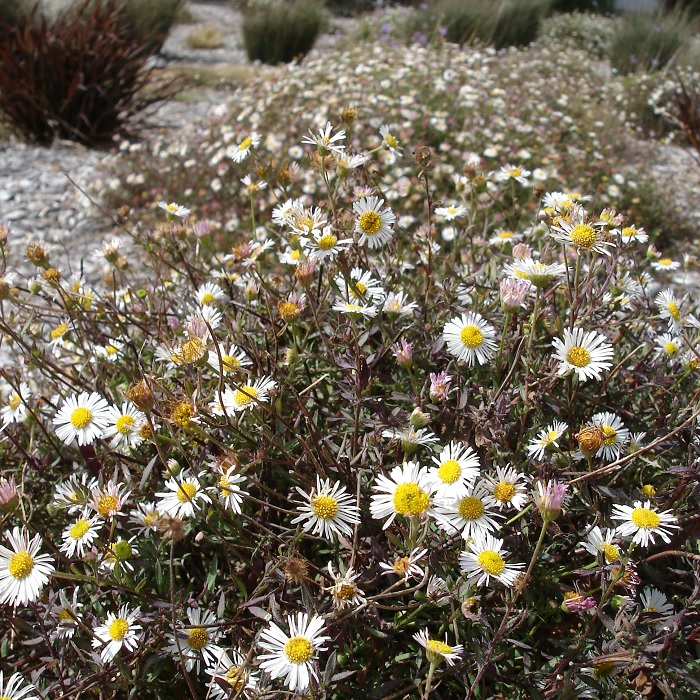
Some of us know Santa Barbara daisy by the less appealing name of ‘fleabane’.

Santa Barbara was not exactly its first choice. Santa Barbara daisy, Erigeron karvinskianus, is not even native to California. It is actually from Central America. It just happens to do very well here, and can naturalize if conditions are right. It can be rather grungy through summer in the wild, but with a bit of watering, it can bloom nicely all year.

The thin stems can spread a few feet without getting more than a foot deep. If even shallower growth is preferred, older plants can be cut down or pulled up as they get replaced by their own offspring. The narrow leaves are quite tiny. The white or slightly pinkish flowers are not much bigger, less than half an inch wide, with prominent yellow centers.

Santa Barbara daisy is also known as Mexican fleabane, both because it is actually native to Mexico, and also because it is supposedly useful for repelling fleas. The problem with using it to repel fleas is that only its smoke is effective. There are probably other herbal alternatives that work just as well without being a fire hazard.

Lily Of The Nile

00805
Agapanthus bloom looks like Independence Day.

It is no lily, but it does live on the banks of the Nile River. Lily of the Nile, Agapanthus africanus, endures both long dry summers and winter flooding. While inundated, it clings to the silty soil with a sturdy network of rubbery roots. Densely mounding foliage regenerates as floodwater recedes. If conditions get exceptionally warm and dry, foliage may eventually shrivel after midsummer bloom.

Home gardens are certainly more hospitable than the floodplains of the Nile River. The luxuriant foliage of lily of the Nile is evergreen locally, even if irrigation is minimal. The rubbery leaves get as long as two feet, arching outward from basal rosettes. New foliage obscures deteriorating old foliage. Plants that get too congested to bloom well might benefit from division of individual rosettes.

Lily of the Nile blooms around Independence Day, with round floral trusses that resemble exploding fireworks. Each blue or white bloom stands about two to four feet high, on slim and bare stems. Individual florets are small and tubular. ‘Storm Cloud’ blooms with darker blue or purple. Agapanthus orientalis may exhibit bigger blooms and coarser foliage. ‘Peter Pan’ stays low and compact.

Elephant Ears

50722-c
The origin of taro is vague.

Taro was grown as a vegetable in ancient Egypt. It was grown in India before that. A few hundred varieties were cultivated in precolonial Hawaii. Taro was likely native to southeast Asia, but has been in cultivation for so long that it is difficult to know where it originated from. In modern American gardens, it is known as elephant ears, Calocasia esculenta, and grown for its striking foliage.

The big and broad leaves are held as high as six feet on long petioles (leaf stalks), and flare out as broadly as three feet, although many varieties get half as tall and broad. Some varieties have weirdly dark foliage. Others have green leaves with colorful veins. A few are simply jade green. Any of the deciduous foliage that lingers into winter should be cut back before spring.

Since they are naturally bog plants, elephant ears likes very rich potting soil and plenty of water. Muddy clay soil that will not float away works fine for pots submerged in ponds. (Ick!) Partial shade is important. Leaves can get roasted if too exposed. To propagate, corms can be divided while dormant in winter. All parts of elephant ears are toxic until cooked.