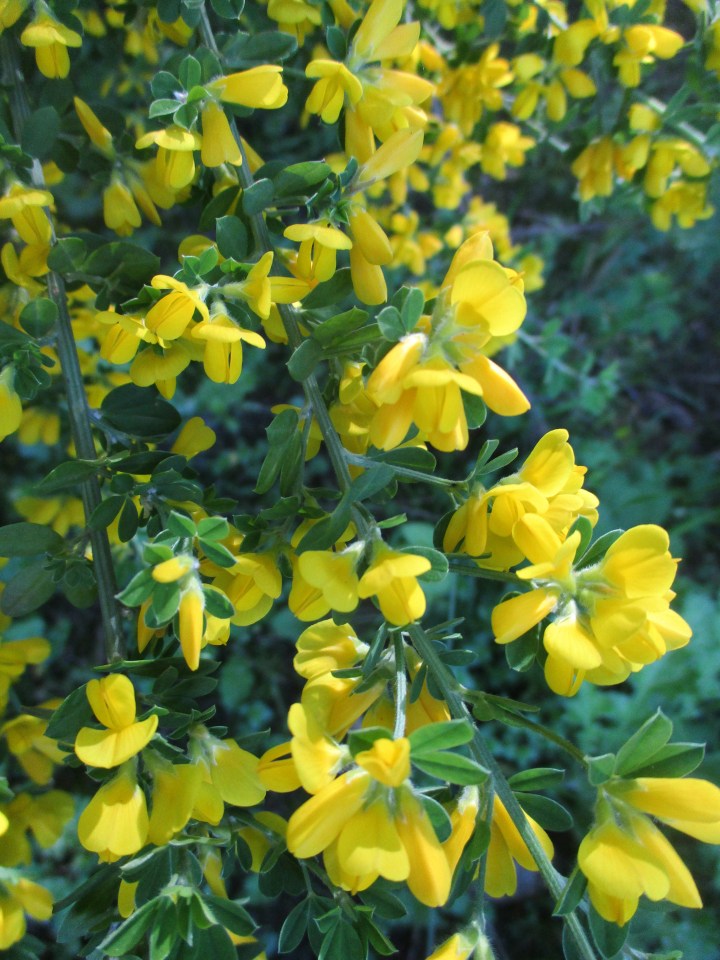
Broom

00415
French broom seems to be indestructible.

Shortly after silver wattle finishes blooming up high, any of four species of broom begin blooming down low. Brooms and silver wattle often naturalize together. All bloom with the same delightfully brilliant yellow. The four brooms are French broom – Cytisus monspessulana, Scotch broom – Cytisus scoparius, Portuguese broom – Cytisus striatus and Spanish broom – Spartium junceum.

Sadly, none are desirable species. All are exotic weeds. They are only a topic for gardening because they are so aggressively invasive. Not only do they overwhelm and displace native species, but they also enhance soil nitrogen to promote the growth of other exotic weeds! They are unpalatable to deer, and are not bothered by insects or disease. Furthermore, brooms are combustible!

It is best to enjoy their cheery bloom from a distance, where they grow wild where they really should not. The various species tend to dominate distinct regions, with some degree of mingling. Big specimens can get eight feet tall, but do not live long as they are replaced by herds of seedlings. French broom is the only evergreen species; but any can defoliate in response to hot dry weather.
Dead Nettle

50401
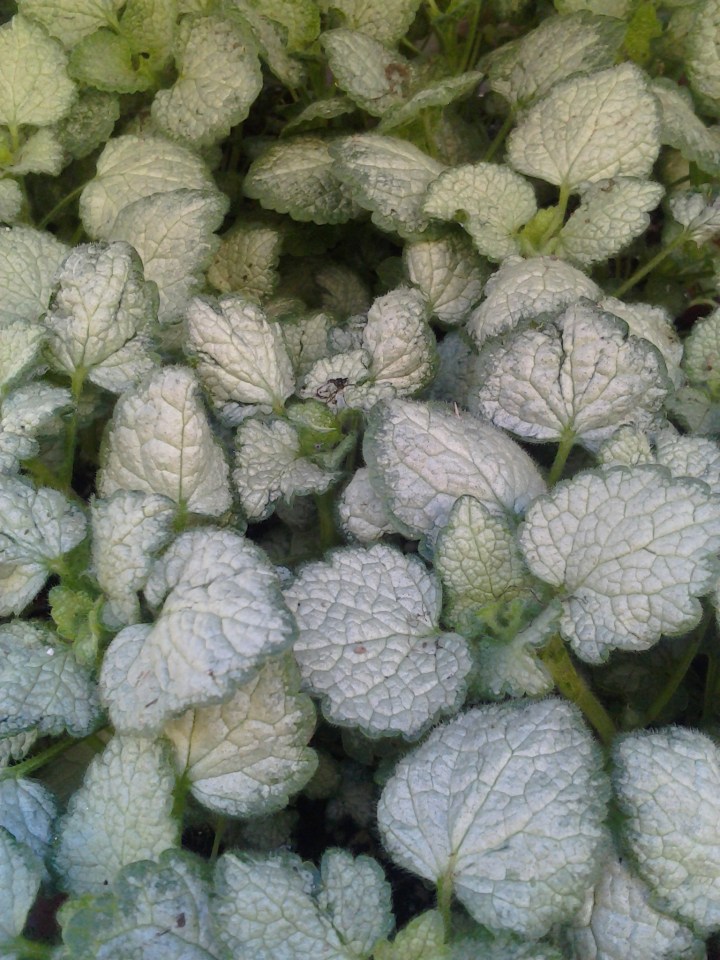
Dead nettle has lively silvery foliage.

Because its common name is so unappealing, dead nettle is more commonly known by its Latin name, Lamium. or more specifically, Lamium maculata. It is a low and subdued plant with pastel pink, lavender or white blooms, and small deep green leaves. However, modern garden varieties have silvery variegated foliage that brightens shady spots. Some are yellowish green.

The herbaceous stems spread only one or two feet at first, but then root into the soil where they land, and continue to spread some more. The mounding growth can get about half a foot deep, or a bit deeper where it can pile up on other plants or rocks. After late spring or early summer bloom, deteriorating flower stems should be shorn back to enhance density of foliar growth below.

Stems that begin to spread a bit too far into areas where they are not wanted can be left long enough to develop roots through spring, and then pulled up and planted where they are wanted. Even before they spread that much, no one would miss a few rooted stems discretely taken from established plants to make copies. Plants in sunnier spots want richer soil and more water.

African Daisy

00408
African daisy excels as bulb cover.

They are more than just shrubbier and more colorful versions of the formerly stigmatized trailing African daisy. Modern African daisies are actually various hybrids of several other species. Extensive breeding complicated their lineages enough for them to be known by cultivar names rather than by species names. To one degree or another, most are probably related to Osteospermum ecklonis.

These fancier modern hybrids of African daisy grow as annuals in harsher climates. If planted just after the last frost date, they bloom splendidly for early spring, and continue to bloom sporadically through summer. If they grow and bloom a bit too well, they may like to be trimmed back to bloom some more. Locally, they persist through winter as short term perennials, to bloom as winter ends.

Bloom provides pastel hues of yellow, orange, pink, ruddy pink, lavender, purple or white. Early spring bloom is most profuse, particularly for fluffy plants that were not trimmed back over winter. The biggest sprawling plants should get trimmed back after bloom. Subsequent sporadic bloom, mixed with random profuse phases, is inhibited only by warm summer weather and cool winter weather.

African daisy wants full sun and regular watering. Mature plants get about two feet deep and broad. If pressed into the soil, outer stems can develop roots to grow as new plants, as the original dies.

Sweet Box

50325
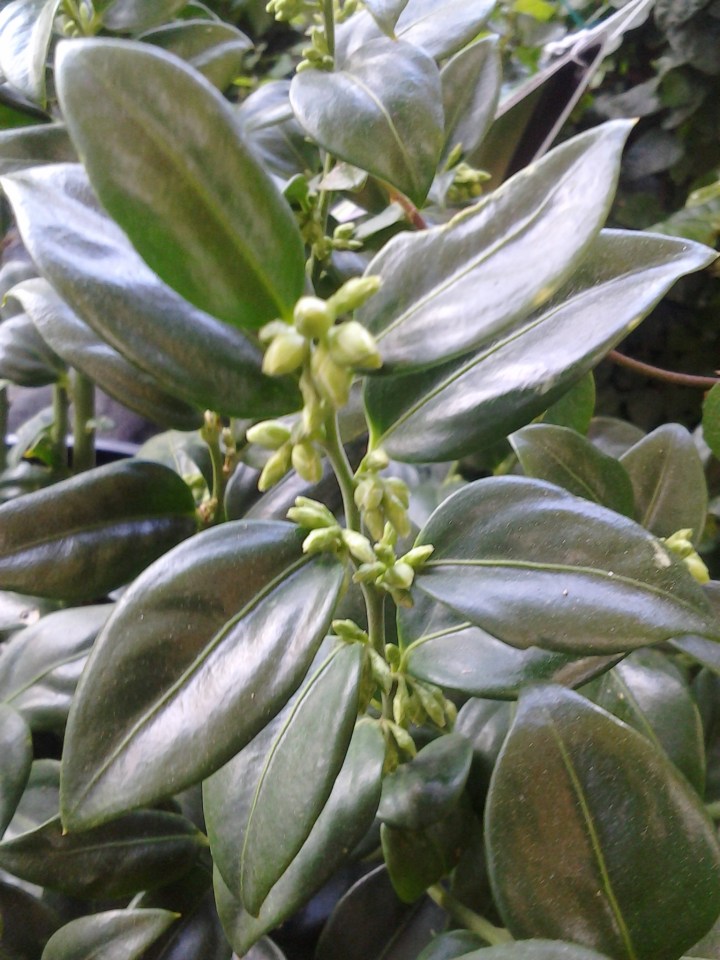
Foliage of sweet box outdoes flowers.

While bloom cycles of most plants are accelerated by the unusually warm winter, sweet box, Sarcococca ruscifolia, seems to be blooming a bit late. It should have bloomed sometime in winter, and finished a month ago. The tiny pale greenish white flowers are certainly nothing to look at, but they produce a remarkably rich fragrance that seems like it would be delicious with coffee.

The foliage is very glossy and dark green, like that of English holly, but the leaves are small and lack spines. Red berries sometimes develop, but are only abundant enough to be notably colorful on plants that are distressed. Sweet box may take a few years to get established and grow to only about three feet high and wide, although it can slowly get a bit larger.

Since it is naturally an understory plant, sweet box prefers at least a bit of shade. Harsh exposure fades foliage. Because of its tolerance of partial shade, as well as its low and dense growth, sweet box is ideal for obscuring foundations. After the first few years, it does not need too much water. It gets established more efficiently in rich soil.

Breath Of Heaven

00401
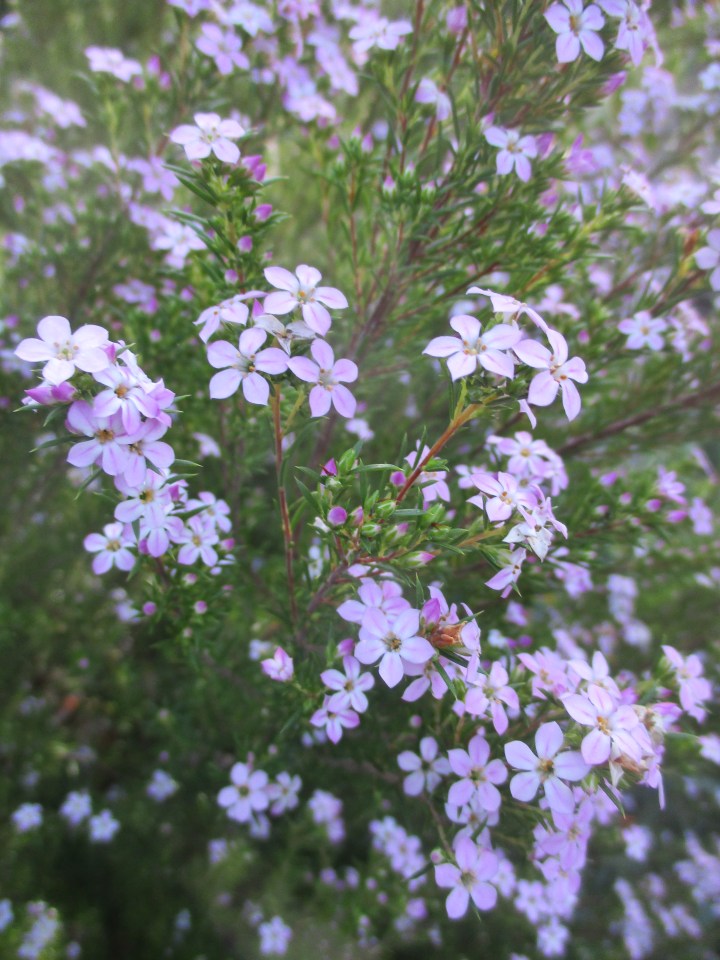
Foliar aroma rather than floral fragrance.

Bloom may not wait until spring. Breath of Heaven, Coleonema pulchellum, can start to bloom late in winter if it chooses to. After another more prolific bloom phase sometime in spring, sporadic bloom can continue until autumn. The delightfully pale lavender pink flowers are tiny, but abundant during bloom phases. A few are likely to linger after the main phases, until another phase begins.

The straight species is not as popular as it formerly was. It gets to be approximately five feet tall and broad, or a bit bigger if crowded. Nowadays, most breath of Heaven are ‘Compactum’, which do not get much taller than three feet, with delightfully wispy light green foliage. ‘Sunset Gold’ has bright greenish gold foliage that stays lower than two feet. All have impressively aromatic foliage.

Breath of Heaven is best where it does not need much pruning for confinement. Frequent shearing compromises foliar texture and inhibits bloom. Partial shade likewise inhibits bloom, although it can also promote an appealingly sparser and wispier foliar texture. Unfortunately, breath of Heaven does not live for very long. Even the healthiest and oldest specimens may not last twenty years.

‘Eureka’ Lemon

50318

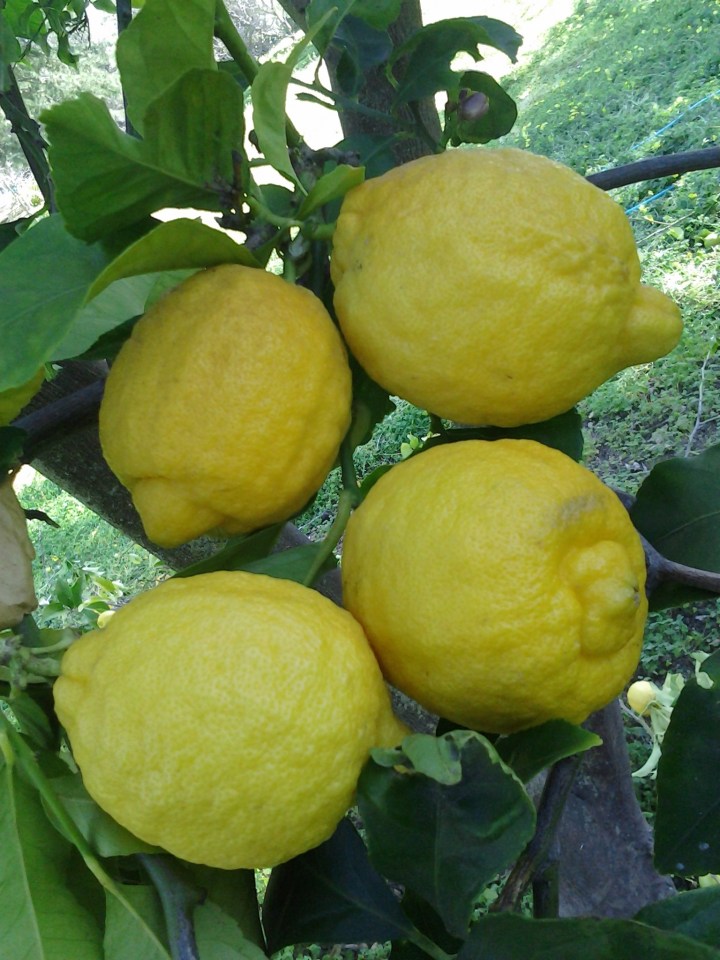
‘Lisbon’ lemon actually came first. It is still grown in orchards for lemon juice and other lemon products. The glossy evergreen foliage is a nice bright green. The late winter bloom is nicely fragrant. Mature trees can be kept about twelve feet tall, or allowed to get much taller. Besides the nasty thorns, the only other problem is that all the fruit ripens within a limited season.

‘Eureka’ lemon, Citrus limon ‘Eureka’, is a mutation of ‘Lisbon’ that is more casual about its schedule. It produces a good quantity of fruit in season through the end of winter, and also produces lesser quantities throughout the year. Because it is so productive, the lesser quantities should be more than sufficient whenever lemons are needed.

The ‘Variegated Pink’ lemon is a mutation of ‘Eureka’, so is a mutation of a mutation. The foliage is nicely variegated with white. The green fruit is striped with yellow until it ripens to yellow. The pulp and juice are pink of course. Like many variegated plants, the ‘Variegated Pink’ lemon stays much smaller than ‘Eureka’ lemon, and is more sensitive to frost.

Onion

00325
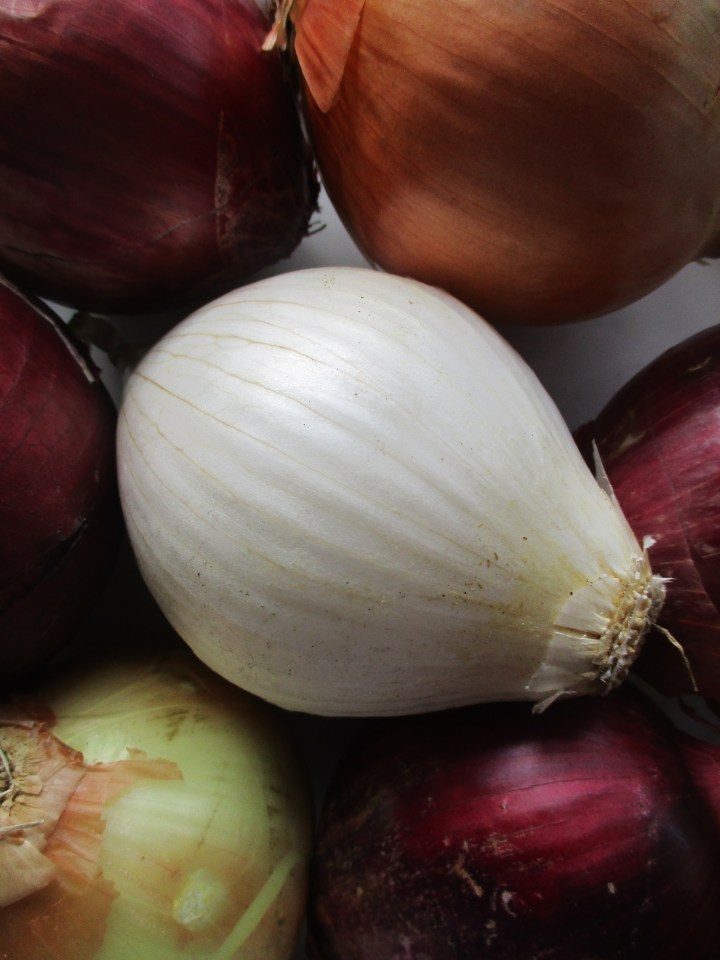
Onions are weirdly bulbous foliar vegetables.

Although it is the most cultivated species of its genus, no one knows the origins of domestic onion, Allium cepa. Leek, shallot, garlic, chive, and a few other species are also popular vegetables. Most common bulbing onions produce familiar distended bulbs that are ready for harvest after defoliating and initiating dormancy in autumn. Green onions are leaves and attached juvenile bulbs.

Onions are probably easiest to grow locally from small juvenile onions known as ‘sets’, that grew from seed during the previous summer. Alternatively, seed sown during summer grows into small plants that go dormant to overwinter, and then resume growth the following spring. Mature onions should go completely dormant in autumn before storage, but are usable directly from the garden.

Yellow or brown onions are the most popular for cooking. Red or purple onions are milder and more colorful for fresh use, and are also popular for stir fry. White onions, whether fresh or cooked, are even milder, and are the traditional onions for salsa. All onions produce distinctively bluish foliage that stands about a foot high. The hollow leaves flop over and shrivel for dormancy in autumn.

Buckbrush

50311
Buckbrush is California lilac without lilac.

Most other specie of ceanothus are more colorful and tame than Ceanothus cuneatus is. It is known as ‘buckbrush’ because the abundant round trusses of minute flowers are typically dingy white instead of the more familiar shades of blue that have earned other ceanothus the common name of ‘California lilac’. However, a few wild plants and some garden varieties bloom blue.

Mature plants are at least six feet high and wide, but typically less than ten feet high and twelve feet wide. They are pleasantly fragrant as they bloom between March and April or May. Roots seem to tolerate almost any soil that drains well and does not get watered too much. Once established, no watering is needed. The scrubby evergreen foliage likes full sun exposure.

Although it is a bit unrefined, and does not want to be pruned for confinement, buckbrush works nicely as screening shrubbery on the perimeter of a landscaped area, or in unlandscaped areas. Newly installed small plants only need to be watered occasionally as they disperse their roots through their first year. Since they are native, established plants are satisfied with rainfall.

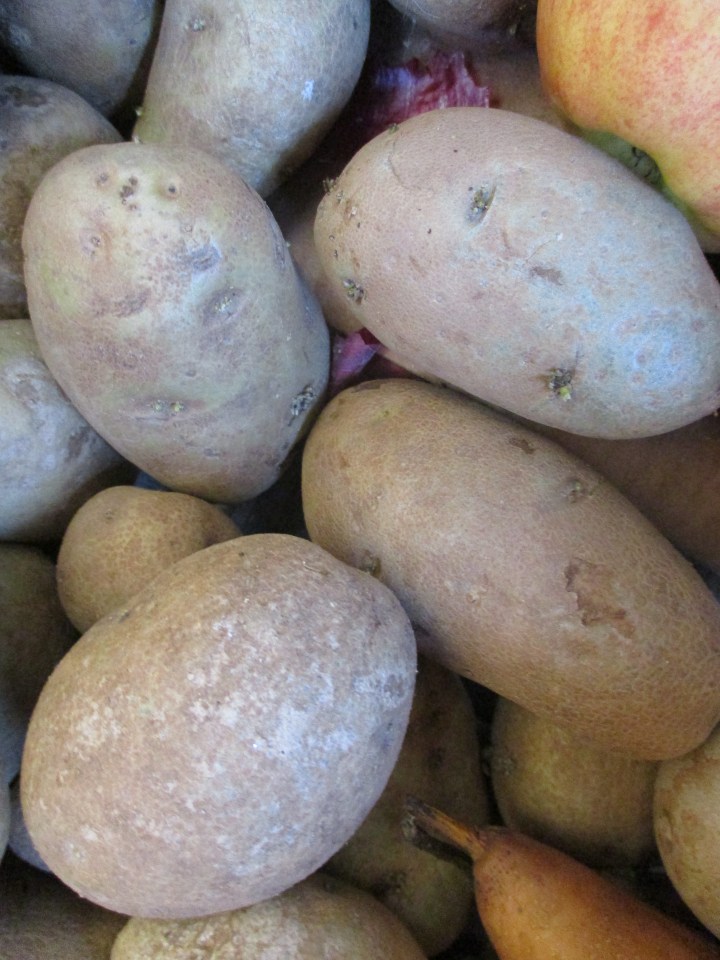
Potato

00318
Grow potatoes now to dig later.

First thing first. Potatoes are not roots. They are only classified as a root vegetable because they grow underground. They are actually a sort of specialized subterranean stem known as a ‘stolon’. Because they are so distended, a more accurate distinction might be ‘tuberous stolon’ or ‘stoloniferous tuber’. Their eyes are buds, which roots lack. Their roots extend from eyes and other roots.

Most cultivated potatoes are of the species Solanum tuberosum. Some of the thousands of cultivars that were developed during the thousands of years that potatoes have been in cultivation are distantly related to other species. Hybridization was a means with which to incorporate desirable characteristics of other species. Potatoes are presently one of the main food crops in the World.

Small potatoes or pieces of potatoes, which are known as ‘seed potatoes’, start to grow in home gardens after the last frost. Potatoes are not grown from actual seed because of the potential for genetic variation. After bloom later in summer, their coarse foliage dies to the ground. Potatoes that grew during the previous season are then ready to get dug. Fruit and all green parts are toxic.

Boston Fern

50304
This fern is nowhere near Boston.

It is not actually from Boston. The first Boston fern, Nephrolepis exaltata ‘Bostoniensis’ was merely discovered in Boston, as a mutant in a shipment of otherwise normal ferns. Unlike the more upright parent plants, Boston fern has softly arching fronds that can hang vertically at the ends.

The fronds are typically about a foot and a half long, and can be a few feet long in humid and partly shady environments. Each frond is comprised of many pinnae that are neatly arranged on both sides of a wiry rachis (leaf stalk). Each leaflet is an inch or two long or longer. Delicate aerial roots sometimes dangle below the foliage.

Through the 1970’s, Boston fern was one of the most popular houseplants. Yet, it really prefers more humidity than it gets inside. It is actually happier on porches or in atriums where it is sheltered from frost and harsh sun exposure. It prefers partial shade outside, but likes abundant ambient sunlight as a houseplant.