 It is easy to mistake various cultivars of Dyckia for diminutive relatives of Agave or Yucca. They form stout rosettes of rigid leaves with wickedly sharp terminal spines. Their comparably nasty but incurved marginal teeth resemble those of most species of Agave, but are generally more abundant. Surprisingly though, Dyckia are instead related to bromeliads. They just happen to be xeric.
Dyckia do not bloom much, but when they do, the tall and arching floral stalks really are more typical of bromeliads. As they bloom late in spring or in summer, the many small individual flowers on each stalk are collectively colorful enough to be delightfully popular with hummingbirds, butterflies and bees. Bloom is most commonly rich reddish orange, but some cultivars bloom red or yellow.
No one seems to mind that Dyckia does not often bloom. The foliage is remarkably striking alone. Many cultivars form dense mounding colonies of pups that, although unpleasant to handle, can be divided for propagation. A few toothless cultivars, armed only with terminal spines, are easier to handle. Individual rosettes can be as tall and broad as a foot. Dyckia do not need much water.
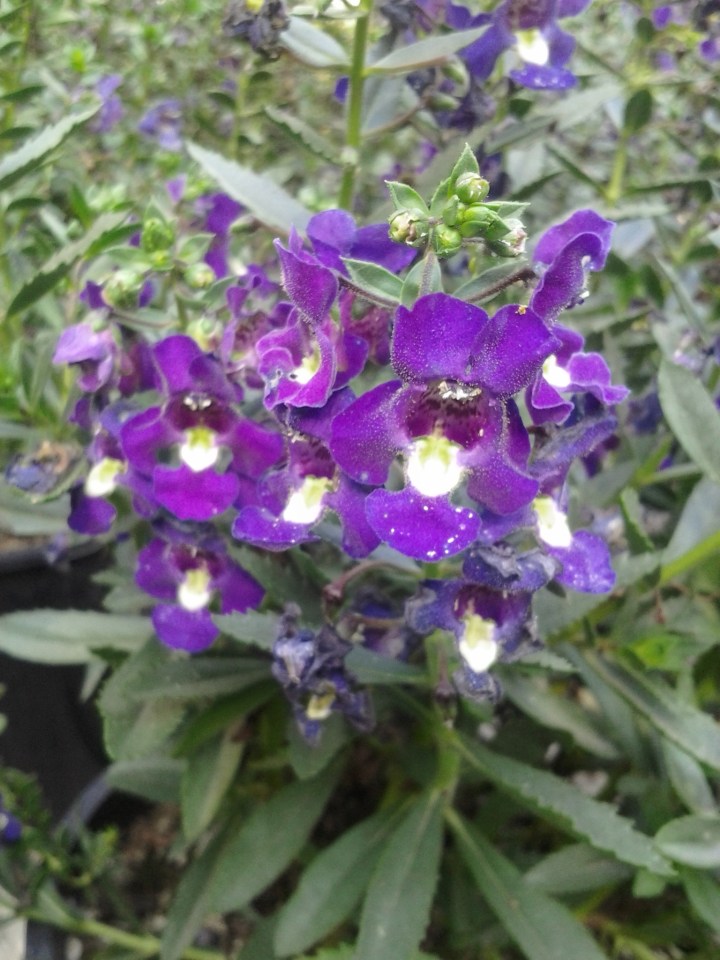 Angelonia is one of those warm season annuals that can actually survive through winter as a pernnial to bloom again next spring. It may even want to continue to bloom untill frost. The flowers can be blue, purple, red, pink or white, and look something like small snapdragon flowers. Most have spots or stripes of an alternate color or two in their throats. Some modern varieties have fragrant flowers. Plants can get a foot or two tall, and almost as wide. In sheltered spots, angelonia can be cut back as soon as it starts to look tired in autumn. Exposed plants might be happier if cut back significantly later, as winter ends. Old growth may be unsightly for a while, but can protect interior stems and roots from frost. Besides, pruning stimulates new growth that will be more susceptible to subsequent frost.
 This is not an easily defined flower. There are hundreds of species within the genus of Viola. Many are known as pansies. Many are known as violas or Johnny-jump-ups. Many are in between. The main difference between these two major groups is that, although very closely related, pansies bloom with bigger flowers, and violas bloom with smaller, simpler and more abundant flowers.
 Actually, it is a fruit; a rather BIG fruit. It happens to be one of the more familiar of winter squash, but is not too commonly eaten. Although it makes excellent pie, and provides edible seeds and flowers, pumpkin is more popularly known as jack-o’-lanterns or Cinderella’s ride to the ball. Pumpkin is not for every garden, since each big and coarsely foliated annual vine needs regular watering, rich soil and considerable space to grow all through summer to produce only one or two big fruit in autumn.
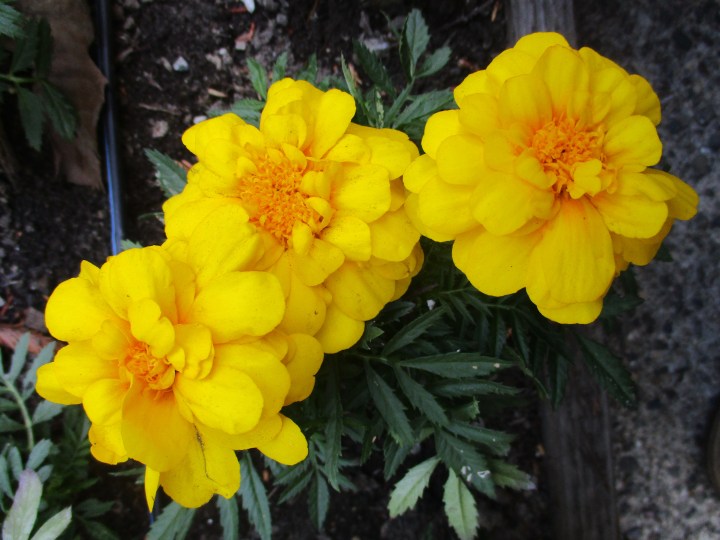 Actually, French marigold, Tagetes patula, is no more French than African marigold is African. All are from Mexico and Guatemala. They were merely popularized and bred respectively in France and Africa. There are now hundreds of varieties. Yet, their color range is surprisingly limited to hues and shades of yellow, orange and ruddy brown. White marigolds are really just very pale yellow.
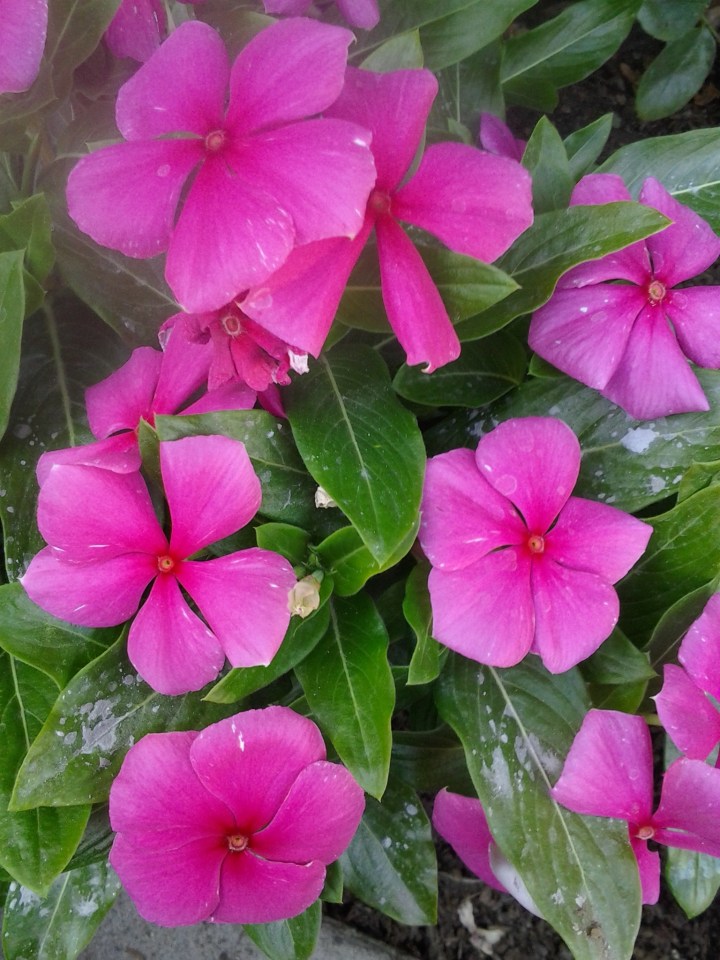 Like gardenia, dogwood and snapdragon, the potentially finicky Madagascar periwinkle, Catharanthus roseus, is often challenging to grow. It enjoys, but seems to prefer more humidity than it gets here. The happiest plants can get nearly two feet tall and wide in sheltered and humid spots. (They can get even larger in exposed spots in humid climates.) Yet, most of us are satisfied with relatively scrawny plants less than half a foot tall.
 Bugs Bunny was an expert. He was always chewing on a carrot, Daucus carota, and rudely talking with his mouth full. Because carrots can be stored in refrigeration for a few months, Bugs Bunny could get one whenever he wanted to. However, in home gardens, they are cool season vegetables that are grown through spring and autumn, but not through summer or the middle part of winter.
 It seems that everyone who has ever experienced the seductive yet powerful fragrance of gardenia, Gardenia jasminoides, wants to grow it, but very few actually can. Gardenias like warmth, but prefer more humidity than they get here, which is why they seem to be happier in partial shade, in atriums, or in urns that can be moved out of harsh exposure during summer. In such sheltered spots, aphid, scale and sometimes whitefly can be problematic.
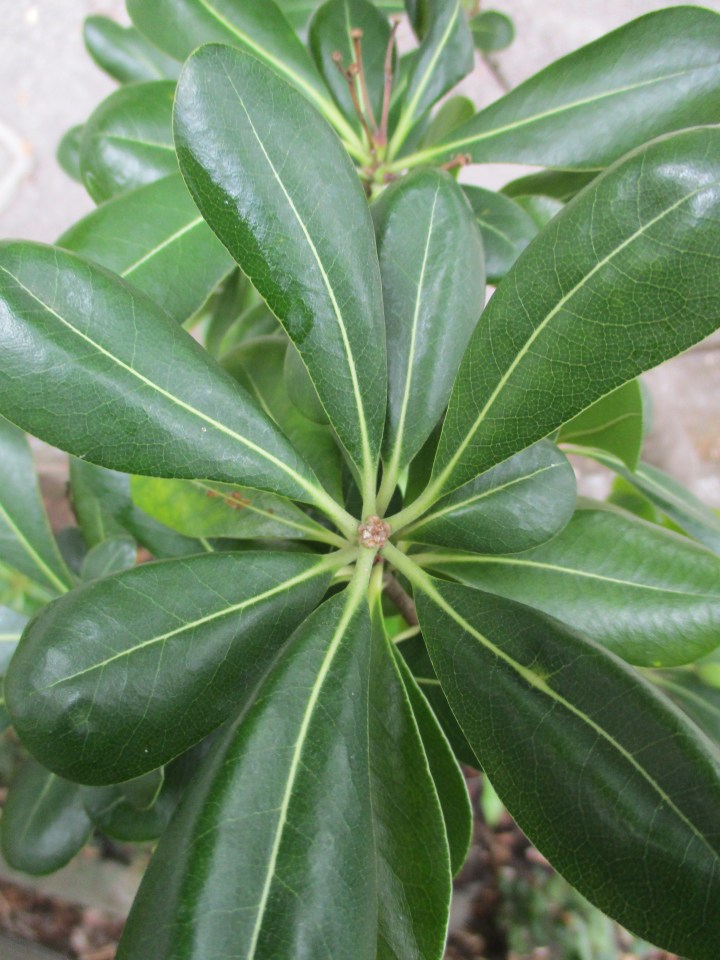 A surplus of common names seems to be a common theme for many plants that we thought we knew the names of. The simple Pittosporum tobira, which might be known here by its Latin name, might instead be known as mock orange, Australian laurel, Japanese pittosporum, and Japanese cheesewood. Its native range is about as diverse, including Greece, Japan, Korea and China.
 Not only does it start to bloom late in summer, but as the name implies, four o’clock, Mirabilis jalapa, blooms late in the afternoon to attract nocturnal moths for pollination overnight. By morning, the white, yellow, variable pink or rarely pastel orange flowers are closed, and their yummy fragrance is gone. Individual flowers often display irregular stripes or blotches of alternate colors, and can be divided into zones that are shaped like slices out of a pizza. Plants get nearly three feet high, but then die to the ground with the first frost. They regenerate from big tuberous roots as winter ends, and can seed profusely.
