 Here on the West Coast of California, most of us know goldenrod only as a color of crayon. In most other parts of America though, it is a common wildflower that is colorful enough to be popular in home gardens. Yet, with more than a hundred specie, it is hard to say exactly which goldenrod, (Solidago spp.) the crayon color corresponds to. All are some shade of gold or yellow, but some are a bit more orange than others.
Most varieties of goldenrod that are available locally bloom in late summer or autumn. Some are still blooming prolifically now, on seemingly overloaded stems that stand taller than two feet. Shorter types that get only a few inches tall are probably unavailable. Perennial rhizomes spread slowly but surely, and can be divided to propagate new plants. Goldenrod needs full sun exposure, but not much water once established.
The blooms of goldenrod are just as interesting physiologically as they are colorful. The floral trusses of the most popular types are somewhat conical, but arching from their own weight. Each of these trusses supports a profusion of minute daisy-like flowers, which are actually composite flowers comprised of even smaller and more abundant florets! Bees and butterflies really seem to appreciate the floral redundancy!
 Is it coincidence that the Latin name of black-eyed Susan is Rudbeckia, or was Becky rude enough to give Susan her black eye? The dark center is something that all varieties have in common, and what distinguishes them from most of the related blanket flower varieties. The daisy flowers of black-eyed Susan are traditionally yellow. Modern varieties can be orange, reddish or bronzed.
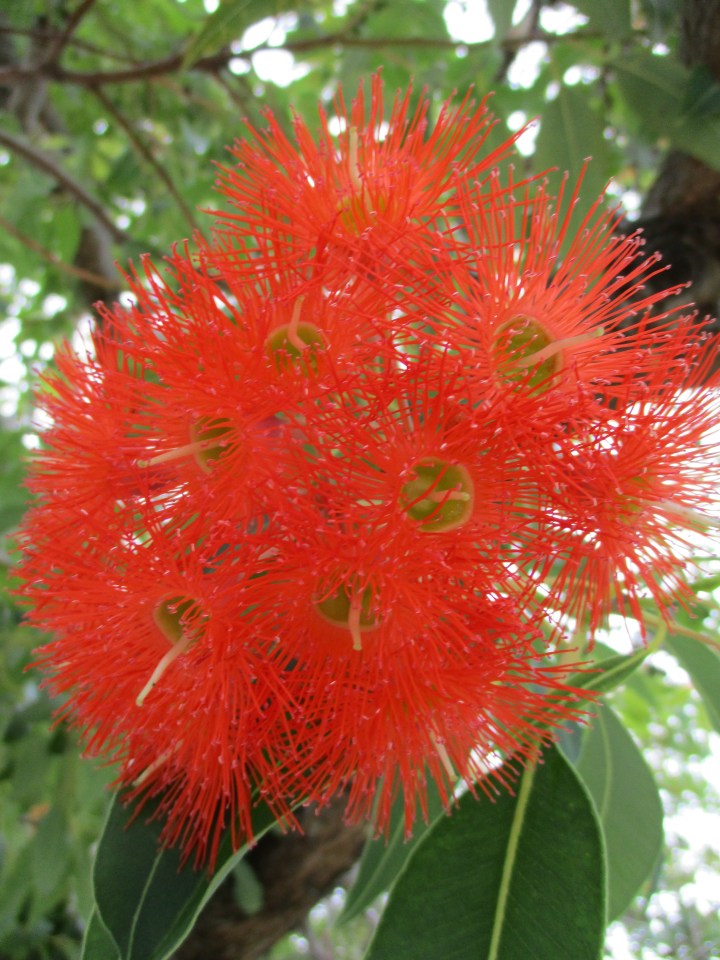 We all know about the bad reputation of eucalypti, especially the notorious blue gum. They are too big, too aggressive, too messy, too structurally deficient, and in groups, they are too combustible. However, there are several eucalypti that are not only appropriate for local home gardens, but because of their resiliency, drought tolerance and adaptability to the local environment, should be more popular than they are.
 Known more as a medicinal herb, and by its Latin name, coneflower or Echinacea, is a delightful prairie wildflower that works just as well in refined home gardens. It blooms in summer and again in autumn, although autumn bloom can be inhibited if plants are not groomed of deteriorating stems from the previous bloom. Like related gaillardia and rudbeckia, coneflower is a nice cut flower.
 What an unflattering name for such striking tropical foliage! The pointed and strap-shaped evergreen leaves of mother-in-law’s tongue, Sansevieria trifasciata, stand vertically, about two or three feet tall. They are rather rigid, and seem to be plastic with a glossy finish. Almost all modern varieties are variegated with silvery gray, white, cream or yellow stripes or banding. Dwarf varieties stay shorter, with flared foliage.
 One of the big four for mild climates, sweetgum, Liquidambar styraciflua, develops an excellent display of mixed yellow, orange and red, regardless of how quietly autumn tries to sneak in. Of the other three, Chinese pistache is more orange with less yellow, flowering pear is more ruddy, and gingko is only bright yellow. They all get very flashy color, but sweetgum just might be the flashiest.
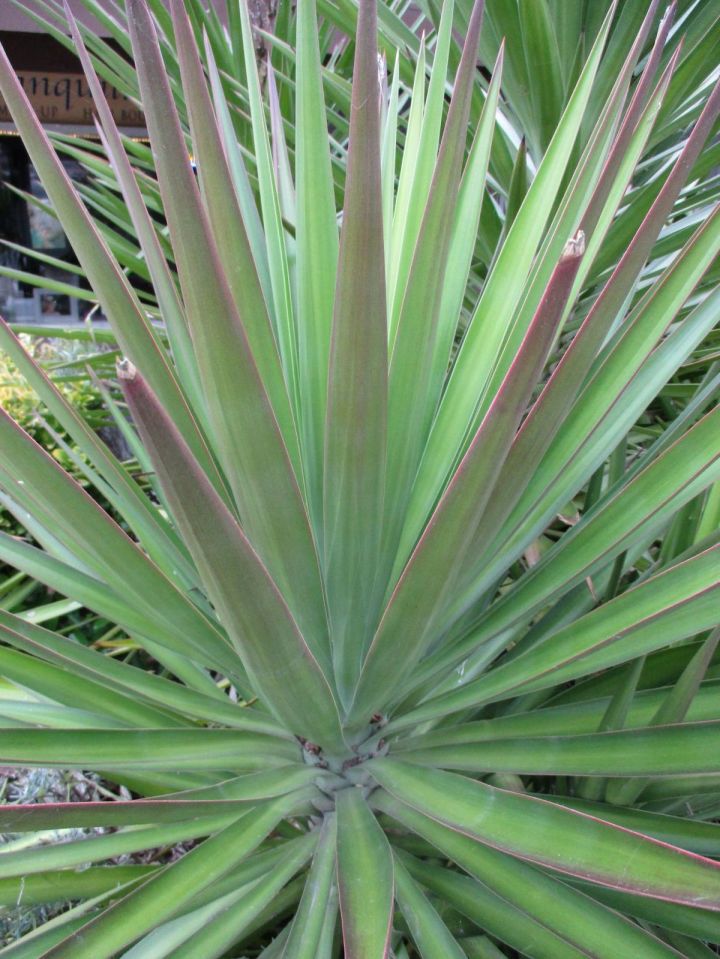 From a simple picture, Spanish bayonet, Yucca aloifolia, is indistinguishable from the common giant yucca. The narrow leaves are about two feet long, and flare upward and outward from terminal buds. Plump conical trusses of waxy white flowers with purplish highlights stand vertically just above the foliage. The main difference is that the leaves are more rigid than they appear to be, with nastily sharp terminal spines.
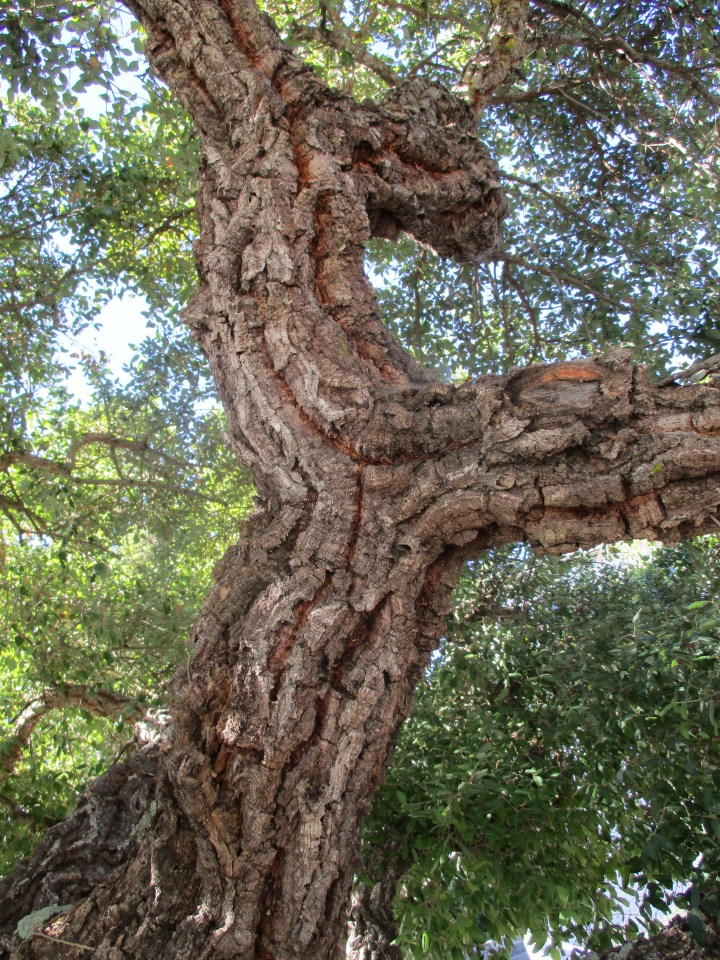 Like redwoods, the cork oak, Quercus suber, is a ‘pyrophyte’, which means that it survives forest fires that burn off competing vegetation. The trunks and main limbs are insulated with a very thick bark. Only the foliage and smaller stems burn off. After a fire, the upper limbs of cork oak regenerate new foliage while other less fortunate plants start over from their roots or seed at ground level.
 Bluegum is famously problematic. It is too big, too invasive, too messy, too structurally deficient, and as demonstrated in the Oakland fire, too combustible. Dwarf bluegum, Eucalyptus globulus ‘Compacta’, is a completely different animal that does not even look related. It gets only about fifty feet tall, with a dense and somewhat symmetrically rounded canopy. The mess and falling limbs do not affect such a large area.
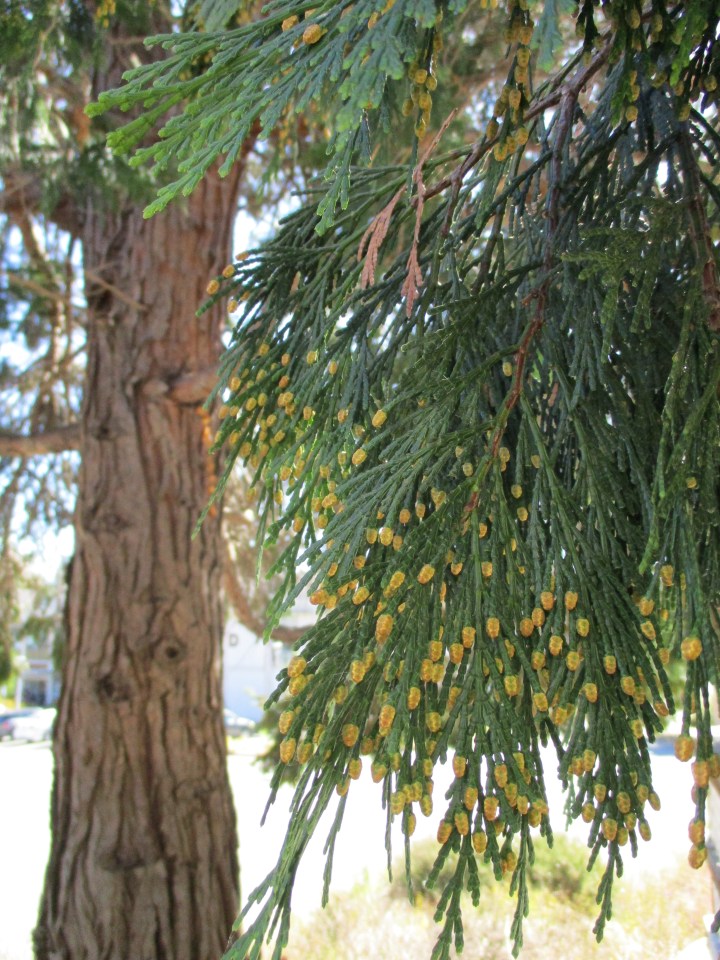 In the west, the incense cedar, Calocedrus decurrens, was made into cedar chests or paneling for cedar closets as a substitute for the more traditional Eastern redcedar (which is incidentally a big juniper). The wood is supposedly aromatic enough to repel moths from woolens and furs. The evergreen foliage is very aromatic as well, so is sometimes used for garlands at Christmas time.
 Tony Tomeo