 There seems to be some discrepancy about the correct spelling of crape myrtle, Lagerstroemia indica. Many of us spell it as ‘crepe’ myrtle, thinking that crepe is the thin colorful paper that the flowers resemble. It is actually a rolled up thin French pancake. The thin paper is actually spelled as ‘crape’. Of course those of us who dislike the commonness of crape myrtle might omit the ‘e’.
There is plenty for horticultural professionals to dislike about crape myrtle. It is remarkably complaisant, and proportionate to small urban gardens. Consequently, it very often gets planted even where other trees would be more practical or proportionate. It is the most common street tree because it so rarely damages curbs or sidewalks, but does not get big enough to shade the street.
The biggest varieties do not get much more than twenty feet tall, so work well in utility easements. Trees might be on a single straight trunk where space is limited, or to display the appealingly mottled bark, they might have multiple trunks. The billowy white, pink, red or mauve blooms are spectacular in late summer. The deciduous foliage can get quite yellow, orange or red in autumn. Hard pruning in winter improves late summer bloom and autumn color.
Fernleaf Yarrow
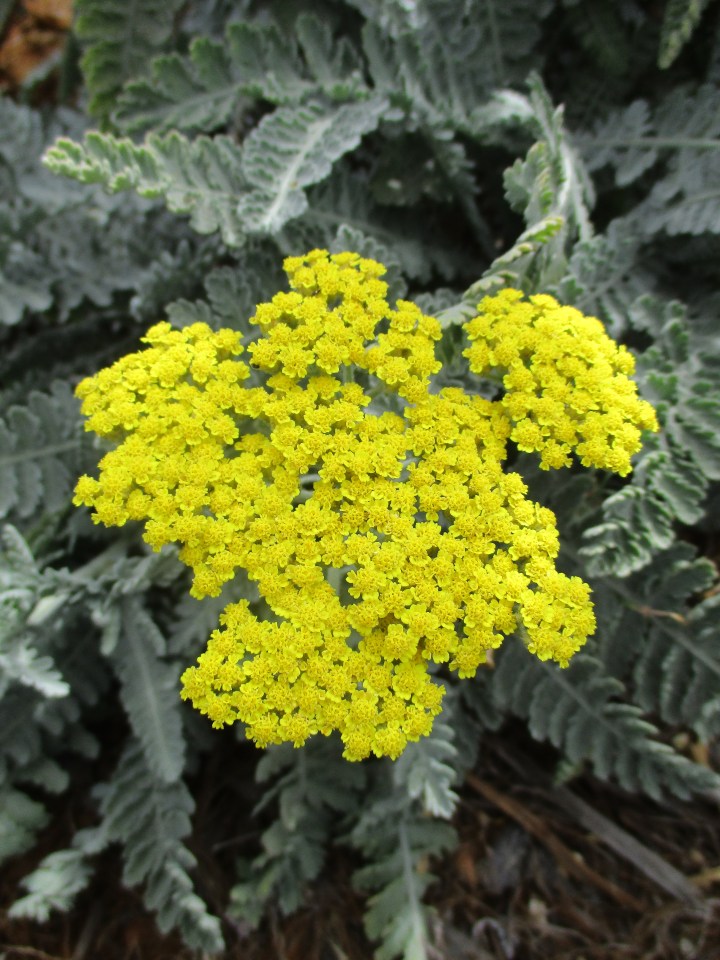 ‘Moonshine’ is probably the epitome of fernleaf yarrow, Achillea filipendulina, even though it is technically a hybrid. From the middle to the end of summer, its three inch wide corymbs (flat-topped trusses) of tiny bright yellow flowers stand as high as three feet above ferny and gray basal foliage. Bloom is best in full sun and warm exposure. Established plants do not need too much water.
Most varieties of fernleaf yarrow also bloom with bright yellow or gold flowers. Some might bloom with pale yellow, rosy pink, pale pink, reddish, white or pink and white flowers. All are good cut flowers, and can be dried. Some varieties are more compact. The most compact varieties work nicely in planters of mixed perennials. Butterflies and hummingbirds find them wherever they are.
Pruning out deteriorating blooms may promote sporadic subsequent bloom until autumn. However, some plants may bloom all at once, and then not bloom again until the following summer. Large blooms on the most vigorous plants may need to be staked. New plants can be propagated by division from mature plants. ‘Moonshine’ and many other cultivars are sterile. Others might self sow.
 Tony Tomeo