My Private Heritage Tree

Okay, I am confused. Regardless, I really should go check on the apple tree.

tonytomeo's avatarTony Tomeo

My plan to collect apples on time this year worked out no better than it did last year. The original article from last year was reblogged to another blog yesterday, along with a brief update to explain the current situation. Hey, I may as well reblog it back here too. These might be the only apples I write about this year. via My Private Heritage Tree

View original post

White Hydrangea

Hey, this would have been appropriate for my earlier Six on Saturday post.

tonytomeo's avatarTony Tomeo

P90907KWhat ever happened to the formerly common white hydrangea? It used to one of the three standard types of hydrangea; and the other two were really variants of the same sorts of ‘pink or blue’ hydrangea that I wrote about in ‘Horridculture – True Colors‘. The few hydrangeas that are white nowadays are lacy, flat-topped, blushed . . . or anything but simple classic white.

This old fashioned simple white hydrangea is just as elegant now as it has always been. It is always white, without pretense of blue or pink. There is no point of giving it something it does not really need just to change its natural color (like those of us in the Santa Clara Valley do to make pink hydrangeas blue; or those of us in the Tualatin Valley do to make blue hydrangeas pink).

The bulky and almost spherically rounded form of this…

View original post 153 more words

Ferns Are For Distinctive Foliage

Oops, I neglected to post anything for today.

tonytomeo's avatarTony Tomeo

Rich green ferns provide distinctive texture.

Ferns are an odd group. They lack the color or fragrance of flowers, or the branch structure of shrubbery, trees or vines. Very few turn color in autumn. They provide only green foliage. Yet, as simple as this seems, the generally evergreen foliage that ferns provide is some of the most distinctive foliage that can be found in the garden.

With few exceptions, ferns are richly deep green. Only a few are lighter green or almost yellowish. The leaves, which are known as ‘fronds’, can be soft and papery, or coarse and tough. The fronds of most ferns are pinnately divided into neatly arranged leaflets; and many ferns have leaflets that are intricately lobed. Some ferns have leaves with more palmate symmetry. A few ferns actually have undivided leaves.

(Pinnate symmetry involves a central midrib or midvein to each leaf, or a central rachis…

View original post 356 more words

Horridculture – Opposite Poles

Utility clearance pruning is necessary, but should not be so idiotic.

tonytomeo's avatarTony Tomeo

P90904This is not about North and South. It is about a utility pole and a pole that remained from a redwood tree that was too close to it. One is there to support a variety of cables and a streetlamp. The other just wanted to grow into a redwood tree to join the rest of the forest. One has been deceased for many years or decades. The other was alive just recently, but is now only a stump.

The picture above shows how many cables the utility pole supports, as well as the streetlamp. When I did my internship in 1988, the arborists whom I worked with knew what each of the various cables were for; high voltage, lower voltage, cable television, telephone and whatever else was up there. Fiber optic cables have since simplified the telephone and television cables.

The picture above also shows how the unfortunate redwood tree…

View original post 228 more words

Props

Three years later, these trees are still doing well with their props.

tonytomeo's avatarTony Tomeo

P90901It has been almost a month since one of three small but sculptural and very prominent coast live oaks at work was destabilized by . . . well, children. They were climbing on it, as most good children should do. There were a few of them; and the tree is old and deteriorating. All three of the trees actually grew from the same rotten stump of a tree that was cut down decades ago.

I wrote about it at ‘Six on Saturday – Do Not Sit On Tree‘. The title will make more sense if you read about it.

To salvage the tree, I pruned off as much of the foliar canopy as possible. This eliminated some of the weight that the trunk needs to support, as well as decreased some of the resistance to wind, which exerts leverage against the compromised root system when wind blows. Sawhorses…

View original post 192 more words

Bad Pollard

As weird as this was and still is, and regardless of how inappropriate the technique is for the species, it has actually been effective. The tree continues to provide very aromatic foliage, without growing too large.

tonytomeo's avatarTony Tomeo


P90831KJust about any other arborist will insist that any pollard is a bad pollard. I am not any other arborist. I have no issue with pollarding certain trees properly.

Pollarding is severe pruning that removes all growth that developed since the last pollarding procedure, leaving only a main trunk and a few main limbs. It is done while trees are dormant in winter, and must be repeated either annually or at least every few years, before the resulting growth develops into major limbs. Pruning must be very thorough and neat, leaving no stubs.

Most new growth develops from where older growth had been pruned away during the previous winter, with only a few adventitious stems possibly developing on the main limbs or trunks. Distended ‘knuckles’ develop where this growth repeatedly gets pruned away and regenerates. All subsequent pollard pruning must be done only on the outside of these knuckles, not…

View original post 330 more words

Horridculture – Pesticide

There was no update to this old article, but now that I think of it, this pesticide was actually effective.

tonytomeo's avatarTony Tomeo

P90828Pesticides are a topic that I do not talk much about. There really is not much to say about them. Only a few are used at the farm, and only while certain destructive insects or perhaps mites are active. Even less pesticides are used in the landscape. It is not that I have serious issue with them. They are just not as useful for controlling pests as proper horticultural techniques are.

Plants that we would expect to require pesticides simply are not welcome in our landscapes. We know that snapdragons and hollyhocks are very likely to be detrimentally infested with rust. Therefore, we grow neither.

Roses live in some of the landscapes only because we do what we must to help them avoid infestation by the various pathogens that they are susceptible to. They get pruned aggressively in winter so that their new growth grows faster than aphid and mildew…

View original post 431 more words

Another One Bites The Dust

Goodness! Gophers were bad three years ago; but are even worse this year!

tonytomeo's avatarTony Tomeo

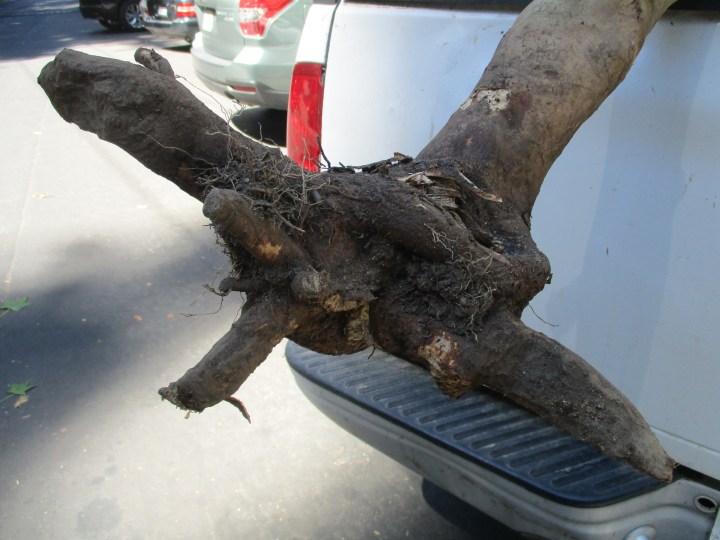
P90825If this looks familiar, it is because it is the second big camellia to be killed here in the same manner in not much more than two months. The damage is not fresh, likely because the gopher that caused it started chewing on the roots as soon as the other camellia was removed. The other camellia succumbed about two months after a similarly damaged cherry tree was removed.

We are now concerned for a remaining third camellia in the same spot, as well as others in the vicinity. There is also concern that the gopher may take interest in something else, such as the birches. We would typically find and destroy any gopher that causes such problems. The difficulty here is that the area is thoroughly covered with a dense layer of Algerian and English ivies.

All evidence of gopher excavation is obscured. Even if we could locate such excavation…

View original post 150 more words

Fake Six on Saturday

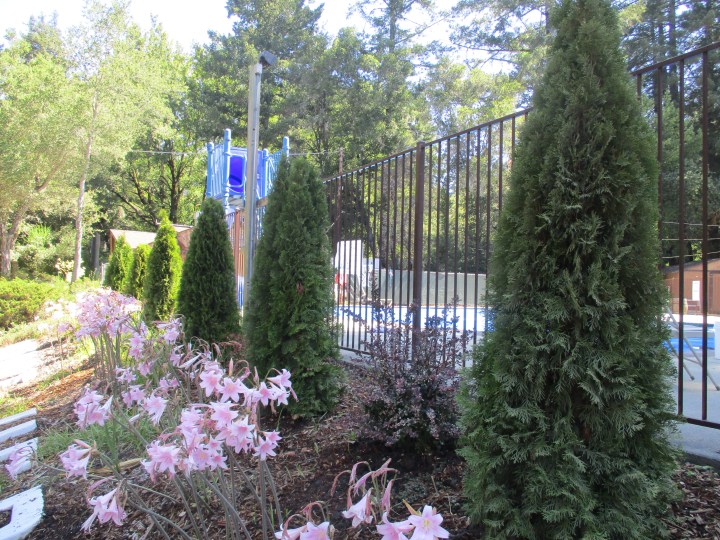
These arborvitae and barberry have done well during the past three years.

tonytomeo's avatarTony Tomeo

P90824K‘Six on Saturday’ is a weekly tradition for many of us who enjoy sharing six horticulturally oriented pictures on Saturday. I just did it earlier this morning.

This is not ‘Six on Saturday’. It is just one picture of six arborvitae. What’s worse is that there is an indistinguishable seventh at the far end of the row. It blends into the sixth in this picture. There are seven barberry between them, with the seventh beyond the last arborvitae. This picture was taken more than a week ago, so most of the amaryllis are done blooming now.

This row of arborvitae and barberry was installed early last winter, after a grungy hedge of photinia was removed. It would have been nice to salvage the photinia, but they were such a mess that the process would have taken more than two years, and even then, would have been patchy.

These arborvitaes will…

View original post 150 more words

Horridculture – True Colors

Good old fashioned hydrangeas with pastel bloom are rare nowadays.

tonytomeo's avatarTony Tomeo

P90821Bearded iris can bloom in almost any color. It is expected of them. There is not much they can do to surprise us.

Dahlias exhibit a remarkable range of both color and floral form. Only a few colors are beyond their range.

Roses, gladiolus, freesias, tulips, hyacinths, petunias, pansies, primroses and several of the most prolific bloomers are expected to provide many choices of color.

Other flowers are not so diverse. Forsythia blooms only in bright yellow, or perhaps a lighter hue of yellow. Mock orange blooms only in white, either single or double. Until recently, before purple was invented, the common species of lily-of-the-Nile were either blue or white. We tend to appreciate such flowers for their simplicity, and do not expect anything more from them.

Decades ago, hydrangeas were either white or pink or blue. I say ‘either’ because what seems to be three choices is actually only…

View original post 205 more words