Gophers!
Horridculture – Rainy Days and Mondays (deferred from Wednesday)

Karen Carpenter famously said, “Rainy days and Mondays always get me down.”
Several old and deteriorating box elders on the roadside outside the gate at work have survived many rainy days and many Mondays during the past many years that they have grown there. Earlier this week though, a rainy Monday brought one down.
It was no surprise. All of the several box elders there are in very bad condition. Most are completely dead and collapsing. However, I can do nothing about them because they extend over the roadway. They must be removed by a County Crew who can remove them safely. Unfortunately, they are unable to do so in a timely manner while so much similar work is needed throughout the County.
The problem with the demise of this particular tree is that it fell onto the hood of a Ford F150 that was travelling toward town. The Ford swerved and collided with a Subaru station wagon of some sort that swerved off the other side of the road, where it seemed to stop just inches from a utility pole. The tree or portion of the tree that fell was not very big, but indirectly caused extensive damage to both vehicles, and necessitated lane closures while the vehicles were removed.
In the picture, which was taken as I opened the gate for the crew, the Subaru is still visible on the opposite side of the road, at the center of the picture. The Ford has already been removed to the side of another road that extends to the right in the distance, beyond the bridge, where the traffic signals are. The taillights belong to one of the responding Sheriff’s cars. Most of the debris from the fallen box elder has already been pushed into the ditch to the right.
New Mouser II
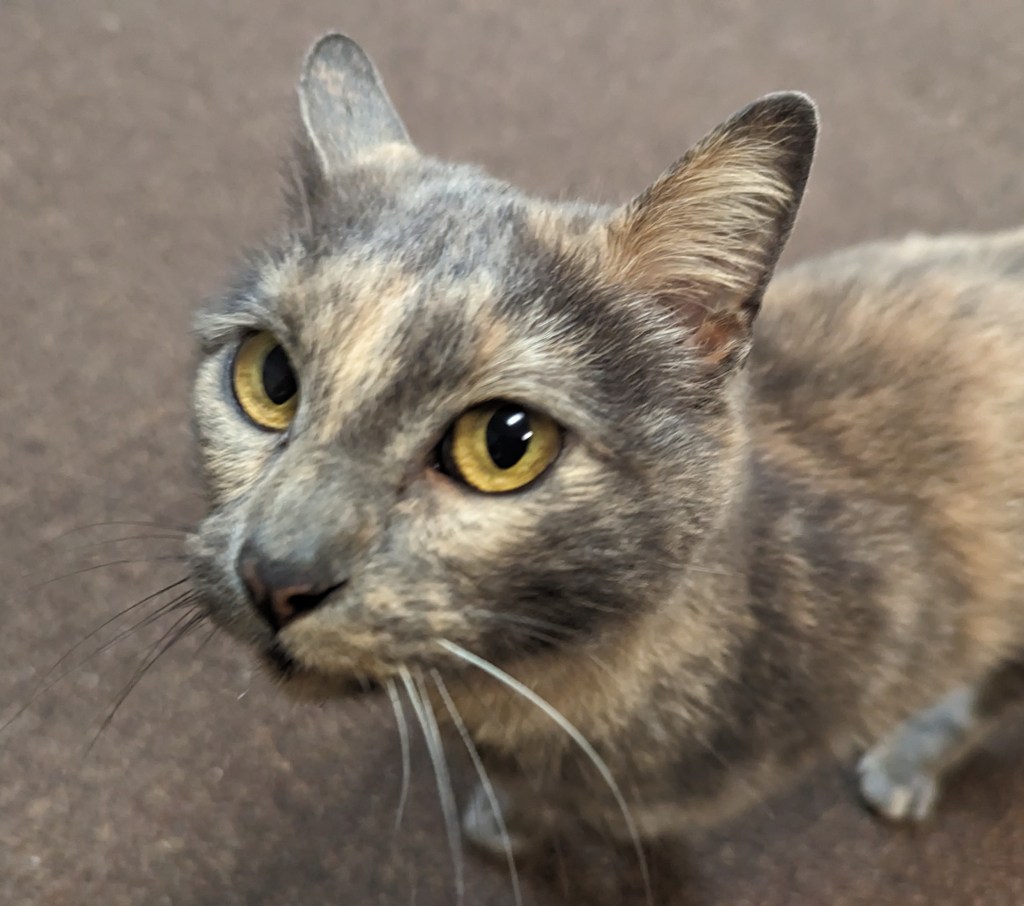
The New Mouser seems content to stay with us here. Actually, she seems to be a bit too content. She has been coming inside, where some on staff do not want her to be. Darla, her predecessor, was never so presumptuous.
Now that she is so comfortable with people, I can get here into a kitty transportation device and take her to a veterinary clinic to determine if she has a chip, and to get her inspected. If necessary, and if she stays here, we may need to get her spayed. (We only assumed her gender according to her color pattern. She may need to be neutered.) I suspect that she was dumped here while young and before getting spayed.
If she stays here, she should get a name. The crew has not agreed on one yet, and several options remain. ‘Snickers’ seems to be the favorite option, although I dislike it. I prefer ‘Holly’. ‘Heather’ is not bad, and seems to suit her better. These are some others that I considered, only to determine that I am not so totally keen on them:
Rhoda – This confuses Rhody.
Erica – This is short for Ericaceae, which is the family of Rhododendron. It is not so bad.
Azalea – This is another type of Rhododendron. I dislike it for this particular kitty.
Lyona – This is short for Lyonothamnus floribundus ‘Asplenifolius’. I am unimpressed.
Leona – This is short for Leonotis leonurus. I am still unimpressed.
Typha – This is Latin for cattail, but sounds like punctuation or a fever.
Myrtle – This is a ‘no’.
Lily – This is for a white kitty.
Rose – This is for a prettier kitty
Daisy – This is for some other kitty that is not this one.
Violet – No.
Flower – No.
Blossom – No.
Aster – Jasmine – Ivy – Poppy — No – No – No and No.
Horridculture – Too Busy To Write (Reblog)
Even after mentioning several times that I must discontinue blogging and reblogging, I feel terribly guilty about not posting anything for today. However, for the second time, there is nothing more than a few of the most recent articles to reblog, and nothing new to post. So, here is one of the recent articles. (If this sounds familiar, it is because this is the second time. Yes, I copied and pasted, and changed ‘second’ for ‘first’.)
Horridculture – Green Walls
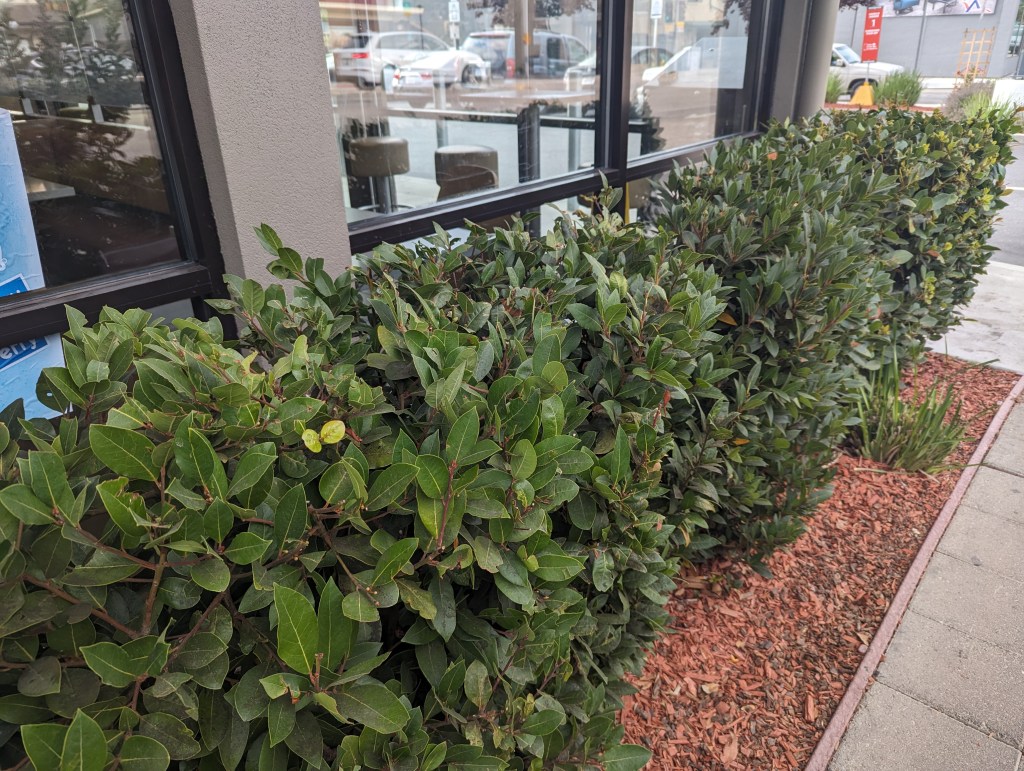
Foundation plantings were quite functional while eavestroughs and downspouts were prohibitively expensive prior to about the Victorian Period. They dispersed rain water as it fell from eaves above, in order to limit surface erosion and muddy splatter onto foundations, basement windows, and lower portions of walls.
Most foundation plantings were tough perennials, such as lily of the Nile, or low and densely evergreen shrubbery, such as English boxwood or Indian hawthorne. Some did not stay so low though. Long after eavestroughs and downspouts became common, some foundation plantings grew into obtrusive hedges in front of exterior walls. Some even obscured windows. Instead of dispersing moisture, they retain moisture and damp detritus that promotes rot of associated walls and infrastructure. Furthermore, they require maintenance, such as shearing. It would be more practical to paint a wall green than to leave overgrown foundation planting pressed up against it.
Vines are no better. They can be practical on reinforced concrete and cinder block, but not much more. Not only do they promote rot, but some destroy paint, siding and stucco. Vermin can get anywhere that vines provide access to.
This is neither about vines nor foundation planting though. It is about this hedge in front of this glass facade. It got my attention because it did not grow slowly into this form from overgrown foundation planting, but was intentionally installed and shorn as such. Then, I realized that it is actually practical. It did not require modification of the wall. It is shorn to maintain a slight bit of clearance from the glass facade, to facilitate cleaning of the glass, and inhibit accumulation of detritus against the glass. Therefore, it does not look so bad from within. Perhaps it is comparable to painting the glass wall green, but is actually more visually appropriate.
 Tony Tomeo