Goodness! Recycling these old articles involves some unpleasant memories, . . . but also some good ones.

 I work for the best. I do not intend to be too terribly pompous about it. I am just being honest.
This is not first time I have worked for the best. I have worked for at least three of the best arborists in the Santa Clara Valley, and two legendary horticulturists. I intend to eventually return to work for one of those legendary horticulturists back on the farm.
The main work I do now is part time and temporary. That means that I work less than four days each week, and will not be working there forever. I try to not think about leaving because it is saddening. I enjoy those whom I work for so much.
I work for only one other horticulturist, and one who is studying to be an arborist. Neither of them grow any significant quantity of nursery stock like I intend to spend the…
View original post 421 more words
 For the first time since last winter, a few raindrops were heard on the roof early last Monday morning. It was over by the time I realized that the odd and unfamiliar noise really was that of raindrops. By the time the sun came up, everything was dry. I do not even know if these few raindrops could be considered to be the first rain of the season. There were a few similar raindrops on my windshield a while back, but they were dismissed as such; merely a few random raindrops rather than a confirmed rain shower.
 Immediately after the Loma Prieta Earthquake, nothing was open for business downtown on North Santa Cruz Avenue south of Bean Avenue. As buildings were inspected for safety and cleaned up, sections of cyclone fence that had kept everyone out were slowly and systematically moved out so that businesses on the east side could open for business. The same slow process was repeated on the west side, moving south from the corner at Bean Avenue, but did not get very far. The old Los Gatos Cinema, as well as the several other building between it and the seemingly destroyed old La Canada Building on the southern corner of the block, were too badly damaged for the fence to be removed.
 There are too many different types of horticultural professionals to count. There are nurserymen who grow horticultural commodities. There are landscape architects and landscape designers who design the landscapes into which some of these horticultural commodities will go. There are landscapers who install such landscapes. Of course, there are gardeners who maintain the landscapes after they are installed. These are just a few of the more familiar horticultural professionals.
 It was so long ago that I barely remember it. I was just a little tyke. My older sister tripped on the driveway and broke one of the Japanese boxwood shrubs in the hedge on the edge of the driveway and front walkway. The hedge was still young then, and not completely filled in. My Pa replaced the missing shrub shortly afterward, but not before my younger brother and I learned that the gap was a shortcut through the hedge. The puny new shrub was not enough to compel us to go around like we had done before. Of course, it did not survive for long. It too got broken off.
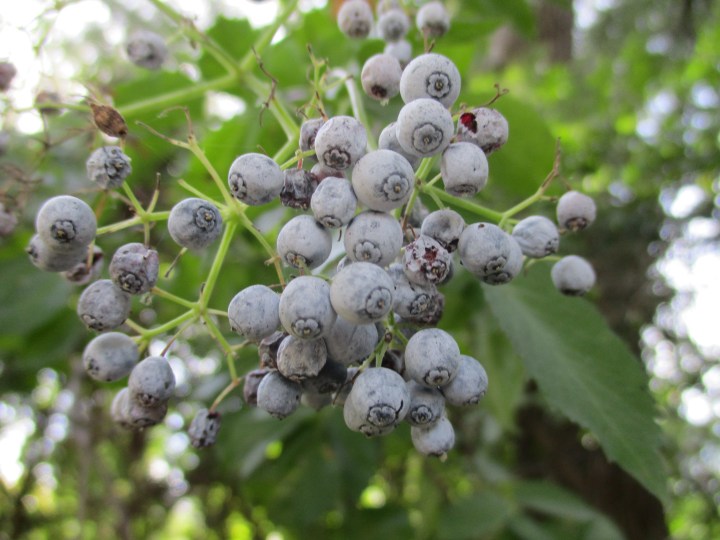 There were barely enough blue elderberries left this late in the season for the blue elderberry jelly that should have won the blue ribbon at the Harvest Festival. It’s a long story.
 Throughout my career as a horticulturist, I have worked in more public landscapes than most. Some of these landscapes were in some of the most notorious neighborhoods of the San Francisco Bay Area and the Monterey Bay Area. Yes, I have found some rather strange items strewn about, including a few that necessitated telephone calls to local law enforcement. Yet, I have never once found a single used syringe.
 Just about everything in this picture is icky! This species of pampas grass, Cortaderia jubata, is one of the most aggressive and noxious of the invasive exotic specie that have naturalized here. It seems to be incarcerated behind the weathered cyclone fence with barbed wire on top. The big water tank is is a harshly stark background. The tired old Douglas firs and ponderosa pines to the left and right seem to be unhappy here. The small coast live oak that is at least trying to make a more cheerful appearance is only oppressed by the surroundings. Only the clear blue sky above lacks the ick factor.
 Straight out of college, I worked briefly for a wholesale nursery that grew landscape stock, which included boxed trees. We also recycled a few trees, particularly from the abandoned homes in the neighborhood around the nursery. (The neighborhood, including the nursery, were in the easement of the Norman Mineta Freeway, which in the process of being constructed at the time.) I had believed that the boxed and recycled trees were for ‘instant’ landscapes, the sort that were for clients who did not want to wait for things to grow. It made sense, particularly in our region where so few stay in the same home long enough for trees to mature.

