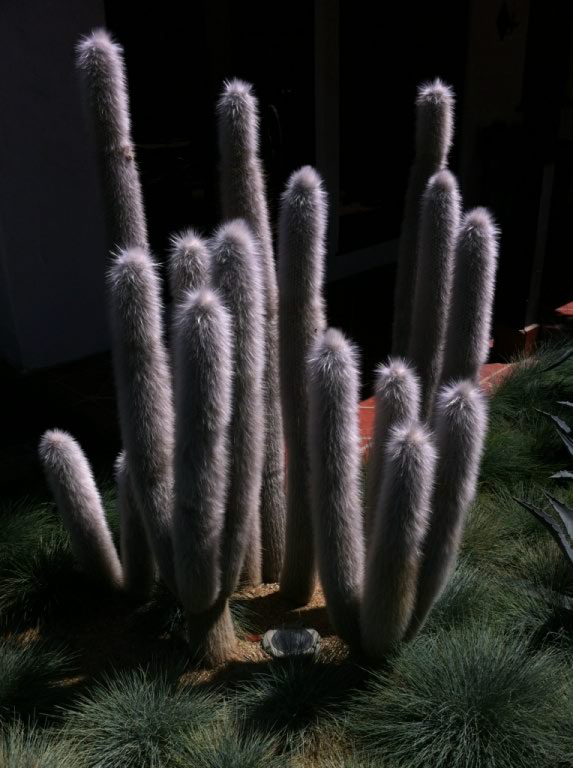
Old man cactus has developed an interesting means with which to shade itself.
The long, white hair of old man cactus, Cephalocereus senilis, that protects it from sun scald in harsh climates is what make it so striking in home gardens. However, the sharp spines concealed by the hair make it more appealing from a safe distance, like in the background behind lower perennials. The white, yellow or red flowers are rarely seen, since they only bloom on old stems that are at least a dozen years old. Such old stems are often cut down to the ground before they bloom because they get too tall and awkward, or because they eventually lose some of their hair as they get too old. There should be plenty of hairier, younger stems emerging from the basal clump to replace the older stems anyway. Individual stems rarely develop branches. Although old man cactus can get quite tall, it is typically kept less than fifteen feet tall.
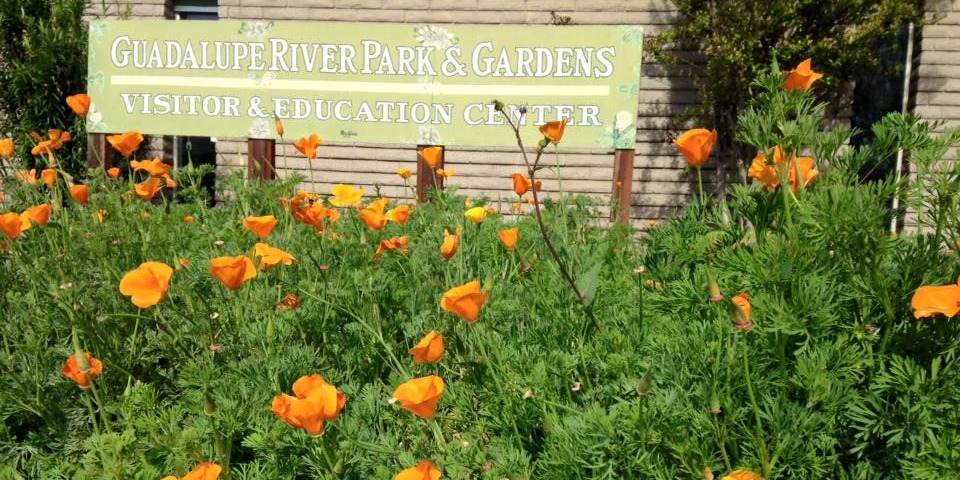
Spring in Guadalupe Gardens, a celebration of healthy living, gardening and the environment, will be here in little more than two weeks, on April 28! The 5 kilometer Fun Run that begins at 9:00 a.m., an hour before anything else, makes its way through the park and back to the main event, where there will be various health professionals to share information about healthy living, and for health screenings. Other exhibits will feature information about the environment and green technology, including presentations about solar energy and worm composting. Recyclable electronic waste can be dropped off free of charge. There will be all sorts of lectures, workshops, activities for children and even dancing and live bluegrass music.
But honestly, the main reason that most of us who read this column attend Spring in Guadalupe Gardens is all the gardening goodies! There will be an abundance of all kinds of plants from all kinds of specialty nurseries. Spring in Guadalupe Gardens has always been a great source of rare and unusual plants, as well as some of the more familiar plants, at reasonable prices.
Not only will there be plenty of plants to buy, but experts and some of the nurserymen who grew many of the plants will be available for advice on selection and cultivation. Representatives from the American Fuchsia Society, the John. E. Stowell Dahlia Society and the South Bay Heritage Rose Group will be there selling their plants, and sharing their expertise and information about membership. It is not too late in the season to select warm season vegetable plants, including heirloom varieties, from the extensive assortment that will be available.
Besides the shopping, Guadalupe River Park Conservancy and Greenwaste will be giving away one free bag of compost to each household. The San Jose Heritage Rose Garden, which is the most extensive public collection of old-world roses in the Western Hemisphere, will be in full bloom and open for tours.
Spring in Guadalupe Gardens will be from 10:00 a.m. to 3:30 p.m., in the Guadalupe River Park and Gardens between Taylor Street and Coleman Avenue in San Jose. There is no charge for admission or parking. More information can be found online at www.grpg.org or by telephoning 298 7657. Registration for the Fun Run, which begins an hour earlier at 9:00 a.m., can be arranged at www.grpg.org/FunRun.shtml.
Would these hanging potted plants even be noticeable if they were not circled?
Container gardening is overrated. Perhaps not so much now as it had been while it was more of a fad a decade or so ago, but it is still overrated nonetheless. Most plants are happier in the ground than they are in confinement. They want to disperse their roots freely to where the goodies are, and not contend with the unnatural temperature fluctuations of contained medium.
There are only a few exceptions for which containment of potted plants is an advantage. Houseplants are the most obvious exceptions. Also, plants that are sensitive to frost can be relocated to sheltered situations for winter if contained. Potted orchids and other flashy bloomers can be prominently displayed while blooming, and then returned to utilitarian locations as they finish.
The justification for the hanging potted plants in the picture above escapes…
Valley oak and coast live oak are the two most magnificent oaks of California. Valley oak likely receives more notoriety. It stands taller, and defoliates to expose its sculptural form through winter. Coast live oak, Quercus agrifolia, is almost as grand within its evergreen foliage. It can grow as tall and broad as seventy-five feet, with trunks wider than ten feet.
Coast live oak is notably variable in the wild. Exposed and solitary trees can grow bigger and older than grove trees. They can live for many centuries, and hang their canopies to the ground. Grove trees may not live half as long, and tend to shed shaded lower growth. Solitary trees are likely to survive fire. Grove trees within forests are less likely to survive.
Coast live oak is more appealing in the wild than within home gardens. Regularly messy debris is mildly herbicidal to some delicate plants below. It also stains hardscapes. Trees that matured without irrigation are very susceptible to rot with new irrigation. Landscapes around such trees must therefore demand very little. Roots are very sensitive to damage.
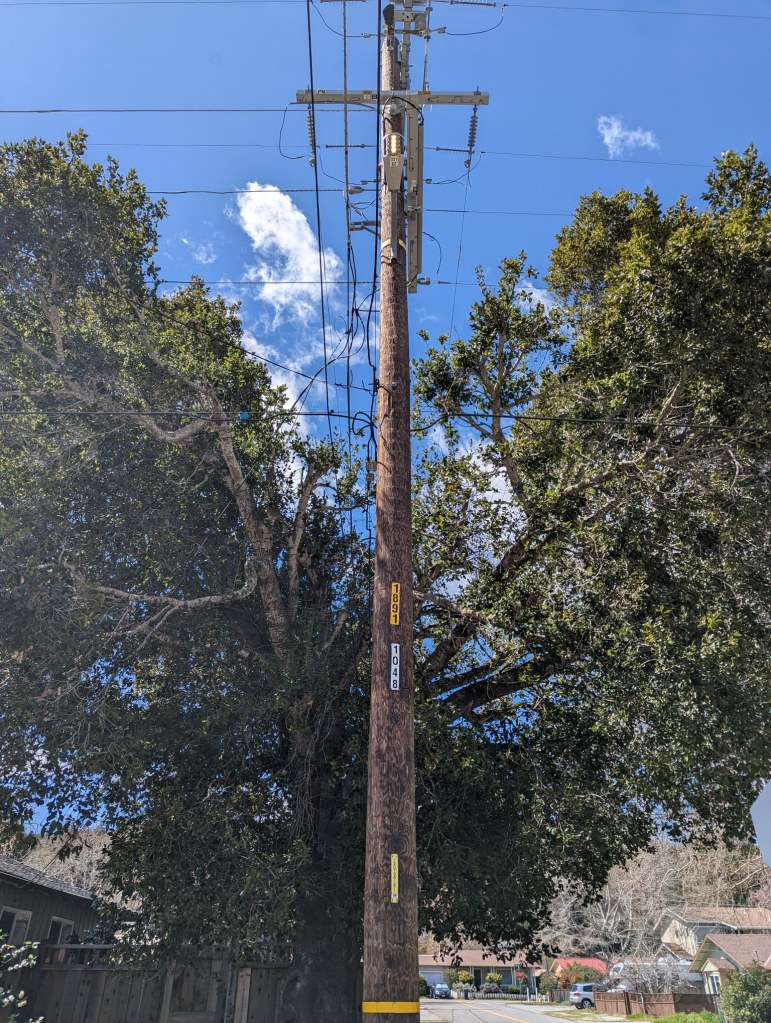
Last winter was a doozy! It involved historic frost, snow, rain, wind, floods and mudslides. A few roads remain closed in some regions. Major electrical outages were too numerous for prompt repair. Weather alone did not cause such outages though. It merely dislodged vegetation that did so. This demonstrates the necessity for utility clearance maintenance.
Utility pruning is a specialized but very often unpleasant sort of arboriculture. It maintains necessary clearance between vegetation and utility cables. Its unpleasantry derives from its harsh efficiency. Clearance is the priority. Proper arboricultural technique is not. There is no compromise. Trees that encroach too closely to cables are likely to regret doing so.
Proper arboricultural procedures are too expensive to justify for utility clearance pruning. Otherwise, electricity and other utilities that utilize cable would be much more expensive. Besides, for many trees within utility easements, proper arboriculture is impossible. They can not accommodate necessary pruning without disfigurement. Several can not survive such disfigurement.
Palms, for example, can not survive without their single terminal buds. They lack limbs to divert growth to. Removal of a terminal bud that encroaches too closely to utility cables is lethal. Palms generally grow only upward. Those that grow tall rapidly can not live below utility cables for long. Very few palms remain low enough to maintain minimal clearance.
Excurrent trees are generally more vulnerable to disfigurement than decurrent trees. The single central trunks of excurrent redwoods and spruces do not adapt to redirection. The several main limbs of decurrent oaks and elms are more cooperative. Compact trees that are unlikely to reach cables are least problematic. Of course, many trees are unplanned.
Arborists can repair some minor clearance pruning damage or disfigurement. They might prevent some damage by timely pruning for containment. Unfortunately, some damage is neither repairable nor preventable. Also, such procedures are too dangerous for anyone who lacks qualification for them. Typical garden enthusiasts must avoid electrical cables!
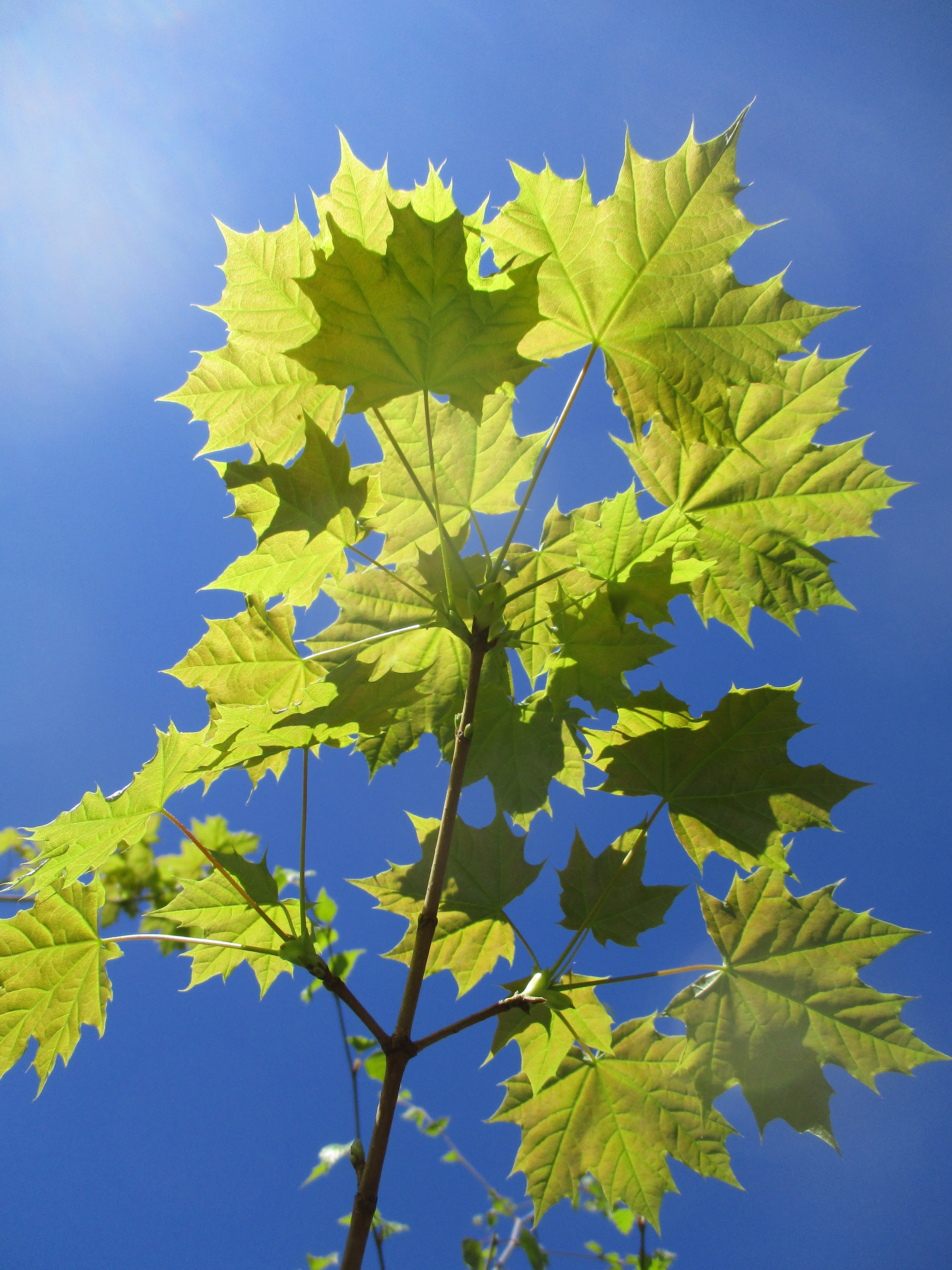
According to these maples, spring is right on time.
Seasons in the Santa Clara Valley are not very distinct. They are not much more distinct in the Santa Cruz Mountains above. Hot weather in summer does not last for more than a few days, and usually cools off somewhat at night. Winter is never very cold, with light snow rarely falling only on the tops of the highest peaks.
Some believe that summer is our only season, with a few days of ‘not summer’. I would say that it is more like springtime all the time, with a few warm days, a few cool days, and a few rainy days. In many ways, it is great for gardening. However, it can be limiting for species that prefer more warmth in summer, or a good chill in winter. It can also be rather boring.
Three years later, some of the Rhus still awaits placement in a permanent home, but the buckeye now lives in Ilwaco, near where I am now vacationing. (Now that this article is recycled, it is not two hours late, as described.)
Apologies for the delay of posting something for noon as I typically do.
These are just two pictures of two species that were not interesting enough for my Six on Saturday post this morning. Now that it is past one as I write this, it will be scheduled to post at two, hence Two at Two.
Most of what we propagate or recycle here has some potential to be used in the landscapes. Sometimes, we salvage something just because it it too appealing to waste, even if there is no plan for what will be done with it later. For example, we now have five nicely canned but otherwise useless Norway maples, just because they needed to be removed from a landscape.
I canned the four specimens of unidentified Rhus in the picture above because I thought I knew what they are, and that…
Rhody, Carson and I finally left on vacation. Although this trip was planned a year ago, it was delayed weekly since February. I had intended to leave prior to March. I finally realized that the timing would never be convenient, so left anyway, after midnight on Wednesday morning. We arrived in Ilwaco on Wednesday night, and went to Skooter’s Garden at Tangly Cottage Gardening in the morning. Of course, we stayed later than intended, ate cookies with coffee, and arrived in Silverdale later than we should have on Thursday night. The first four of my Six here are gifts from Tangly Cottage Gardening, so are approved by Skooter. The last two were at the Port of Ilwaco.
1. Canna ‘Stuttgart’ is tall and elegant, with small peachy orange flowers and irregularly white variegated foliage. I requested a copy of it shortly after leaving without it last year.
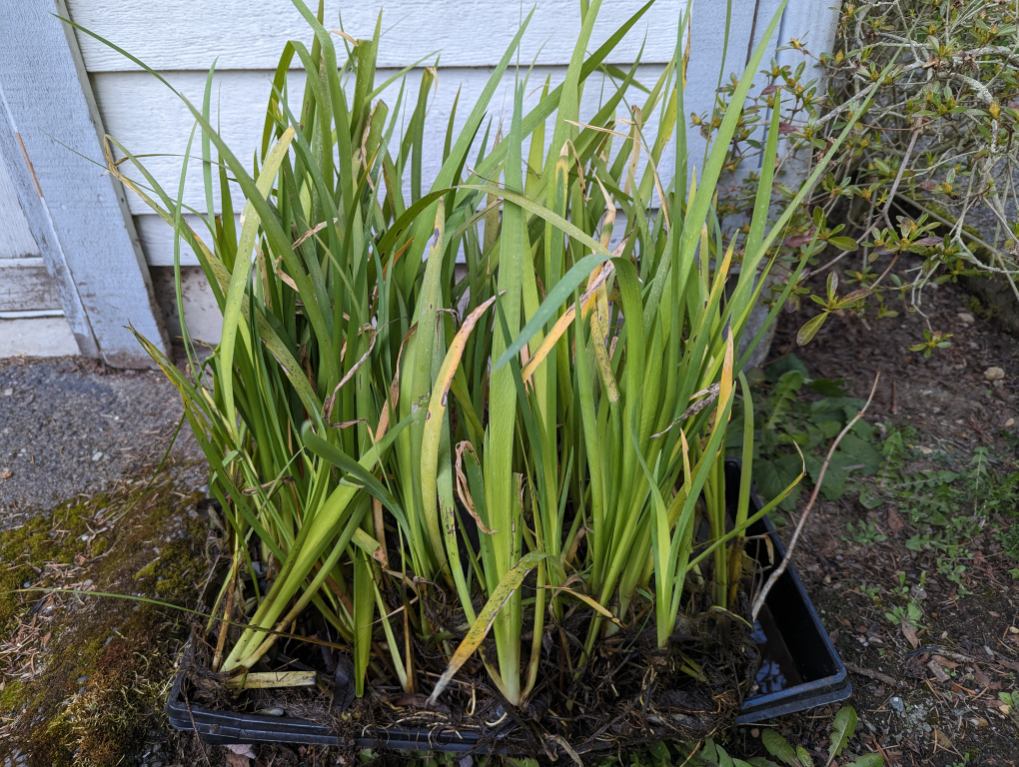
2. Iris X Louisiana ‘Black Gamecock’ is the most popular Louisiana iris, with dark purplish blue bloom. I requested some of it when it was removed from Skooter’s Gaden. This colony will divide into many individual rhizomes. I expect to get significant mileage from them, and I know they will multiply efficiently.
3. Iris unguicularis, Algerian iris was s surprise. It was split after my arrival, directly from a healthy colony within Skooter’s Garden. I had been impressed with the sky blue bloom, but could not justify trying it. Now, no justification is necessary. We will likely put much of it within the Blue Garden. I know that this colony is not very impressive in this picture, but the rhizomes are the important parts.
4. Sambucus racemosa, red elderberry grows wild in Skooter’s Garden. I had been wanting this for a while, but did not think to request it last year. I requested it this year, so got four good wild seedlings.
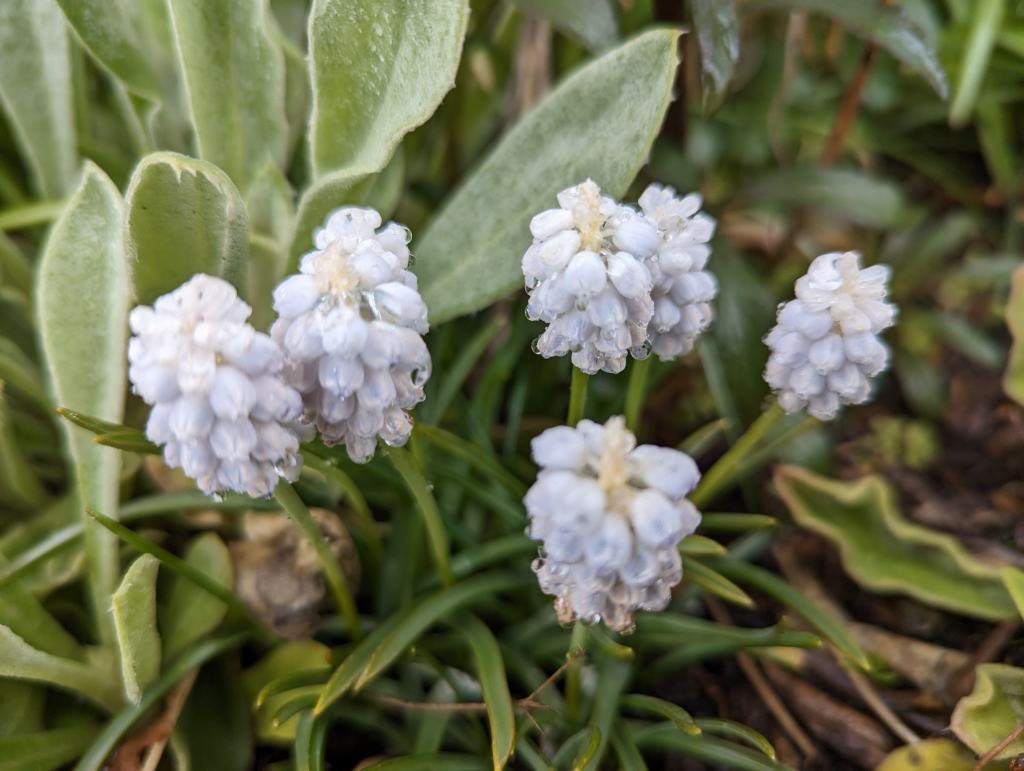
5. Muscari armeniacum ‘Album’, white grape hyacinth inhabits the landscapes at the Port of Ilwaco. I got copies of this last year because I had been wanting it for a while. I know that blue is the most traditional color for grape hyacinth, but white is my favorit color. It may go into the White Garden at work.
6. Muscari armeniacum, grape hyacinth is quite abundant at the Port of Ilwaco. I did not request any of it because I already have a small colony of it for my own garden, and I do not want any others to mingle with them, regardless of how similar they seem to be.
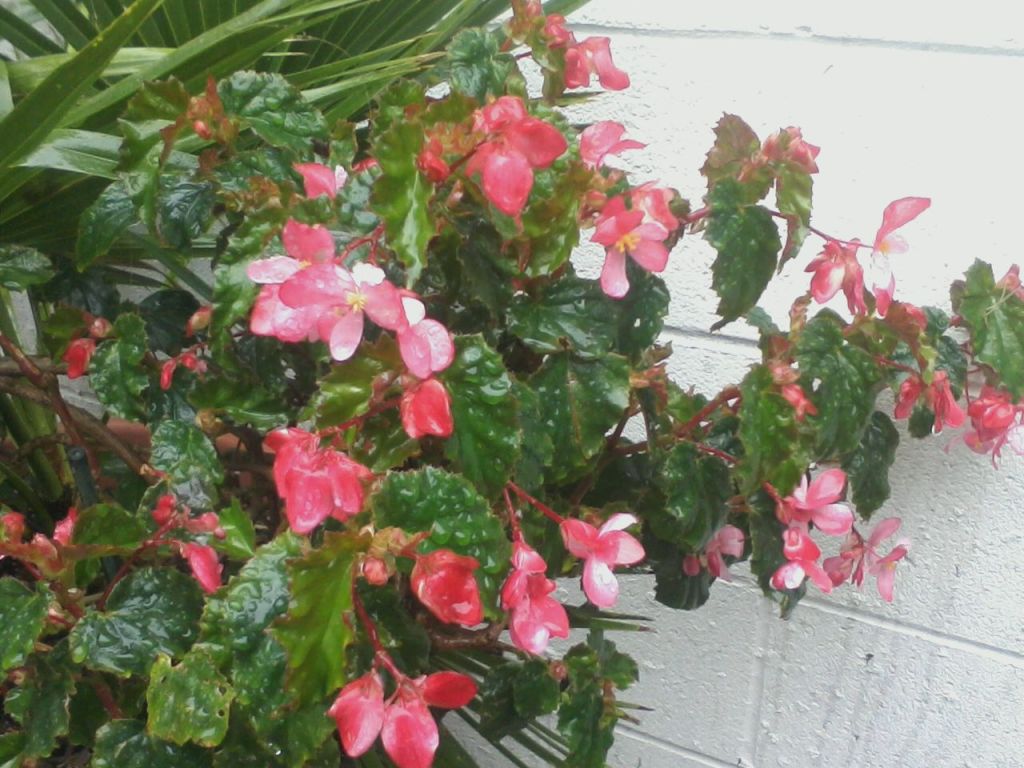
Richmond begonia is very easy to propagate by cuttings.
It is difficult to say whether Richmond begonia, Begonia ‘Richmondensis’, is grown more for unusual waxy pink flowers that bloom throughout the year, or rich glossy green leaves with bronzy red undersides. Perhaps it is the distinctive combination of both characteristics. Perhaps it is because Richmond begonia is so easy to grow in partial shade near porches or atriums where other flowering plants would want more sunlight. It only wants relatively rich soil and regular watering, and is quite happy in pots. Mature plants eventually grow to two feet tall and broad. Lanky branches that get cut back to promote dense growth can be rooted elsewhere in the garden.
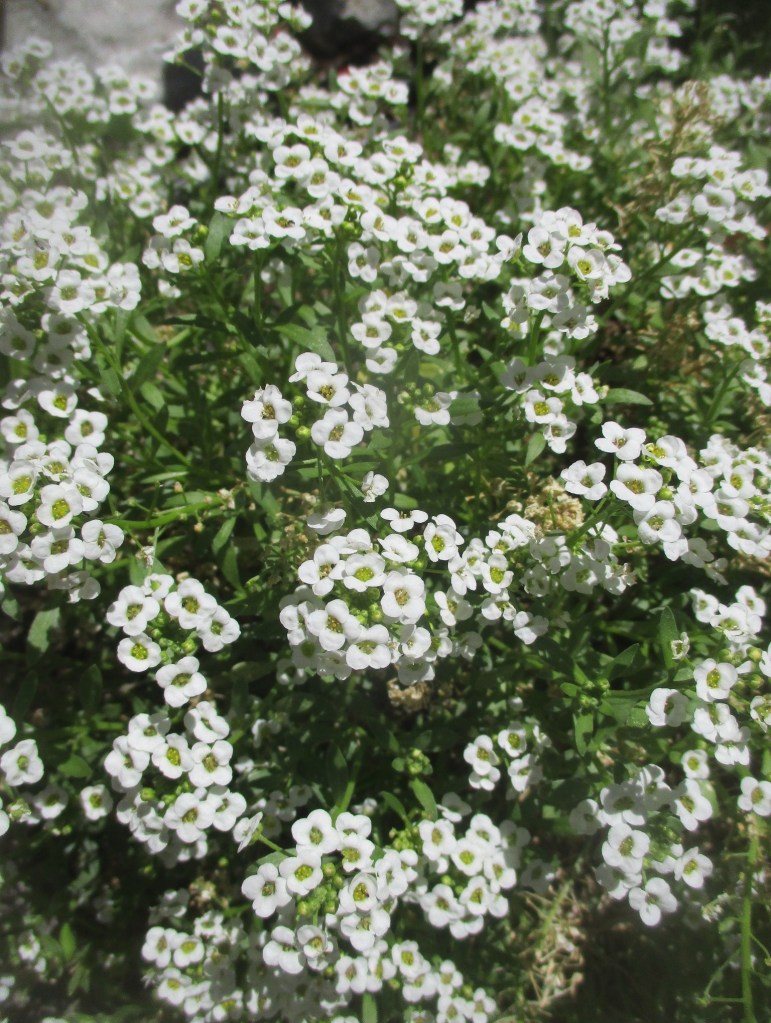
Sweet alyssum can seem to be perennial, but bloom best during warm weather.
The common and almost stigmatized nasturtium has always been my favorite of the flowering annuals. It is technically a warm season annual that gets its seed sown at the end of winter so that it can grow and bloom with bright yellow, orange and sometimes even red flowers all spring and summer and into autumn. However, because winters are so mild here, the foliage is appealing even while bloom is inhibited by cool winter weather. By the time older plants die out, seedlings are already maturing to replace them; so they function like perennials. Nasturtiums are so easy to grow that many garden enthusiasts consider them to be weeds, or too cheap and common to bother with. Yet, their carefree nature is precisely why so many of us enjoy them so much.
Sweet alyssum shares the same reputation that causes it to be shunned by some but appreciated by others. It can be white, pink or purple when initially planted, but eventually reverts to white as it naturalizes. (Pink and purple types produce white blooming seedlings.) Like nasturtium, it blooms less over winter, but never really goes away, since seedlings are always there to replace older plants. It is easy to grow from seed sown late in winter, or can be planted from cell packs after winter for more immediate results.
All sorts of warm season annuals that are now available in nurseries are ready to replace the cool season annuals that bloomed through winter. Busy Lizzy (impatiens) and petunias are the most popular as well as the most colorful. French marigold has the best yellows and oranges, as well as bronze. Lobelia is a classic companion for sweet alyssum or marigold, providing all kinds of blues, as well as purple, purplish rose and white (although white is rather redundant to alyssum). Cosmos blooms in many shades of pink, from very pale to almost red, as well as white. Most varieties stay quite low while others get a few feet tall.
The less popular warm season annuals are sought by those who like their unique colors or other appealing characteristics. Floss flower blooms pale blue or lavender with funny fuzzy flowers. Cockscomb are mostly the colors of marigold as well as red, but with unusual plume-like blooms. Verbena and moss rose may not fill in soon enough to work as bedding plants, but have rich colors that look great with other assorted annuals or perennials. Although statice, pincushion flower (scabiosa) and zinnia can function as bedding plants, they are more often grown singly, in small groups or as borders around more homogenous bedding plants.

 Would these hanging potted plants even be noticeable if they were not circled?
 According to these maples, spring is right on time.
 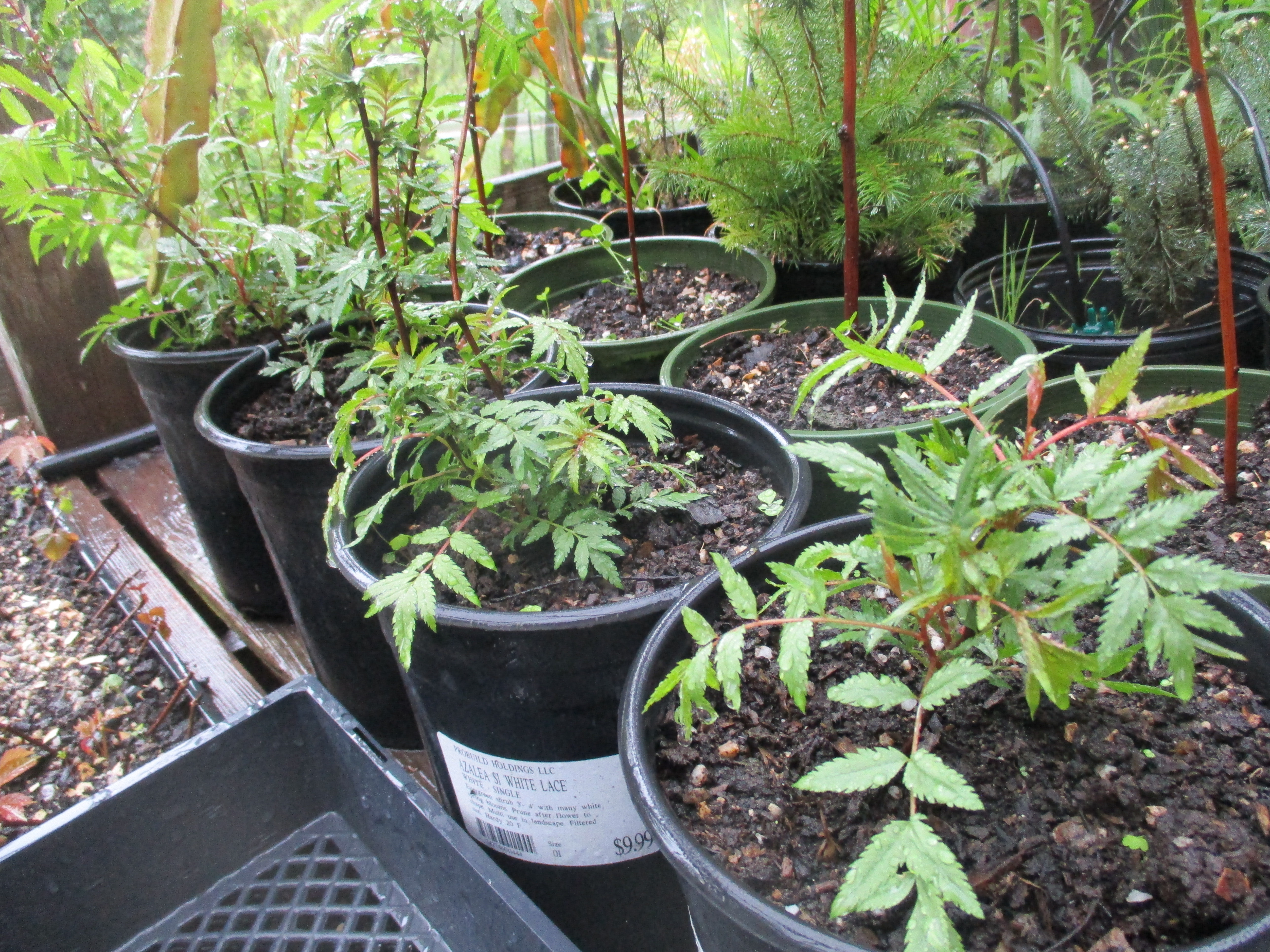 This species of Rhus remains unidentified.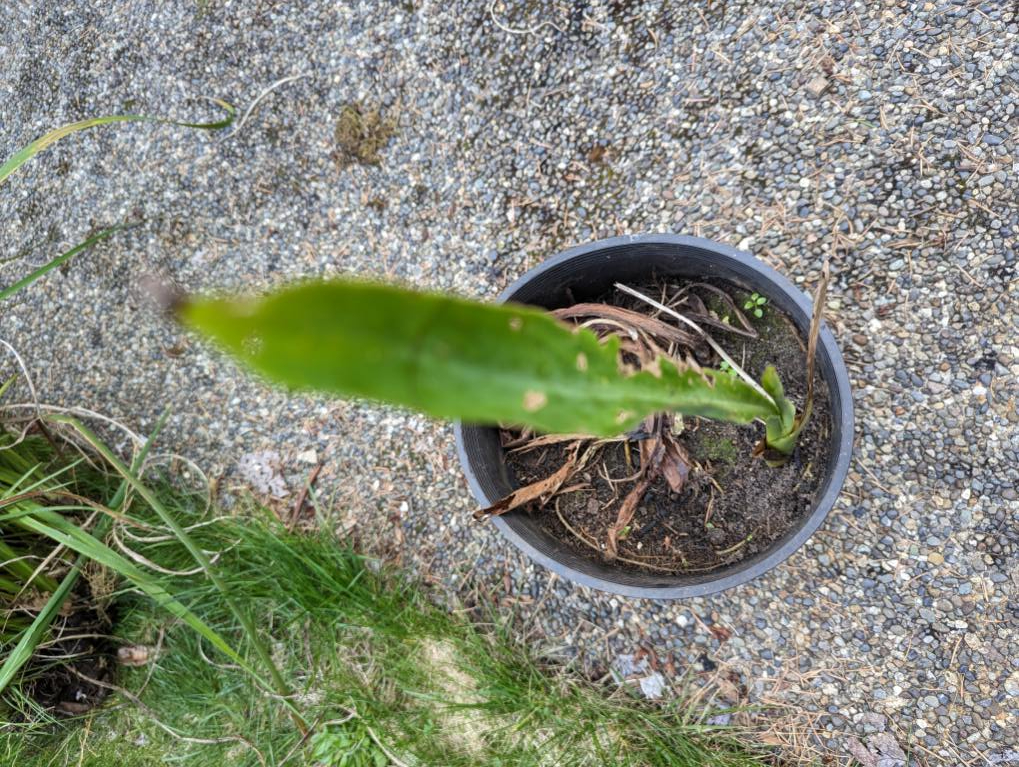



 Tony Tomeo