Canning

Surplus fruits and vegetables can be canned for later.

It seems to me that the reason that so many of the kids I grew up with do not like apricots is that they were so common when we were younger. Because there were still several abandoned orchards, and most of us had at least one apricot tree in our backyards, we ate apricots in every form imaginable; fresh, dried, in pies, in cobblers, as jams, as apricot nectar (juice) and of course, canned. By the time we grew up and moved on, we were done with apricots.

Apricots happen to be one of the many ‘high-acid’ fruits that are remarkably easy to preserve by canning, which is how and why they are available as jams and canned apricots at any time of the year. In fact, almost all of the fruits that were so commonly grown in the vast orchards of the Santa Clara Valley, like prunes, plums, cherries, nectarines, peaches, apples and pears, are also high-acid fruits that are relatively easy to can in various forms. ‘Low-acid’ vegetables, like broccoli, corn, pumpkin (squash), spinach and beets, as well as meat and poultry, were not so commonly canned only because they take considerably more work to can with the use of a pressure cooker (in order to achieve higher temperatures).

Because home canning can potentially be dangerous if done improperly, it is best to learn something about it first. This is why the Guadalupe River Park Conservancy has arranged for UC Master Preserver Susan Algert to conduct the workshop ‘Safe Methods for Food Preservation and Canning’. Participants will learn the importance of canning to kill toxic pathogens, and why high-acid produce gets canned in a hot water bath while low-acid foods need to be canned in a pressure cooker. Canning is an alternative to freezing for preserving overly abundant produce from the garden.

(Outdated information regarding classes has been omitted from this recycled article.)

Horridculture – “Help! I’ve fallen and I can’t get up!”

The landscape maintenance industry attracts apathetic idiots. There is no nice way of saying it. Those who have flunked out of everything else and simply do not care can push a mower. I can not imagine how infuriating this must be for gardeners who take their work seriously. It must be more difficult for them to observe than it is for me.

More to the point, the jacaranda tree in the median pictured above fell down and stayed that way long enough for the canopy to try to grow into a normal tree. It likely got run over by a car. No one bothered to try to stand it up and stake it, or more simply remove it, and maybe replace it. It just stayed there, for YEARS. So-called maintenance ‘gardeners’ just mow around it, and weed whack the grass that they can not mow below the horizontal trunk. Arborists might eventually groom the canopy. Apparently, they all find this to be acceptable horticultural procedure.

The Brazilian pepper tree pictured below is almost as weird. It is slightly more tolerable only because it has not been in this position as long. Perhaps SOMEONE or ANYONE will realize how inappropriate its horizontal orientation is for the parking lot that it inhabits, and remove it. It had been falling over slowly, which is why the exposed roots are already weathered. No one bothered to prune it for weight reduction or to improve the clearance on the side that it was falling toward. Otherwise, it might have been able to support itself, even with a bit an irregular but tolerable lean. Now that it is on the ground, some so-called ‘gardener’ pruned it around the parking spaces that it fell between. Seriously! The bumper of the pickup is against a now hedged portion of the canopy of the fallen tree. The branches to the left in the picture were pruned between adjacent parking spaces so that they can actually accommodate parked cars as they were intended to. Seriously, rather than simply cut the tree ‘down’ and remove it, someone devoted that much effort into something as crazily dysfunctional as this. IT WOULD HAVE BEEN MUCH EASIER TO DO THIS PROPERLY!

Oxeye Daisy

Oxeye daisy is actually a perennial.

Like several annual warm season bedding plants, oxeye daisy, Leucanthemum vulgare, is actually perennial. Also, some of the less extensively bred sorts disperse enough seed to naturalize and potentially become invasive. Increasingly popular modern varieties that are prudent with seed might not be true to type. Some might revert to more prolific forms.

Modern varieties should not get much higher than a foot and a half. They should also be more dense than the simple species, which gets a few feet tall. Foliage and form is quite variable among varieties. Stems are solitary or branched. They may be leafy or sparsely foliated above basal rosettes. Leaves might be lobed or serrate, with or without petioles.

The solitary, paired or tripled composite blooms of oxeye daisy are not so variable. They are classic daisies, with a dozen to three dozen clear white ray florets surrounding bright yellow disc florets. Without deadheading, fresh new bloom overwhelms deteriorating old bloom. Oxeye daisy is splendid as a cut flower. Spring bloom continues through summer, and can actually continue sporadically for as long as the weather is warm.

Warm Season Bedding Plants Begin

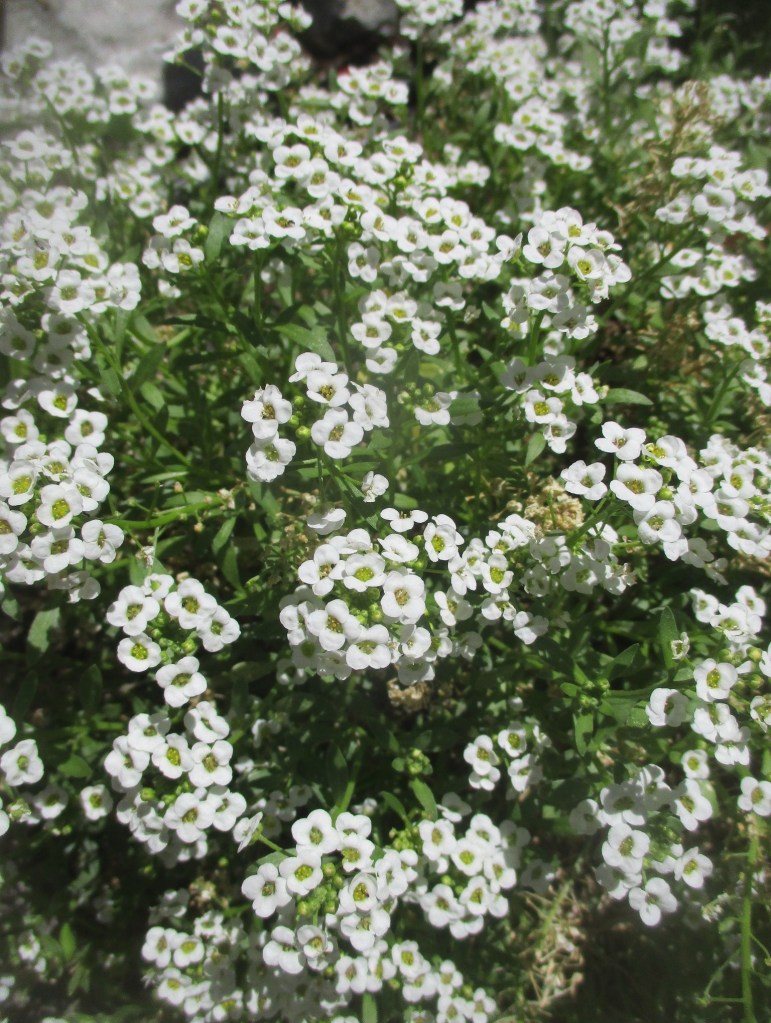
Alyssum grows very readily from seed.

Annual bedding plants are surprisingly more popular among those who enjoy gardening less. Those who procure the services of gardeners appreciate the rich colors and simple efficiency of annuals. Many who are more directly involved with their gardening consider them to be decadent. Nonetheless, warm season bedding plants will soon be in season.

Cool season bedding plants should perform well until the weather becomes too warm for them. There is therefore no rush to replace them yet. Besides, it is likely still a bit too cool for mature warm season bedding plants to be out in the garden. However, seed for warm season bedding plants takes time to grow. Some should start now to be ready for spring.

For example, petunia, impatien and zinnia are some of the most popular of warm season bedding plants. Almost all of them arrive at their respective gardens as somewhat mature plants within cell packs from nurseries. Presently, such plants may be vulnerable to frost. However, seed of these plants that begin now should start to grow after the threat of frost.

Not many of even the most avid of garden enthusiasts grow these popular warm season bedding plants from seed. Yet, a few do so. Some unusual or rare plant varieties are only available as seed. Many common wildflowers and ‘true to type’ annuals provide seed for subsequent generations. Such seed generally start in flats with shelter from frost indoors.

From flats, seedlings may graduate to cell packs or small pots prior to transitioning into a garden. Some should actually begin within cells rather than flats. Seedlings relocate into a garden when adequately mature, whether from flats, cells or pots. Seed for many warm season bedding plants perform best directly in the garden though, without transplanting.

Nasturtium seedlings do not grow well within the confinement of cells. Then, they remain somewhat pekid for a few days while they recover from transplanting into a garden. They grow so much more efficiently from seed sown directly into a garden. Marigold can grow about as well from seed directly in the garden as they can as seedlings that grew in flats.

Expiration Date

Perhaps I should have shared updates on these seed. To be brief, I should have utilized bottom heat.

tonytomeo's avatarTony Tomeo

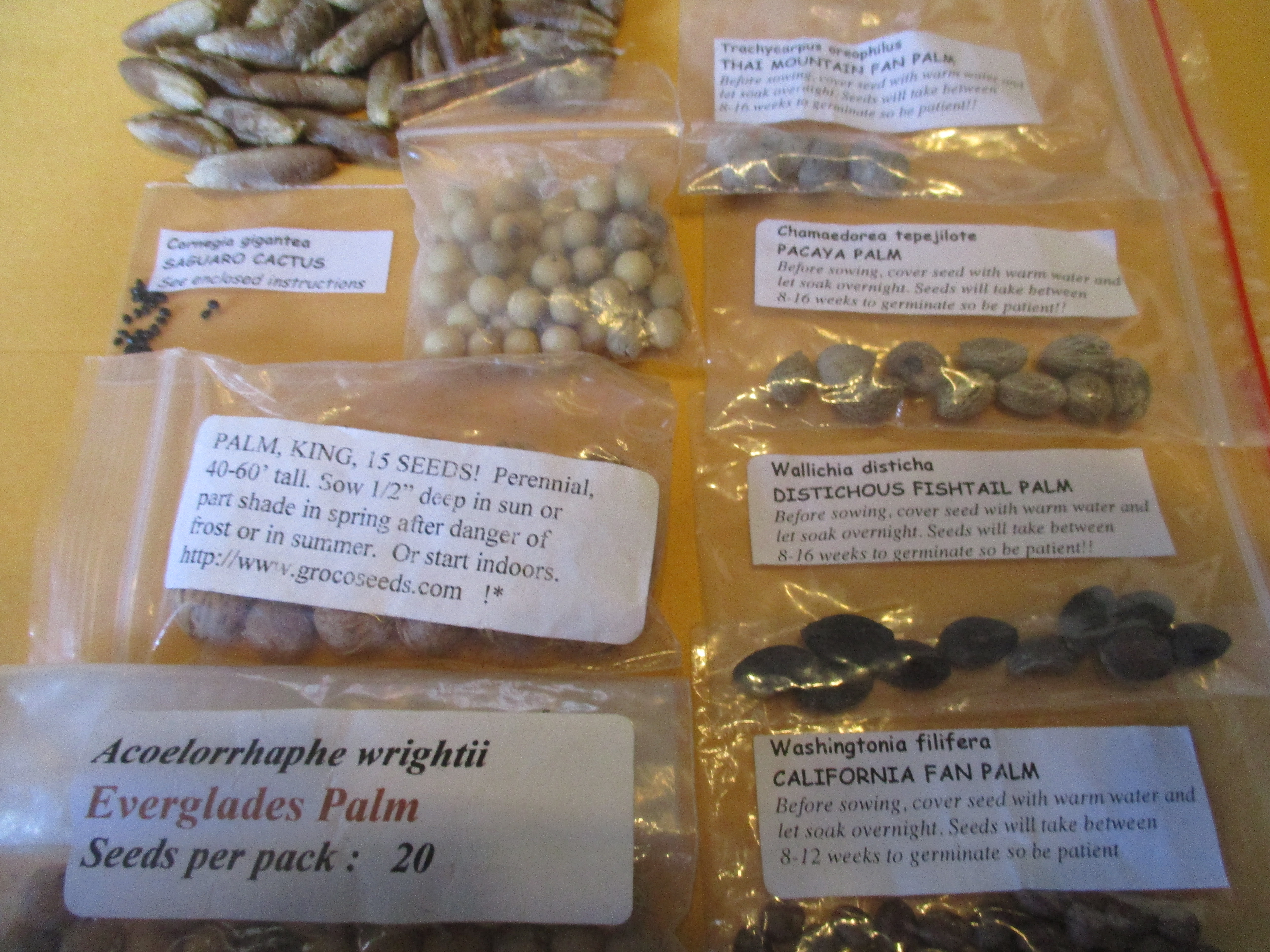
P00223-2 All those palm seed . . . and saguaro cactus.
This is worse than the various seed that I happen to collect at work. It is worse than the seed of various species that I brought back from Oklahoma. These are seed that I purchased online and then misplaced . . . for a few years . . . or actually several years. Some were already old at the time, so are about a decade old now. There are leftovers from seed that were sown in 2010.

There was not much expense involved. Back then, they were even less expensive than they would be now. Those that I got a significant volume of were purchased mainly because they were so inexpensive. I figured I could find homes for the surplus that grew from them later. Most of the seed were purchased from eBay. Some were randomly collected for free from…

View original post 188 more words

Norwegian Wood

Well, I tried to use them as understock for Schwedler maple, but they did not take. They regenerated with better than original form, but still need a home where they will not naturalize.

tonytomeo's avatarTony Tomeo

P00222K Isn’t it good?

This is really getting to be a problem. Too many feral plants that we find at work get canned as if they will eventually be installed back into a landscape somewhere. The small nursery where they recover until their relocation is getting crowded. Although many are practical and appropriate for such recycling within the landscapes here, some are not, so may be with us for a while.

Five feral Norway maple saplings were found in one of the landscapes where mature trees were pruned for clearance from a roof. We could not just leave them there. They eventually would have been overwhelmed by the rest of the forest, or grown too close to the same roof that we pruned other trees away from. They were very easily dug, so came back to the nursery with us.

It was too late to prune them as necessary. They are…

View original post 153 more words

Six on Saturday: SNOW?!

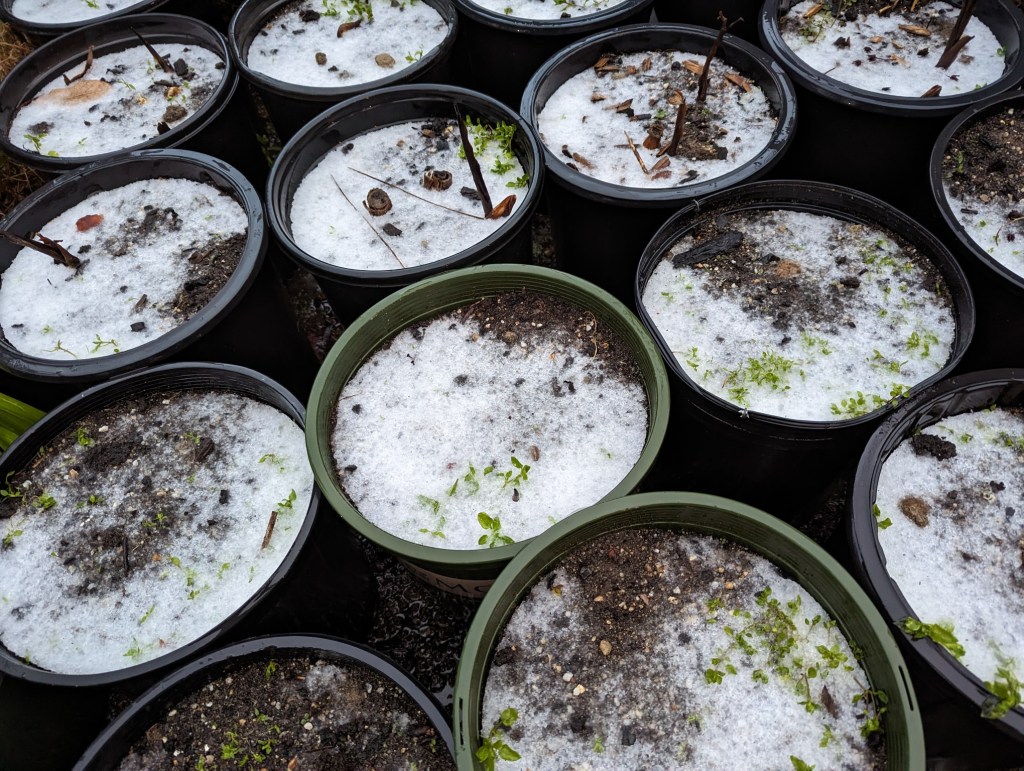
Snow is extremely rare here. It falls every few years in my neighborhood, which is about 1,500 feet above sea level, but this is nearly nine hundred feet lower. For the Santa Clara Valley, just over the Santa Cruz Mountains, it has not snowed since 1976. A forecast that included a possibility of snow was quite a surprise. Actual snow early Thursday morning was more of a surprise. It resumed overnight and into Friday morning with thunder and lightning. Of course, almost all of it melted, so that it was no more than two inches deep. I can understand why those who contend with it regularly during winter dislike it. Yuck! Rhody stayed inside all day.

1. Clivia miniata, Kaffir lily is the most recent and shameless acquisition from Craigslist. Someone in Santa Clara wanted them thinned, so I got a trunkload, totally without guilt.

2. Clivia miniata, Kaffir lily really was justified! More than two dozen split and groomed shoots are a bit more than enough and very appropriate for this shaded and narrow bed.

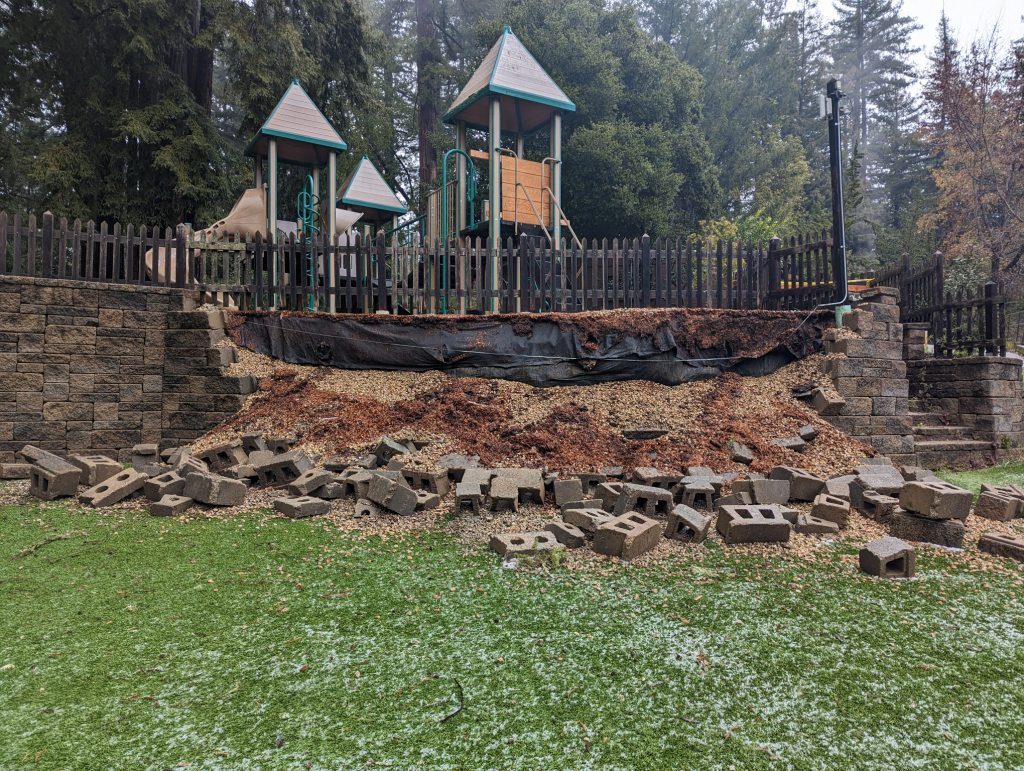
3. Jericho was not the inspiration for this landscape. It merely succumbed to all the rain. The upper few courses of stone got hastily but futilely removed as the wall began to lean.

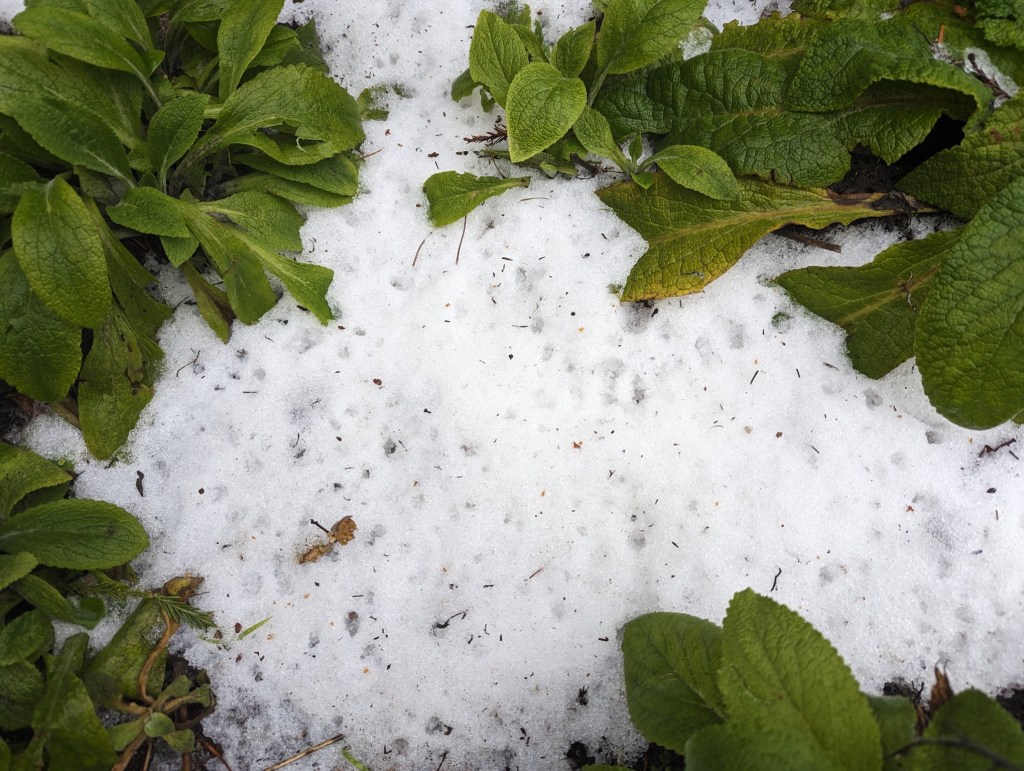
4. Digitalis purpurea, foxglove does not do much now, and is merely incidentally to this strange picture anyway. Snow from Thursday and Friday is the major development here.

5. Canna is likewise incidental to this picture of what seems to be snow, but may merely be hail, which remained after the snow mostly melted. Canna are still dormant anyway.

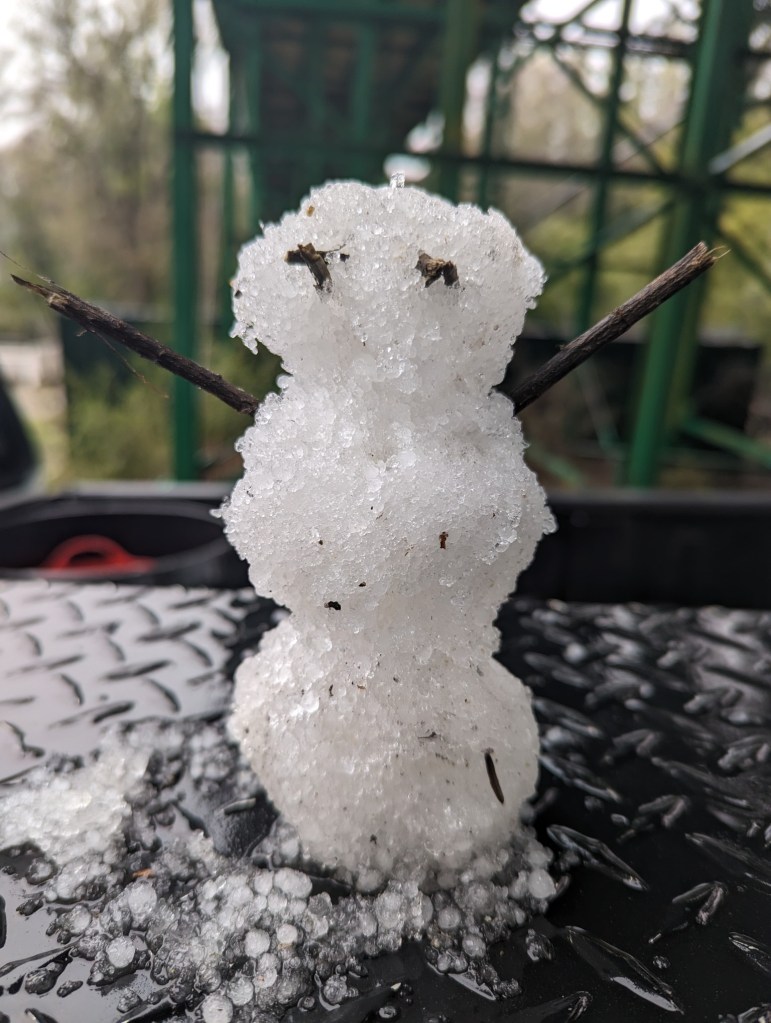
6. Snowman of three handfuls of slush and sticks is here just so that I can brag about the snow here. However, I find that snow is cold, wet and icky. I can see why it is unpopular.

This is the link for Six on Saturday, for anyone else who would like to participate: https://thepropagatorblog.wordpress.com/2017/09/18/six-on-saturday-a-participant-guide/

Japanese Black Pine

Japanese pine is more proportionate to confined urban home gardens than more common species.

Not many large specimens of Japanese black pine, Pinus thunbergiana, can be seen around the Santa Clara Valley. They can get taller than a hundred feet on straight trunks in their natural range on the coast of Japan, but locally, rarely get more than a quarter as tall on leaning and irregular trunks. They just are not quite as happy in the dry air here (minimal humidity). They are purported to be more tolerant of smog than most other pines that were so sensitive to the nasty smog of the 1970’s, but are more likely to become infested with insect pathogens as they get old.

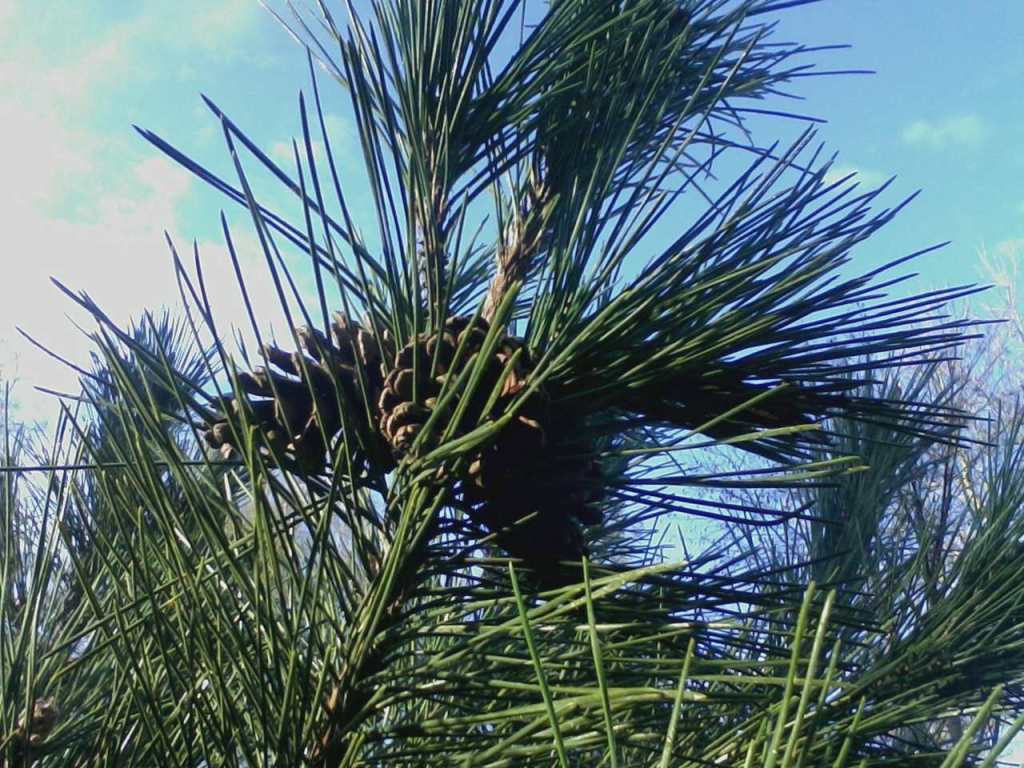
With their angular and somewhat open growth, and classic pine foliage and cones, Japanese black pines are one of the more distinctive pines. Since they do not get too large, they can work well as sculptural specimen trees in small garden spaces and atriums. Even if they grow up above the eaves, their leaning trunks and outstretched lower limbs with rough gray bark are as distinguished as those of larger trees.

The paired somewhat stiff needles are about three or four inches long. The small but stout cones stay green through most of their first year of development, and then turn brown as they mature and open to disperse their seed in the second year. They are only about two inches long, but can become annoyingly abundant among aging trees.

Gophers!

The best rodent control devices are useless against gophers.

Punxatawney Phil retreated from his shadow on Gobbler’s Knob, predicting a late spring. That was more than two weeks ago, and we are still waiting for a late rainy season to start! Regardless, Punxatawney Phil did his job and has gone back home to hibernate, or whatever he does this time of year. If only all rodents would do the same. Gophers do not ever seem to take any time off.

There is little agreement on how to efficiently evict gophers from the garden. A rodenticide that can only be applied by qualified pesticide applicators is purported to be the most effective means of extermination for large scale landscapes, but is not available to the general public and is very expensive when applied by professional exterminators.

Thumpers, battery powered devices that emit low frequency vibrations at random intervals, are only moderately effective at repelling gophers, and look rather odd in a lawn. Those cheap plastic whirlie thingies that spin in a breeze, causing their wiry stems to vibrate, are probably just as effective if occasionally relocated to keep the gophers from getting too comfortable with them. People who do not consider them to be appealing lawn ornaments think that they are tacky though.

Flooding gopher runs with water, or leaving sharp objects or chewing gum in the runs are generally not effective. It is nearly impossible to flood a system of runs, which is typically equipped with drainage. Gophers who are unfortunate enough to cut themselves on something sharp will bleed to death because their blood does not coagulate, but they are careful to not do so. Likewise, gophers who eat chewing gum will die because they can not digest chewing gum, but they prefer to eat roots. Besides, who really wants make gophers die in such agony?

Good old fashioned McAbee gopher traps, which incidentally were invented in Los Gatos, are probably the most effective means with which to eradicate gophers. They are difficult to set for a beginner; so it is a good idea to get trained by someone with experience. It is also important to set the traps in pairs with one trap in each direction of the main run below the exit tunnel, instead of setting a single trap in the exit tunnel. It takes some extra digging but is worth it. Because each pair catches only a single gopher, the empty trap should be sprung when pulled from the ground to avoid hurting someone. Do not let dogs dig up traps!

Trapping is only a temporary solution. Eventually, more gophers are likely to move in, necessitating more trapping.

Horridculture – Reading Palms

Few arborists read palms like they should. Most simply do not care like those I worked for so many years ago. Some of their butchery is deplorable, and some even kill the palms that they are paid to maintain.

Fortunately, the first example here might be explainable.

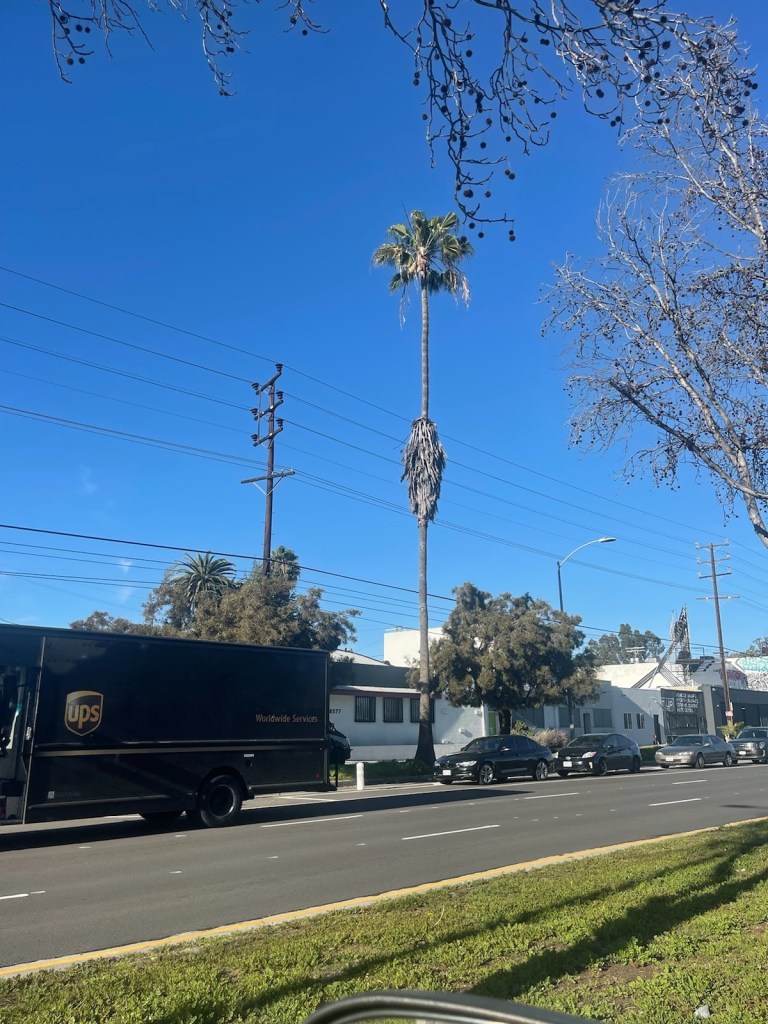
It is not uncommon for palms to wear beards of old fronds. Some beards extend all the way to the ground from the viable tops of the associated canopies.

This beard is very different. The canopy is neatly trimmed, without a bead directly below. However, a portion of beard remains on the middle of the trunk. Why would an arborist leave such an impassable obstacle between the ground and the canopy that will likely need grooming again?

I suspect that the tree had been neatly groomed until it got dangerously close to the high voltage cables. Arborists who are not certified for ‘line clearance’ are not allowed to work so close to cables, so were unable to groom the trunk any higher.

However, with boom lifts to avoid climbing, arborists who are certified for such clearance pruning removed the portion of the beard above so that dead fronds do not fall onto the high voltage cables. Such arborists who perform minimal utility clearance pruning are not allowed to do any more than necessary, so can not remove the portion of the beard that is not a threat to the cables, although it is out of reach for other arborists. Therefore, as silly as this looks, this may not be as egregious as it seems to be.

The second example can not be explained so easily. These three Mexican fan palms are very dead. They have been dead for so long that they are now decaying too severely for arborists to climb them safely for removal. Their death was certainly not natural. They were decapitated. Someone climbed to the tops of each of these three palms and cut their single terminal buds off, but left the trunks to die.

Did someone think that they would regenerate new terminal buds or branches like yuccas? If so, why were the trunks left so high? This really defies explanation.

These dead trunks can not be left here. They are so tall that if one falls, it could damage the apartment building across the street, and anything else that happens to be in between. They could kill someone! There are three of them! They are unsafe to climb, so must be removed by crane, which is very expensive.