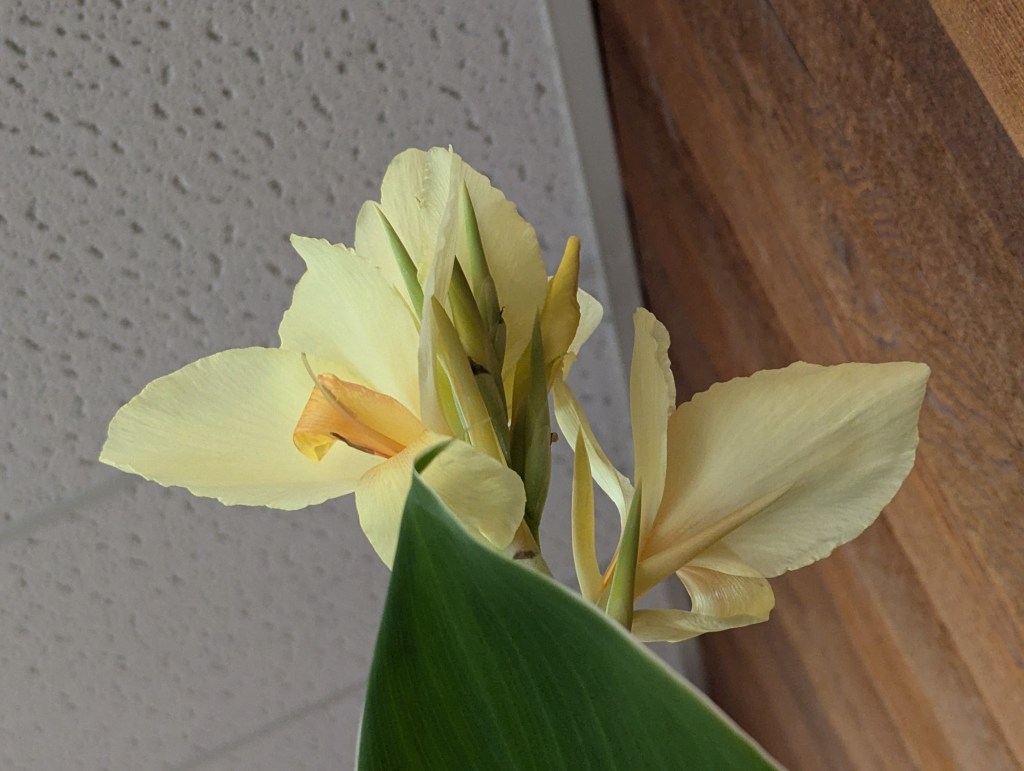
Just about everything in my garden has history in someone else’s garden. Almost nothing came from a nursery. I like to say that purchases are against the rules. However, I did purchase ‘Alaska’ Canna from Horn Canna Farm because I want to grow a white canna. I am over the shame already, and am very fond of this first white canna that I have seen since I was very young. As you can see, it is not very white, and is more of a creamy white or vanilla white. Actually, it is very pale yellow. It is presently growing as a houseplant in one of the buildings at work, which might have enhanced the pale yellow color of its bloom. I believe that it would have been whiter out in the weather. It is already growing quite nicely, so will need to move out into a landscape with all the other Canna for next year. I doubt that it will be as popular as the other brightly colored Canna, but a few who see it in bloom might recognize how rare creamy white Canna are now. I think that ‘Alaska’ would contrast splendidly with the dark bronze foliage of ‘Australia’.
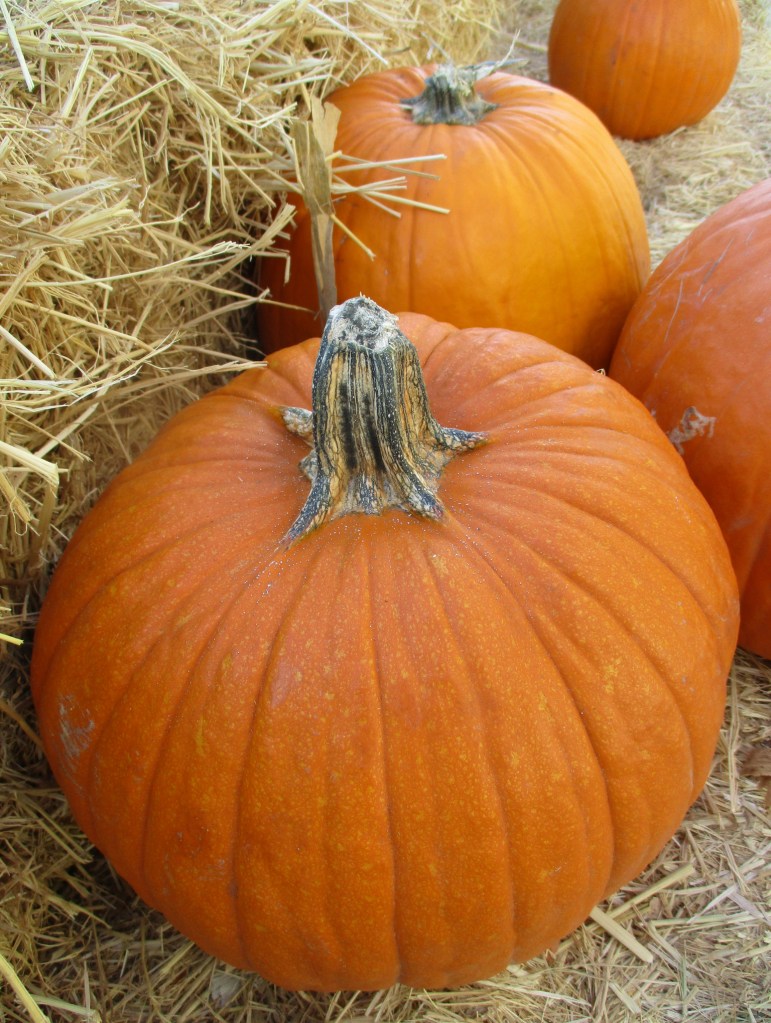
Pumpkins are the most famous winter squash. However, they are more familiar as decor than for culinary applications. For that, butternut and acorn squash are probably the most popular. Kabocha squash, though, is becoming about as readily available. LIke so many squash, it is a variety of Cucurbita maxima. It grows very well within local home gardens.
Kabocha squash vines sprawl over the ground, and can reach more than eight feet long. Alternatively, vines can climb trellises. Because their fruits weigh only about two or three pounds, they need no support. Slings may become necessary if unusually vigorous fruits grow more than five pounds. Powdery mildew can be problematic with congested vines.
Kabocha squash look like small and dark green pumpkins. Some are striped with lighter green or ivory white. Their flesh is yellow or orange, around a hollow interior full of seed. They take quite a while to cure after harvest though, from one and a half to three months. After curing, they can last even longer, and may even be fresh as summer squash ripens.
Cool season vegetables do not include any winter squash. All squash are warm season vegetables. They all begin their growing season in early spring to grow through summer. Their foliage begins to fade by autumn, and then succumbs to winter chill. The difference between summer and winter squash is their harvest time. Winter squash ripen for winter.
Conversely, summer squash produce for summer. They produce several more individual fruit that are ready for harvest before they ripen. They produce even more in response to the harvest of their juvenile fruit. Any fruit that matures for too long can get big and tough. It also diverts resources that should otherwise sustain production of fresh young squash.
Winter squash produce fewer fruit that mature through summer to ripen by autumn. Some types produce only two or three individual fruit. Fewer fruit concentrate resources, so that individual fruit are relatively large. Pumpkin, which is a famously big winter squash, may grow singly on its vines. Once ripe, some winter squash might last for months into winter.
Ideally, some type of squash should always be available from the garden. Winter squash become available as summer squash finish. Then, summer squash become available as stored winter squash deplete. However, winter squash are supposedly better if they cure for two weeks after harvest. Summer squash might finish a while before that can happen.
Hubbard, butternut, acorn and kabocha squash are all types of winter squash. Countless others are available. Their vines are more rampant than those of typical summer squash. Those with relatively lightweight fruit can climb trellises or shrubbery to conserve space. Although they do not bloom as much as summer squash, their yellow flowers are edible.
Winter squash develop more uniformly with occasional turning as they grow. This entails turning fruit weekly so that all sides of it get exposure sometime. By now, the palest sides should face upward. Fruit should retain its short stem when cut from its vine. It is likely to mold without it. There is no rush to harvest though, since fruit can remain as vines wither. Exposure to mild frost supposedly enhances the flavor of winter squash.
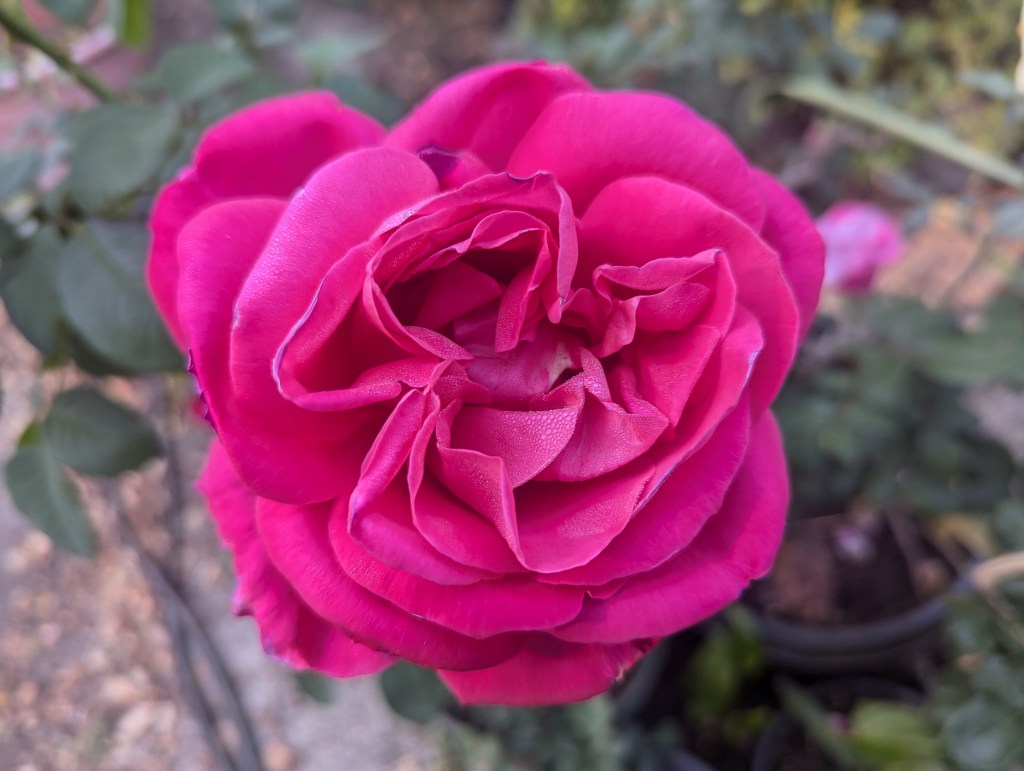
As mentioned last week, I got pictures of the roses that were in bud at the time, in bloom now. It will be autumn on Monday, though, and cool season annuals are replacing warm season annuals.
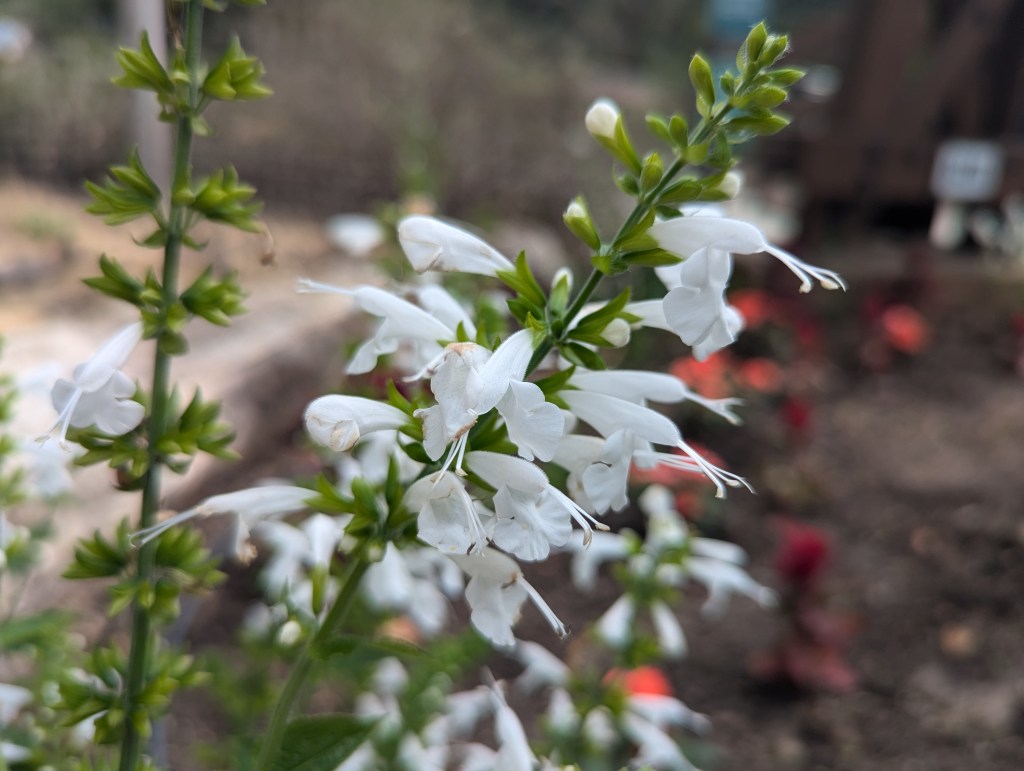
1. Unidentified Salvia was added to one of the landscapes by someone who was here for the summer, just prior to his departure. Now, I have no idea what it is. I could ask, but I feel that I should recognize it, or at least be able to identify it. I like its pure white bloom.
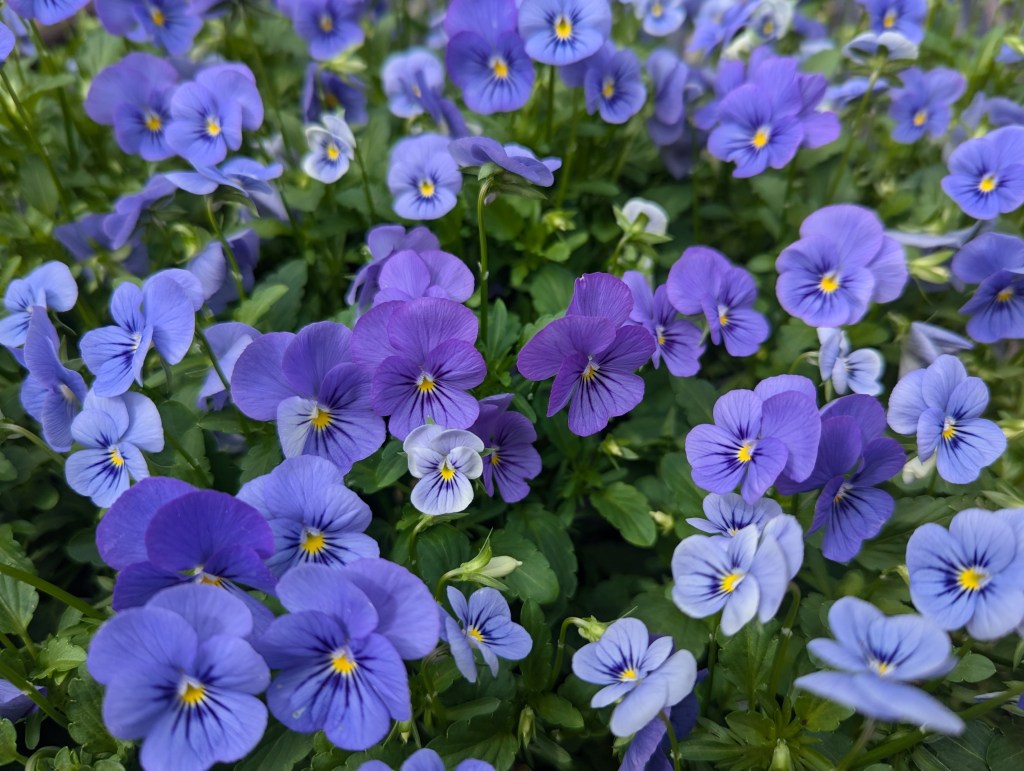
2. Viola is now in season, whether or not it seems as if it should be. We must rely on the date as much as the weather. While the weather suggests that it is still summer, the date insists that Monday will be autumn. These viola will be safe with several days of warmth.
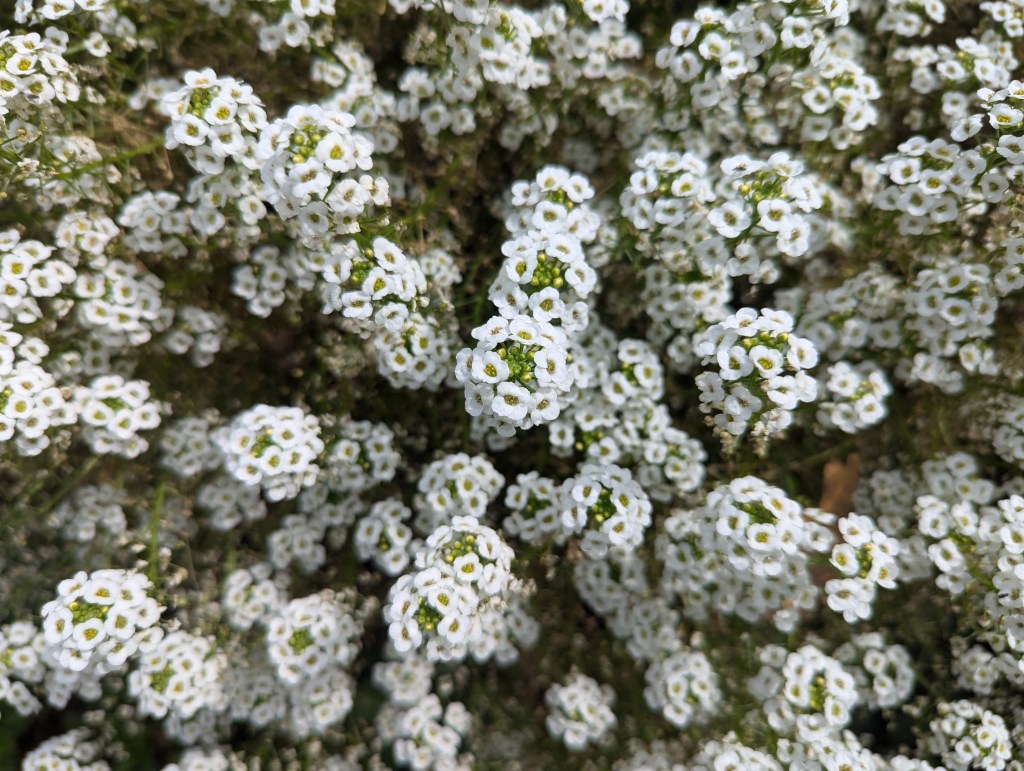
3. Lobularia maritima, alyssum makes the transition from warm season annuals to cool season annuals difficult. It is still too pretty to remove. Technically, it could perform as a short term perennial until individual plants get too old. By that time, it can reseed itself.
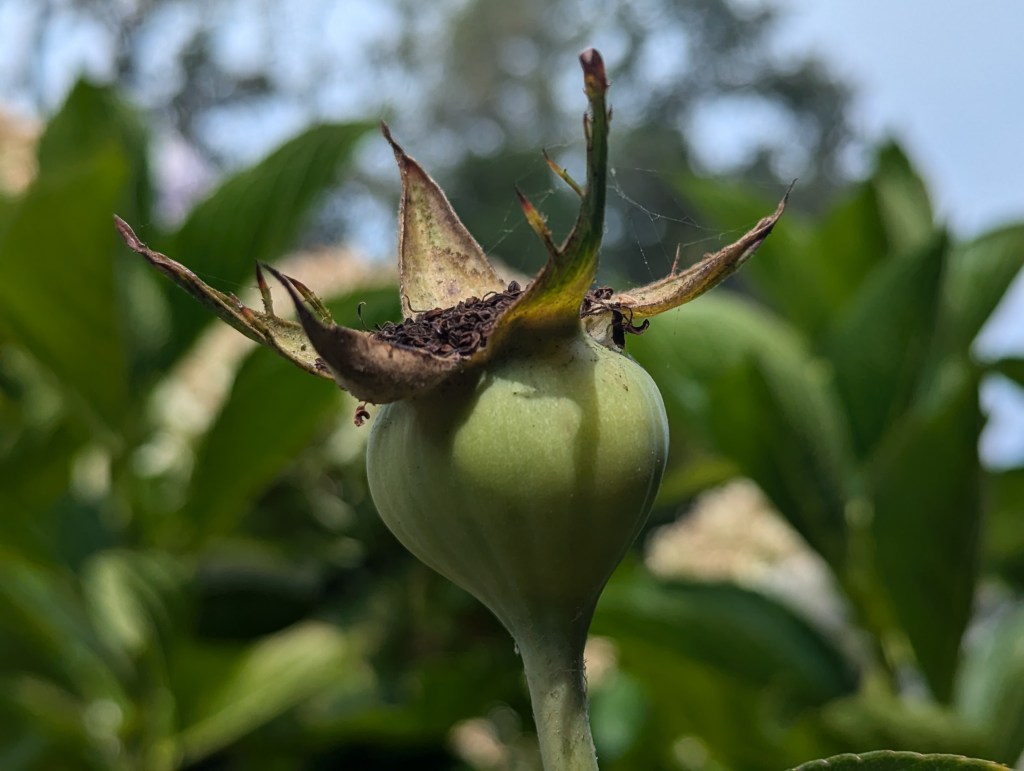
4. Rosa spp. of an unidentified cultivar produced a few notably plump rose hips like this to remind me that I have been negligent with deadheading. Now that subsequent bloom is unlikely, I could leave them to ripen. However, the new roses are continuing to bloom.
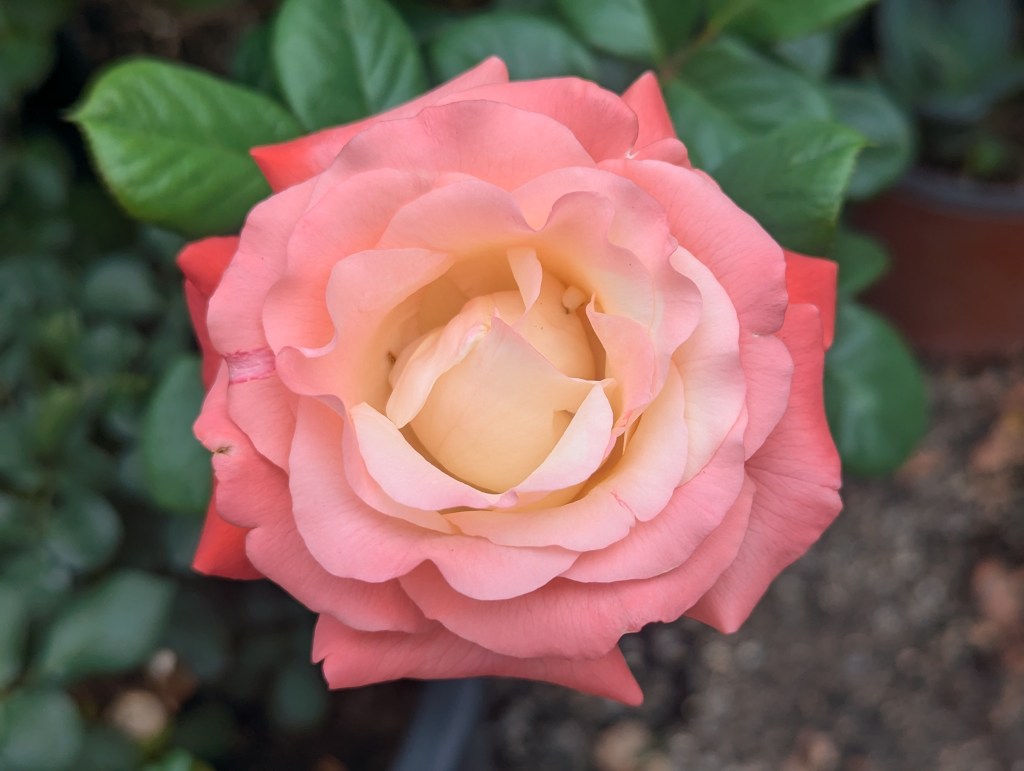
5. Rosa ‘Sheer Magic’ rose is one of the new roses that surprisingly bloomed after brutal and unseasonable relocation. This is the same flower that I posted a picture of while still in bud last week. A few more floral buds continue to develop but will lack time to bloom.
6. Rosa spp. of an unidentified cultivar is another of the new roses. This is also the same flower that I posted a picture of while still in bud last week. I have reason to believe that this rose is ‘Chrysler Imperial’, which should be red, but very often blooms reddish pink.
Redgum eucalyptus is famously adaptable and resilient.
Although not quite as aggressive, sloppy, big or structurally deficient as the notorious blue-gum eucalyptus, the red-gum eucalyptus, Eucalyptus camadulensis, is one of the ‘other’ eucalyptus that give eucalyptus a bad reputation. It is realistically too big and messy for refined urban gardens, and can be combustible if overgrown or too abundant. It is consequently probably not available in nurseries, despite being one of the most common species of eucalyptus (second only to blue-gum) in California. Red-gum eucalyptus has the advantage of being one of the most resilient large scale trees for unrefined or semi-wild landscapes, and works well where it has space to grow in many of the local county parks.
Now that it is half way through September, it is impossible to ignore that tomatoes did not have a good season. Most of us who grow tomatoes were embarrassed by their performance until we realized that everyone else who grows them was also experiencing similar disappointing results. It was not because we did not water them properly. Nor was it because they lacked particular nutrients. They simply wanted warmer weather.
Plants that were put out early before the warm weather last spring did much better at first, but then decelerated as the weather became milder instead of warmer. Cool nights certainly did not help. Mildew, which typically slows a bit as weather becomes drier (less humid) though summer, instead continued to proliferate so that new foliage became infected almost as soon as it developed.
Earlier predictions that the weather would eventually get warm were not accurate enough for many of us who are only now getting enough tomatoes for fresh use, but not an abundance for canning, drying or freezing. There is still some time for most of the tomatoes that are on the vines now to ripen; but many will probably remain green by autumn. Some but not all of the last green tomatoes can ripen off the vine. Perhaps the only good news about all this is that there should be plenty of green tomatoes for pickling.
Sadly, tomatoes were not the only warm season vegetables to be dissatisfied with the weather. Green bean vines and bushes were generally healthy and made good beans, but did not produce very abundantly. Corn was likewise of adequate quality, but on smaller ears and less abundant. Even zucchini, which typically produces too much, was a bit subdued. Marginal vegetables that really prefer warmth, like eggplant and bell pepper, were downright disappointing.
Even if the weather gets warmer in the last days of summer, languishing tomato plants can not ketchup on production. They can be left to make a few more tomatoes, but will eventually need to get out of the way of cool season vegetables. Cabbage, kale, turnip greens, beets, radishes and all the slower growing vegetables that take their time through autumn, winter and early spring will want their space back soon. They will hopefully have a better season.
If possible, cabbage, broccoli, cauliflower and some of the larger cool season vegetable plants can be plugged in amongst the finishing warm season vegetable plants. Then, by the time the finishing warm season vegetable plants need to be removed, the next phase of cool season vegetable plants is already somewhat rooted and has a head start. This process works well in small spaces with good quality soil.
The main problem with this procedure is that it prevents potentially depleted soil from getting amended and well mixed between planting. It can also be a bit awkward to get the spacing of rows, furrows or mounds of the next phase of vegetable plants to match up with the previous phase. Smaller vegetable plants that get sown directly from seed into rows, like turnip greens, carrots, beets and radishes, really prefer customized bed preparation, after the warm season vegetables have been removed.
It may not look like much, but it gets annoying, especially at night.
The industrial shop buildings at work are not exactly visually appealing. Fortunately, they are partially obscured from the roads outside by wild forest trees within the adjacent Zayante Creek and a roadside ditch. One road is on the opposite side of Zayante Creek. The other is on the opposite side of the roadside ditch that is perpendicular to Zayante Creek. Their intersection with associated traffic signals is therefore right outside. I added five Arizona cypress trees to the forested area of the roadside ditch, and three Monterey cypress to the forested area of Zayante Creek, to obscure the buildings more in the future. Unfortunately, though, some of the trees beyond needed to be removed for renovations of a major water main for Santa Cruz. One was a mature Monterey cypress between one of the shop buildings and the intersection of the two roads outside. Not only did this reveal the view of the backside of the building from the roads and intersection, but it revealed the view of the intersection from the few windows of the building. Now, from where I do much of my writing, I can see this traffic signal monotonously change from green to yellow to red.
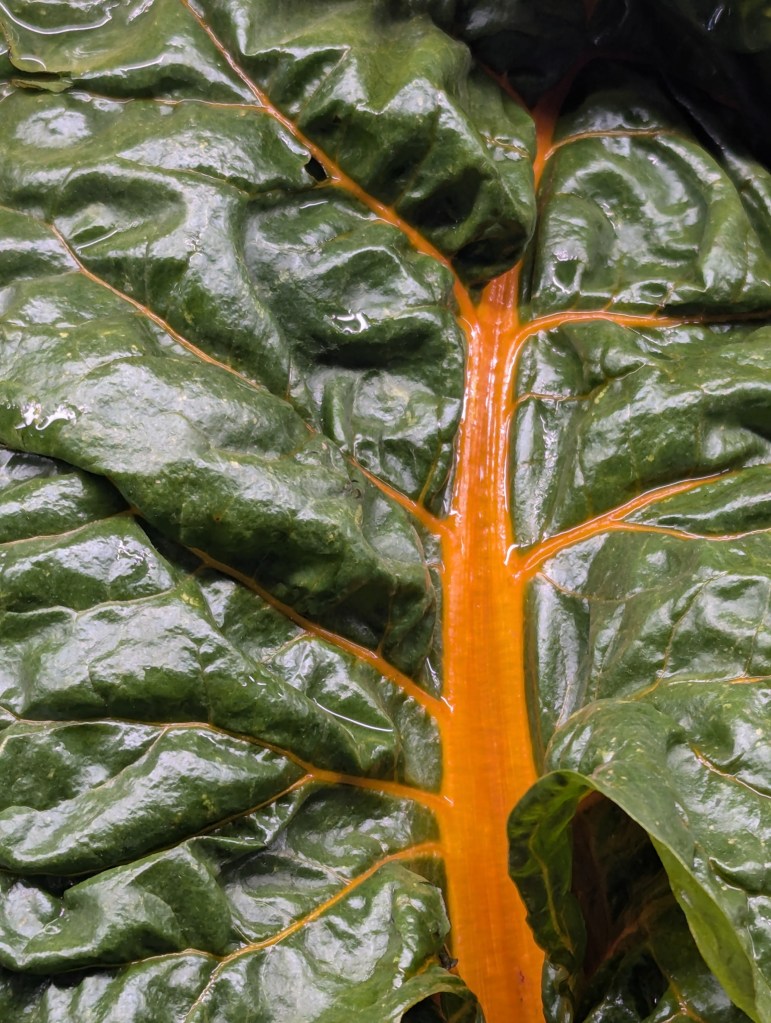
Among the cool season vegetables that are now seasonable, this one is too cool. Swiss chard, Beta vulgaris subsp. vulgaris var. flavescens is as ornamental as edible. Its richly deep or bronzy green foliage is a splendid backdrop for cool season annuals. The same foliage is edible, either fresh or cooked. Yet, even as a vegetable, it is nicely ornamental.
The wide petioles and leaf veins can be white, yellow, orange, pink or maroon. Although varieties with simple green petioles are more productive, they are less popular. ‘Rhubarb Chard’ and ‘Ruby Chard’ develop deep red petioles and veins. ‘Rainbow Chard’ is a mix of varieties with petioles and veins of various colors. Some have darkly bronzed foliage.
Although a cool season vegetable, Swiss card performs very well for spring and autumn. It only succumbs to summer warmth. In cooler climates, it might succumb to severe frost. Since only external leaves are harvested, it retains its ornamental quality for a long time. Swiss chard like sunny exposure and rich soil. It wants water when winter rain is sparse.
Warm season vegetables that started late last winter will be finishing their seasons soon. Cool season vegetables, or winter vegetables, should begin to replace them. This might sound familiar as the same scenario for warm and cool season annuals. After all, almost all vegetable plants are either annuals or biennials. Few perform for more than a season.
Just like annual bedding plants, different vegetable plants perform to different schedules. Some warm season vegetables begin to deteriorate as warm weather ends. Others may continue to produce until frost. Some cool season vegetables need an early start. Others can start late and grow through cool winter weather. Gardens need not transition quickly.
Besides, different phases of some types of vegetables begin and finish at different times. Although late phases of corn continue to grow, early phases are already done and gone. Although late phases of beet might begin months from now, early phases can begin now. Warm season vegetables, ideally, relinquish space as cool season vegetables require it.
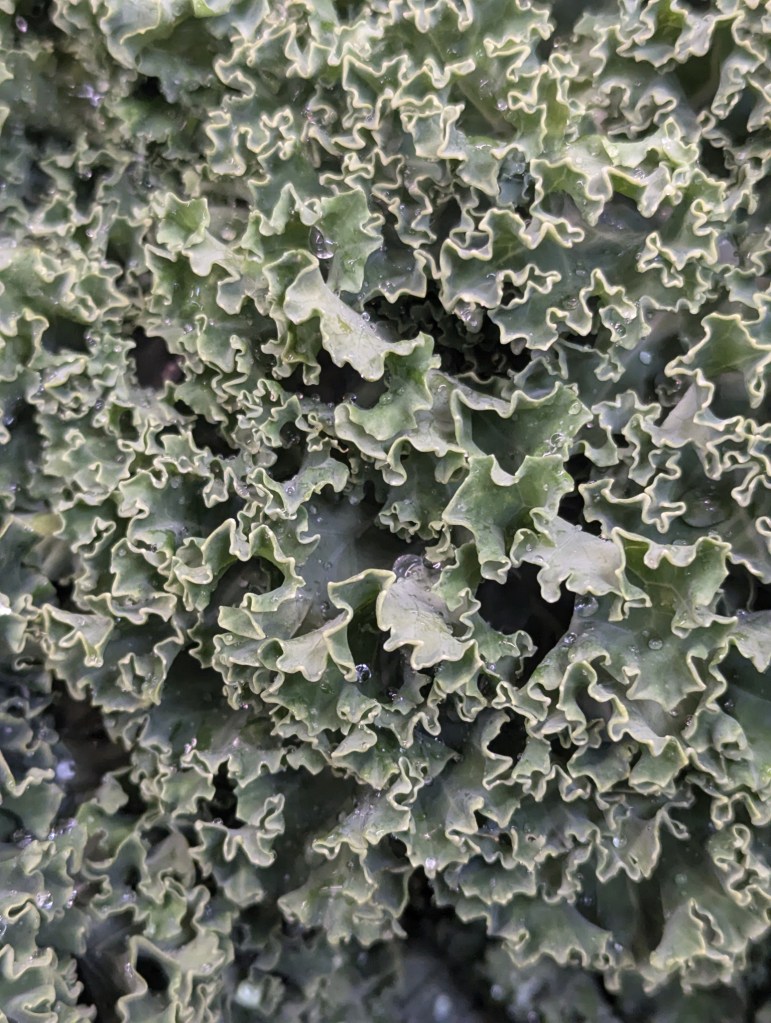
Cool season vegetables grow slower than warm season vegetables. Also, more of them are true vegetables rather than fruit that contain seed. Many are distended roots, such as beet and carrot. Many are distended foliage, such as cabbage and chard. A few, such as broccoli and cauliflower, are distended floral bloom. Peas are actually fruiting structures.
All root vegetables should grow directly from seed. They are vulnerable to disfigurement if transplanted. Besides, they typically grow in significant quantities that are not practical for transplant. These include beet, carrot, radish, turnip and parsnip. Cucumber and pea, although conducive to transplanting, also perform better from seed. So do lettuce greens.
Heading lettuce, though, is more like cabbage and larger cool season vegetables. Since only a few are necessary, transplanting them as seedlings is practical. Besides, they are conducive to transplanting. Cell pack seedlings for cool season vegetables are available from nurseries now. Seed is always available. It can go directly into a garden or into cells for transplanting later, as summer becomes autumn, then winter.



 Tony Tomeo