Remember the Beverly Hillbillies? That was a really lame sitcom; but it was somehow very popular at the time.
Each episode began with the stupid jingle that explains how and why the formerly impoverished but suddenly wealthy Clampetts left their home in Bugtussle and moved to Beverly . . . Hills that is.
As they drive their decrepit Oldsmobile down Bedford Drive just west of downtown, the palms flanking the roadway are prominently visible to the left and right. This strictly regimented collection of Canary Island date palms alternating with Mexican palms was not very big back then, in the early 1960s. By the 1980s, they were strikingly grand. Sadly, they are now deteriorating from old age. Many of the broad Canary Island date palms have succumbed to pink rot, so are now absent. Some of the Mexican fan palms are also lacking. It is saddening to see them now…
All crabapple trees flower. Almost all subsequently produce fruit. Those designated as ‘flowering’ crabapples exhibit the most spectacular bloom, but generally produce inferior fruit. A few cultivars are nearly fruitless. Crabapples not designated as ‘flowering’ are not as bold in bloom, but generally produce larger fruit of better quality. Their fruit is useful for jelly and other culinary applications.
Almost all crabapple trees here are flowering crabapples. Fruiting crabapples are rare locally. Their fruit is not as popular as it is in other regions. However, flowering crabapples that produce big fruit are increasingly trendy. Their fruits can get as wide as an inch and a half, almost as big as fruits of fruiting crabapples. If not picked or eaten by birds, even typical berry sized fruits are messy.
White, pink or reddish pink bloom is impressively profuse, just prior to spring foliation. In fact, bloom is comparable to that of flowering cherries, and only a bit later. Most flowering crabapples get no taller than fifteen feet. Aggressive annual dormant pruning is not necessary as it is for trees that produce heavy apples. Instead, mature trees appreciate summer structure pruning and thinning.
Most major pruning happens while the plants that need it are dormant through winter. That is why it is known as ‘dormant pruning’. Such pruning would be so much more disruptive while plants are blooming, fruiting, foliating or growing. Pruning that happens during other seasons is not as aggressive as dormant pruning. Spring pruning, although practical for some plants, is relatively docile.
For deciduous fruit trees, dormant pruning is very important. It concentrates resources into fruit production, but also limits production to sustainable quantities. Otherwise, such fruit trees would be unable to support the weight of their own copious fruit. Spring pruning of such trees is simply too late. By that time, superfluous fruit has already consumed significant resources, only to be wasted.
Stone fruit trees and pome fruit trees are familiar examples of deciduous fruit trees that rely on dormant pruning. Stone fruits include peach, nectarine, apricot, plum and their relatives. Pome fruits are primarily apple and pear. Ironically though, their fruitless but flowering counterparts perform best with spring pruning instead. As similar as they all are, they have completely different priorities.
Flowering cherry trees bloom more spectacularly than fruiting cherry trees, but produce no fruit. Similarly, flowering crabapple trees bloom more colorfully than fruiting apple trees, but produce only tiny fruit. Neither must sustain production of significant fruit. Nor must they support the increasing weight of developing fruit. Prolific bloom is their primary function. Spring pruning accommodates.
Spring pruning allows flowering trees to first bloom as profusely as possible. Pruned out stems have already served their purpose. Because fruit production is not a concern, spring pruning is less severe than dormant pruning. Nonetheless, because dormant pruning is so practical for so many plants, spring pruning may seem impractical. It is tempting to prune dormant flowering trees now. Doing so harmlessly compromises bloom.
Every invasive exotic (non-native) species has a story of how it got here.
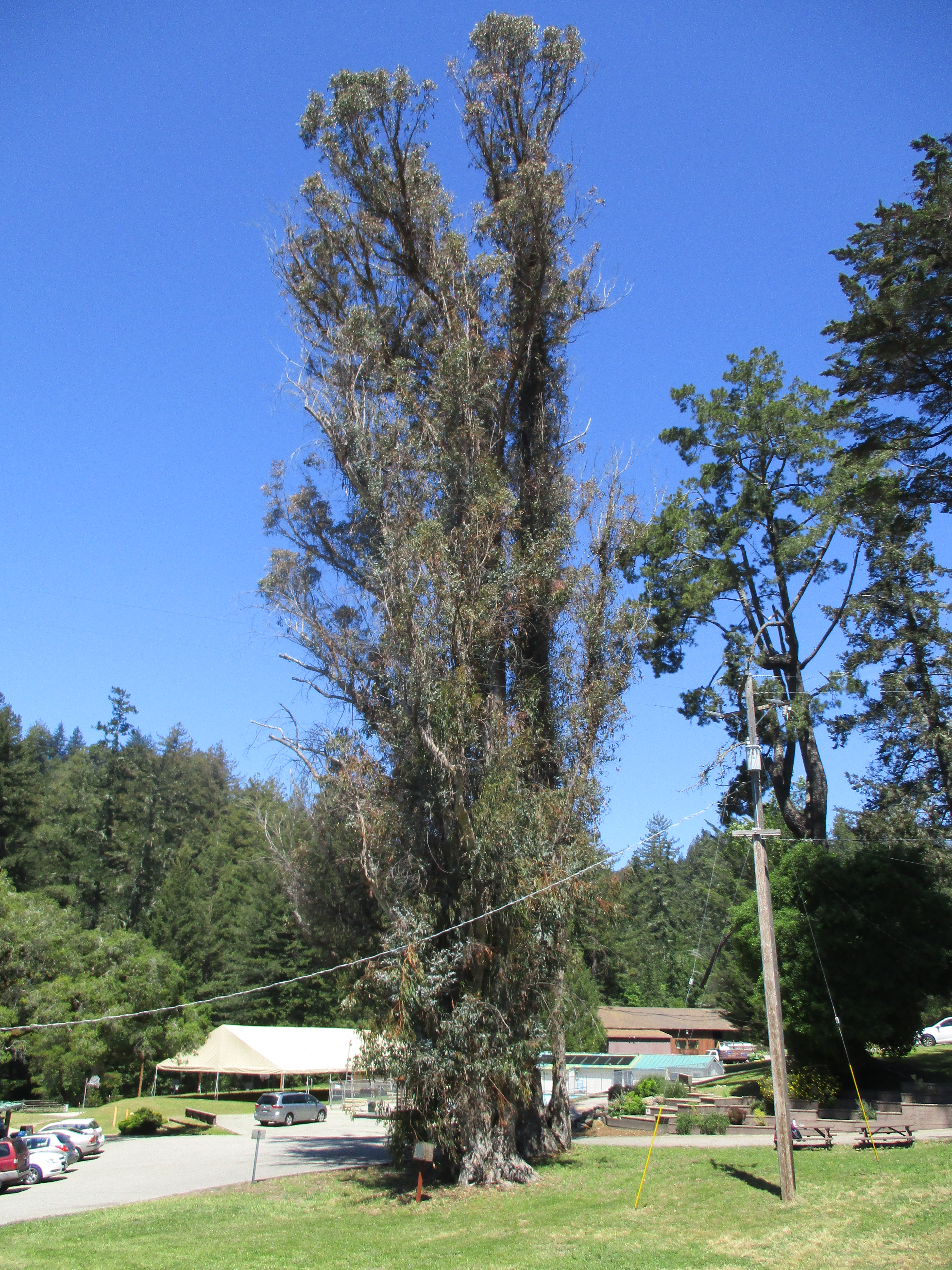
Blue gum and red gum were imported to produce the timber needed for railroad ties. Many annual specie were forage crops for grazing cattle. Some got here by stowing away as seed on or inside cattle or other animals. Supposedly, mustard seed was broadcast by those traveling on the El Camino Real so that other travelers could find the route later. Then there are all sorts of invasive exotics that were imported simply because people liked to grow them in their gardens.
It is difficult to imagine why anyone would import any of the weedy specie of broom (Genista specie) or the sloppy species of pampas grass (Cortaderia jubata). It might have made sense at the time, before more appealing specie were introduced, or before less invasive modern cultivars were developed. Black locust has…
According to Ecclesiastes 3:1, “There is a time for everything.” Unfortunately, this is still not the time for me to write new articles, which is why I continue to recycle old articles such as this.
There is a time for everything, and a season for every activity under the Heavens:
Verses 2 through 8 continue to list a few examples of more specific activities that happen at specific times. If there were more examples, autumn foliar color would probably be cited as well. After all, autumn foliar color happens in . . . well, . . . autumn.
Perhaps it was omitted for brevity. Of course, there is the possibility that it was omitted to avoid confusion. If it had been cited, it might have been described simply as ‘foliar color’ rather than ‘autumn foliar color’. Some foliage colors earlier if distressed. Some foliage does not color until frosted. Some might even delay color until it is in the process of getting replaced by new foliage. Then there are the many sorts of evergreen foliage that do not color at all, or at least in…
Rhody and I needed to go to San Jose for the past three days, and will be going there again at least until April. We had not been there or even into the Santa Clara Valley for a very long time. I did not realize how long we had been gone until I collected my accumulation of mail on the way through town, and found Christmas cards!
1. Tecoma stans is the second most important topic of my Six for this week! The Shrub Queen sent me these seed from wild plants that are native to Southern Florida! It is so rare here that I had seen it only a few times prior. A compact cultivar became available only a few years ago. I wanted the straight species. Embarrassingly, these seed were in my mailbox since December.
2. Camellia japonica is still blooming, with buds that will continue even longer. Technically, it is not late. Some bloom as late as March. I do not remember the name of this particular cultivar.
3. Ribes sanguineum is native to the forests only a few miles from here. This one and another like it were planted here a few years ago. Two others that bloomed white did not last very long.
4. Narcissus pseudonarcissus, or simply ‘daffodil’, bloom sporadically in the oddest of situations. Their bulbs remained where they got planted years ago, as the landscape changed over them.
5. Spirea prunifolia ‘Plena’ is sparsely branched, but perhaps delightfully so. I am surely no expert in regard to aesthetics, but it seems to me that more profuse bloom would be less delicate.
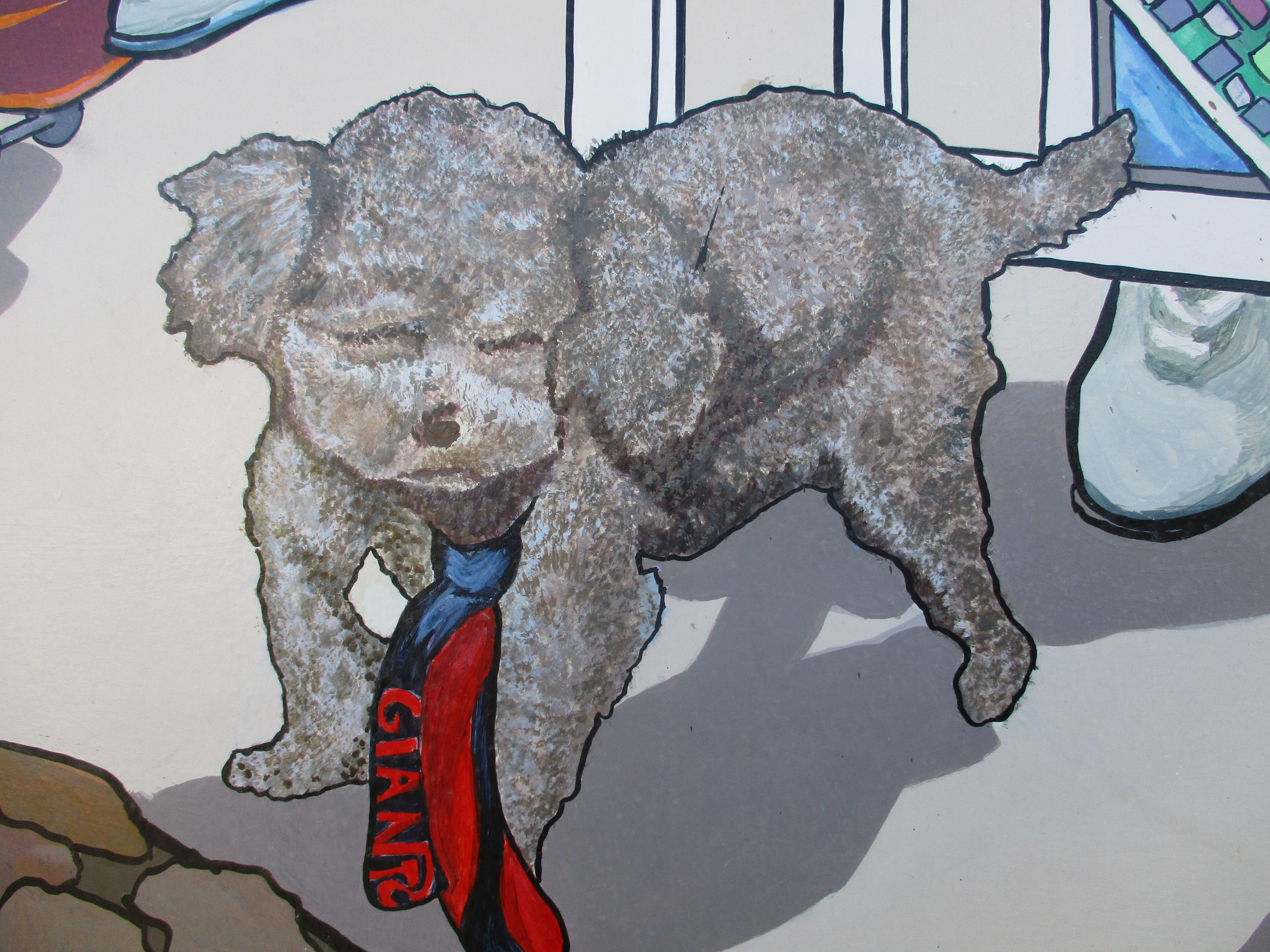
6. Rhody is the most important topic of my Six for this week. This was the moment immediately prior to his realization that I was aiming the camera at him, and his spry reaction to avoid it.
This is the link for Six on Saturday, for anyone else who would like to participate:
The small trusses of tiny, pale pink flowers of daphne, Daphne odora, really do not need to be too flashy with such powerful fragrance. Actually, the flowers might be considered to be less interesting than the glossy evergreen foliage. The most popular cultivar, ‘Marginata’, has a narrow ivory or pale yellow edge to each leaf. Each leaf is only about two or three inches long. Each domed flower truss is about as big as half of a ping pong ball. Daphne is sometimes grown to compliment and provide fragrance for boldly colorful but fragrantly deficient camellias.
Daphne is unfortunately notorious for being somewhat finicky. It likes rich soil and reasonably regular watering, but quickly rots if soil stays too damp or drains inadequately. The roots are quite sensitive to excavation. Partial shade is no problem. Yet, even the biggest and happiest specimens do not get much more than three feet high and five feet wide, and rarely live more than ten years. Daphne is toxic, and the sap can cause dermatitis.
Pussywillow is an odd cut flower. It is neither fragrant nor very colorful. It just gets cut and brought into the home because the distinctively fuzzy catkins are so interesting. They are appealing alone or mixed with other late winter flowers. The otherwise bares stems can get cut just as soon as the fuzz is beginning to become visible within the swelling buds. Bloom accelerates once the cut stems are brought into a warm home.
There are actually several other plants that can provide bare twigs that can be ‘forced’ into bloom in the home. ‘Forcing’ is simply the acceleration of bloom of such twigs by cutting them and bringing them from cool winter weather into warm interior ‘weather’. Flowering quince, flowering cherry and flowering (purple leaf) plum have likely finished bloom; but forsythia, hawthorn, flowering crabapple and many of the various fruit trees that have colorful bloom will be ready to be forced any time. Some daring people even force redbud, dogwood, witch hazel, lilac and star and saucer magnolias.
When the deciduous fruit trees that bloom well need to be pruned in winter, some people intentionally leave a few spare branches to be cut and forced later, just before bloom. These include almond, cherry, apricot, plum, prune, nectarine, peach, pear, apple and a few others. When stems get cut for forcing, they should be pruned out from the trees according to proper dormant pruning techniques, and can be trimmed up accordingly when brought into the home. Flowering (non-fruiting) trees should likewise be treated with respect when stems for forcing get pruned out.
Twigs to be forced should be cut just as the flowers are about to bloom, and preferably, as a few flowers are already blooming. They should be put in water immediately, and if possible, cut again with the cut ends submerged. Buds that will be submerged when the stems are fitted into a vase should be removed.
Once in a warm home, the rate of bloom will be accelerated, although everything blooms at a particular rate. Apple and pear bloom later than most, and can bloom slow enough to justify cutting stems while already blooming. As forced stems bloom, they can be quite messy, but the mess is probably worth it.
It was probably one of the best television shows for children back then, and probably still is. Everyone of my generation in American remembers Sesame Street. We all identified with it, even if our neighborhood did not look like Sesame Street, or lacked the variety of neighbors. Sesame Street sometimes took us on television field trips to other neighborhoods. Some were more familiar. Those that were more foreign were presented within a compelling and inviting context that got us interested in how other children lived within their respective societies.
Some kids lived in big cities and rode on buses. Others lived in suburban areas with big gardens. Some lived on farms with hens and cows. There were even kids who lived near a forest surrounded by big tall evergreen trees. The trees were probably the firs, spruces and hemlocks of New Hampshire. I do not remember. I just knew I…
Japanese maples get all the notoriety. They have such delightful texture and form. Many are proportionate to small spaces, such as atriums. Realistically though, they are overrated and overused. Meanwhile, other maples that work as larger shade trees remain obscure. Norway maple, Acer platanoides, gets broad enough to shade much of an urban garden, but rarely gets to forty feet tall.
Of course, Norway maple has innate limitations. It dislikes arid and harshly warm desert climates. Nor does it like to be too close to the coast. Los Angeles is about as far south as it wants to live. In the Pacific Northwest, it gets much bigger, and develops greedy roots. The non-cultivar species is invasive there. Norway maple defoliates neatly for winter, but then refoliates late in about April.
Almost all local Norway maples are cultivars. ‘Schwedleri’ has richly bronzed foliage. It is rare now, but was a popular street tree in the 1950s. ‘Crimson King’ has richer purplish foliage, but is less vigorous. ‘Drummondii’ displays delightful variegation. The deciduous foliage of Norway maple turns soft brownish yellow or gold for autumn. The palmately lobed leaves may be five inches wide.