Six on Saturday: Getting There Is Half The Fun

The biggest valley oak in the Santa Clara Valley supposedly lives next door to where I lived in town. Well, that was too far to go to get the picture I needed for the garden column next week. Another lives on the other side of the tracks.

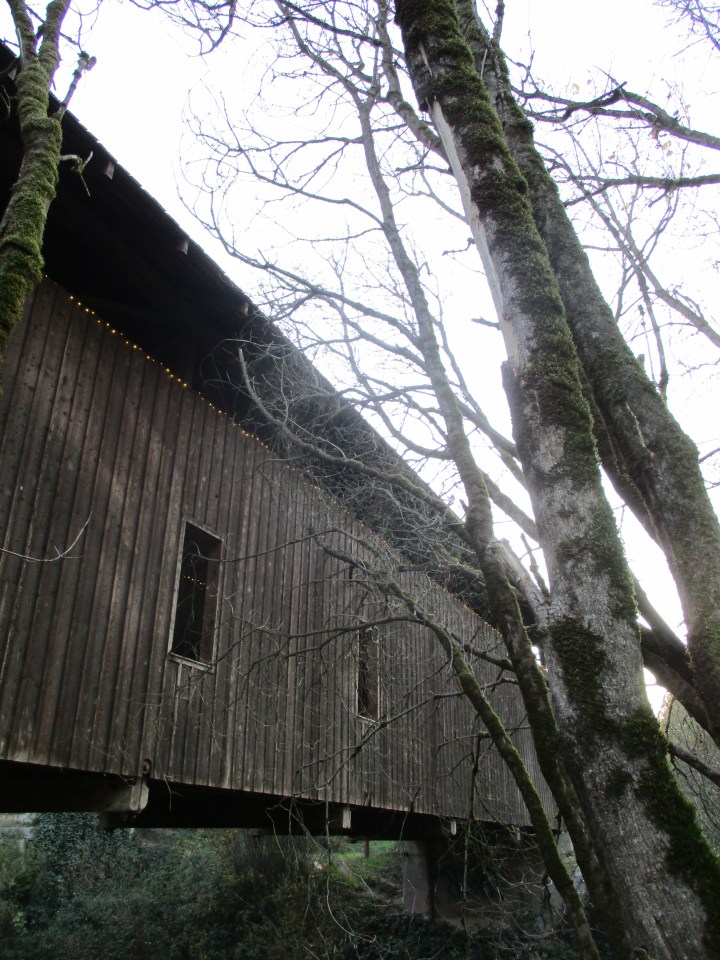
1. Roaring Camp Railroad is out back. The Depot is out of view to the right, on the other side of Zayante Creek. The big valley oak that I got a picture of is on the left, but does not look so big from here. A few ecosystems mix here, so ponderosa pines, Douglas firs and all the riparian trees mingle with the coast live oaks and redwoods. However, I doubt that valley oaks are native.

2. Rhody stayed home. These grates on the pedestrian catwalk on the bridge are not intended for small paws. Some of those trees down there are about thirty feet tall! Most are white alder.

3. Riparian trees are close enough for pictures from a pedestrian bridge just downstream. That foliage in the middle of this picture is a sycamore. However, the deteriorating bridge is closed.

4. Old valley oaks, which are native just a few miles away, seem to have been planted here; since they all are on roadsides or driveways. Whether native or introduced, they happily self sow.

5. Moss makes these sculptural limbs seem to be older than they are. This now massive valley oak was a shrubby young pup in photographs from the 1920s. It was likely planted after 1906.

6. Gnarly roots were exposed by erosion on an embankment between the big valley oak and the train tracks. I suspect that the tree was planted to shade the depot during the late afternoon.

This is the link for Six on Saturday, for anyone else who would like to participate:

Six on Saturday – a participant guide

Pumpkin

Brightly colored pumpkins ripen in autumn.

Actually, it is a fruit; a rather BIG fruit. It happens to be one of the more familiar of winter squash, but is not too commonly eaten. Although it makes excellent pie, and provides edible seeds and flowers, pumpkin is more popularly known as jack-o’-lanterns or Cinderella’s ride to the ball. Pumpkin is not for every garden, since each big and coarsely foliated annual vine needs regular watering, rich soil and considerable space to grow all through summer to produce only one or two big fruit in autumn.

Most pumpkins are big and round, and have smooth and bright orange skin. Those grown for jack-o’-lanterns are brighter orange, and not quite as meaty. Those grown for pie are often a bit smaller and meatier, with a rustier orange color. The biggest pumpkins get too huge to move easily, but lack flavor. The flavors and densities of many weird modern varieties are as variable as the green, red, pink, yellow and white hues of their skins. Some pumpkins have been developed specifically for their seeds, which are known as pepitas, or are used for production of pumpkin seed oil.

Pumpkins Exemplify Ripening Winter Squash

Winter squash are replacing summer squash.

Zucchini is probably the most reliable of warm season vegetable through summer, even when tomatoes are having a bad year. A single zucchini plant produces enough for a household. Two plants produce enough to share with neighbors. Pattypan, crookneck and other varieties of summer squash may not be quite as reliably productive individually, but can be assembled as a delightfully variable team that produces early in summer, and is just now finishing.

The fruit of summer squash is best when immature and tender. It gets tougher and loses flavor as it matures. Because development of seed within maturing fruit exhausts resources, plants are actually more productive if the fruit gets harvested while immature. In other words, they can either make many small fruits, or a few large fruits. The plants have coarse foliage on big but relatively confined annual plants.

Winter squash is very closely related to summer squash. The shabby annual vines sprawl over much larger areas, and can even climb fences and shrubbery. The main difference though, is that each plant produces only a single fruit or only a few individual fruits that are allowed to mature completely through summer. Their ripening fruit is just now becoming available as summer squash are running out. The fruit is supposed to be best after frost has killed the foliage, which could take a while here.

Hubbard, acorn, turban, spaghetti, kabocha and butternut squash, as well as the many varieties of pumpkin, are the more popular types of winter squash. Unlike summer squash, winter squash can be stored for quite a while, and need to be cooked to be eaten. While winter squash do not produce as many fruiting female flowers as summer squash produce, they seem to make at least as many male flowers that can be harvested while still fresh.

Male flowers can be stuffed, battered and fried, or simply fried. After they have been pollinated and set fruit, female flowers are typically too wilted to be eaten. All squash produce more male flowers than female flowers. Even the most fruitful of summer squash produce about three times as many male flowers as female flowers.

Kahili Ginger

Kahili ginger blooms as summer ends.

It is not the ginger that is so popular for culinary purposes, but it is the most popular for home gardens in the West. Kahili ginger, Hedychium gardnerianum, is so vigorous and easy to grow that it has potential to be invasive in ideal situations. Fortunately, it does not produce many of its sticky seeds locally. It therefore migrates primarily by dispersing rhizomes, which are not noxiously fast.

The delightfully fragrant bloom begins late in summer, and will finish soon. As many as forty small pale yellow and red flowers radiate from each cylindrical floral truss. Blooms stand neatly vertical, even if the stems supporting them lean. As cut flowers, they last only for a few days. Deadheading after bloom eliminates unwanted seed (if that is a concern), and unclutters the tidy foliage below.

However, with or without deadheading, the lush foliage is only temporary after bloom. It deteriorates as the weather cools through autumn. Cutting the herbaceous canes to the ground before they get too unsightly will expose some of the thick rhizomes. New canes will grow a few feet tall next spring and summer. On the canes, each leaf extends in the opposite direction of the leaf below it.

Fertilizer Is A Seasonal Commodity

Fertilizer is about to be passe.

Fertilizer, in simple terms, helps plants grow. It provides a bit more of what growing plants crave. In some situations, it compensates for nutrient deficiencies. Fertilizer can be organic or synthetic. Various formulations serve a variety of purposes. Custom formulations appeal to plants with discriminating taste, such as citrus, orchids and roses. Slow release fertilizer lasts for a month or two.

Of course, proper scheduling of the application of fertilizer is very important. Fertilizer can actually become toxic with excessively frequent application. Fertilizer that provides significant nitrogen to promote vegetative growth after bloom can inhibit floral growth prior to bloom. Fertilizer that promotes root growth for new plants is unnecessary for mature plants. The diets of plants are variable.

Summer lingers later here. Regardless of the weather, it is now autumn. This is when deciduous plants start the process of defoliation for their winter dormancy. Evergreen plants are less obvious about their winter dormancy. Some remain active and even bloom through autumn and winter locally. Nonetheless, cooling weather and shortening days inhibit vascular activity of almost all plants.

Except for cool season vegetables and bedding plants, not many plants benefit from fertilizer applied this late. New plants might appreciate a bit just to help them adjust to their new environment. Some deciduous plants, particularly roses, like a last late application of fertilizer as they get ready for their long winter dormancy. Lawns might want fertilizer this late or perhaps later to stay green.

Otherwise, it is getting late to utilize fertilizer.

Late application of fertilizer can be very detrimental to plants that are sensitive to cool weather. Such plants typically finish growing through summer. By autumn, their mature foliage and stems are either resilient to minor frost, or are dieing back (defoliating) for winter dormancy. Fertilizer can stimulate premature development of new growth that will be much more sensitive to even mild frost.

Six on Saturday: A Bit More Color

Since the Fire, my Six on Saturday posts have been rather gloomy. Titles such as ‘Pompeii‘, ‘Revelation‘ and ‘Revelation II‘ are appropriately descriptive. More color is in order.

1. Silvery bark of a silver maple is sort of colorful. Hey, the next five really are more colorful. I planted this tree as a young twigling in the Santa Clara Valley when I was in high school. It had a second trunk, which I layered as another tree for the front garden. This tree is in back. I would like to get a copy for my own garden. This is now an old picture that I got during evacuation.

2. Orangish red bloom is that of ‘Pollack’ zonal geranium, which is grown more for its very variegated foliage. However, this bonus bloom is on a specimen that reverted to be less variegated.

3. Peachy Peruvian lily looks pink to me, but is not quite as pink as the pink sort. There is a yellow sort here too. They certainly are prolific. In 1986, I worked with these as a cut flower crop.

4. White phlox self sowed here last year or earlier, and have performed splendidly. There are more this year than there were last year. It would be excellent to get a few more for next year.

5. Blue annual morning glory grew up with my tomatoes. Oddly, they did not do so well where their seed were actually sown intentionally, in pots on the deck up above the vegetable garden.

6. This is my favorite picture this week. I can not read what, if anything, is written in paint on this rock. It looks like someone enjoyed painting it, and placing it to be found out in the garden.

This is the link for Six on Saturday, for anyone else who would like to participate:

https://thepropagatorblog.wordpress.com/2017/09/18/six-on-saturday-a-participant-guide/

Tree Of Heaven

50923
Tree of Heaven or tree of Hell?

‘A Tree Grows In Brooklyn’ documents the resiliency and invasiveness of the common but typically undesirable tree of Heaven, Ailanthus altissima. Once a single female tree get established, the extremely prolific seeds get everywhere, including cracks in concrete. The resulting seedlings conquer wherever they are not dug out. If cut down, they just resprout from the roots.

Male trees smell horrible while blooming for about a month in spring or summer. They are pollinated by flies, so naturally smell like what flies like. The tiny yellowish or tan flowers hang on panicles that can be a foot and a half long. Female blooms are not as big, prolific or objectionably fragrant. However, stems, leaves and all other parts of both genders smell rotten when handled.

Tree of Heaven, which has earned the alternative names of ‘tree of Hell’, ‘stink tree’, ‘ghetto elm’ and ‘ghetto palm’, is no longer a tree that gets planted by choice. It is typically a tree that plants itself, and on rare occasion, happens to grow into a good situation. They should not be allowed to overwhelm more desirable trees, or get too close to concrete or other damageable features.

Young trees grow very fast to about forty feet tall. Older and slower trees do not get much taller, although sheltered trees can get twice as tall, with elegant gray bark. They do not live much more than fifty years. The big pinnately compound leaves are surprisingly pretty. On vigorous shoots, individual leaves can get as long as two and a half feet, with leaflets as long as six inches.