Lemon Bottlebrush

00916
Hummingbirds enjoy red lemon bottlebrush bloom.

As its compact cultivars gained popularity over the years, the formerly common lemon bottlebrush, Callistemon citrinus, became passe. Most are mature specimens in old fashioned landscapes. It is unfortunate. Only lemon bottlebrush and weeping bottlebrush can grow as small trees. (However, lemon bottlebrush is now classified as Melaleuca citrina. Most Melaleuca get notably larger.)

If competing for sunlight, mature specimens of lemon bottlebrush can almost reach upstairs eaves. Well exposed specimens may not get much more than half as tall, with mounding form of about equal width. Removal of low growth to expose sculptural trunks and handsomely shaggy bark promotes higher growth above. Shearing of hedges should not be too frequent to allow some bloom.

Bright red bloom is sporadic through the year, and gets more abundant as summer becomes autumn. The small and staminate flowers are densely set in cylindrical ‘bottlebrush’ formation. These blooms are about two or three inches long, almost as wide, and popular with hummingbirds. Dense evergreen foliage is aromatic. Individual leaves are narrow and about two or three inches long.

Schedule Bloom For Every Season

00916thumb
There is bloom for every season.

Early spring bloom is best. That is simply how the schedule of the majority of flowers works. The priority of flowers is pollination. Pollination is necessary for the production of seed. The production of seed and any associated fruit takes time. Seed, whether contained within fruit or not, then disperses before winter. After soaking and chilling through winter, seed germinates for the next spring.

For a variety of reasons, some flowers prefer to bloom earlier, later, or randomly through the year. Some are from climates in which they want to avoid harsh weather of a particular season. Some rely on pollinators who are active for a limited time. Regardless of the reasons for their bloom schedule, early, late and randomly blooming flowers add color to the garden before and after spring.

Many flowers that bloom randomly through the year tend to bloom better and later with a bit of persuasion. Cutting roses regularly seems innocent enough, but actually deprives rose plants of their efforts to produce seed. So does deadheading to remove their developing fruit structures that contain seed. Plants respond by trying to bloom again or more prolifically than they would otherwise.

Lily of the Nile reliably provided much of the color through the middle of summer. Many gardens have some. Some gardens have many. Their color range is limited, but effective. Now that they are done, canna, dahlia and delphinium should continue to bloom until frost. Mexican blue sage that took a break after spring bloom should bloom even better as summer ends, and into early autumn.

The bloom schedule of many flowers of the Compositae (or Asteraceae) family also coincide with late summer. Some have been blooming since spring. Some just started recently. These include but are not limited to cone flower, blanket flower, zinnia, cosmos, coreopsis, sunflower and Japanese anemone. African daisy and euryops daisy often bloom well after the earliest rains of autumn.

Eucalypti that bloom colorfully, such as red flowering gum, Eucalyptus ficifolia, bloom after the warmth of summer, but before cooling autumn weather.

Six on Saturday: Pompeii

The CZU Lightning Complex Fire got no closer than a mile and a half from here. Except for the ash and the aroma of smoke, there is not much evidence of a fire. The burn zone is within view from here, but the forest is just as green as it was prior to evacuation. I received news while away that smoking debris was falling from the sky here, so did not know what to expect when we returned. So many neighbors were not as fortunate.

1. Fire roasted leaves blew in from the fire. Some were still smoking as they fell. These are two madrone leaves at the top, three tanoak leaves at the bottom, and redwood below the middle.

2. Ash is everywhere! I left on the day prior to the yet unforeseen evacuation, with the intention of returning later, so left windows open. It now smells like a barbecued bacon burger in here.

3. Summer squash survived days of warm weather without irrigation. This was the worst of the wilt. There was nothing ‘ini’ about the ‘zucchini’. They looked like a herd of green dachshunds.

4. Pole beans were in reasonably good condition as well. They recovered rather efficiently after getting irrigated. The few beans that started to wilt and dry were just plucked and discarded.

5. Boxelder are suspiciously defoliating prematurely under a smoky orange sky. I do not know if it is associated with the smoke or the weather, but I doubt that President Trump is involved.

6. Blue gum that is still confined to a #15 can did not wilt any more than the summer squash or pole beans. I am impressed! It must have rooted into the ground below the bottom of the can.

This is the link for Six on Saturday, for anyone else who would like to participate: https://thepropagatorblog.wordpress.com/2017/09/18/six-on-saturday-a-participant-guide/

Carob

50902+
John the Baptist really knows carob.

The locusts that John the Baptist ate out in the desert were not grasshoppers. They were the nutritious locust pods of the carob tree, Ceratonia siliqua. Their familiar sweet cocoa flavor was probably fine for a while, but the starchy texture must have gotten dreadfully monotonous. After all these centuries, carob is still grown for food and as a shade tree.

It takes a very long time for a carob tree to get taller than forty feet. Most are less than thirty feet tall, and not quite as broad. Their rounded canopies are very dense. The stout trunk and limbs are quite sculptural, with variably but handsomely textured bark. The five or six inch long evergreen leaves are pinnately compound, with very glossy round leaflets.

Unfortunately, the big chocolaty pods are abundant enough to be messy if not harvested. Trees that do not produce pods bloom in autumn with seriously stinky male flowers that attract flies for pollination. Some trees are both male and female, so are both messy and stinky. Because carob trees are grown from seed, their gender can not be predicted.

Since they are from the drier regions around the Mediterranean Sea, carob trees really do not crave for much water once they have dispersed their roots. They grow somewhat faster if watered generously a few times through summer, but will survive without it. Too much water will cause buttressed roots that will break nearby concrete.

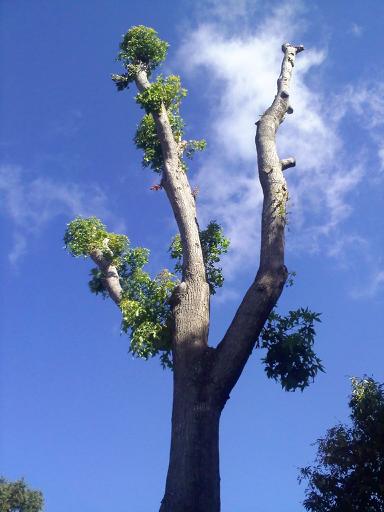
Mature Trees Need Professional Help

50902thumb
Arboriculture is specialized horticulture of trees.

Arborists are horticulturists who are specialized with the horticulture of trees, which is known as arboriculture. In urban gardening, they are not as familiar as gardeners who mow lawns and tend to the annuals, perennials and shrubbery that are close to the ground; but they should be. The trees that arborists maintain are the most significant features in most landscapes.

Bad annuals or poorly tended lawns can get unsightly, but are not too hazardous. However, a tree can be extremely hazardous if it becomes unstable or develops structural deficiency. Falling trees or limbs are very dangerous, and can cause all sorts of damage to anything within reach. Arboriculture is therefore the most important horticulture in home gardens with trees.

Sadly, many trees are severely damaged by improper pruning, which is often performed by those hired to prune them. Some get pruned too severely, or get pruned in the wrong season. Others do not get pruned aggressively enough. Either way, many get structurally compromised so that they drop limbs as they mature. Some trees get damaged too severely to salvage.

This is precisely why arboriculture should be done by qualified arborists. Unfortunately, finding such an arborist may not be as easy as it would seem to be. The industry is notoriously overrun with ‘hackers’, who are unfamiliar (and often unconcerned) with what trees need, and how trees respond to improper pruning.

The International Society of Arboriculture, or ISA, certifies arborists who pass an exam of arboricultural expertise. ISA certified arborists maintain their certification with regular involvement with the ISA, which involves arboricutural seminars and classes, as well as networking with other professional arborists. Certified arborists can be found at the website of the ISA at isa-arbor.com.

Bird Nest Cypress

00909
Bird nests should be so refined.

Port Orford cedar is a grand tree. It is native to the southern coast of Oregon and the very northwestern corner of California. Mature trees in the wild are more than a hundred fifty feet tall. Some of the older big trees within landscapes are more than forty feet tall. However, the cultivar known as bird nest cypress, Chamaecyparis lawsoniana ‘Nidiformis’ is remarkably diminutive and shrubby.

Bird nest cypress grows slowly, and may never get more than five feet high and wide. Individual plants are mounding with rather flat tops. A row of plants eventually becomes a low informal hedge. Distinctively flat sprays of slightly grayish evergreen foliage exhibit a soft feathery texture. Unless pruned otherwise, abundant dense foliage obscures main limbs with fissured reddish brown bark.

Most cultivars of Port Orford Cedar, including bird nest cypress, are uncommon here. They actually prefer cooler and moister climates. Locally, they are sensitive to harsh exposure and wind while the weather is warm. A bit of partial shade is no problem. Established plants do not need much water, but should not get too dry for too long. Selective pruning, not shearing, sustains natural form.

Weather Is All About Climate

00909thumb
Summer weather continue into autumn here.

Weather has no thermostat. There is no automation. It is naturally variable. Weather is constantly changing like, well . . . the weather. We take what we get when we get it. It is impossible to predict how this summer will end. Others in the Northern Hemisphere are already getting ready for autumn. It is likely to arrive bit later here than elsewhere. That is the nature of the Mediterranean climate.

Summers here are naturally long, dry, and somewhat warm. Rain is rare between spring and autumn. Almost all of the rain happens during the naturally mild winters. Springs and autumns both are naturally quite brief. Such weather may seem to be boring, but is excellent for gardening. It is why the summer growing season is so long. Unfortunately, it is also why the fire season lasts too long.

Indian summer is something of a misnomer here. This is not India. Nor is it Indiana. Besides, Indian summer in other regions of North America describes an unusual weather pattern, not the usual. It is unseasonably warm and dry weather after a first frost of autumn. Alternatively, it is unseasonably early warm and dry weather in spring. Locally, it is merely typical summery weather of autumn.

This weather pattern and climate were assets for agricultural commodities that grew here a long time ago. They are still assets for those who now live here, especially those who enjoy gardening. However, such weather necessitates certain accommodations. Irrigation for actively growing plants is important later into autumn than it is in other climates. Autumn planting happens later as well.

Nights continue to get longer and cooler though. It is not so obvious because gardening happens during the day. Warm season vegetables notice the difference, and slowly decelerate production. Some deciduous plants may slowly begin to discolor. Roses continue to bloom as they slowly begin to shed lower foliage. Eventually, they will get their last applications of fertilizer until next spring.

Warm season annuals may start to to look tired as fresher cool season annuals move in.