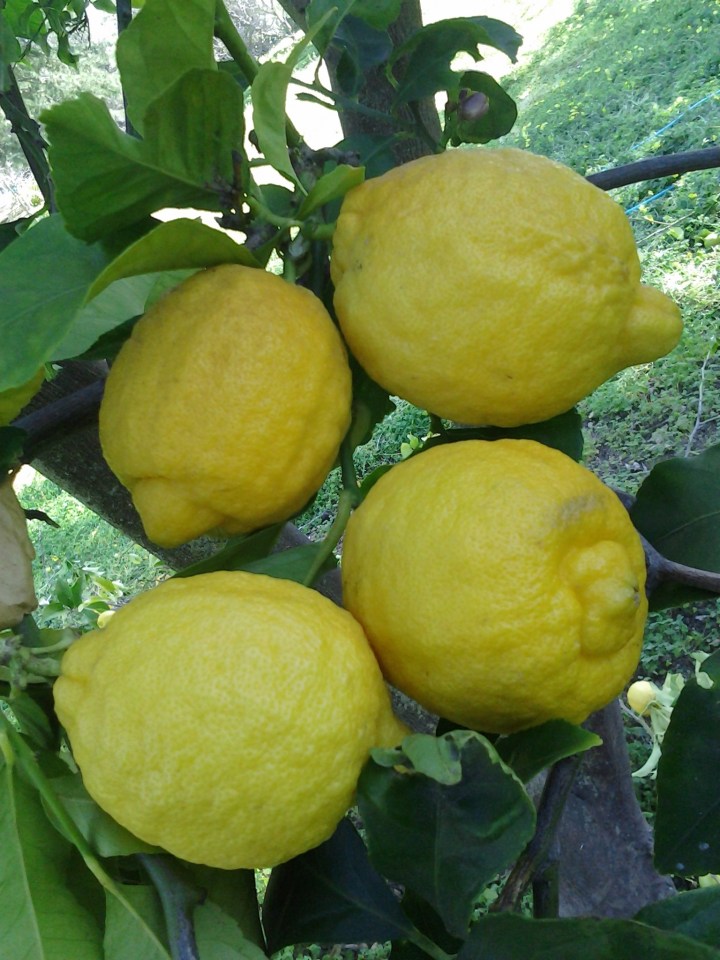
‘Lisbon’ lemon actually came first. It is still grown in orchards for lemon juice and other lemon products. The glossy evergreen foliage is a nice bright green. The late winter bloom is nicely fragrant. Mature trees can be kept about twelve feet tall, or allowed to get much taller. Besides the nasty thorns, the only other problem is that all the fruit ripens within a limited season.
‘Eureka’ lemon, Citrus limon ‘Eureka’, is a mutation of ‘Lisbon’ that is more casual about its schedule. It produces a good quantity of fruit in season through the end of winter, and also produces lesser quantities throughout the year. Because it is so productive, the lesser quantities should be more than sufficient whenever lemons are needed.
The ‘Variegated Pink’ lemon is a mutation of ‘Eureka’, so is a mutation of a mutation. The foliage is nicely variegated with white. The green fruit is striped with yellow until it ripens to yellow. The pulp and juice are pink of course. Like many variegated plants, the ‘Variegated Pink’ lemon stays much smaller than ‘Eureka’ lemon, and is more sensitive to frost.
Citrus trees that are grown from seed take a few years to mature enough to produce fruit. As they mature, the juvenile stems are outfitted with thorns that are even nastier than thorns on adult growth! Because most citrus has been extensively bred, seed grown trees are very likely to exhibit genetic variations. This is why citrus trees are cloned from stems of stock trees.
Cloned trees are genetically identical to their parents, so will always produce the same fruit. They are cloned from adult growth, so do not need time to mature from juvenile seedlings. They can therefore bloom and produce fruit as soon as their roots are ready. Also, their thorns are less dangerous.
Cloning citrus is not as simple as rooting them from cuttings though. With few exceptions, citrus trees are grafted onto genetically different rootstock. Most citrus trees in home gardens are grafted onto dwarfing rootstock that limits the size of the trees when mature. Orchard trees are grafted onto rootstock that allows them to get significantly larger.
The graft union, where the upper part of a grafted tree is attached to the rootstock, is typically visible just above the ground. The base of the trunk below the graft union is typically a bit more stout than the relatively lean section of trunk above the graft. Trunks of old trees are often more furrowed below the graft union than above it.
Sometimes, the rootstock tries to do more than provide roots. It can produce stems from below the graft union, known as ‘suckers’ that can potentially compete with the grafted portion of the tree above. Unfortunately, understock grows more aggressively than most types of citrus, so can overwhelm and shade out the desirable parts of an otherwise healthy citrus tree.
The most common understock for citrus produces suckers that are outfitted with unusually big and wicked thorns that are not to be messed with! If fruit develops, it seems to be humongous and disfigured lemons that lack flavor. Before they overtake good citrus trees, suckers should be pruned neatly away as they develop, without leaving any stubble to regenerate more sucker.
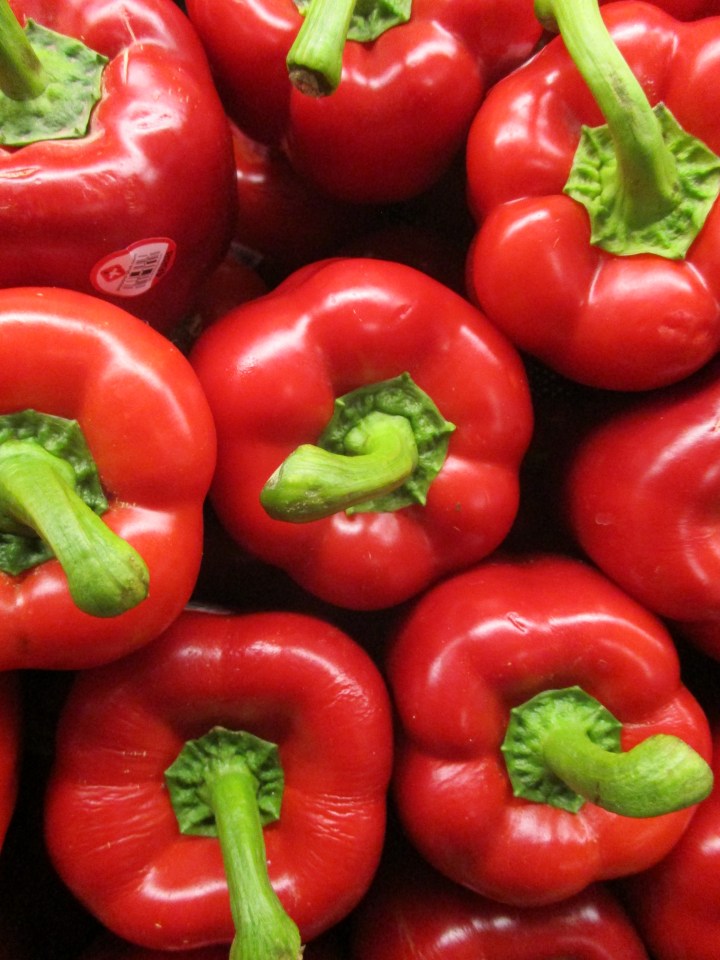
Sweet bell peppers are actually more of a challenge to grow.
This illustration is relevant neither to the topic, nor to that really creepy rock band of the same name. Even though the band has been popular since I was in high school, all that I know about them is that I am none too keen on their music. Embarrassingly, I do not know much more about the topic, and it has been a hot topic much longer than I have been growing my vegetables.
Vegetables make no music of course. I just mean that I am no more familiar with contemporary cultivars of hot pepper than I am with music that I do not appreciate. I happen to appreciate some types of peppers, and some of them happen to be hot peppers. However, I have not bothered to get acquainted with those that are so ridiculously hot that I do not want to grow them.
Why should I? What are they good for? Why waste my time, limited garden space and other resources on something that no one wants to eat or add to any recipe? They are not particularly productive. If they were, they would only make more of something that is just as useless as the few that each plant produces. I can not even justify putting effort into finding a picture of one.
Those who indulge in this fad brag about it profusely. They post pictures of their few tiny hot peppers online, with sensational claims that there is nothing hotter. Some post selfies with their free hand dangling one of their weird peppers over their extended Gene Simmons tongue. Some even post videos of their drunken friends tasting their peppers, as if it can not be done sober.
I suppose that, regardless of how pointless it seems to me, it is one way to enjoy gardening.
Although it is the most cultivated species of its genus, no one knows the origins of domestic onion, Allium cepa. Leek, shallot, garlic, chive, and a few other species are also popular vegetables. Most common bulbing onions produce familiar distended bulbs that are ready for harvest after defoliating and initiating dormancy in autumn. Green onions are leaves and attached juvenile bulbs.
Onions are probably easiest to grow locally from small juvenile onions known as ‘sets’, that grew from seed during the previous summer. Alternatively, seed sown during summer grows into small plants that go dormant to overwinter, and then resume growth the following spring. Mature onions should go completely dormant in autumn before storage, but are usable directly from the garden.
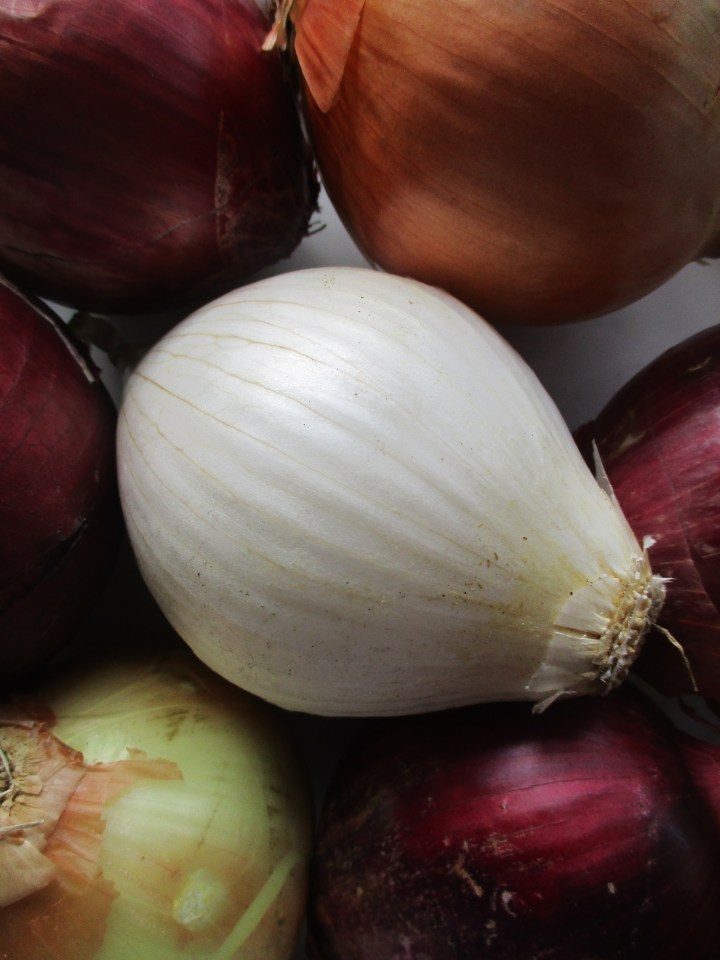
Yellow or brown onions are the most popular for cooking. Red or purple onions are milder and more colorful for fresh use, and are also popular for stir fry. White onions, whether fresh or cooked, are even milder, and are the traditional onions for salsa. All onions produce distinctively bluish foliage that stands about a foot high. The hollow leaves flop over and shrivel for dormancy in autumn.
Vegetable gardening is not permanent landscaping. With few exceptions, vegetable plants are annuals, like bedding plants. They do their respective jobs within only a few months. When finished, they relinquish their space to different vegetable plants of a different season. More of the same will be in season again in a few months. Crop rotation is something to consider when that happens.
Crop rotation is standard procedure for field crops involving several acres of the same variety of vegetable. Some crops grow on the same land for a few years. Some change annually. With few exceptions of big perennial vegetable plants, none stay in the same location for too long. Some fields go fallow for a season without production. Most simply produce a different type of vegetable.
Vegetables that grow for too long in the same soil eventually deplete some of the nutrients that they use most. Different types of vegetables deplete different types of nutrients. Crop rotation allows soil that was depleted by one type of vegetable to be used by another type that does not mind the depletion. While slowly depleted of a new set of nutrients, soil recovers from previous depletion.
For example, a sunny side of a fence is an ideal spot to grow pole beans. It is tempting to grow them there annually. However, they do not perform as well for a second season, and are likely to be scant for a third year. However, tomatoes appreciate what beans do to the soil, and do not miss what they took from it. After tomatoes take what they want for a season, beans are ready to return.
Crop rotation also helps to disrupt the proliferation of host-specific pathogens that overwinter in the soil and decomposing plant parts.
Generally, new vegetable plants should not be of the same family as vegetable plants that they replace in a particular location. Beans, squash, okra or corn should be happy where tomatoes grew last year. Peppers and eggplants are of the same plant family as tomatoes, so are likely to crave what the tomatoes already depleted. They are also susceptible to some of the same pathogens.
This is the third spring that I got picture of this pair of flowering cherry trees in bloom. I took several pictures last year, ranging from closeup pictures of the flowers, to pictures taken from a distance like the picture above. Fewer pictures were taken during the previous spring of 2018, before these trees were groomed of copious necrosis. Sadly, this picture will be one of the last.
The trees will be cut down this year. They stayed just long enough to bloom this one last season, but will not likely be here much longer. They are deteriorating at such a rate that if I were to prune the necrosis away after bloom, there would not be much remaining. The tree to the right in this picture would be only a rotten stump with a few limber twigs protruding from the top.
Structural integrity has been so compromised by decay that, even without the weight of all the limbs that have been pruned back during the past many years, the trunks could easily break off at the ground. When I remove them, I will likely just push the tree to the right over without cutting it first. If there were any branches left, a kid could knock it over by trying to climb it.
As much as I would prefer for these trees to last much longer, I want to install their replacements as soon as possible. Planting them this spring would give them all summer to disperse roots and grow a little bit before blooming next spring. I know they will not be much to look at for a few years, but many years from now, they might be as spectacular as these two originals were.
Regardless, it will be a saddening task to cut down these distinguished trees.
This tank could use some greenery . . . or maybe not.
The scrub palm incident should have reminded me that there is such a thing as too much of good thing. By the way, I do intend to grow every single seedling that germinates and somehow find homes for them all. I suspect that almost all will live in my own garden, but at least I know they will live in a good home. I have grown surpluses before, and I actually plan to do it again.
For examples, that big herd of cedar seedlings that was partly reassigned into landscapes is just too numerous for all seedlings to be accommodated. Most of what remains will get canned to be installed into landscapes later. Since we planted about as many as we possibly can here, most will likely go to Los Angeles, and installed onto embankments of the Santa Monica Freeway.
That is too many cedars; but I just can not bear to discard them as I should. Nor can I leave them to grow into a crowded and likely rat infested grove. They should be happy in Los Angeles.
Anyway, I was asked to grow a few copies of Boston ivy for a pair of concrete columns that support a pedestrian bridge. Two specimens were already planted on two other concrete columns of the same pedestrian bridge, from which English ivy had been removed. Two other specimens grow on a concrete retaining wall from which Algerian ivy gets removed ahead of its advance.
I should have just plugged a few cuttings into a can, and then separated them and plugged them directly into the landscape as they rooted. Instead, I plugged cuttings into a flat. Well, I could not just plug a few, and leave the rest of the flat empty. I filled an entire flat with a hundred cuttings. I expected a high mortality rate, but alas, almost all of the cuttings are doing quite well.
Now we are finding all sorts of concrete retaining walls and other infrastructure where we can plant Boston ivy. We are also realizing that there is a difference between ‘can’ and ‘should’. As I was dumping greenwaste, I noticed how austere this big water tank looks. Boston ivy would really appreciate all that surface area! There is enough to plant all the way around the perimeter!
Then, I thought of all the reasons why clinging vines are not allowed onto water tanks. They deteriorate the paint, which allows the tanks to rust. They allow rodents to climb up to the top of the tank, which is really not a good place for rodents. They need maintenance, which is not justifiable for landscape features that serve no practical purpose. They need (ironically) watering.
If the tank were in a more prominent location where it should be obscured, it would be best to plant dense evergreen trees, such as cypress trees, around it. Such trees would be planted at a distance, to maintain reasonable clearance. Really though, the tank is in a secluded place, where not many of us see it. It needs no landscaping, so will remain as austere as it has always been.
But, what about the cyclone fence around the water tank? All those surplus grape vines could most certainly make good use of it as a trellis! Okay, I get it. It would take too much work, and there is too much potential from problems . . . rodents, maintenance, watering, damage to the fence, and half of all the grapes would be locked inside where only a few of us could get to them.
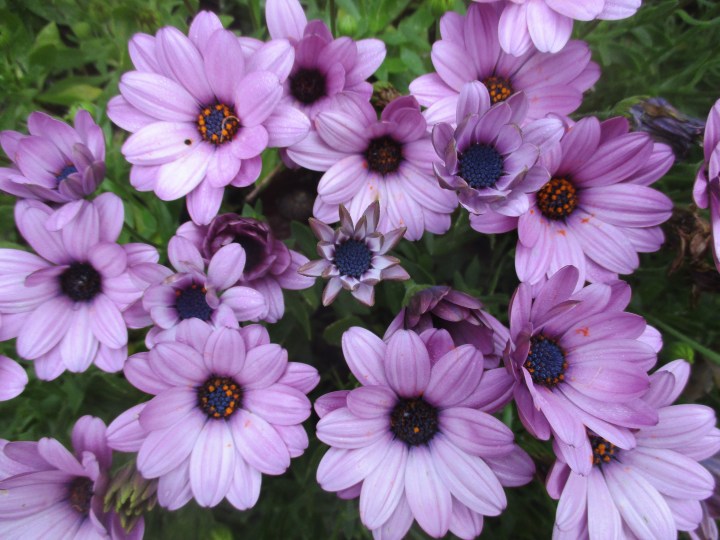
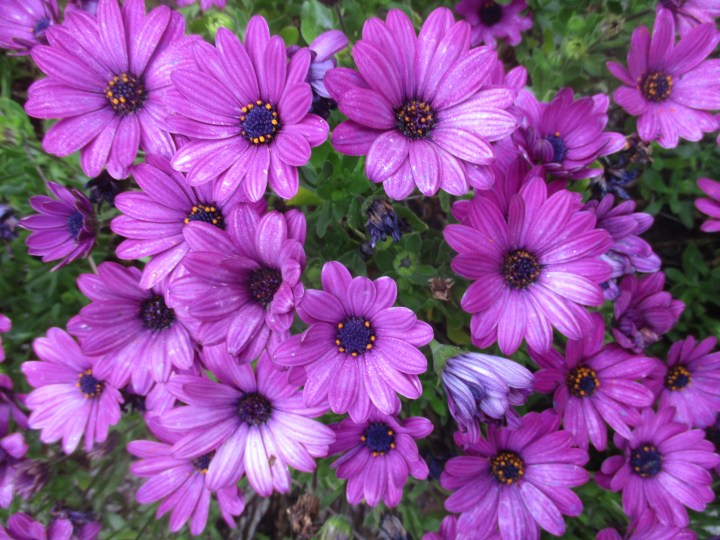
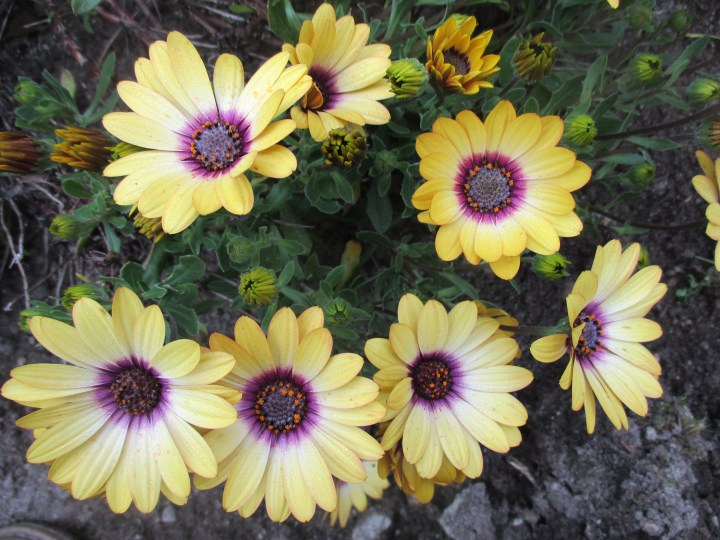
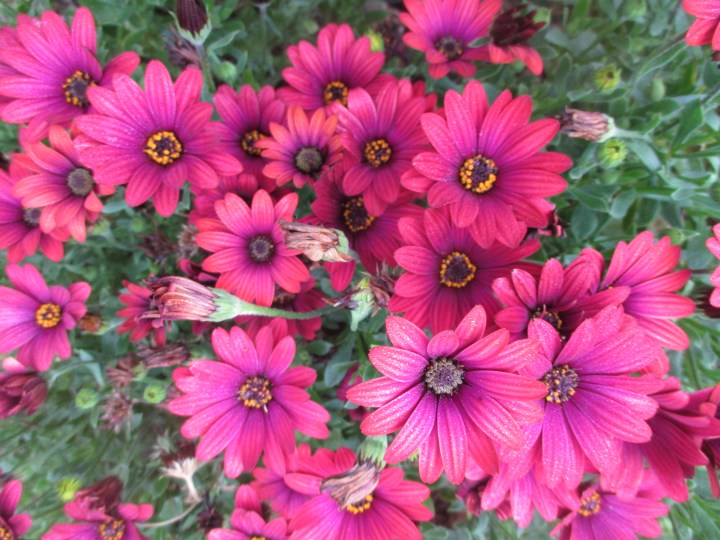
Girls can see more colors. Furthermore, they know all their fancy names. Sometimes, I suspect that they just make up names as necessary. There are four African daisies at work that are odd colors that I can not identify, and another flower that I know is not lavender.
1. Blue is the easiest of these colors. Others might say it is pale, soft or sky blue. Even I can see that it is most definitely not lavender, as some might insist. Is this species so easy to identify?
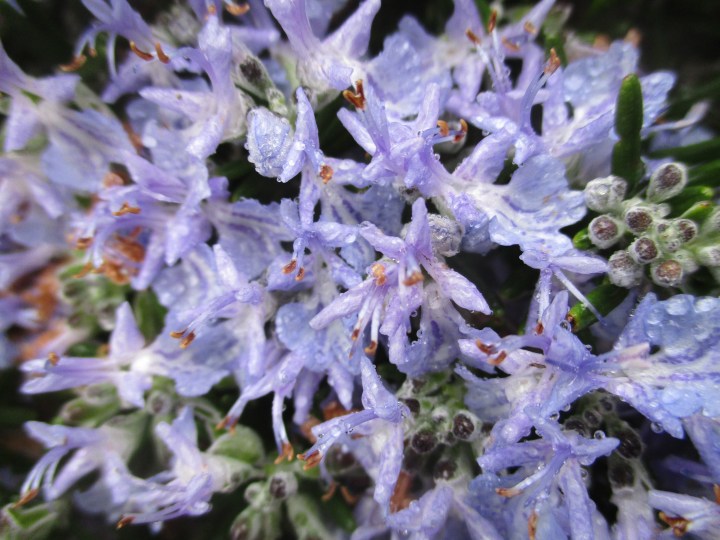
2. Blue is the only color for rosemary. It is more obvious up close in the previous picture. It is easier to mistake it for lavender if that is the color that is expected from the particular species.
3. Lavender is how I would describe this color. Perhaps it is pale lavender. I have been told that this is lilac or pale lilac. That makes sense, since common lilac blooms with lavender flowers.
4. Purple or light purple works for this one. Heck, if the previous is pale lavender, this could be lavender . . . that is not pale. Alternatively, it could be lilac, . . . but probably not the pale sort.
5. Yellow or pale yellow should be good enough. I do not know what buff is, but I do not believe that this is it. Nor does it strike me as lemon or butter yellow. I know what colors lemons are.
6. Red should be good enough, although I would believe if this is rust or rusty red. I am open to suggestion on this one. It is quite a distinctive color. I like it, even though I can not identify it.
This is the link for Six on Saturday, for anyone else who would like to participate:
Most other specie of ceanothus are more colorful and tame than Ceanothus cuneatus is. It is known as ‘buckbrush’ because the abundant round trusses of minute flowers are typically dingy white instead of the more familiar shades of blue that have earned other ceanothus the common name of ‘California lilac’. However, a few wild plants and some garden varieties bloom blue.
Mature plants are at least six feet high and wide, but typically less than ten feet high and twelve feet wide. They are pleasantly fragrant as they bloom between March and April or May. Roots seem to tolerate almost any soil that drains well and does not get watered too much. Once established, no watering is needed. The scrubby evergreen foliage likes full sun exposure.
Although it is a bit unrefined, and does not want to be pruned for confinement, buckbrush works nicely as screening shrubbery on the perimeter of a landscaped area, or in unlandscaped areas. Newly installed small plants only need to be watered occasionally as they disperse their roots through their first year. Since they are native, established plants are satisfied with rainfall.
California is a big place, with more environmental diversity than any other state and most other countries. It includes rainy and cool forests of Del Norte County, and dry and hot deserts of Imperial County. The snowy mountains of Placer County and the mild coastal plains of Los Angeles County are here too. There are hundreds of miles of sandy beaches and big fertile valleys.
Consequently, plants that are native to California are just as diverse. Many that are very well adapted to the environments that they naturally live in are not so well adapted to other environments that may be only a few miles away. They really do not want to go to some of the more divergent climates in other regions.
Coastal redwood that is so happy within its natural range on the foggy western slopes of the coast ranges to the north are not so happy on the drier eastern slopes of the same ranges. It probably would not survive for long in the Mojave Desert. California fan palm from the hot and arid region of Palm Springs languishes on the damp and cool western edge of San Francisco.
Most of the popular California native plants are popular because they do not need much water, if they need any at all. However, some are as unhappy with local climate conditions as exotic plants from other continents are. For example, few plants tolerate drought as well as Joshua tree does. Yet, Joshua tree is likely to grow fast and then rot because winters are too damp for them locally.
Of all the excellent plants that are native to California, the most excellent for local gardens are either the few plants that are native to the local region, or the many others that are native to similar regions. They do not need cold Sierra Nevada Winters, hot Death Valley summers, Mojave Desert aridity or San Francisco fog. They are right at home here.
Even natives need some help adapting to a new garden. Confining their roots to cans while they grow in nurseries is very unnatural for them. Once planted, they will need to be watered while their roots disperse enough to survive on rainfall, or with minimal watering.