Almost all of the fruit trees that I encounter are or were neglected to some degree.
Many were planted a long time ago by someone who was able to maintain them at the time, and perhaps for many years, but then relocated, passed away, or just got too elderly as the trees grew and required more work.
Many were planted by those who simply enjoy gardening around their homes, and wanted to grow some fresh fruit, but were not aware of how intensive the maintenance of most of the fruit trees is, or how to execute such maintenance properly.
Many were planted by so-called ‘gardeners’ or so-called ‘landscapers’ who had no intention of actually ‘maintaining’ them, or believed that they could ‘maintain’ them with motorized hedge shears and a blower . . . just like they ‘maintain’ everything else.
There is a young but nicely productive ‘Eureka’ lemon tree at work. I would not say that it is neglected. Someone has been maintaining it well since it was installed. However, I remind others at work to take some of the lemons because the tree gets overloaded with otherwise unappreciated and unused fruit.
The tree is strategically located right outside of one of the big cafeteria kitchens, so that those who work in the kitchen could use the fruit. The kitchen probably uses more lemons that the still young tree could produce, but does not seem to use any from the tree.
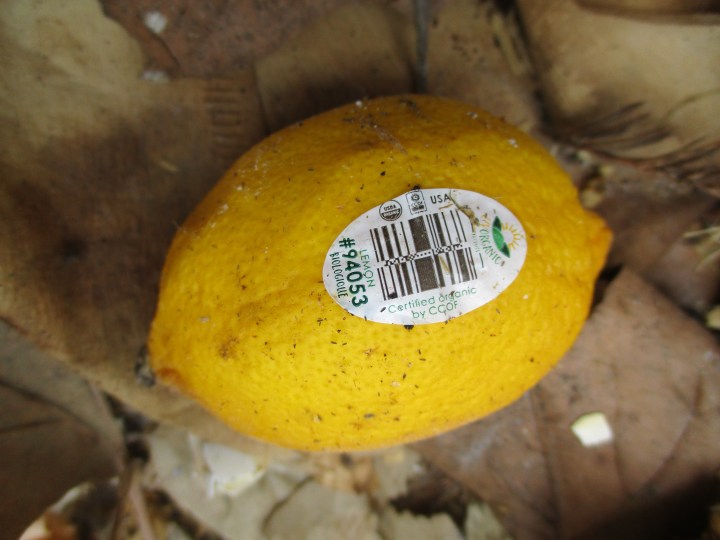
While dumping greenwaste from the kitchen onto the big compost piles, I noticed this labeled but unused lemon. I can not help but wonder why lemons from my tree aren’t good enough, and why this particular lemon wasn’t good enough either. How many of us nowadays would even recognize a lemon tree, or appreciate the fruit that it produces?
This lemon tree right outside of one of the kitchens is loaded with fruit.
Apologies for the lapse of posting articles as typically scheduled at midnight here for this morning and yesterday morning. The article that had been scheduled for yesterday morning posted an hour earlier, at 11:00 p.m. on Sunday night. The article that had been scheduled for this morning posted an hour earlier, at 11:00 p.m. last night. I neglected to adjust the schedule on Sunday for Daylight Saving Time.
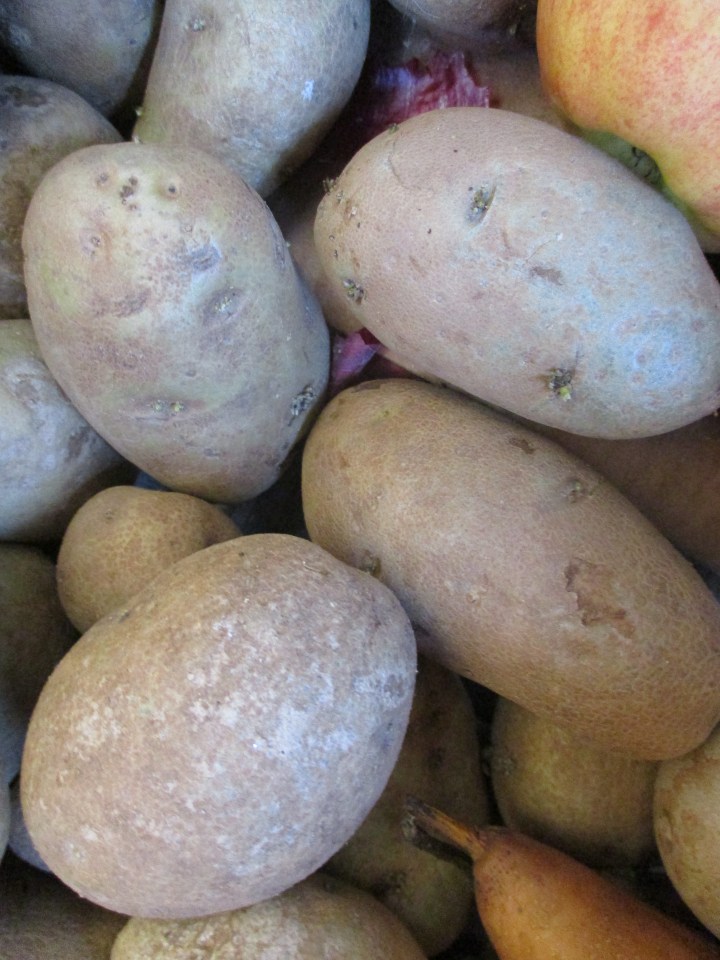
First thing first. Potatoes are not roots. They are only classified as a root vegetable because they grow underground. They are actually a sort of specialized subterranean stem known as a ‘stolon’. Because they are so distended, a more accurate distinction might be ‘tuberous stolon’ or ‘stoloniferous tuber’. Their eyes are buds, which roots lack. Their roots extend from eyes and other roots.
Most cultivated potatoes are of the species Solanum tuberosum. Some of the thousands of cultivars that were developed during the thousands of years that potatoes have been in cultivation are distantly related to other species. Hybridization was a means with which to incorporate desirable characteristics of other species. Potatoes are presently one of the main food crops in the World.
Small potatoes or pieces of potatoes, which are known as ‘seed potatoes’, start to grow in home gardens after the last frost. Potatoes are not grown from actual seed because of the potential for genetic variation. After bloom later in summer, their coarse foliage dies to the ground. Potatoes that grew during the previous season are then ready to get dug. Fruit and all green parts are toxic.
The weather agrees with the calendar this year. It is time to start replacing remaining cool season vegetable plants with fresh warm season vegetable plants. In fact, according to how the weather has been through February, the process could have begun quite some time ago. Frost, which is the limiting factor for warm season vegetables, is very unlikely this late, even if wintry rain resumes.
The past month of springy weather makes it easier to replace aging cool season vegetable plants with those that are now in season. Cool season vegetable plants obviously perform best through the cool weather of autumn and winter. They perform into spring where winters are cooler. Unseasonable warmth here accelerated their maturation. They deteriorate if not harvested soon enough.
Most of the the cool season vegetable plants produce vegetables that truly are vegetative. Most individual plants produce only once. For example, one cabbage plant produces only one cabbage. Conversely, most warm season vegetable plants actually produce fruit. Some produce many fruits through their season. Even some warm season vegetative leafy greens can produce repeatedly.
Tomato, pepper, eggplant pole beans and the various summer squash can get planted early to produce until they succumb to frost at the end of the season. Cucumber and pea do not produce for such an extensive season, so might be grown only in spring or the end of summer. Corn and root vegetables produce only once, so their seed get sown in multiple phases to prolong their season.
Corn, root vegetables and most greens grow best from seed sown directly into a garden. There is no need to start them inside here. Confinement can disfigure root vegetables anyway. Because so many individual plants are grown, it is impractical to purchase seedlings.
However, purchasing a few seedlings of tomato, pepper, zucchini and most other warm season vegetable plants is not as impractical. If only a few are desired, they are not much more expensive than seed. They are conducive to transplant, and will continue to produce through the season.
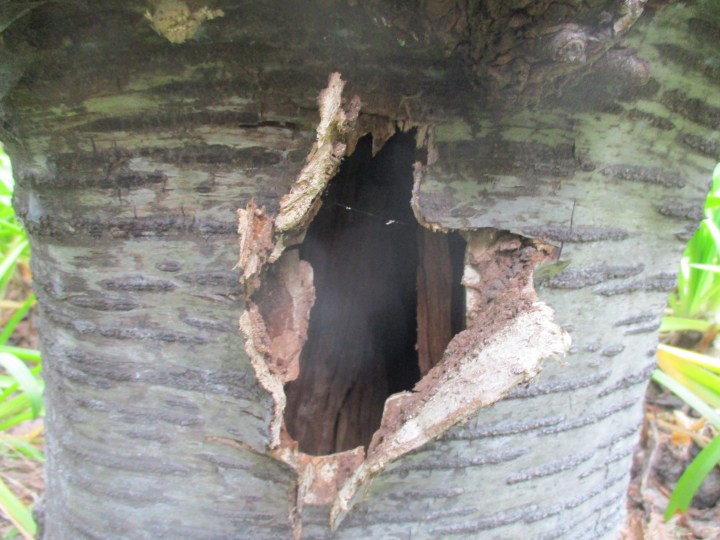
It really looks like something erupted from within!
That was a scary movie back when horror movies really were scary! The first appearance of the baby alien was the creepiest part and one of the scariest scenes! It is too disturbing and gory to describe here. Those who have seen it may have noticed how it might seem to be weirdly relevant to the cavity that opened in the rotting trunk of this deteriorating flowering cherry tree.
With a bit more distance, the rotting trunk looks sort of like an associate of ‘H. R. Pufnstuf’ after an interaction with a baby alien. If you can remember who H. R. Pufnstuf was, you probably shouldn’t. He starred in his own television show for children on Saturday morning in the 1970s. It was disturbingly weird and perhaps even inappropriate for the children it was intended for.
So, it is both rotten and unsightly.
With even more distance, it is obvious that this is nothing to joke about. This is one of two flowering cherry trees that I have been so protective of, and put so much work into temporarily salvaging. Both should have been removed and replaced years ago. This project was scheduled for after bloom in 2018, postponed until after bloom in 2019, and has yet to be done even now.
The problem is that these trees are so popular and so appreciated by the Community. They have been here in the most prominent spot in the neighborhood for several decades. There are not many who remember when the trees were young. No one seems to remember before the trees were here. They are as historical as the older buildings. I can not bear to cut them down.
As you can see, there is no choice now, at least for this particular tree. It is already so decayed that it can barely support its own weight.
As pretty as the bloom is, the disfigured branch structure and trunk are no longer appealing.
These daisies are rarely without some degree of bloom.
There is not as much difference between the seasons here like there is in other climates. It might seem like we get only summer, with a briefly cooler and slightly rainy time of ‘not summer’. I can recognize the changing of the seasons because I am familiar with them. Those acquainted with more normal climate mind find our subdued seasons to be rather boring, and restrictive.
People from climates with more extreme weather and more pronounced seasons might not expect mild weather and mild climate to be restrictive or limiting. They tend to notice what grows here that would not survive out in gardens through colder winters, such as bougainvilleas, tropical hibiscus and so many of the popular succulents. Even more tropicals survive farther south.
What they do not notice are what does not do so well here. Although stone fruit does remarkably well here, and many apples and pears are more than adequately productive, there are many cultivars of apple and pear that prefer more chill than they could get here. Lilac gets sufficient chill to bloom well here, but not enough to bloom as splendidly as it does in the Upper Midwest.
For example, some might be impressed by the perennial daisies that bloom sporadically whenever they want to throughout the year here. These daisies take no time off for winter, and are rarely damaged by frost every few years or so. They are so rarely without bloom that it is not often possible to shear off deteriorating bloom without removing some of the unbloomed buds.
What goes unnoticed is the potentially subdued bloom of the forsythias, which are so reliably prolific where winters are cooler. Some are real duds this year, and all are blooming notably late. This is one of the consequences of a mild climate.
Forsythia, with twigs that are still bare in the background, is not much to brag about.
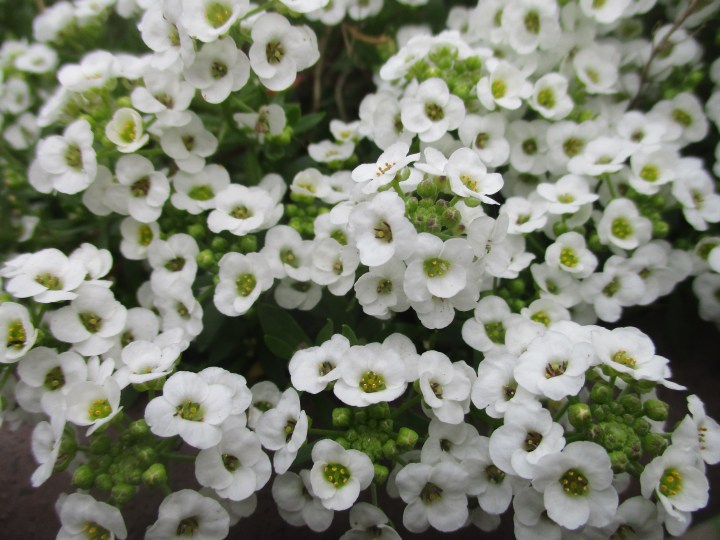
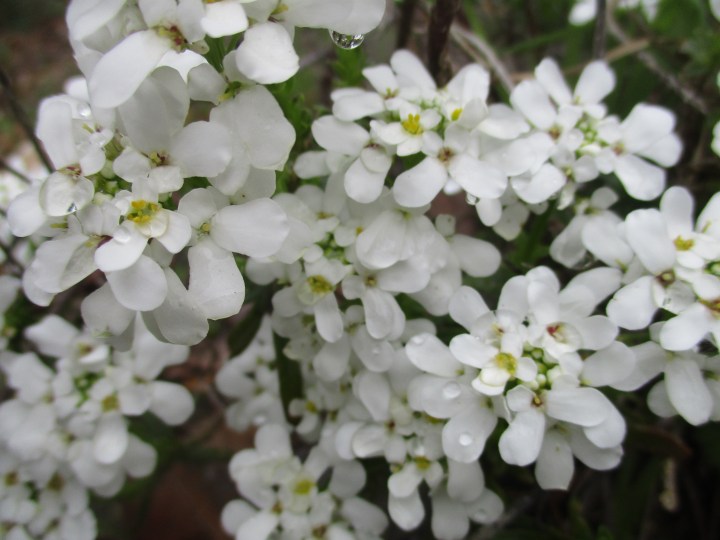
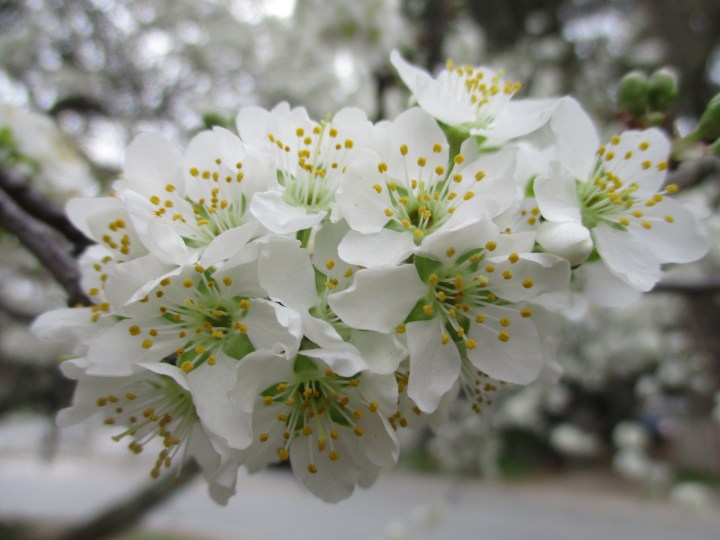
It is a long story. I did not get out to get any pictures until Friday. By that time, I was none too selective. I just got pictures of what happened to be convenient. It really is coincidence that all happen to be white. The first three are from work. The other three are on roadsides in town. 1, 3 and 6 have potential to be colors besides white. However, 1 and 6 are typically white in their feral state as shown here; and only one cultivar of 3 is only slightly blushed.
1. Alyssum – can not decide if it is a warm or cool season annual. A new generation starts to bloom before predecessors finish, regardless of season. All are feral, so none are pink or lavender.
2. Candytuft – is mistaken, by some, for alyssum. It blooms almost as continuously. It really should get cut back about now. Although, no one wants to cut it back while it continues to bloom.
3. Clematis – is evergreen, but was defoliated by harsh winter pruning. It lacks sufficient space to grow wild. Earlier bloom is fading already. The ‘Apple Blossom’ cultivar has blushed bloom.
4. Plum – of unknown origin blooms spectacularly at a gas station in town. Bloom is not quite as delicate as that of other feral American plum that naturalized from old stone fruit understock.
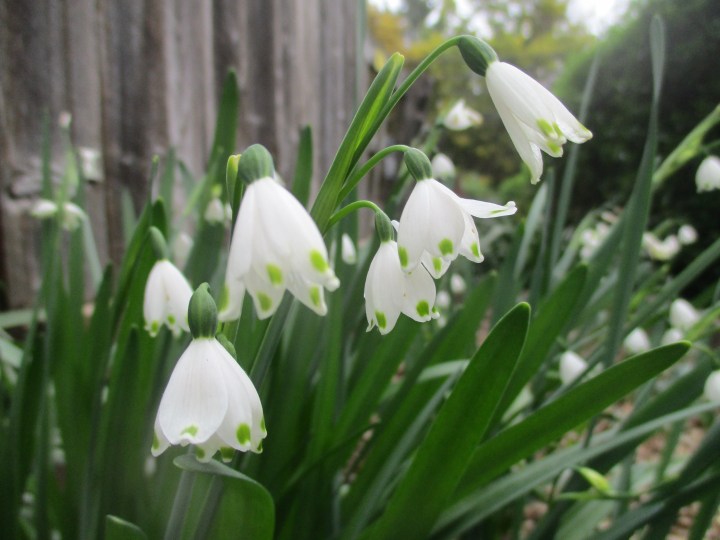
5. Snowflake – grows wild along roadside drainage ditches, but does not seem to be aggressively invasive. Mine bloomed earlier just like this. This is what I grow instead of trendy snowdrop.
6. Calla – is in the same ditch with the snowflake. It is even less aggressive. Weird colorful hybrids do not naturalize at all, probably because they are weaker, and do not produce viable seed.
This is the link for Six on Saturday, for anyone else who would like to participate:
It is not actually from Boston. The first Boston fern, Nephrolepis exaltata ‘Bostoniensis’ was merely discovered in Boston, as a mutant in a shipment of otherwise normal ferns. Unlike the more upright parent plants, Boston fern has softly arching fronds that can hang vertically at the ends.
The fronds are typically about a foot and a half long, and can be a few feet long in humid and partly shady environments. Each frond is comprised of many pinnae that are neatly arranged on both sides of a wiry rachis (leaf stalk). Each leaflet is an inch or two long or longer. Delicate aerial roots sometimes dangle below the foliage.
Through the 1970’s, Boston fern was one of the most popular houseplants. Yet, it really prefers more humidity than it gets inside. It is actually happier on porches or in atriums where it is sheltered from frost and harsh sun exposure. It prefers partial shade outside, but likes abundant ambient sunlight as a houseplant.
Without color or fragrance of flowers, ferns provide some of the most distinctive foliage in the garden. They do not turn color in autumn. Only a few tree ferns develop sculptural branch structure. Yet, they do their job well, and many are happy to do so in spots that are a bit too shady for other plants.
Almost all ferns are low perennials that produce foliage that arches outward from the center. Some can get quite broad. A few tree ferns grow upward on trunks (although the trunks are merely tough roots that grow through decomposing stems). Australian tree ferns can get quite tall and broad where sheltered from wind.
The staghorn fern is a weird epiphyte that naturally clings to tree trunks or rock outcroppings where it collects organic debris that falls from trees above. In home gardens, it is popularly grown on wooden plaques or as a hanging plant. Hanging plants do not necessarily need pots, or sometimes engulf their pots as they grow.
Leaves of ferns are known as ‘fronds’, and with few exceptions, are intricately lobed or divided into smaller leaflets known as ‘pinnae’, which are arranged on opposite sides of leafstalks known as ‘rachi’ (or singularly as ‘rachis’). The staghorn fern has unusually branched but otherwise unlobed fronds. The bird’s next fern has has distinctively simple fronds without any lobes or pinnae.
Most of the popular ferns are naturally understory plants that grow below larger plants. Even most tree ferns grow amongst larger trees. This is why so many ferns tolerate shade so well. In fact, many prefer partial shade, and will actually fade or scorch if too exposed. However, it is also why so many ferns prefer rich soil with an abundance of organic matter.
Maidenhair, rabbit’s foot, bird’s nest, holly, Boston and a few other ferns are popular as houseplants. Because home interiors are a somewhat arid for them (lacking humidity), some ferns like to be misted daily. Ferns respond well to regular but light application of fertilizer. Too much fertilizer can roast foliage.
Because ferns are not expected to bloom, nitrogen (which can inhibit bloom for some plants) is not a problem. Ferns that are out in the garden can therefore get fish emulsion or a bit of the same sort of nitrogen fertilizers that keep lawns green.
I seriously can not think of a title for this one. All that comes to mind is too objectionable. Writing about it will not be much easier.
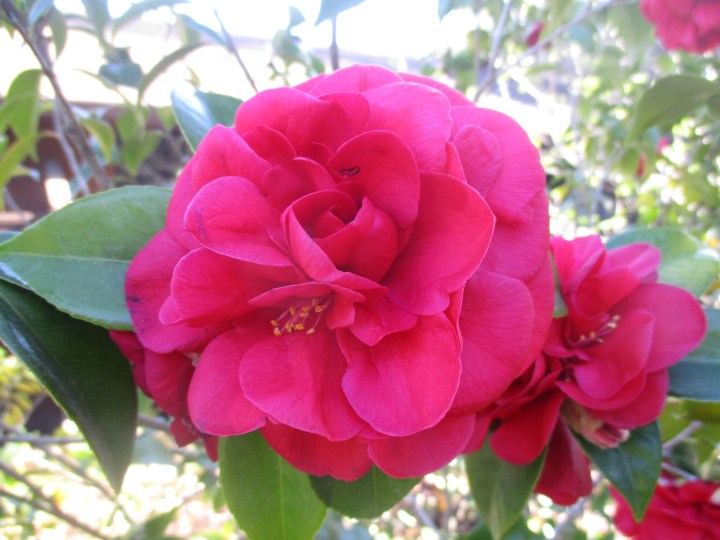
It began with a few mature camellias that were in need of grooming a few months ago. They were sufficiently shabby that I did not mind pruning them at the wrong time. Ultimately, almost all of what was groomed out was necrotic anyway, so did not compromise bloom significantly. I was pleased that the eventual bloom would be better presented against a neater background.
Then, I was informed that several of the same camellias would need to be removed to facilitate the installation of a new sidewalk. That would have been useful information before I put such meticulous effort into grooming them. It was briefly annoying; but I did not fret long. I planned to recycle the camellias, and realized that I would have groomed them in the process anyway.
At the time, there was no rush. I thought that the camellias would get to bloom prior to relocation. In the meantime, someone else removed a rotting madrone stump nearby. I thinned and groomed a sloppy filbert into an impressively tailored specimen. Immediate relocation of the camellias was not yet a priority. We had not even identified the precise location of the sidewalk.
Then, there was another disappointment. The project was unexpectedly scheduled immediately after another nearby project that would be completed in only a few days. It would have been more expensive for the crew to leave after finishing the primary project, and then return for the secondary project. I might salvage the camellias, but I knew I could not salvage their bloom.
That is not the worst of it. After planning to relocate the five or so offending camellias on Wednesday or Thursday, I was informed on Tuesday morning that three had already been removed by the backhoe operator who had removed old concrete pavement from the other nearby project. By removed, I mean they got torn mercilessly from the ground and completely destroyed.
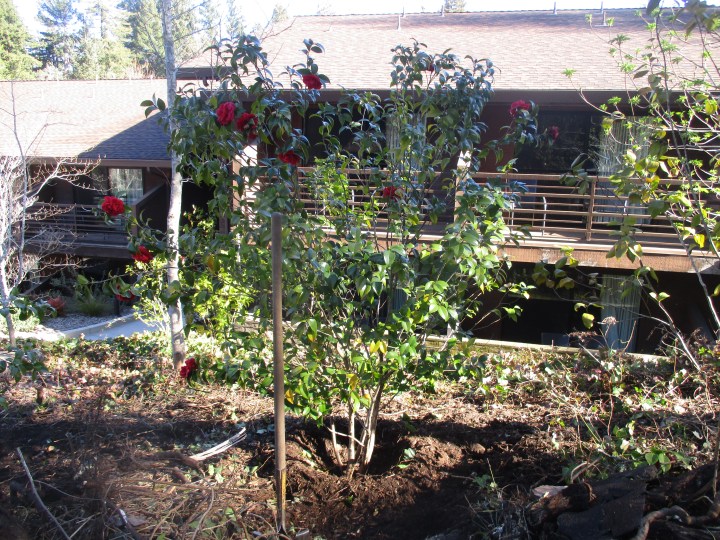
One of two relocated camellias demonstrates how mature the three that were needlessly destroyed were, although they were not so broad. That is a shovel handle in front.
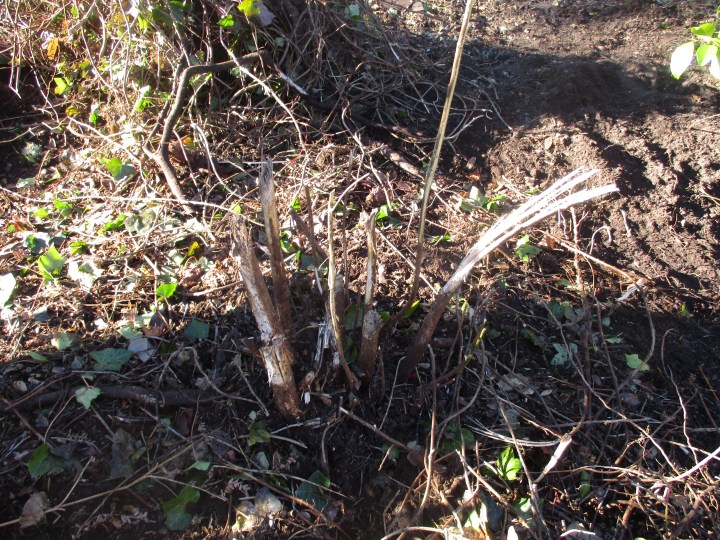
No other excavation was done. Asphalt pavement and a curb that need to be removed remain intact. The unwanted ivy is just as unwanted and intact as it was before this weird incident, as if nothing happened. The craters where the camellias got gouged out are barely visible. The only other damage was the mutilation of my well groomed filbert, which was not even in the way.
It was as if the camellias were targeted. Two survived only because someone arrived on site to stop the backhoe operator from destroying them also. There was no regard for any associated subterranean infrastructure, such as an irrigation system and electrical landscape lighting. I suspect that the filbert was mangled just because it was too close to one of the targeted camellias.
I tried to conceal my anger as I frantically relocated the two surviving camellias, while the backhoe operator who so needlessly and blatantly destroyed the other three worked with the crew at the other project just a few yards away. I tried to convince myself that the incident was merely an honest mistake. I doubt that the backhoe operator intentionally targeted the camellias.
As I finished, and was calmly leaving the site, something happened that made me realize that perhaps some of my anger was not completely unfounded. I still do not believe that the backhoe operator was intentionally malicious. I realized instead that the backhoe operator, regardless of his intentions, should most certainly not be operating such potentially dangerous machinery.
From where the crew was taking a break, and the backhoe operator seemed to be enjoying a cigarette, a voluminous and aromatic cloud of marijuana smoke drifted to where I could smell it.
What these guys do prior to or after work is none of my business, as long as it does not compromise their safety or rationality. If someone wants to go off and use their so-called medication in private during the day, he should do so discretely and moderately. Someone who can generate such a voluminous cloud of smoke with no regard to what others think about it has a problem.
Someone took the initiative to destroy my formerly well tailored filbert, but not to remove the carcass. I could have left it to regenerate, but I do not want to look at it anymore.