 Incandescent light bulbs were the standard form of electric lighting for more than a century after their invention. It took a while for fluorescent and halogen lamps to become popular; and by the time they did, high intensity discharge (HID) lamps had already become available. Nowadays, light emitting diode (LED) lamps seem to be replacing all sorts of electric lighting.
For a brief time in the late 1980s, high intensity lamps that were being used for large scale applications and street lamps became a fad for exterior household lighting. They worked nicely for driveways, so many of us believed that they would work just as nicely for night lighting of home gardens and patios.
By that time, most of us had realized that the sickly yellowish glare of the sodium vapor type of high intensity lamps that were so common as street lamps was not at all appealing around the home, and was downright unflattering for foliage and flowers in the garden. Mercury vapor high intensity lamps became more popular for such applications instead, even though their slightly bluish bright glare is no more inviting.
During this time, while the renowned landscape designer Brent Green and I were still studying horticulture at Cal Poly in San Luis Obispo, his father had a rather fancy mercury vapor lamp installed in his backyard.
Of course, Brent was furious! He had put so much effort into cultivating a remarkably inviting outdoor living space, only to have it illuminated at night like an industrial warehouse. When turned on, the lamp made a constant buzzing hum. It hung from a wall like a big glowing paper wasp nest. Brent referred to it at the ‘beehive’.
The quality of light produced by modern electrical light sources has fortunately improved since then. Nonetheless, contraptions such as this street lamp suspended on an otherwise exemplary ponderosa pine are not easy to warm up to.
Six on Saturday: Rhody In Pictures
All I wanted was just one good picture of Rhody in the weeds for an illustration for the gardening column. I wrote about weed seeds, such as foxtail and burclover, that are dangerous to pets. That article will post on Monday, but can be found now at the Canyon News.
Anyway, Rhody would not cooperate. His defiance was so annoying, . . . but also adorable. I used a picture of another terrier on the lawn at Felton Covered Bridge Park instead. (The article in the Canyon News does not use the thumbnail image.) These are a few of the pictures of Rhody that I did not use.
Even though they are irrelevant to horticulture, I posted these pictures here because they are too amusing to delete without sharing. My primary ‘Six on Saturday‘ article was posted separately.
1. Rhody really can be cute until he realizes that I want to get a picture of him.
2. Then he gets pompous.
3. He briefly considered trying to cooperate.
4. He did not consider it for long
5. Then he got annoyed that I was still trying to talk him into being cute for pictures that he wanted no part of.
6. By this time, it was obvious that I needed to turn the camera off.
This is the link for Six on Saturday, for anyone else who would like to participate:
https://thepropagatorblog.wordpress.com/2017/09/18/six-on-saturday-a-participant-guide/
Six on Saturday: Sedge Removal
What a nasty job! We know this sedge, or whatever it is, as ‘razor grass’ because it cuts like razors. It is difficult to pull from the rocky creek bottom and bank with the creeping stolons still attached. The creek is mucky. The water is wet. The gloves I wear to avoid getting slashed obviously get just as mucky and wet.
It was such a miserable job last autumn that we postponed most of it for winter. I figured that I could wait for the dangerous foliage to die back, and then just pull up the stolons below the dead foliage. It might have been a good idea, if only we had returned to actually execute our plan. By the time we got back, new foliage was already maturing.
I was so dreading returning to this job, but then found that the fresh new foliage was not nearly as dangerous as the more mature foliage that we pulled late last summer and autumn Furthermore, the new rosettes had not dispersed their roots quite as firmly as expected. They were suspiciously easy to pull, with the stolons still attached. Dead old rosettes seemed to be completely necrotic and decayed. It was too easy.
I expect at least a few new rosettes will develop later. There were likely some down under the muck that were not up when I was there. I also expect that some will grow from bits of stolon that were left behind. However, nothing has been seen in the past three weeks or so since we did this. (I would have shared these pictures sooner, but there were other pictures to share instead.)
Speaking of other pictures to share, there are six more on my secondary ‘Six on Saturday‘ post. I did not want to save them for later because they are almost irrelevant to horticulture, but I did not want to delete them without first sharing either.
1. Sedge, or whatever it is, is difficult to handle, and is even more difficult to handle when trying to separate the stolons from the stones on the bank of the creek.
2. It did not take long to fill each of these plastic bins. I did not leave any foliage hanging over the edge, because I did not want to get cut when picking up the bins.
3. These bins can be used as a flotation device. Actually, it was rather annoying that they kept floating away until they got filled. It was a nice day to be in the creek.
4. This acorus grass was mostly overwhelmed by the sedge, or whatever it is. I should have gotten a ‘before’ picture. It looks great now, and is happy in the muck.
5. While pulling sedge, I found these two knees developing from the roots of one of our two bald cypress. This particular tree was supposed to be a dawn redwood.
6. I also noticed that the montbretia was blooming more than it normally does down in the deep shade. It is a voracious weed too, but inhibits even worse weeds.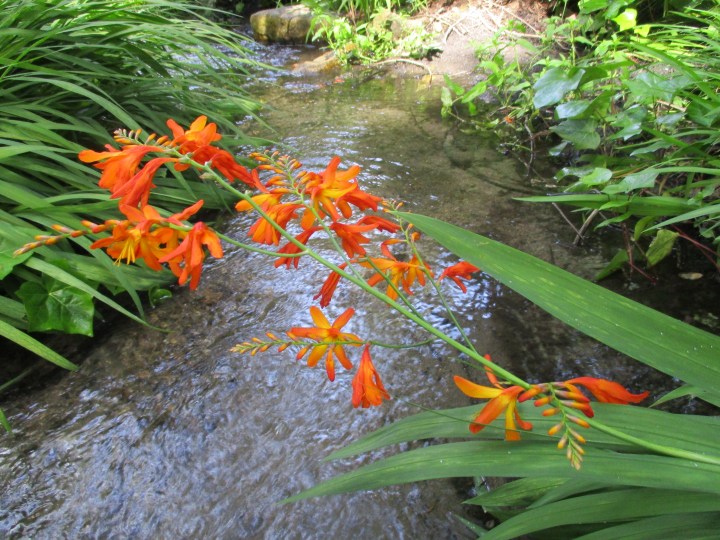
This is the link for Six on Saturday, for anyone else who would like to participate:
https://thepropagatorblog.wordpress.com/2017/09/18/six-on-saturday-a-participant-guide/
Garden Verbena
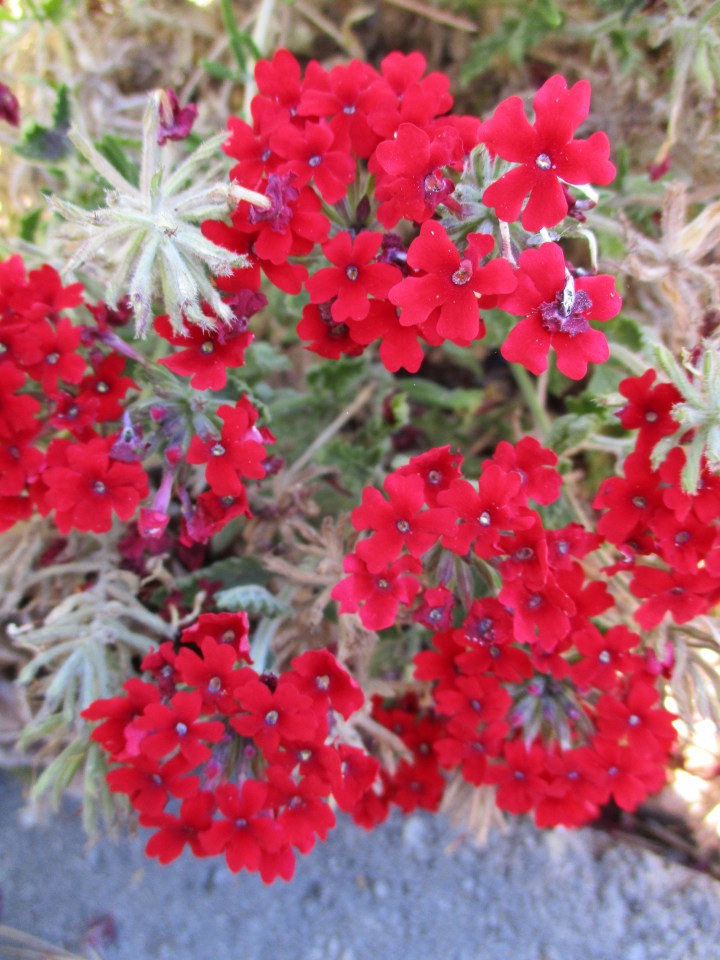 It is fair to say that garden verbena, Verbena X hybrida, is a reliable warm season annual. It gets planted in spring to spread out and bloom through summer with bright pink, red, purple or almost blue, or softer pastel pink or pale white. It is commonly replaced with cool season annuals by late autumn. However, garden verbena is actually a short term perennial that can survive winter to bloom for a few years.
Perhaps individual plants do not last long enough to be practical as permanent ground cover. Yet, if mulched just so, the thin branches can root where they touch the ground, and then grow into new plants to replace the original plants before they die out. Stems do not spread or cascade much more than a foot from where they are rooted. Nor do they stand more than six inches deep.
Artificial Turf Has Real Advantages
 Lawn is the carpeting for our outdoor spaces. Like pavement or decking, it makes the space in or gardens useful for more than growing other plants. Since it is designed to share its space with us, we give it more ground space than any other type of plant. For what it contributes, most of us do not mind giving lawn all the water and attention that it requires. It really seems indispensable.
Realistically though, most of us are lazy; and we really should be using less water in our gardens. Perhaps it would be more polite to say that we should more selectively prioritize the expenditure of limited resources and effort. Lawns that do not get much use are probably not worth all the work and water. There are easier ways of managing extra space than covering it with turf grass lawn.
Whether we like it or not, artificial turf is very undemanding, and requires no water. It is a bit too uniform and perfectly colored to convince those who bother to notice that it is not real turf, but it is still more convincing than old fashioned artificial turf. It is durable enough for children and dogs, as long as no one tries to dig in it. It does well where dark shade prevents real grass from growing.
The cost of artificial turf is an important consideration. It is relatively expensive for those who maintain their own lawns. However, artificial turf that last for many years is less expensive than paying gardeners to mow for just two or three years. The perfect uniformity of color and texture that might be unappealingly unnatural for horticultural purists is so worth the extra expense to perfectionists.
Installation of artificial turf in a new landscape is relatively easy, since irrigation can be installed only for adjacent plants that require it. Replacement of real lawn with artificial turf in an established landscape is much more challenging, or in rare situations, impractical. Trees and adjacent plants that are reliant on lawn irrigation will need to be watered (somewhat) where the original lawn was.
It seems silly and contrary to water conservation to water artificial turf, but it is sometimes necessary until roots of established plants adapt and migrate to other sources of water. This can take a few years for trees that are surrounded only by lawn. Irrigation need not be as frequent as it was to sustain turf grass, but should be sufficient to sustain any other plants while they figure things out.
Horridculture – Metasequoia glyptostroboides
 The easier name is ‘dawn redwood’. I just used the big and fancy Latin name because that is how landscape designers with something to prove say it. If the big name does not impress clients, an explanation of how rare it is, and that it is one of only a few deciduous conifers, will likely do the job. Even back when it was still a fad, I got the impression that was its main function; to impress clients.
It is not even a particularly practical tree. If it gets too big for its situation, it is difficult to contain without disfiguring the canopy. Because the priorities for most were conformity to a fad and to dazzle a client, not much thought went into their appropriateness to their respective landscapes. Consequently, many went into landscapes that were not big enough for them.
Although deciduous, dawn redwood does not even get good color in autumn. It just turns rusty brown, and quite frankly, looks dead.
It is true that there are only a few deciduous conifers. However, the dawn redwood stopped being rare shortly after it became a fad. I mean, how rare can it be if every landscape designer with something to prove gets to plant one?! Isn’t that what happened to the formerly rare yellow clivia after it became a fad?
The only one that I work with now happened to be planted before dawn redwood became a fad. I suppose that makes it okay. It is quite tall now, and has plenty of space to mature. However, I can not help but notice how silly it looks with all the other surrounding coastal redwoods. Although very different, it is similar enough to look like a coastal redwood with some serious problems, especially when it seems to die every autumn.
Matilija Poppy
 If California poppy had not been designated as the California state flower, Matilija poppy, Romneya coulteri, might have been. It was nominated, but was less popular at the time, partly because it was familiar only to those near its native range in Southern California. Some of us know it as ‘fried egg flower’, because the big and floppy white flowers with yellow centers look like fried eggs.
Matilija poppy is a big and bold perennial, with flowers that are bigger than any other native species. They can get more than six inches wide! These flowers stand on top of lanky stems that might get taller than six feet. The somewhat sparse and light grayish foliage has a uniquely bristly but also slightly rubbery texture. Individual leaves might be longer than six inches, with elongated lobes.
As a native of dry chaparral regions, Matilija poppy is very resilient, and does not need watering once established. However, to survive long and dry summers, it starts to die back early, so should get cut to the ground later in summer or early in autumn before it becomes too unappealing. It then stays dormant through winter before regenerating in spring. Rhizomes can spread aggressively.
Boulders In Modern Landscape Design
 It is hard to say why boulders and sculptural stone are sometimes incorporated into American landscapes. A long time ago, boulders were only left in landscapes if they were to big and heavy to move out of the way or break apart. Early American landscapes were designed to express dominance over nature by replacing as much of it as possible with unnaturally organized landscapes.
Slowly through history, less refined and more relaxed landscapes became more tolerable, and then became popular as an expression of rebellion to earlier formality. Nowadays, most landscapes are inevitably informal, partly because so many believe that informality is more natural, and partly because few landscape designers will design anything else. Simplicity and symmetry are passe.
This informality allowed for the incorporation of various elements from various styles of landscaping, regardless of how incompatible some of such elements were with each other. Boulders and sculptural stone that had been traditional with many Asian styles of landscape design were added to American landscapes in rather nontraditional fashion. It has been a slow process of evolution.
Boulders are obviously nothing like viable and dynamic plant material, although they do contribute form, texture and color to a landscape. Designers might say that bigger and sculptural boulders add drama without even trying. In some situations, boulders are as functional as they are aesthetically appealing. They can obstruct unwanted traffic or hold back soil that is at a higher elevation.
If they need not conform to any of the various Asian landscape design traditions, there are not many rules for the use of boulders and sculptural stone. Exotic stone that might be incompatible to big open landscapes where exposed endemic stone is visible nearby, might be just fine in enclosed gardens where there is no reference for what is natural.
The standard rule of burying as much as two thirds of a boulder to make it seem as a natural outcropping is only valid if it is intended to look like a natural outcropping.
Wild Radish
 This is why I do not bother growing greens in the garden just yet. Wild radish grows here wild; and there is way too much of it. Most but not all of it gets mown in meadows or cut down with weed whackers on the edges of roadways. There is no need to cut down that which is out of the way. Besides, we could not cut it all even if we wanted to. There is wild turnip and mustard too. All are prolifically naturalized and invasive exotic species.
These radishes do not make the distended roots that garden varieties of radishes are grown for. Nor to the wild turnips make distended turnip roots. They, as well as the mustard, do make good greens though. They may not be quite as good as fancier garden varieties, but I can’t beat the price, or get any other type of vegetable for such minimal effort. I only need to go grab what I want when I want it. There really is no cultivation involved.
Even though their seed is not sown in phases to extend their season, they remain productive for a long time, and only stop producing if they get too dry in summer. If I were to grow a garden variety of turnip green, I would sow a few phases a few weeks apart so that, as an earlier phase finishes, a later phase begins producing. Unlike other types of greens that must be gathered prior to bloom, wild greens can be taken from blooming plants.
Wild greens can be canned like collards, but are better if simply frozen. Unbloomed floral trusses are like tiny bits of broccoli. If gathered while still young and tender, thicker stems can be chopped and cooked like broccoli stalks, and can even be pickled.
Like Peas In A Pod
 Generally, that is how they are. Almost all perennial pea flowers bloom with the same bright purplish pink color of the bloom in the picture below. That is, of course, before their pods develop, but you get the point. We sort of know what to expect from them.
As I mentioned in the ‘Six on Saturday‘ post last week, from which the picture below originated, variants like the pink bloom in the picture above are sometimes observed. The rare clear white flowers are my favorites. There might be fluffier double flowers too; although, in my opinion, the single flowers are prettier and look more like pea flowers should look.
I also mentioned last week that, although perennial pea has a sneaky way of growing where it is not wanted, it typically does not grow reliably from seed sown intentionally where it might actually be desirable. I have tried. The seed just did not cooperate. I managed to get a few to grow, but only because I put out a few hundred to compensate for the expected minimal rate of germination.
Because I like the white so much, I took seed from a vine that had bloomed with single white flowers. I figured that they would be more likely to produce a few white blooming progeny. I would have been satisfied if only a single vine in a group of several bloomed white, but got only a few vines that all bloomed with the typical bright purplish pink. They were pretty nonetheless, but were ironically removed when the site was redeveloped.
I also collected seed from vines that bloomed with the common single bright purplish pink flowers, just in case the viability rate of their seed might somehow be better. They were sown into a different situation, so even if I happened to know how many of the seed that were sown germinated and grew, it would not be an accurate comparison. Regardless, I was no more impressed with the result. Perennial pea is best appreciated as weed.

