These are some of the bridges in the neighborhood where I work. There are several others that I did not get pictures of, as well as several more closer to town. Bean Creek happens to flow into Zayante Creek here, and Zayante Creek flows into the San Lorenzo River just a short distance away. Bean Creek flows through the farm a few miles upstream. Zayante Creek flows right past my home.
If you happen to know who Miley Cyrus is, she was photographed in the waterfall where Ferndell Creek flows into Bean Creek, which is literally just a few feet upstream from where Bean Creek flows into Zayante Creek. I do not know who she is, but I can understand why she came here to have her photograph taken.
1. Under the Conference Drive Bridge over Zayante Creek, East Zayante Road, Roaring Camp Road, Roaring Camp Railroad, and an access road to a (Rhody’s) baseball field, one would not guess that this bridge covers so much territory. The two roads below are on opposite sides of Zayante Creek. I posted pictures of this bridge before, but during winter while the box elders were bare. One box elder off to the left fell not too long ago.
2. Over Zayante Creek, just a short distance upstream and around a bend to the east, this small pedestrian bridge is closed until it can be repaired or replaced. Rhody does not seem to mind. Except for the light green box elders off in the distance, the trees to the left are some rather nice specimens of white alder. The foliage to the right is that of California buckeye, which is a weirdly ‘twice deciduous’ species that can defoliate during summer.
3. Under Roaring Camp Railroad Bridge over Zayante creek, just another short distance upstream from the pedestrian bridge (#2), we can see some more white alders, as well as some coast live oaks in the background. The lighter foliage to the left is likely box elders. This railroad passes under the significantly higher Conference Drive Bridge (#1) just a short distance in the opposite direction. They are almost perpendicular to each other.
4. Over a nicely landscaped section of Ferndell Creek, this small pedestrian bridge is probably the best place to see most of the rhododendrons when they bloom. Most are off the left, but that unrecognizable shrub to the right is one of the biggest. It is about ten feet above the bridge, and about twelve feet below! The big camellia that was killed by gophers earlier was just to the left at the far end of this bridge, just in front of the redwoods.
5. Under another pedestrian bridge just a very short distance downstream from the bridge pictured above (#4), recently planted Boston ivy is beginning to climb the pair of pillars in the background. Now that we know it does well here, we will eventually add more to climb the closer pair of pillars, after the English ivy gets removed. The site from which I removed sedge earlier is just upstream to the left, between the two pedestrian bridges.
6. Over Conference Drive, and a short distance up the road form the Conference Drive Bridge (#1), this small pedestrian bridge was built at a time when Conference Drive carried much more traffic. The road was closed to through traffic and bypassed in 1968. I like how the bridge leaps up into the redwoods and back down again on the far end. I need to prune these redwoods for clearance, but try to leave them cozily close to the bridge.
This is the link for Six on Saturday, for anyone else who would like to participate:
https://thepropagatorblog.wordpress.com/2017/09/18/six-on-saturday-a-participant-guide/
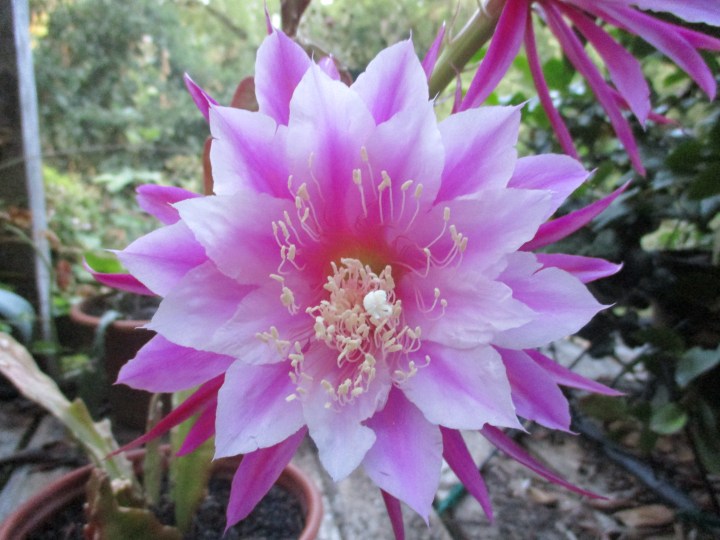
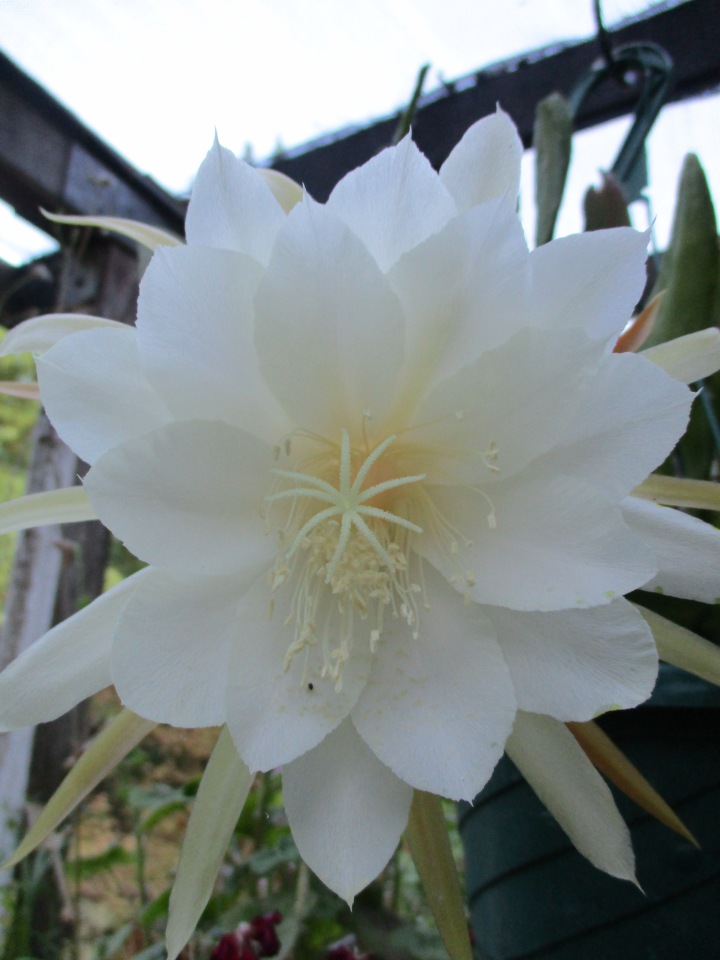 Epiphyllum oxypetalum was my very first epiphyllum. A friend’s mother gave me three long cuttings, which were cut in half to make six cuttings. They grew like weeds, and I was quite pleased with them. At the time, they were the only epiphyllum that I wanted. The wide nocturnal flowers are strikingly pure white and nicely fragrant, and stay open late into the morning if the weather is right. Since white is my favorite color, I craved no more.
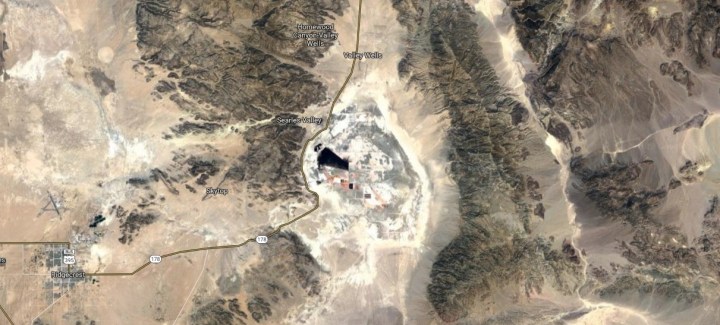 Trona is not as obscure as it seems. I would have needed to zoom in a bit more for it to appear on ‘Google Maps’, but it is there, just to the northwest of what seems to be a big crater of some sort in the middle, right where the map is labeled ‘Searles Valley’. You might have seen Trona before, from more flattering, or at least more realistic perspectives, in movies such as ‘Star Trek V’, ‘Planet of the Apes’ (2001), ‘Land of the Lost’ and ‘Holes’.
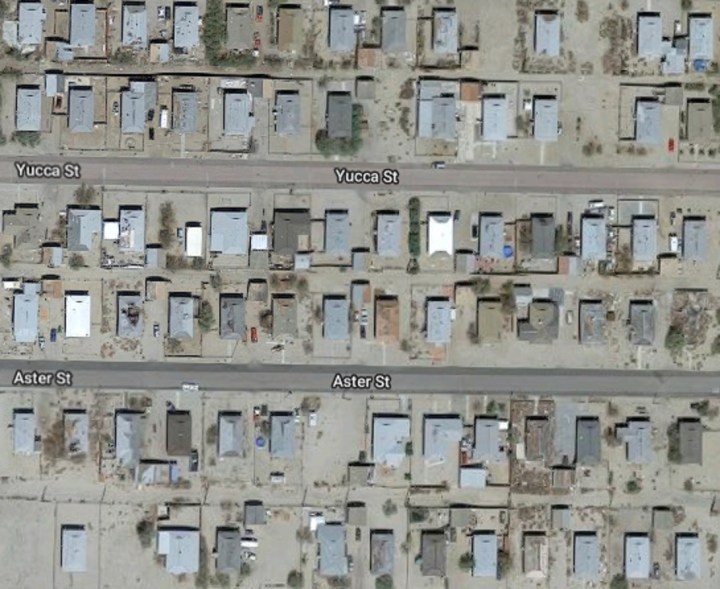 Trona
Trona The Nile River floods annually, inundating everything in its floodplain. Lily of the Nile, Agapanthus africanus, survives by hanging on firmly with a thick network of rubbery roots. It grows and blooms in warm weather as floodwater recedes, and then survives through a long, warm and dry season until the river floods again. It tolerates both drought and flooding, although it prefers more stability.
 Anyone who has ever owned a cat knows that no one owns a cat. They do whatever they want to do, whenever and however they want to do it. They take orders from no one. If they decide to use a dry spot in the garden as their litterbox, or a tree trunk as their scratching post, it is impossible to dissuade them. They are so smug and arrogant. It is no wonder that so many dogs dislike them.
 There are mixed emotions about tree removal permits that so many municipalities need to issue in order for a ‘heritage’ tree to be cut down legally. Most of us want to believe that in America, we have certain rights to do what we want to on the properties that we own. Obviously, that makes the most sense. However, if it were that simple, many more prominent trees that are collective assets to the larger communities would be removed.
 Whether it is grown intentionally, or considered to be a common roadside weed, there is no denying that perennial pea, Lathyrus latifolius, knows how to brighten some of the wilder parts of the garden with brilliant purplish pink bloom. Some garden varieties bloom either pale pink or white, just like a few random feral plants do. Bloom resembles that of sweet pea, but without fragrance.
 Weeds are weeds because they grow where they are not wanted. They might be desirable plants in the wild within their native ranges, or beyond their native ranges where they are useful, but for one reason or another, are undesirable in other situations. In fact, many of the most invasive exotic (non-native) weeds were imported because they were useful for something, and then escaped.


 Batman and Robin were here!