 This is the beginning of one of several new knuckles on a pollarded crape myrtle tree that was pollareded for the first time just this past winter. It was quite a mess of thicket growth that was too congested to bloom well. It is also located in a confined situation where it could not just be groomed, pruned up for clearance, and then just left to develop a larger canopy higher up. Pollarding will both contain it, as well as invigorate healthier growth.
New shoot growth now emerging from the ends of limbs that were pruned back last winter will elongate and eventually bloom through spring and summer. Next winter, after all the colorful autumn foliage has defoliated, the tree will get pruned back to these same knuckles to repeat the process. Stems will get cut back as neatly as possible, leaving no stubs, but such pruning causes knuckles to become slightly more distended as the develop.
Minor shoot growth that develops elsewhere on the mature stems below the developing knuckles should be removed as it appears. It is easy to knock off now, before it gets big enough to need to be pruned off. Knocking it off or ‘peeling’ it off, as drastic as it sounds, is actually better than pruning it off. It removes more of the callus growth that is likely to develop more stem growth later. New growth should be concentrated into the knuckles.
Pollarded crape myrtles bloom later than those that are not pollarded, but they bloom more profusely. They are also more resistant to mildew, and develop better foliar color in autumn.
The picture below shows the same crape myrtle that I got the picture of the single knuckle above from, shortly after it was pollarded. This picture was used another article at:
https://tonytomeo.com/2019/03/16/six-on-saturday-picture-dump/
Six on Saturday: Spring Flowering Trees – With Problems
You probably do not notice the problems while distracted by the profuse bloom. That is just swell. It is gratifying that the trees that I work with are appealing to those who see them. Since I work with them, I notice their problems. I would have posted just close up pictures of the flowering cherries and flowering crabapples, but because they are blooming at different times this year, I got only these three.
1. The shade of the big redwood trees is a bit too dark for this flowering cherry tree. It is always this sparse. What is worse is that the upper layer of bloom is suspended on a single horizontal limb that extends from the right, out the backside, back in toward the center and off to the left as it is seen here in the picture. What looks like supporting limbs is actually trunks of birch trees in the background. I would prefer to cut the awkward limb off, but you can see how flat topped the remaining portion of the tree would be without it.
2. This is the main reason the tree remains. These double white flowers are the whitest of the trees here.
3. My absence at a previous work day at the Presbyterian Church was the problem with this ‘Prairie Fire’ flowering crabapple. I had worked with this tree for a few years to thin out the thicket growth, and repair structural damage. Then, because I was not there, someone else pruned it indiscriminately with hedge shears and loppers! What a mess! It is best that you can not see the damage within the canopy. I don’t know why this was done. The tree only needed minor trimming for clearance above parked cars. After bloom, I will start the process of structural repair all over again.
4. These rosy pink flowers make it all worth it though.
5. This flowering cherry actually looks better than I expected it to this year. I pruned out so much necrosis last years that I figured that the tree was deteriorating. I expected a bit more new necrosis to develop this years. As you can see, that did not happen so much. I am not disappointed. Actually, I am impressed that there is no necrosis worth noticing. The worst problem with the tree right now is that it is disfigured by the unexplained necrosis. Well, that will not prevent us from appreciating the bloom.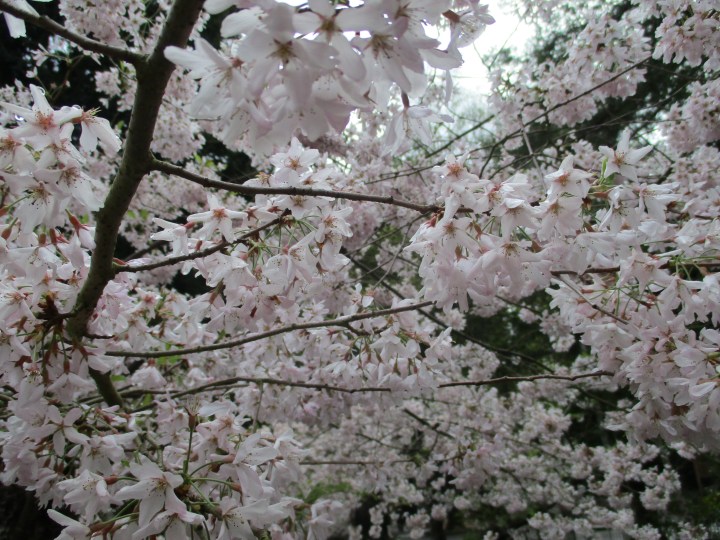
6. This is the bloom close up. It is very similar to the other two old cherry trees that I will be cutting down this year. I wrote an article, and perhaps others, about them earlier. https://tonytomeo.com/2019/03/31/the-end-of-the-cherry-blossom-festival/
This is the link for Six on Saturday, for anyone else who would like to participate:
https://thepropagatorblog.wordpress.com/2017/09/18/six-on-saturday-a-participant-guide/
Iceplant
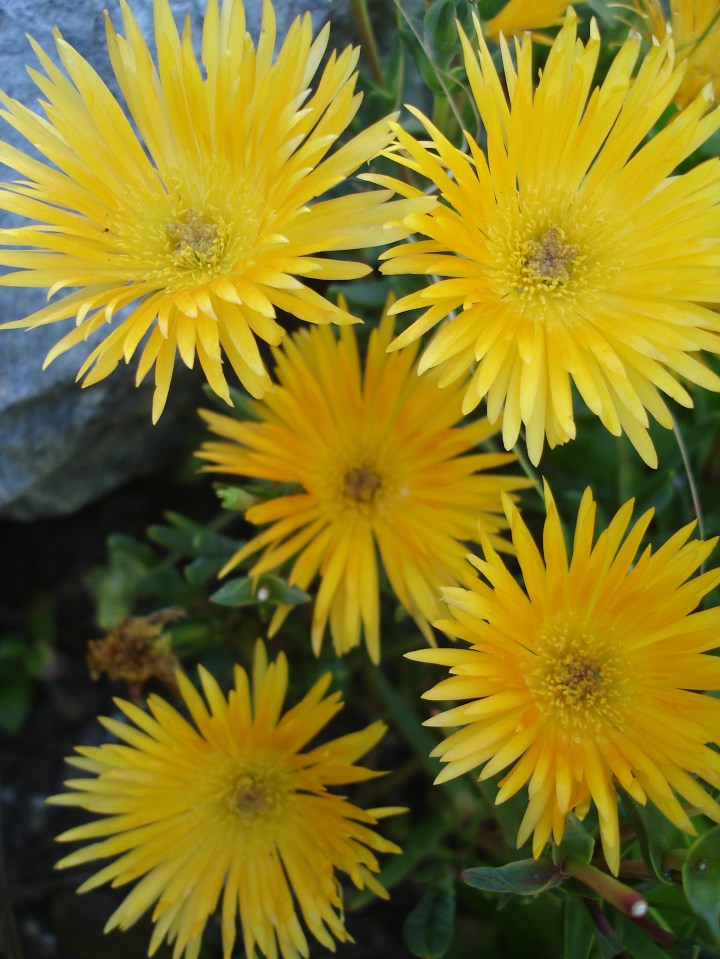 Bright pink bloom that can be profuse enough to obscure the succulent foliage below is nothing new for iceplant. Some bloom bright purplish pink. Others are reddish pink. A few are softer pink or white. What is unexpected is iceplant that blooms bright yellow, orange or gold, like Lampranthus aureus does. (Freeway or beach iceplant that blooms soft yellow or pink is not a true iceplant.)
Lampranthus arueus neither spreads as far nor cascades quite as well as other types of iceplant, but if planted a bit closer together, it can cover quite a bit of ground. It gets about a foot deep, or a bit deeper if crowded by other plants. It is very easy to grow from cuttings stuck wherever new plants are wanted. The inch and a half wide flowers are slightly wider than those of other iceplant.
All iceplant are quite undemanding. Although they bloom better and stay greener with occasional watering, they do not need much water. They should only be fertilized if they get wimpy. After the spectacular primary bloom phase early in spring, too much fertilizer might inhibit sporadic bloom later in summer. Unfortunately, the healthiest iceplant may not bloom again after spring bloom.
Plant Problems Are Sometimes Exaggerated
 It is not easy for wild trees to adapt to a refined landscape. After a lifetime of adapting to their native environment and dispersing their roots to where the moisture is through the dry summers, they must adapt to all sorts of modifications such as excavation, irrigation and soil amendment. Newly installed plants grow into a new landscape while some mature trees succumb to disease and rot.
Oak root rot is such a common disease in California that there are only a few places where it is not found in the soil. It is not often a problem to new plants, but often becomes a problem to mature trees that suddenly get more water than they are naturally adapted to, particularly if roots have been violated, and the soil has been amended to retain more moisture. Change is not always good.
However, many of the same trees that are so susceptible to oak root rot if the environment around them changes can be remarkable adaptable as young trees. California sycamore happens to be a riparian tree that naturally grows near water. Although old trees may not adapt well to change, young trees planted in new landscapes will adapt to the water that is available as they mature.
California sycamore trees that are adapted to landscape or lawn irrigation are not likely to be bothered by oak root rot until they get old. Realistically though, any old sycamore is susceptible to oak root rot. The only difference is that those that get more water mature faster, so get old sooner. A California sycamore tree planted into a home garden may live only one century instead of two.
Verticillium wilt is another disease that can be found in most places throughout California. It is notorious for severely disfiguring and killing ash trees and many other plants. However, it needs moist soil in which to proliferate. Because lawns are irrigated so frequently and often excessively, ash trees in lawns are innately susceptible to verticillium wilt. In situations that are not irrigated so frequently, newly planted ash trees can mature into healthy shade trees.
Horridculture – Weed Eaters
 The most destructive tools that so-called ‘gardeners’ have access to are hedge shears. They use them on just about anything within their reach. If a tree is not beyond their reach, they are likely to shear it into a nondescript glob of a shrub, complete with lodgepole stakes and straps that never get removed. Yet, in all their enthusiasm, they will not properly shear hedges that are actually intended to be shorn. Well, I have ranted on that enough.
The second most destructive tools that so-called ‘gardeners’ have access to are weed eaters, which are also known as weed whackers or edgers. Although not actually related to real edgers, they are known as such just because they are so commonly used for the same purpose. Weed eaters are designed to cut weeds indiscriminately, and are quite efficient at doing so. The problem is that they cut or try to cut anything else they encounter.
So-called ‘gardeners’ often gouge the paint off of the bottoms of walls and fences, just because it is easier to cut the weeds there with a weed eater than it is to pull them. What is worse is that they also often cut off the tops of perennials that are trying to regenerate in spring after winter dormancy. Spring or summer bulbs might never get a chance to bloom. Perennials, groundcover plants and shrubbery are not safe from the blatant indiscretion.
The sad little Memorial Tree in Felton Covered Bridge Park gets gouged more than annually by a weed eater. Every time it happens, I am assured that it will not happen again; but if the weeds get cut before I pull them from around the trunk, it does . . . very regularly. I was also assured that the tree would be outfitted with a tree-guard, but as you can see, it has not yet happened. I am told that I can not put my own guard on the trunk.
Those causing this damage are non-horticulturally oriented people who are assigned community service for some sort of infraction, so should not really be expected to know how to use weed eaters properly; not that this is any consolation for the damage. What is worse is that such damage is so commonly caused by so-called ‘gardeners’ who really should know better, and charge good money to take care of the trees they damage and kill
The most recent article about the Memorial Tree, with a link to a previous article that links to previous articles . . . and so on, can be found at: https://tonytomeo.com/2018/10/14/memorial-memorial/
Lisbon Lemon
 It may not be the mother of all lemons, but Lisbon lemon, Citrus limon ‘Lisbon’, is the original cultivar from which ‘Eureka’ lemon was derived; and ‘Variegated Pink’ lemon was later derived from ‘Eureka’ lemon. ‘Variegated Pink’ is still uncommon, and the pink juice is unusual, but because its variegated foliage is less efficient than greener foliage, it is more manageable in small spaces.
The only distinguishable difference between ‘Lisbon’ and ‘Eureka’ is the scheduling of the fruit. Both are the biggest of the dwarf citrus, and can get as tall as second story eaves. Both have nicely aromatic glossy green foliage. Both are somewhat thorny, and get big thorns on vigorous growth. Yet ‘Lisbon’ is now rare, while ‘Eureka’ is second in popularity only to the unrelated ‘Meyer’ lemon.
That is because, after primary winter production, ‘Eureka’ continues to produce sporadically throughout the year, which is what most of us want in our home garden. ‘Lisbon’ may seem to be more productive, but only because it produces all of its fruit within a limited season that is finishing up about now. The fruit that ripens now may linger for months, but no new fruit ripens until next season.
Citrus And Avocado From Seed
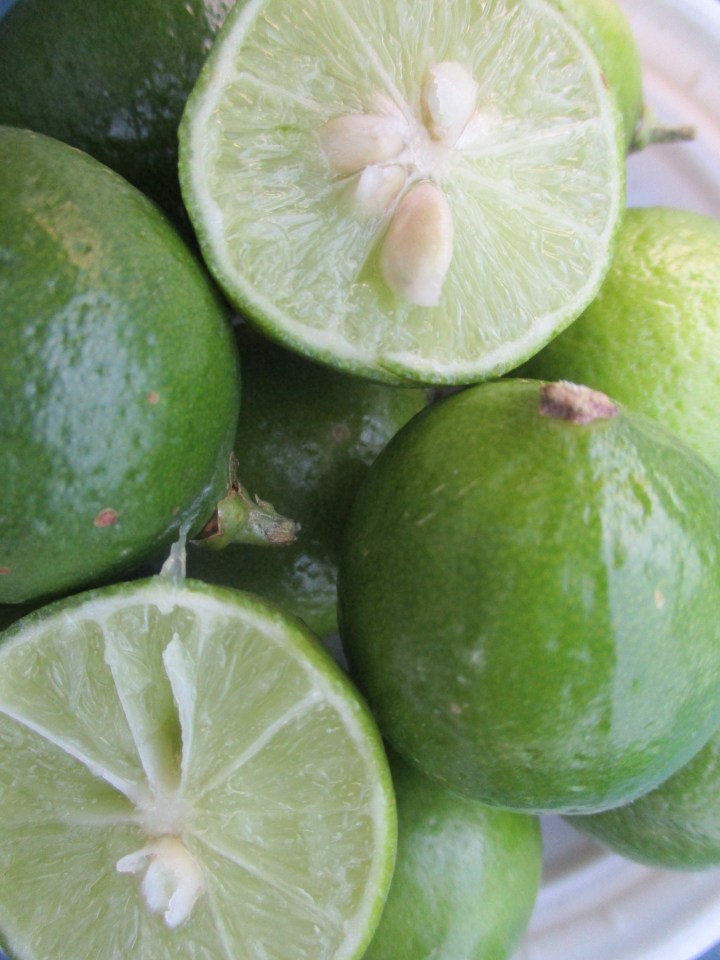 Is it possible to grow citrus from seed? The quick and simple answer to that question is, “Yes.” After all, many cultivars of citrus were originally bred from other cultivars, and then grown from seed. But of course, this an overly simplified answer to an unrealistically simple question about a surprisingly complicated process. Perhaps a better question is “Should citrus be grown from seed?”.
Almost all citrus are grafted for a variety of reasons. Those that are not grafted are grown from cuttings only because they do not need whatever advantages understock (or rootstock) provides for their counterparts. Either way, they are all cloned by some form of vegetative propagation. This ensures that they are all genetically identical to their parents, without potential for genetic variation.
Citrus have been bred and developed so extensively that most types are very genetically variable. Those that are the most variable tend to produce fewer seeds, and might even be classified as seedless. Those with more seeds are probably more genetically stable. Nonetheless, it is impossible to predict if seed grown citrus will resemble their parents, or be something totally different.
Furthermore, citrus are cloned from ‘adult’ growth that is ready to bloom and develop fruit. Those grown from seed start out with vegetative ‘juvenile’ growth that will not bloom. Juvenile growth is typically more vigorous and thornier than adult growth, and possibly wickedly thorny! Some types of citrus outgrow their juvenile phase quite readily, while others may take several years to do so.
Avocado trees grown from seed exhibit some of the same difficulties. Although they lack thorns, they do grow very vigorously and very tall for quite a few years before they bloom. By the time they develop fruit, the fruit could be too high to reach, and quite different from the original.
Just because citrus and avocados can be grown from seed does not mean that they should be. However, different is not necessarily bad. Many seed grown avocado trees get pruned into
The Overlooked Trillium
 Other species must be more interesting than what is native here. There are supposedly as many species of Trillium as there are of Yucca; forty-nine. All but ten are native to North America. The others are in eastern Asia. They are desirable and respected perennials to those who are familiar with them. White trillium is the official wildflower of Ohio, as well as the official floral emblem of Ontario. Ours would not likely qualify for such status.
The few around here appear only briefly about this time of year, and bloom with these small purplish burgundy flowers. They are only a few inches high, so are easy to miss. By the time they get noticed they are finished with their bloom. Their foliage lasts only until the weather starts to get warm in late spring or early summer. During their brief season, they somehow manage to store enough resources to repeat the process for many years.
This particular species is supposedly known as ‘giant wakerobin’, or Trillium chloropetalum. It is so diminutive, that I can not help but wonder about those that are not ‘giant’. Others that I see around here have more rusty red or ruddy brown flowers that stay closed most of the time. Western trillium, Trillium ovatum, lives here too; and I may have seen its foliage without distinguishing it from giant wakerobin, but I have never seen it bloom.
The trilliums that are native here live in partial shade out in forests, but away from more aggressive plants. They do not transplant easily, and do not like refined gardens.
Other trilliums in other regions bloom with bigger flowers in white, pink, red, purple, pale yellow or green. They must be more impressive than ours, and should at least be more adaptable to home gardens and landscapes.
Charles Grimaldi Brugmansia (not a bio)
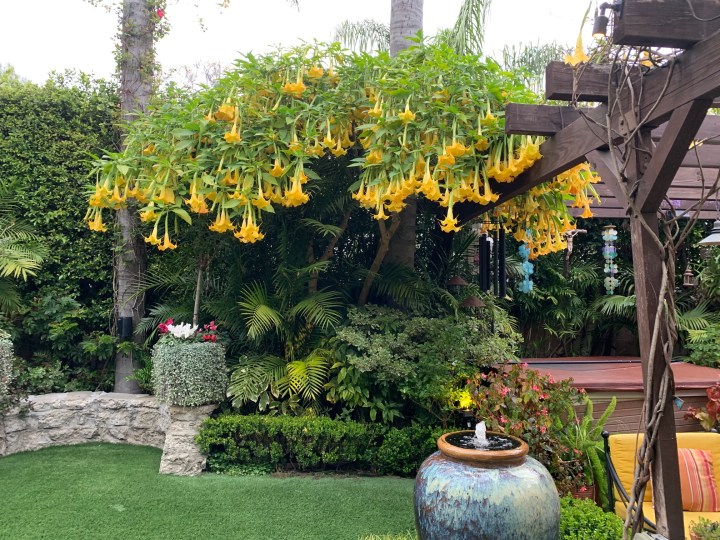 When spelled like that, the whole thing looks like someone’s long name. ‘Charles Grimaldi’ really is someone’s name, and the particular cultivar of brugmansia happens to be named after him. Because no one knows who the parents of this hybrid cultivar are, the species name is omitted. It is therefore described by just the genus name followed by the cultivar name, as Brugmansia ‘Charles Grimaldi’; or simply ‘Charles Grimaldi brugmansia’.
After all that, some of us know it, as well as all other cultivars, even more simply as ‘angel’s trumpet’. They are more likely to be distinguished by floral color and form than by cultivar name. For example, Brugmansia ‘Charles Grimaldi’ might be described as a single yellow angel’s trumpet. There is also a single white, a double white, a single pink, a single pink with variegated foliage, and so on. Most are fragrant at least to some degree.
This particular specimen was not planned. As I mentioned in my ‘Six on Saturday’ posts earlier today, my colleague, Brent Green, planted it out in the back garden as a wimpy #1 (1 gallon) specimen many years ago. It grew like a weed and displaced a few other perennials that were too close to it. Brent coppiced it to the ground annually for a few years. It grew back and bloomed spectacularly and very fragrantly through each summer.
A few years ago, rather than coppice it back to the ground, Brent had me pollard it on a few tall trunks. Rather than regenerate as a big fluffy and obtrusive shrub that occupied too much of the limited space, it was able to spread out up and above the garden, while the tall and lanky trunks were pruned bare. The abundant and very fragrant flowers naturally hang downward from the upper growth.
Six on Saturday: Brent’s Garden II
Yes, this is another sequel; and yes, this is my second Six on Saturday post for today. So far, no one has told me that posting twice is against the rules.
These are six more of the many pictures that my colleague, Brent Green, sent to me. They are of his home garden in Mid City Los Angeles, which is much more interesting than my utilitarian sort of garden. I explained the situation in more detail with the first post last week, and briefly mentioned it in the other Six on Saturday post just prior to this one.
The other Six on Saturday for today was posted here: https://tonytomeo.com/2019/04/06/six-on-saturday-brents-garden/
1. This is the small elevated porch-like patio at the rear of the garden from which the first of the six pictures in the previous post was taken. (This picture was taken from the back porch seen in that picture.) You can see how it, and the low wall to the left, were constructed from the broken concrete of the old driveway. The very edge of the new driveway is barely visible at the left edge of the picture. More on that with the fourth picture.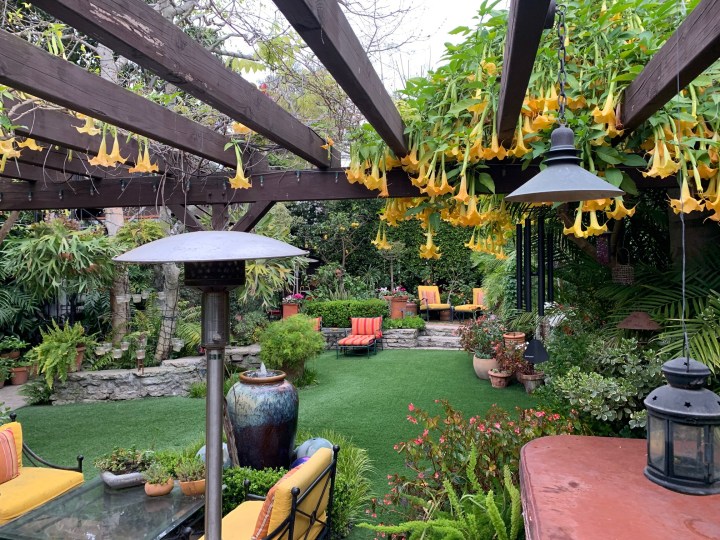
2. You can not see the most interesting feature of this picture, which is just to the left of the previous picture. Right there in the middle, completely obscured by vegetation, there is a small garage that was converted to an office with a deck on the roof, where I camp out when I go to Los Angeles. It is like sleeping in a tropical jungle with a view of the ‘HOLLYWOOD’ sign, which by the way, is different from sleeping in a redwood forest.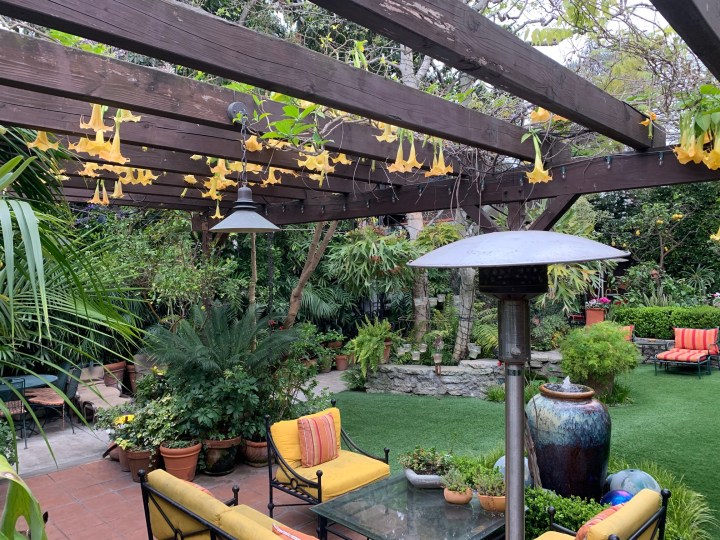
3. Just to the left of the previous picture, the ‘driveway’, which I will explain next, extends from the garage that is now an office to the street out front. In the narrow space between the driveway and fence, this overgrown mess of pink jasmine on top of a ficus hedge behind a thicket of bamboo palms obscures the house next door. All this jasmine is VERY fragrant all day and into evening when the angel’s trumpet gets powerfully fragrant too.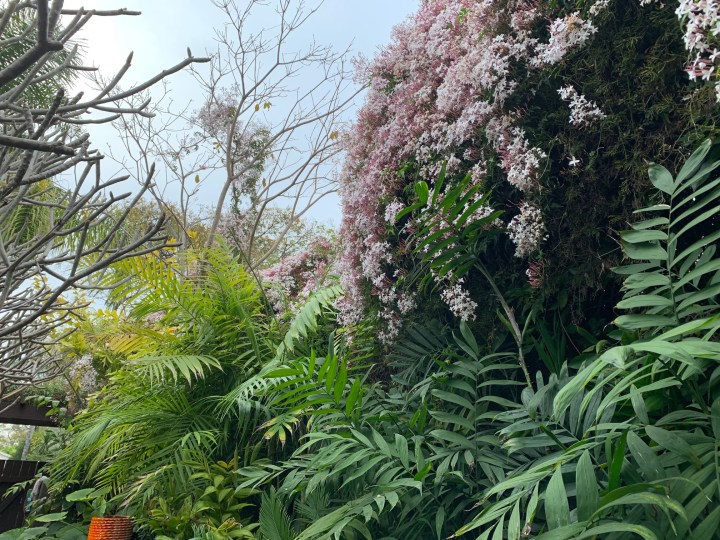
4. Now the driveway. The old pavement was removed and recycled into other features. The new pavement replaced it . . . but was never used as a driveway. The gate seen here is wide enough for a car to fit through, but is never opened. A car couldn’t get through all this vegetation anyway. A French door from the dining room opens up onto a wide spot where that weird orange fountain in the middle is. It all became more nice patios space.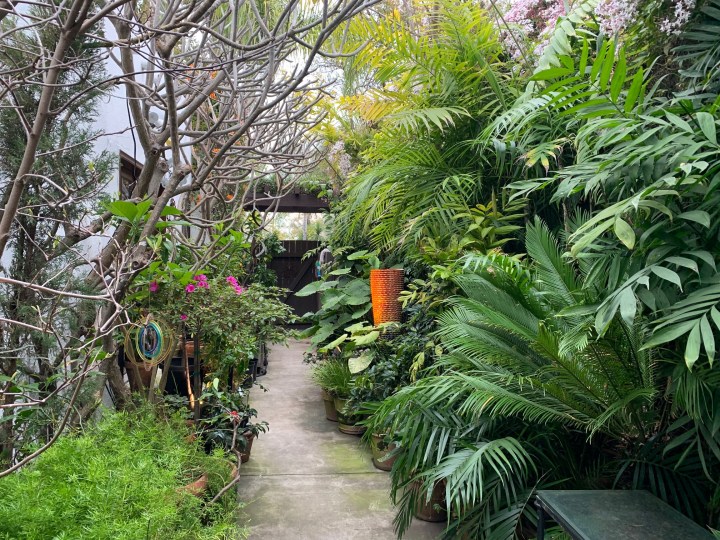
5. Coming back around to the back patio from where the first two pictures (of these six) were taken, we can see how thoroughly the garden space is enclosed by vegetation. No outside structures are visible. You would never guess that this garden is about a block from the Santa Monica Freeway, and that it is surrounded by other homes and apartment buildings. Even the utility cables out back are hidden. Fountains obscure ambient noise.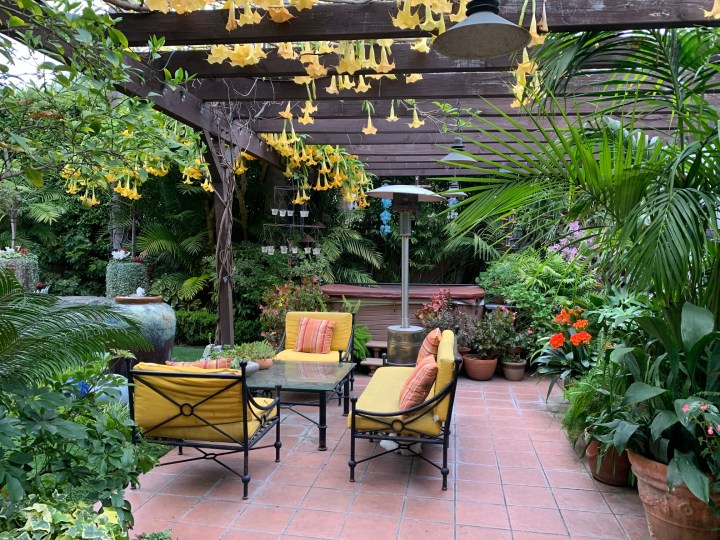
6. Way back in the corner on the right of the previous picture, behind the kentia palm and past the glass door of the master bedroom, we find another blooming azalea, like the specimen in the third of the six pictures posted earlier. For Southern California, this is an impressive specimen. The big staghorn fern above and behind it is really getting monstrous. I have no idea what that weird twisted purple plastic device is. Brent has such bad taste.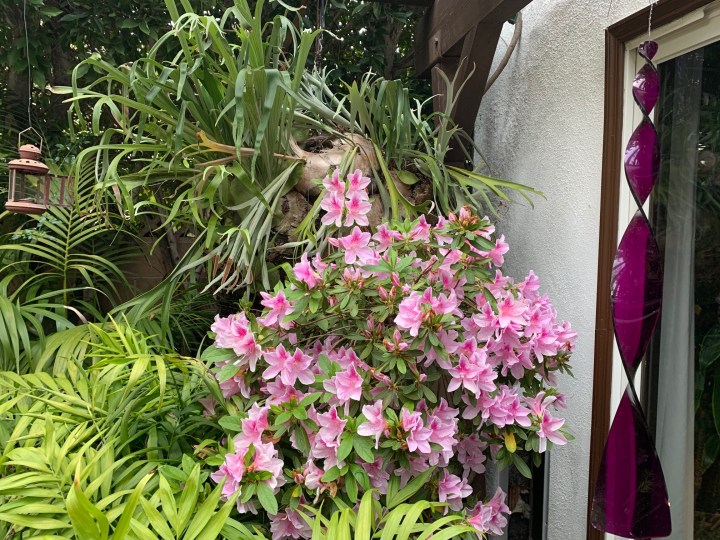
This is the link for Six on Saturday, for anyone else who would like to participate:
https://thepropagatorblog.wordpress.com/2017/09/18/six-on-saturday-a-participant-guide/

