Six on Saturday: Tequila


If one of these six different agaves happens to be the blue agave from which tequila is made, I would not know. I only know that all six are various specie or cultivars of the Agave genus. The sixth picture is that of the common century plant, Agave americana, which is not used for tequila. I have no idea what the other five are. The fifth looks like it could possibly be a picture of Agave victoriae, but if I remember correctly, I was specifically told that it is not.

All six of these agaves were procured by my colleague. The first specimen is still potted at the shops where we work. The second specimen was relocated into a new landscape early last spring. The other four are within minimal proximity of each other, in a more established part of the landscape. There happens to be two agave pups in the Infirmary Nursery. At least one is from the agave in the second picture. I believe that the second pup is the same as well, but it seems to be developing teeth.

The wickedly sharp teeth and spines of most specie of agave are the main reason that agaves are not more practical in home gardens or small landscapes. It is not practical to try to snip the terminal spines off, because more develop with every new leaf. If they get enough space out of the way, agaves are bold and remarkably striking big perennials that are very resilient to arid climates.

There are no captions this week, because I do not know what to say about agaves that I know nothing about.

1.P81027

2.P81027+

3.P81027++

4.P81027+++

5.P81027++++

6.P81027+++++

This is the link for Six on Saturday, for anyone else who would like to participate:

https://thepropagatorblog.wordpress.com/2017/09/18/six-on-saturday-a-participant-guide/

Carpet Rose

51028They compare to more traditional roses like instant coffee compares to real coffee. They are too easy and cheesy. However, even instant coffee can be rather good as long it is not expected to taste like the real thing. Likewise, carpet roses do not produce big and fancy flowers on long stems for cutting, but they have other attributes that are advantageous in the landscape.

The small but ridiculously abundant roses that started blooming late last spring are only now finishing. Bloom can be white, pink, red, coral, scarlet, gold (orangish yellow), yellow or white. The rich green foliage is remarkably resistant to disease, and lasts until frost. The arching stems can spread a few feet without getting much more than three feet tall. Most cultivars stay shorter. Some get quite wide.

Like other roses, carpet roses will need to be pruned back severely while dormant in late winter. Yet, they do not need to be pruned nearly as carefully. Because they grow as thickets of canes, they do not need to be thinned to only a few canes when pruned. Even if old canes do not get pruned out, they will get overwhelmed and replaced by newer canes naturally.

Falling Leaves Get Into Everything

51028thumbEven if they had been clean since they were emptied out last winter, gutters (eaves-troughs) near deciduous trees will eventually need to be cleaned again as they collect falling leaves through autumn. Leaves may continue to fall for several weeks, and will fall more abundantly as they get dislodged by rain.

Too many fallen leaves clog gutters and downspouts. If too much debris is left in downspouts for too long, it rots and settles so that it can be very difficult to dislodge. If rainwater can not adequately drain through gutters and downspouts, it can only flow over the edges of gutters. The falling water can erode the ground below, and splatter mud onto nearby walls.

This may not seem like much of a problem, but the reason that gutters and downspouts drain rainwater to the ground gently is to keep the walls dry and clean. Damp walls are likely to rot, especially if water splatters into basement vents. This is why early American homes that lacked expensive gutters were often outfitted with dense ‘foundation’ shrubbery or perennials to soften the splatter.

Leaves that accumulate in the valleys of the roof (where perpendicular slopes meet) should also be removed. Debris can also collect on the upslope side of a chimney. Homes with room additions have more awkward spots to collect debris than unaltered homes. Flat roofs and parapet roofs are of course very likely to collect debris under trees, and may need to be raked more than once.

Vines should not be allowed to climb onto roofs. They can tear apart roofing material, collect debris, and promote rot. Likewise, limbs of trees and large shrubbery should not be allowed to touch roofs, gutters, or even walls. Their motion in the breeze is abrasive to shingles, gutters, paint and siding. They can literally grind off shingles and break terracotta tiles.

Tree limbs should also be kept clear of chimneys. Even during rainy weather, hot exhaust from a chimney can dry and ignite limbs that get too close. Pine, cypress, cedar, and palms with beards (accumulated dead fronds) are very combustible.

Horridculture – WEED!

0Q: What do I spray on my medicinal marijuana plants to kill mealybug?
A: Roundup.
This solutions takes care of two problems at the same time; the mealybug infestation as well as the weed that it is growing on! Cutting the weed at the base and simply discarding it is just as effective and even more practical because it does not involve a toxic, environmentally controversial, and expensive chemical herbicide. The best option is to simply not grow weed in the first place.
I am a horticulturist. I love what I do. I love plants. However, I do not worship them.
When I grew citrus trees back in the early 1990s, I happened to enjoy all sorts of rare and unusual citrus fruit that grew on the trees that we grew. However, there were no citrus themed clothing, jewelry, accessories, home furnishings or tattoos. There was no overly indulgent or theatrical manner of consuming the fruit with fancy blown glass utensils designed for doing so, or a traditional technique of taking a piece and passing the rest around. I enjoyed citrus and got on with my life. Yes, I enjoyed growing citrus AND I had a life.
I realize that almost all of those who use marijuana medicinally do so responsibly. That is fine. Keep it out of my way. I am no more interested in smelling it, seeing it, or fleeing the smoke, than anyone else is interested in sharing my prostate medication. I find it to be quite objectionable and offensive.
It would not be so objectionable if those who use it excessively would not so predictably assume that I am a horticulturist because I grow it! Again, there is more to life and the flora of the world than WEED! If you are a stoner, wastoid or burnout because of your reverence for pot, do not recommend that I should try it! It is not as if you are a good example of the attributes of WEED!

Dwarf Alberta Spruce

81031It is so tempting to dress up a densely conical dwarf Alberta spruce, Picea glauca ‘Conica’, as a garden gnome for Halloween. They are so symmetrical that they seem to have been shorn that way. They are too small to be classified as trees, but are not as shrubby as most shrubbery either. Their practicality is rather limited to formal situations where their strict symmetry is desirable.

Dwarf Alberta spruce is very different from the straight (not dwarf) species that can get to almost fifty feet tall. It instead grows very slowly, and stays quite small, although it can eventually reach downstairs eaves. The finely textured evergreen foliage is soft but slightly bristly. The tiny individual needles are only about half an inch long. The aroma of crushed foliage might be objectionable.

Dwarf Alberta spruce is popularly grown as a potted Christmas tree, and happens to be one of the few coniferous plants that can stay potted long enough to functions as such for a few years. In the ground, it wants rich but well drained soil. It can rot if the soil stays too damp. Red spider mite can be a potential problem. Although it likes full sun exposure, it can get roasted in hot situations.

Plan Ahead For Coniferous Evergreens

81031thumbWe all know what autumn is for. Planting, of course. Yes, it is a recurring theme; but there are so many different things to plant. Dormant bulbs need to get into the ground before cool and rainy winter weather. Deciduous plants that should be planted while dormant prefer an early start if planted as soon as they defoliate in autumn. Believe it or not, most evergreen plants are no different.

Evergreen plants do not experience the degree of dormancy that defoliated deciduous plants do, but they too are significantly less active during autumn and winter than they are during warmer weather. Therefore, if possible, they should also be planted in autumn, so that they can begin to slowly disperse roots through winter, to be ready to resume growth as weather warms next spring.

All planting should be planned. This is more important for trees, big shrubbery and other plants that are difficult to relocate once they have dispersed their roots. Some broadleaf evergreens that get bigger than expected can be pruned into submission. However, most coniferous evergreens are notoriously difficult to contain if they get too big for the situations into which they get planted.

‘Coniferous’ plants are those that produce cones. Cypress, pine, fir, spruce, cedar and redwood are the more familiar coniferous trees. Most coniferous trees, except for most of the various cypress, have excurrent branch structure, with lateral limbs extending from a central trunk. They can not be pruned down without disfiguring their central trunks. Lateral limbs can be disfigured if pruned back. Such trees should therefore be planted where they can grow unobstructed to mature size.

Juniper and arborvitae are some of the more familiar of coniferous shrubbery. They can be shorn even into formal hedges, but only if shorn very regularly. Their dense foliage shades out interior foliage. If they get too big for the respective situations, they can not be pruned back into submission without exposing their bare interiors. Once exposed, bare interior stems may never recover.

White Pumpkin

71004thumbTheir creamy white exteriors do not reveal much about the flavor within. They looks like they might taste like vanilla, or coconut, . . . or maybe Swiss cheese. Below the white skins, white pumpkins (Curcubita pepo) have orange flesh that really tastes like other pumpkins, but maybe a bit milder, like ‘pumpkin-light’. They are popular because they look so cool, and make great jack-o-lanterns.

They take a while to mature, so pumpkin plants should get into the garden as soon as weather is warm enough for them in spring. They can be grown from seed sown directly, or from seedlings. They want rich soil, and need to be watered regularly in order to grow evenly through summer. The annual vines sprawl on the ground, producing only one or a few fruits each, finishing by first frost.

Popular varieties of white pumpkin, like ‘Cotton Candy’, ‘Lumina’, ‘Casper’ and ‘Silver Moon’ can weight more than ten pounds. Less common ‘Full Moon’ can get to be seventy-five pounds! White pumpkins makes as many edible flowers as orange pumpkins make, but not as many seeds. ‘Baby Boo’ and ‘Gooligan’ weigh less than a pound, and are only a few inches wide, so are inedible.

My Private Heritage Tree

P81020+++++I really believed that I had something special here. A few fruit trees that are either remnants or descendants of remnants of fruit trees of the old Zayante Rancho have survived on a vacant parcel east of town.
There are two pear trees, a prune tree and an apple tree. The pear and prune trees are too overgrown to make much fruit. Almost all of the fruit that they manage to produce is too high to reach, and of inferior quality. They could be renovated, but the process would require severe winter pruning for several years.
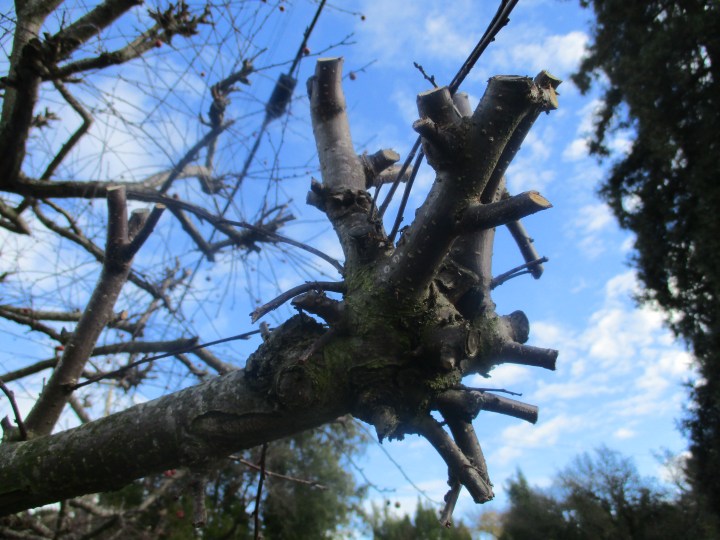
However, the apple tree is still somewhat compact and quite productive. Much of the fruit is within reach for the ground. Much of the rest can be shaken from the tree without damaging it too much. Although abandoned for decades, someone actually put the effort into pruning the apple tree a few years ago. It still needs some major pruning, but would be easier to renovate and restore than the other trees.
I can not identify the cultivar of the apple, or even the type. The fruit looked and tasted like some sort of Pippin apple earlier in the season, but is now slightly more blushed than other familiar Pippin apples in the region. It could of course be another cultivar of Pippin. It is not very juicy, but is quite richly flavored. Winter pruning to concentrate resources would probably improve the quality of the fruit.
Until recently, anyone who wanted to forage for a bit of fruit from these few fruit trees had open access to them. Both prunes and pears needed to be knocked out of their trees, and collected from the ground. Timing was critical for the prunes. They would be unripe if a few days early, or squishy and on the ground if a few days late. Apples were the most popular because they were more abundant and easiest to collect from the tree.
Unfortunately, the vacant parcel needed to be fenced. Only those who are involved with maintenance of the parcel have access to the trees now.
Well, I happen to occasionally work for one of those privileged few, which indirectly gives me access to the distinguished trees.
Of course, I could not resist bragging to my Pa about my privileged access to these now private heritage trees, especially the apple tree. As I said earlier, I really believed that I had something special here.
To my surprise, and perhaps disappointment, my Pa is very familiar with my special apple tree! I had nothing to brag about that he could not also claim! He actually picked apples from it with his mother when he was a little tyke living on Ashley Street in town!

Winter Squash Last For Months

IMG_20140301_073739With all the talk about replacing warm season vegetables and bedding plants with their cool season counterparts this time of year, we should also address the irony of summer squash and winter squash. Their designations suggest that they too grow in specific seasons; summer and winter. Duh. It would make sense that summer squash would be replaced by winter squash during autumn.

However, both groups are warm season vegetables that can get planted or sown as seed in early spring. The vines of both summer and winter squash grow through spring and summer, and then eventually succumb to the first frost. The difference is that summer squash start producing early and abundantly, and continue to produce through summer. Winter squash ripen slowly in autumn.

Summer squash, like zucchini, pattypan and crookneck squash, are very prolific. Zucchini can be overwhelmingly so. However, their fruits, which are incidentally considered by most to be culinary ‘vegetables’, are best fresh. Otherwise, they are quite perishable. They can be frozen or canned, but do not hold up well. Consequently, good summer squash are unavailable after the first frost.

Winter squash, like Hubbard, acorn, butternut, turban and spaghetti squash, as well as pumpkins, are not nearly as productive. Individual plants might produce only single large fruits, or only a few small fruits, depending on variety. These fruits develop and ripen so slowly that they are not ready until autumn, as the vines are withering. Supposedly, exposure to slight frost improves their flavor.

The advantage of winter squash is that the fruits are tough enough to be stored for months into winter, hence their designation as winter squash. Some pumpkins can be stored out of the weather for months after winter, although flavor and nutritional quality slowly deteriorate. If that is not long enough, the flesh of winter squash can be peeled, and then frozen or canned. Unfortunately, winter squash are no substitute for summer squash, and take more work to cook, but they are certainly worth growing.

Vahz, Vawz or Voz

P81020‘V-A-S-E ‘ is probably how it is spelled, just like that which is pronounced exactly as it looks, or ‘vays’. ‘Vahz’, ‘vawz’ or ‘voz’ just sounds fancier, . . . or bigger.

That is how I learned it. ‘Vays’ is the smaller version that is designed to contain one or only a few flowers and maybe some foliage. ‘Vahz’, ‘vawz’ or ‘voz’ is the much larger version that is designed to contain entire bouquets or ‘floral arrangements’. Those that contain only dried flowers and foliage do not even need to hold water.

I learned this from those who were experts on the subject. My Aunt Betsy and her best friend Cathy were ‘flower children’. They rented an apartment in a hip and trendy neighborhood in western San Jose back in the early 1970s. The neighborhood was so trendy and hip that the neighbors were known as ‘hippies’. Aunt Betsy and Cathy outfitted their apartment accordingly, with wicker, shaggy rugs, and a big spider plant hanging from beaded macrame.

Of course, there was also a rather big ‘vahz’, ‘vawz’ or ‘voz’. It was cheap molded plaster painted glossy chocolaty brown. It contained a billowy abundance of only two species of dried cut flowers, cattails and pampas grass, that had been sprayed with hair spray to prevent them from sharing their seed. It was as gloriously hideous as it sounds, and more than adequately expressed impeccable cultural refinement and a keen appreciation for the remarkably distinctive and exquisitely tacky style of home decor that was so prevalent at the time.

The cattails might have been collected on the side of Highway 80 in Auburn, near the home of Aunt Betsy’s Great Aunt Mamie. The pampas grass might have been found in Vasona Lake County Park in Los Gatos.