It is pretty but pervasive. Actually, I do not really find scarlet pimpernel to be all that appealing, but this is how someone who reads my gardening column in the Santa Ynes Valley News describes it. Embarrassingly, she requested that I discuss scarlet pimpernel while it was more of a problem back on June 7, but I only recently read the message. By now, it is already dying back for autumn, and is completely deteriorated in dry and hot exposed areas. It will be back next spring, and will bloom with tiny peachy orange flowers so that it can throw tiny but ridiculously abundant seed by summer before anyone notices. Flowers can be other colors in other regions. The sprawling stems can spread more than a foot wide, and can get up to about ten inches high if sprawling over other weeds. The tiny and soft leaves are arranged in opposing pairs. Scarlet pimpernel may not seem like much of a threat now that it is deteriorating, but new seedlings will be profuse early next spring, and can compete with seedlings of more desirable plants.
Control of scarlet pimpernel is not easy. If application of herbicide is an option, it does not stick to the foliage of scarlet pimpernel very well, even with a wetting agent. Hoeing eliminated larger plants, but does not kill the seed that the larger plants have already tossed. Scarlet pimpernel starts throwing seed so early that it must be pulled as soon as it appears in very early spring. Like I said, it is not easy. The small plants are not even easy to see. The process must be repeated at least weekly for a while, just because some seedlings will emerge after the first batch is gone.
Fortunately, scarlet pimpernel is not very vigorous. If it comes up through mulch, only a few plants will survive, and they will be easy to pull. They do not compete with other more vigorous plants well either. Many simple ground covers will simply shade it out, although it can mingle with and ruin some of the finely textured ground covers like baby tears and thyme.
I am sorry that I do not have any more information about scarlet pimpernel than is commonly known. I am speaking primarily from experience, and my experience has not been as bad as with other more aggressive weeds. Scarlet pimpernel always seems to be around, but is not so much of a problem that I am too worried about annihilating it completely.
Big Trees

They are the biggest. Giant redwoods are revered for their age and size. It was not always like that.
Many of the biggest giant redwoods were killed merely for bragging rights. Whoever discovered the biggest got to arrange to get it cut down, and then pose on the stump for photographs. Some trees were cut down just so the rings could be counted. Many felled trees were just left to rot where they fell. It was not practical to transport the lumber out of the remote regions of the Sierra Nevada where the trees lived. That was at a time when ‘sportsmen’ shot from trains into herds of wild buffalo, only to pose with the biggest dead carcass they could find in the aftermath, and then leave all of the deceased to rot on the prairie.
So, at about the same time in history that the related coastal redwood was being harvested so indiscriminately for lumber, the biggest of the giant redwoods were killed primarily for sport. Even in regions from which lumber could have been transported from, no one could figure out how to get such massive giant redwoods onto the ground without fracturing the lumber within. Because their wood is so brittle, smaller giant redwoods that were harvestable were simply cut and split into shakes, grape stakes, and fence posts and rails. Young and healthy specimens of the biggest trees in the World were used for the smallest and most unglamorous forms of lumber.
The biggest of the giant redwoods are of course protected now, mostly within national parks. They are quite accessible to those who want to visit and admire them. I got this picture with one of my esteemed colleagues in front of the General Sherman tree in wintertime back in the early 2000s.
Six on Saturday: Redwoods Again
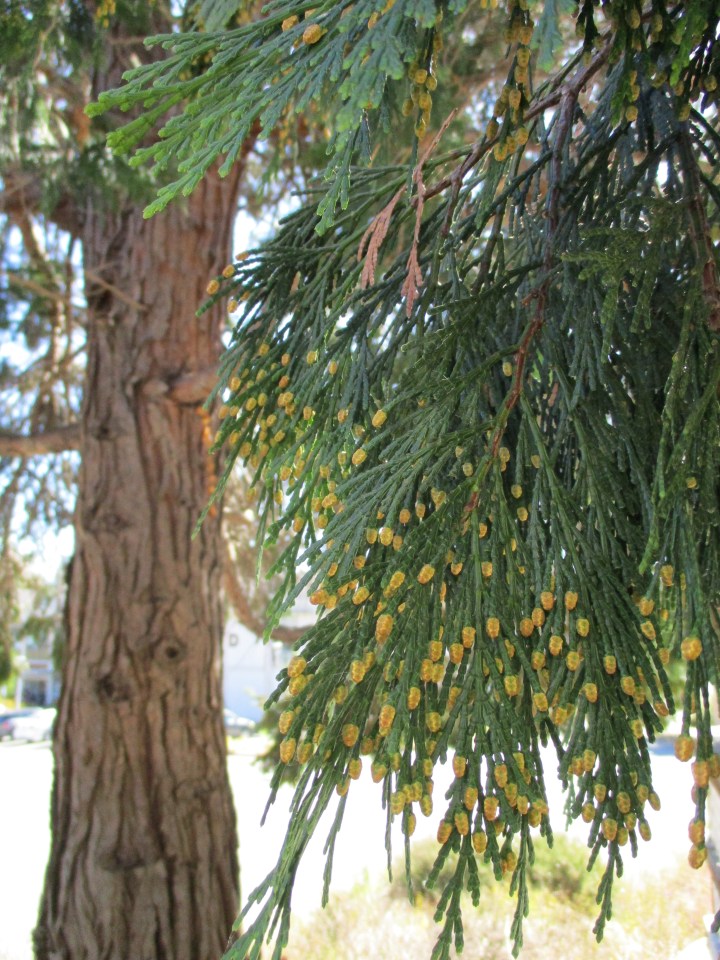
Redwoods are such interesting trees. There is always something to write about them. I happen to live and work within the native range of the coastal redwood. I often work with very big redwoods, both in the wild, and in landscaped areas that were formerly wild. There are no other trees that are comparable. The giant redwoods in the Sierra Nevada are bigger, but they are also very different.
1. In most home gardens and landscapes, trees that get cut down get recycled into greenwaste and firewood. Not many are big enough to get recycled into lumber. Even fewer are big enough to get milled into big timbers. This milled redwood lumber is drying before getting milled again into timbers and smaller sizes of lumber that will get used to repair and remodel some of the historical old buildings. A bit of pine lumber is also obtained from the big ponderosa pines nearby.
2. Limbs, foliage, bark and parts of the redwood trees that can not be milled into lumber get chipped. Chips get used as mulch in landscaped areas. After taking this picture, I realized that it is not really a pile of chipped redwood, but is instead chipped wood waste. Chipped redwood is typically green with foliage. Oh well, you get the idea.
3. The Ewok Village of ‘Star Wars IV – Return of the Jedi’ was in a redwood forest near Fortuna. This is not really an Ewok Village.
4. It is a Redwood Canopy Tour. People (not Ewoks) can be seen on a platform in the yellow rectangle just above and to the right of the center of the picture. Someone on a zip line can be seen in the white rectangle just below and barely to the left of the center. It looks crazy to me, but many of my colleagues do crazier things at work.
5. Most of us have seen pictures of massive redwood trunks. Most of us have seen pictures of redwood forests. Not so many of us have seen what the foliage looks like.
6. This perennial pea has nothing to do with redwoods, but needed to be included as a token flower for this week. Besides it is cool. It is softer pink than the bright purplish pink that is so typical, and is blooming very late.
This is the link for Six on Saturday, for anyone else who would like to participate:
https://thepropagatorblog.wordpress.com/2017/09/18/six-on-saturday-a-participant-guide/
Here are a few links for some of my brief articles about redwood:
https://tonytomeo.com/2018/08/17/dawn-redwood/
https://tonytomeo.com/2018/08/12/general-sherman-tree/
https://tonytomeo.com/2018/08/04/albino/
https://tonytomeo.com/2018/08/04/six-on-saturday-bits-and-pieces-ii/
https://tonytomeo.com/2018/07/14/six-on-saturday-redwoods/
https://tonytomeo.com/2018/05/12/six-on-saturday-tree-ring-circus/
https://tonytomeo.com/2017/10/15/redwoods/
https://tonytomeo.com/2017/10/05/big-tree-in-a-small-town/
California Bay
Just because California bay, Umbellularia californica, can be used like Grecian or sweet bay for culinary purposes does not necessarily mean that it should be. California bay has a stronger and much more pungent flavor and aroma. Some might suggest substituting less than half California bay for Grecian bay. However, even if the intensity is adjusted accordingly, the flavor might be off.
As the name suggests, California bay is native to California. However, because it is from rainier climates, it prefers a slight bit more water than it would get naturally in the drier parts of the local chaparral climate. It provides nice cooling shade in large landscapes, but is a bit too dark and messy for refined home gardens. The aromatic leaf litter can annoy delicate annuals and seedlings.
Well exposed trees can eventually get more than thirty feet tall and almost as broad. Forest trees that compete with other trees can get a hundred feet tall! Small trees can be shorn as hedges. If not watered too generously, the roots tend to be rather complaisant. However, old trees can eventually develop massively distended burl growths known as lignotubers at the bases of their trunks.
Herbs Are For All Seasons
There are only four seasons in which to grow herbs, but herbs are used for all sorts of seasonings. Most herbs are aromatic evergreen foliage. Some might be flowers, flower buds, stems, bark, seeds, roots or really any plant part. Those with the strongest flavors might be classified as spices. Herbs are used for culinary purposes. Many might be used medicinally. Some just smell pretty.
Most herbs are best fresh, like mint, chive, cilantro and parsley. Bay leaf and lavender are herbs that are more commonly used dried rather than fresh. Sage, rosemary and oregano can be used either dried or fresh, depending on the desired effect. Yet, for many of us, dried herbs are used merely because of convenience. They are available when their fresh versions are out of season.
Many gardening texts suggest that herbs that need to be dried should be collected and dried about now. That is true in the sense that most happen to be ready about now. Some might have been better earlier in the year. A few might need to mature a bit more. There are probably many that get collected and dried when it is convenient for us, or when overgrown plants need to be pruned.
Vegetative rosemary stems should be collected before they bloom again. Obviously, that might not be right now. It blooms in random phases. The trick is to catch it between phases. Lavender flowers get collected as they finish bloom. Oregano is an odd one, since the vertical stems with flower buds on top get cut for drying while the sprawling growth on the ground is good for fresh use.
Because rosemary is available throughout the year, it is not often dried. Even while in full bloom, there is plenty of foliage to go around. When it gets dried, it is probably because the dried flavor is preferred for a specific recipe. Other herbs are likely to be dried because they are not available during part of the year. Many herbs are annuals or perennials that die back through the winter. Drying the last bits of cilantro may not seem like a good idea now, but might be useful in winter.
Horridculture – Agave
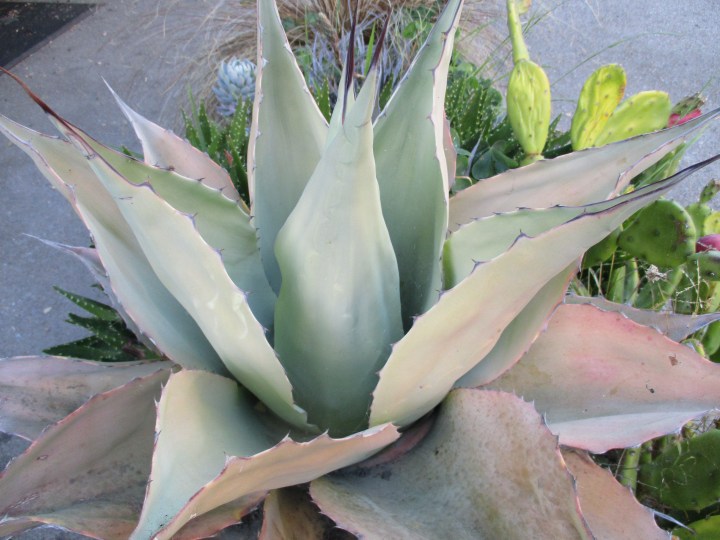
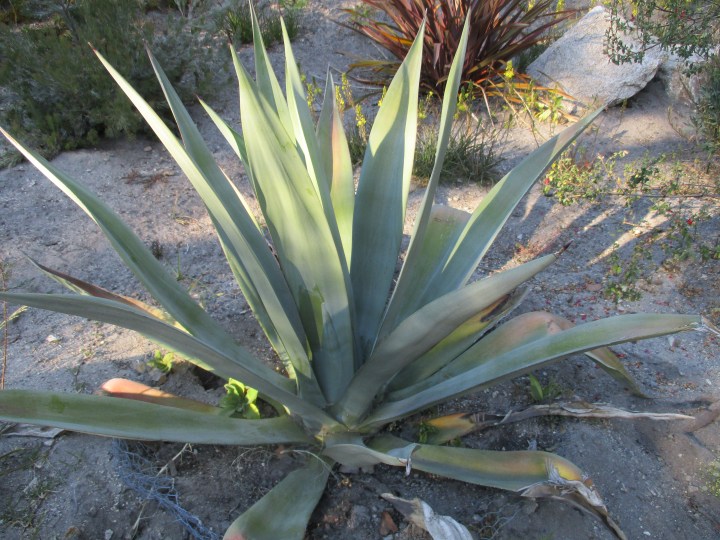
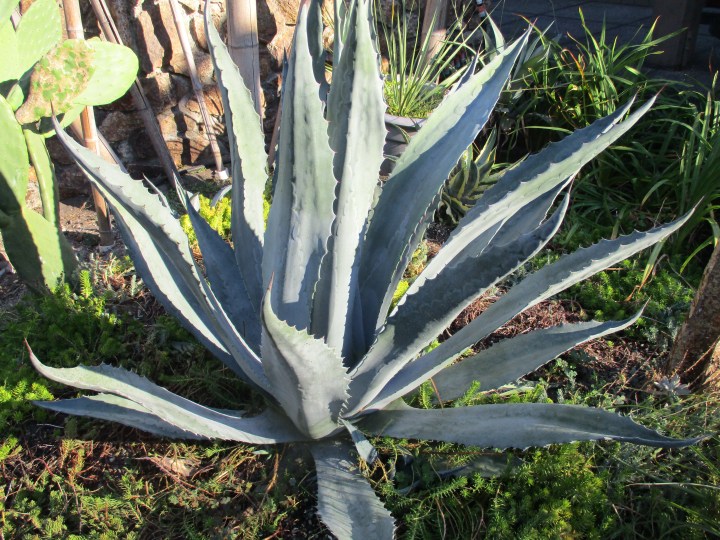
When they became a fad in the 2000s, it was one of the very few fads that was actually sensible for California. Agaves certainly are not for every landscape, and certainly do not suit everyone’s taste, but they are ideal for the climate here. In some regards, they are more practical than the more popular of the native specie that tend to be scrubby looking and short lived. Agaves really should have become trendy a long time ago.
The problem with the fad, like so many other fads, is that it caused the object of desire to be overly popular for a while. Many agaves consequently got planted into situations where they did not belong. Landscape designers often forced them into the gardens of clients who did not know what they were, or did not even like their bold style. To show them off most prominently, designers often put the agaves next to walkways, driveways and doorways, rather in the background.
Those who know agaves know that they belong in the background because of their nasty foliar teeth! Technically, they are neither thorns not spines, but they are so wicked that they are known by both terms. These teeth are remarkably sharp and stout. Next to walkways and doorways, they can inflict significant injury to anyone unfortunate enough to bump into them. Next to a driveway, they can puncture tires! The foliar teeth of agaves are so dangerous that they do not belong anywhere in the gardens of homes where children or dogs live.
What is worse about those that are too close to walkways and such is that they grow! Landscape designers are notorious for installing small agaves that grow large in tight spots, merely because they were so cute and innocent when they were small.
Bird’s-Nest Fern
Ferns tends to be . . . well, ‘ferny’, with divided or intricately lobed foliage. Staghorn ferns and bird’s-nest ferns are the more familiar of the rare exceptions. Staghorn ferns have two types of simple undivided fronds, and both types lack rachi. Bird’s-nest ferns have weirdly simple fronds that, although equipped with prominent rachi, lack any distinctive division or lobes that make ferns ‘ferny’.
Asplenium nidus is the more familiar of the bird’s-nest ferns, although none of them are common. It is usually grown as a potted houseplant, and is sometimes grown in rich and well watered soil in sheltered atriums. In the wild, it typically grows as an epiphyte, attached to the trunks or limbs of trees, where it collects rain and organic debris that fall from above into its flaring smooth foliage.
Fronds of mature bird’s-nest fern are commonly about two feet long and four inches wide, and can be twice as long and wide in ideally warm, humid and sheltered situations. They are arranged in neat funnel shaped rosettes. Partial shade is best. Bright ambient light is not a problem, but keeps foliage lower and more dense. Direct sunlight can easily scorch foliage. Frost kills entire plants.
Where The Green Ferns Grow
The list of what ferns will not do is more noteworthy than the list of what they will do. They do not bloom with colorful or fragrant flowers. The do not produce fruit. Very few turn color in autumn, and their color is generally nothing to brag about. Most ferns will not maintain their appeal through drought, or if neglected too long. Nor will they tolerate heat and wind, especially in full sun exposure.
Yet ferns are still popular for what they ‘will’ do. They provide remarkably distinctive and stylish foliage. They survive in spots that are too shady or perhaps too damp for other plants. Ferns will be quite happy in pots or planters, and some are happy to grow as houseplants. Ferns somehow avoid getting eaten by deer. If a fern gets tasted by a deer who does not know better, it will survive.
All ferns are perennial. Most are evergreen. Their foliage arches upward and outward from the terminal buds of stout rhizomes. Some ferns develop dense foliar rosettes. A few develop trunks by growing vertically instead of horizontally, and dispersing roots downward through their own decomposing fibrous rhizomes. Many ferns will get quite broad. Many are quite delicate and diminutive.
Ferns may not require too much maintenance, but the little bit of maintenance they require is somewhat important to keep them looking tidy. Old foliage should be pruned away as it is replaced by new foliage. This may be as simple as pruning away all old foliage just after new foliage develops early in spring. For some ferns, small batches of old foliage might get removed through the year.
The foliage of ferns is comprised of leaves known as ‘fronds’. With few exceptions, the fronds of ferns are intricately lobed or divided into smaller leaflets known as ‘pinnae’. (‘Pinna’ is singular for pinnae.) These pinnae are arranged on opposite sides of fibrous leafstalks known as ‘rachi’. (‘Rachis’ is singular for rachi.) Rachi are quite fibrous and tough, so should be cut close to the ground with pruning shears when they get groomed, rather than plucked.
Premature Color
Halloween is my all time least favorite of the fake holidays. I will not elaborate on this now, but will say that the appearance of Halloween decorations as soon as the Fourth of July decorations were outdated on the fifth makes me dislike Halloween even more. Halloween is an autumn pseudoholiday. It is not meant for summer!
Autumn foliar color, or fall color, is known as such because it happens in ‘fall’ . . . or autumn. It is not meant for summer any more than Halloween is.
This little Japanese maple did not get the memo. Perhaps it thought that no one would notice if it got an early start. It was a nice bronze in spring and the early part of summer, and somehow managed to maintain good color without roasting when the mild weather so suddenly became more seasonably warm a while back, but is now turning this nice pinkish red as if it is done for the year. This picture is slightly more than week old, so this little tree has been slowing down for a while already.
I can not complain. I am actually impressed that this tree did not get roasted when the weather changed earlier. Japanese maples are susceptible to scorch in our arid climate, and the ‘lace leaf’ cultivars are the most sensitive. More resilient foliage, including English laurel cherry, got roasted.
What will this Japanese maple look like in autumn? I can not predict. It would be nice if it held the premature color through autumn and defoliated on schedule in winter. It might defoliate as prematurely as it colored, leaving it bare part way through autumn. The bark could scald if too exposed while the sun is still high and warm. The weather will determine what happens next.
The Bad Seed
This salvia would probably look badder without it. Yes, that’s badder and not better. I mean, if all these slightly unsightly seeded stems were cut back, then the even more unsightly deteriorating foliage below would be more prominent. When one looks at it that way, the bad seed suspended above does not seem all that bad.
It is doubtful that the ‘gardeners’ who ‘maintain’ this site put that much thought into it. They are, after all, the same who ‘maintain’ the firethorn that is pictured in this article from June 27 (The Wrong Plant In The Wrong Place https://tonytomeo.com/2018/06/27/horridculture-the-wrong-plant-in-the-wrong-place/ ). There were probably too busy botching something else to notice that this salvia is in need of botching as well.
There is some unpruned black sage nearby that displays similar but smaller seeded structures on more irregular and arching stems, rather than vertical stems that stand upright. They too are somewhat appealing in a weirdly sculptural sort of way. They might stay like that until winter, when they will likely get pruned back as they deteriorate in the weather.
Sunflowers are commonly left after bloom just because finches and other seed eating birds like them so much. They do not get cut down until the birds are finished with them. To many, this is the main reason for growing sunflowers.
Another excuse to be lazy about deadheading spent blooms is that many will provide seed that can be collected for the next season, or merely allowed to self sow and naturalize. Leaving open pollinated vegetables out to go to seed is a common practice. For example, the last few radishes to be pulled might just be left to bolt, bloom and go to seed. Cosmos tends to throw its seed whether we want it to or not.