Kashmir Cypress

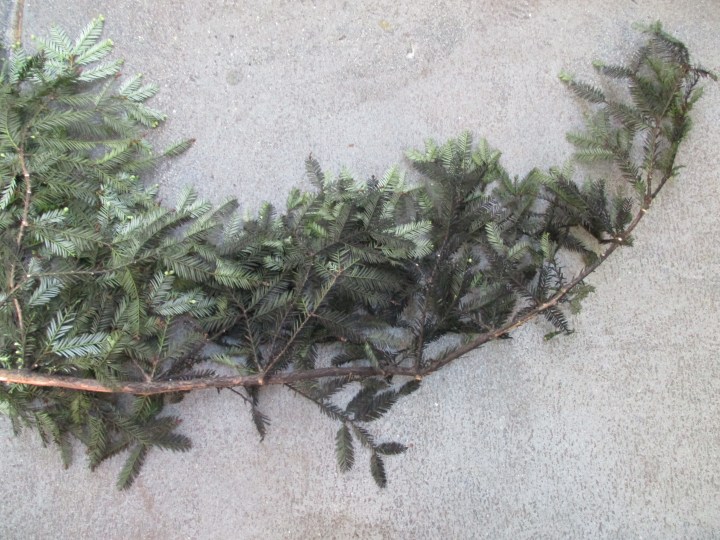
70809Plants are usually well suited to the climates that they are native to. Glaucous (slightly reflective grayish) foliage is more common in harsh climates where darker green foliage might get cooked by the sun. Pendulous growth is more common among plants that want to shed heavy snow efficiently. Kashmir cypress, Cupressus cashmeriana, has both, but is from a tropical monsoonal climate.

It is a stately tree that can eventually get taller than fifty feet. Within its native range in the eastern Himalaya, old trees can get three times as tall! Limber stems might hang downward several feet. The minute scale leaves are neatly set on limber stems arranged in flat sprays, similar to, but more defined than those of arborvitae. Foliage is silvery grayish green, and perhaps slightly bluish.

Mature trees do not need much water, but would probably be happier if watered occasionally through summer. Kashmir cypress is unfortunately susceptible to the same diseases and insects that afflict Leyland cypress. That is a serious risk to consider before planting prominent specimens. Incidentally, Kashmir cypress is also known as Bhutan cypress, and is the national tree of Bhutan.

Division Is Equal To Multiplication

70809thumbMathematically, division is the opposite of multiplication. Horticulturally, they are the same. Digging and splitting overgrown perennials to propagate them is known as ‘division’ because it divides many rooted stems or rhizomes of one plant into many new plants. Division is a form of propagation; and propagation is commonly known as multiplication. So, we divide plants to multiply them.

Autumn is generally the best time for panting. It is after most of the warmest and driest weather, and just before the cool and rainy weather that keeps newly planted plants from getting too dry. It seems obvious that autumn would also be the best time for division. However, a few perennials that are dormant or mostly dormant by the middle of summer can be divided now for an early start.

Bearded iris may not look dormant with their leaves still green, but they are about as dormant now as they will get. If divided now and allowed to slowly disperse roots through the remainder of summer, they can prioritize the production of new foliage when they come out of dormancy in autumn, like they would do naturally. Like many perennials in mild climates, they grow through winter.

Once dug, the plump rhizomes need to be separated from the old shriveled rhizomes that they grew from. For most, the best segments of rhizome are between the leafy tips and the stalks of the flowers that bloomed earlier this year, although it may not be easy to see where floral stalks were attached. The older sections of rhizome behind the flower stems are probably shriveled already.

The freshly divided segments of rhizome should then be groomed of deteriorating old leaves. Remaining green leaves can be cut in half to remove drying tips. Rhizomes then get replanted just below the surface, with the perpendicular fans of foliage standing upright. The main difficulty with dividing iris now is that they will need to be watered until the rain starts late in autumn. Bergenia, lily-of-the-Nile and a variety of perennials with big rhizomes get divided in a similar manner.

Horridculture – Bullwinkle

P80808This rant may not go in the direction you expect it to. The pictures suggest that this would be about the bad vegetation management crews who severely disfigure trees that get too close to utility cables. It is not.
This is about horticultural ‘professionals’ who plant trees where they will encroach into utility cables, with no regard to what might eventually be done to them in order to keep electrical service reliable and safe. The native oak in these pictures likely grew from seed, so unless someone knows the squirrel who buried the acorn, there is no one to blame. Many of us who enjoy home gardening are sometimes not aware of how tall and wide particular trees can get when we plant them. Horticultural ‘professionals’ should know better! That is what they charge so much money for when they design a landscape.
Palm trees are the worst! They grow only upward, with only a single terminal bud. Once that terminal bud encroaches into a utility easement, there is no option to prune back to another branch that might direct growth around the easement. ‘Pruning’ the only terminal bud back kills the entire tree. Yet, some landscape ‘designers’ continue to prescribe the all too trendy queen palm for the backsides of urban landscapes, even if utility cables are back there like they so typically are.
The oak in these pictures got a Bullwinkle cut, with big ‘antlers’ reaching upward and to the left and right of cables that are directly above. The lower picture sort of shows a ‘step back’ cut into the top for clearance from other perpendicular cables that pass over that edge rather than directly above. The tree is in surprisingly good condition, and gets pruned as properly as possible for the difficult circumstances.P80808+This brief article from a few days ago discusses a few more details about easements. https://tonytomeo.com/2018/08/02/easements-really-should-be-easier/

Phlox

80815Those outside California sometimes envy our ideal climates and soils. More of a variety of plants can be grown here than in most other places in America. There are not many plants that can be grown elsewhere that will not grow here. However, phlox, Phlox paniculata, is an example of a plant that can do well here, but for some reason or another, is much more popular everywhere else.

Phlox is native to much of the eastern half of North America, and has naturalized in other areas where it escaped cultivation in home gardens. Locally, it needs to be watered regularly to bloom on time in late summer. It is quite happy out in the open but might prefer a bit of partial shade in the afternoon here where summers are warm and dry. Powdery mildew can sometimes be a problem.

Bloom can be various hues of pink, purplish pink, red or white. The inch wide flowers are neatly arranged on conical terminal panicles about four to six inches wide. Blooming stems stand almost three feet tall and spread almost as wide. The somewhat narrow leaves are about four inches long. Phlox is mostly grown from seed, and can be propagated by division of perennial basal growth.

Think Outside The Nursery Pot

80815thumbA dressed turkey that is packaged for retail sale in a supermarket is not ready to be eaten right away. If frozen, it must be thawed slowly. It must then be unwrapped; and little bag of giblets must be removed from inside, before the turkey gets stuffed and finally cooked. Although the inexperienced sometimes cook a turkey with a giblet bag still inside, doing so is not the correct procedure.

Plants that are purchased in retail nurseries are similarly packaged in such a manner that facilitates transportation from production nurseries to retail nurseries, and from retail nurseries to home gardens. Their roots are contained in vinyl cans. Larger trees might be boxed. Occasionally, balled and burlapped plants are available. Most trees and vines, and some tall perennials are staked.

Vinyl cans, which are also known as nursery pots, are designed for growing nursery stock in, and containing the stock as it is transported. That is all they are designed for. They are not meant to be used as planters in home gardens. Most young and actively growing plants that tolerate them in production nurseries really do not want to be confined to vinyl cans any longer than necessary.

Even if plants that are brought home from a nursery are to be grown in pots, they should be planted into more appealing pots that are designed for the comfort of the plants within, and not just left in the nursery pots that they were grown in. Clay pots and wooden planters are comfortably porous and better insulated than thin black vinyl that gets dangerously hot if directly exposed to sunlight.

Alternatively, nursery pots can be shaded and obscured within slightly larger pots, within groups of other pots, or by settling them into shallow shrubbery or deep ground covers temporarily. Plants that are big enough to provide their own shade are likely too big for their nursery pots. Invasive plants like mint are often grown in nursery pots that are buried almost to the rim in the ground, although mint eventually escapes through drainage holes. It is good to know the limitations of what nursery pots are useful for.

Knees

P80805When a plant that should be compact or shrubby gets too lanky with exposed lower stems, it is described as ‘leggy’. We do not hear much about plants that develop ‘knees’. Perhaps that is because there is only one species that does so. That one species happens to be very rare here. If there are other specie that develop knees, I do not know what they are.

‘Knees’ are weird appendages that grow upward like stalagmites from the roots of bald cypress Taxodium distichum, particularly where the trees grow wild in swampy conditions. Knees can get quite tall. One of our professors used to tell us that they could do some serious damage to a canoe. Perhaps knees are why bald cypress is locally unpopular in landscapes.

However, I happened to notice that bald cypress is a common street tree in downtown Oklahoma City. Just like most other street trees, they are installed into small tree wells, but otherwise surrounded by pavement. They were remarkably healthy and well structured specimens that were too young to have damaged the pavement. Yet, I could not help but wonder what they will do as they mature. Even before the trunks grow as big around as the small tree wells that they are in, what would happen if knees develop?

There happens to be not one, but two bald cypress at work. The smaller is alongside a small stream. The larger is adjacent to a lawn where the soil is seemingly dry on the surface, but quite soggy just below the surface. This larger specimen is already developing distended burls that seem to be rudimentary knees. Although there is no pavement to break, the tree happens to be shading a picnic area where knees, if they develop, would be quite an obtrusive problem.P80805+

Albino

P80804KHow Italian! Red, white and green! A coastal redwood with a white albino sport (mutant growth) amongst otherwise deep green foliage. Actually, it is very Californian. Coastal redwood is endemic to California with only a a few north of the border on the extreme southern coast of Oregon.
Such sports are quite rare. Back in the late 1970s, an article in World Magazine mentioned that only five of these albino ‘trees’ where known to exist. There were actually more, even back then, but others were not documented. (They were WithOut Papers – WOP.) The specimen in the picture is at a home that is about a century old, so it was known about for a very long time, although not documented.
Albino foliage is a lethal mutation. It lacks chlorophyll, so can not sustain itself. It only survives because it originates as basal watersprouts that remain attached to the original green trees that produce and then sustain it. Attempt to graft albino grown onto other green trees has been unsuccessful.
Albino growth looks pretty in pictures, and is provides striking (although very perishable) cut foliage that is even more striking with black flowers, but does not make such a nice tree. It stays shrubby at the base of the originating tree, without developing distinct trunks or substantial branches. It does not shed old foliage as efficiently as green growth does, so always looks grungy. To make matters worse, albino foliage is more sensitive to frost, so gets killed back every few years or so, and then is slow to shed the dead foliage and stems.
Coastal redwood is one of the most fascinating trees in the World. It is the tallest, and among the biggest and oldest. It is no wonder that it is the state tree of California.

Six on Saturday: Bits and Pieces II


It has been a while since I posted a sequel to anything like I used to do so commonly. I am only doing it now because I do not have six pictures that fit a particular theme. There are not six different camellias or six different rhododendrons blooming at the same time. There is not a new landscape with six different newly installed plants to show off. Instead, I merely found a few amusing or silly pictures from work for this week. I sort of like #5 because it is interesting even to those of us who are familiar with it. I will actually elaborate a bit more on that later at noon.

I know these Six on Saturday posts do not fit with my other articles, but hey are fun for those us who participate. You can see other Six on Saturday posts by other writers at the link at the bottom of the page. You might even want to give it a try and participate yourself.

1. This might look like a signs at the Generic Aroboretum, or the Arboretum for the Horticulturally Disinterested, but the signs really refer to buildings that are named after trees. Almost all of the buildings in the neighborhood are names after flora of some sort.P80804

2. Woodpecker pantries are often constructed in old coastal redwood trees with soft bark. It seems silly to me; but it must be effective. Otherwise, woodpeckers would not put so much effort into stocking them. Woodpeckers deposit single acorns into the holes bored into the bark, in order to store the acorns for later. Some of these holes are very old, so have stored several acorns over several years. At lest one woodpecker guards the pantry from squirrels while the other woodpeckers are out and about collecting acorns. Such pantries are typically in trees that are isolated from others, so that squirrels can not enter from other trees, and then raid the pantry from above. The only access to the squirrels is from the ground. This panty does not seem to be active at the moment, but discarded acorn shells at the base of the tree indicate the it was active in recent history.P80804+.JPG

3. Coastal redwood trees are very efficient at regenerating from stumps of harvested trees. This tan oak wanted to give it a try too. It did not really regenerate from the stump of course, but merely grew from an acorn in the detritus that collected on top of the stump, and rooted into the rotted wood. The fractures visible at the bottom of the stump are caused by expanding tan oak roots.P80804++

4. Which of these things does not belong here? Do you remember that from Sesame Street? Blue hydrangeas are not common here, although we have quite a few that are fertilized to be blue. I thought that these looked silly together because they are so similar in color.P80804+++

5. Albino coastal redwoods are so fascinating. The white foliage can not survive without chlorophyll, so must remain attached to the original green tree that produced the white mutant growth. This takes a bit of explanation, so I will write a bit more about this about noon.P80804++++

6. Finally, we have two silly looking tiny weds that grew in a crack in the big rock that I wrote about earlier in Rock Concert. https://tonytomeo.com/2018/04/07/six-on-saturday-rock-concert/ They are not much to look at, but this looks like one of those artistic pictures that other writers take.P80804+++++

This is the link for Six on Saturday, for anyone else who would like to participate:

https://thepropagatorblog.wordpress.com/2017/09/18/six-on-saturday-a-participant-guide/

New Guinea Impatiens

70802Good old fashioned busy Lizzie is hard to find nowadays, if it can be found at all. The nasty mildew that kills it so quickly might not be prevalent everywhere, but happens to be a serious problem where most of the bedding plant farms are located. Now, the formerly uncommon New Guinea impatiens, Impatiens X hawkeri, which is somehow resistant to the mildew, is becoming popular.

The two specie have distinct personalities though. Busy Lizzie dazzles with cheery cartoonish colors, and bloom profuse enough to almost obscure the light green foliage. New Guinea impatiens has bigger and bolder flowers of white, pink, red, magenta, lavender, purple, apricot and reddish orange, but does not try to hide its rich green, bronze, purplish bronze or gold variegated foliage.

New Guinea impatiens are more expensive, and are not available in cell packs like most other bedding plants are. They are most popular in four inch pots. They do well in pots and tolerate partial shade, but want rich soil and regular watering. Mature plants can get more than a foot wide, and might get as tall if crowded. Although grown as annuals, they can survive as short term perennials.

Easements Really Should Be Easier

70802thumbLike Michael Jackson said, “You got an easement on down the road.”. . . or something like that. In older neighborhoods, that is where the utility easements are usually located. These are zones for utility poles that suspend electrical, telephone and television cables. When electricity first became available, that was the easiest place to put the cables, and the practice continued for decades.

Utility easements in middle aged neighborhoods are usually at the rear boundaries of back yards. They were put there to get out of the way of shade trees in front yards, particularly street trees. Where there are alleys in back, easements are on one side of the alley or the other. The same applies to narrow streets with easements. More modern neighborhoods have subterranean utilities.

Those of us who must contend with easements know how difficult they can be. Trees that encroach too closely to the high voltage cables on top of the poles must be pruned for clearance, even if such pruning disfigures or kills them. Lower cables for telephone and cable television sometimes get tangled with vines or big shrubbery because clearance from vegetation is not such a priority.

Utility providers have access to easements to maintain their systems. So do the tree services that have the grim task of pruning encroaching vegetation for clearance from high voltage cables. They do what they must to maintain reliable service; which is unfortunately not always compatible with what we want for our trees. Clearance pruning is too often unsightly, but it is very necessary.

The only way to avoid unsightly and disfiguring clearance pruning to to only plant trees that will not encroach into high voltage cables. Of course, in small gardens with big easements, the choices of trees that stay proportionate to available space are very limited. Except for Mediterranean fan palm or palms that stay very short, palms should never be planted below utility cables. They grow only upward, and can not be pruned around cables, so must be removed when they get too close.