Not So Fruitless Cherry Trees

P80520The ‘politically correct’ designation for them now is ‘flowering cherry’. We all know what it means, but it is not quite as accurate. After all, they all flower. Fruiting cherries can not make fruit without flowering first. The old fashioned designation as ‘fruitless cherry’ is more accurate, but not so appealing. Besides, after half a century, the work of these two deteriorating old fruitless cherry trees has not been in vain.

We are not certain what cultivar they are. I think of them as ‘Akebono’ because that is what I am familiar with. However, those who have been acquainted with them longer know them as ‘Yoshino’. The tree structure seems to be more similar to that of ‘Akebono’. The bloom seems to be more similar to that of ‘Yoshino’. My Mother happens to like ‘Akebono’, so if she ever asks, I know what to say. However, I would tell my Pa that they are ‘Yoshino’ because that happens to be the middle name of his newest son in law, who he gave my baby sister #5 away to. It does not really matter what their name is. They are some of the most important trees in the neighborhood.

You would think that with all the very old and very big redwoods here, that these puny and decrepit flowering cherry trees would not be all that important. Some of the redwoods are hundreds of feet tall and hundreds of years old. They will still be here for a very long time after the flowering cherries are gone. Flowering cherries can last for centuries where they are happiest and pampered in old gardens in Japan, but rarely last half a century here, even in the best of conditions.

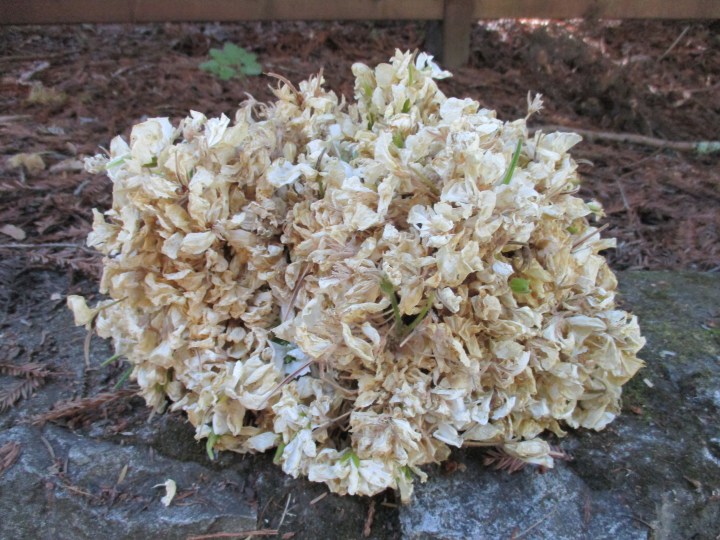
However, everyone in the neighborhood knows these cherry trees. There are only a few people who can remember before the trees were planted in the late 1960s. They are spectacular in bloom, particularly with the dark green backdrop of the rest of the landscape and redwoods. The picture below shows a close up of the bloom about a month and a half ago. One can imagine the entire canopy of the trees covered with this bloom before new foliage appears. It was even more spectacular years ago, before the canopies started to deteriorate and die back. There is not much left of them now.

They really are as bad as they look in the picture above. The closer of the two trees is just a stump with that silly little stub on top to make it look even more disfigured. I could not cut off the stump because some of the minimal remaining viable stems originate there. It does not matter much. There is no way to repair these trees, or make them any prettier. Either of the trees could die at any moment. We are ready to plant at least one replacement, although we will likely only plant one. The objective is to restore the bloom that was there before, but we know that there is no replacement for the trees that those who are familiar with are so fond of.

I have worked with MANY trees through my career, including a few that are (or were) very cultural significant. I was very disgusted by the lack of respect for a group of historic redwoods that used to be outside the old City Hall in Sunnyvale before the mall was build around them, over the area that used to be downtown. I inspected the big old coast live oak at the Scott Residence in Scott’s Valley, where the founder of the town resided. Again, I was saddened by the lack of concern from people who live there now but know nothing of local history, and care even less. At the Winchester House, I witnessed idiotic mislabeling of the historic California fan palms flanking the driveway, as well as blatant lies about their history. Well, I could write another article about this rant. These not so fruitless flowering cherries do not fit into this category anyway.

It seems that everyone is aware that the flowering cherries will be gone soon, and they understand why. No one questions the need for removal. It is saddening anyway. Yet, it is also gratifying to know that these trees are appreciated and respected as much as they are. Those who know them appreciate all the work they put into making their lives a bit more colorful and happier. For half a century, these flowering cherries have been doing what they were planted to do. They had a very good and fruitful career.P80414

Jumping Juniper!

P80519KOh, the stigma of juniper never gets old! No matter how many cool new cultivars get introduced, and how many specie get rediscovered, they are still though of as those nastily prickly ‘tams’ that were too common in the 1950s. Even some of us who really like junipers dislike tams, not only because they share their stigma with all other members of the genus, but also because they really are nasty and prickly, and not as useful as their overuse would suggest. Are they deep ground cover or shallow shrubbery? They might work for a few years, or maybe many years, but they eventually crash into each other or other plants and pile up into a dense thicket that can not be pruned without being deprived of all dignity.

In the neighborhood where I primarily work, we have a ‘do not plant’ list. Such lists typically cite specie that are notoriously invasive, such as pampas grass, blue gum eucalyptus, Acacia dealbata and English ivy. In regions where fire is a concern, specie that are notoriously combustible, such as cedar, cypress, rosemary and manzanita, are also cited. Almost all of the specie on our list are there for good reason. I mean, we can figure out why they are undesirable in the neighborhood. Then there is juniper. No specie are cited; just the entire genus. Juniper.

Perhaps the eastern red cedar, Juniperus virginiana, is too likely to become an invasive exotic here, so the entire species was condemned. Perhaps junipers in abundance are just too combustible. The ‘do not plant’ list provides no explanation.

There are a few mature junipers in the landscapes that were installed before the list was compiled. A hedge of such junipers was recently removed because it was in the construction zone of buildings being renovated. It was no loss really. They were quite disfigured after decades of reliable service. However, at one end of the hedge, there were two much younger junipers that were added relatively recently to replace one that had been removed to facilitate access to subterranean utilities. They might have been added after the ‘do not plant list’ was compiled. No one really remembers. The list was compiled a few years ago, but distributed only recently.

Before the landscape was demolished, we took a few plants that could be dug up, and canned them back at the nursery for use elsewhere in other landscaped areas. We could not just leave the two small junipers to die. We dug and canned them too. Now they are back in the nursery, with no hope of finding a home back in the landscape from which they came. They happen to be nice specimens, and are certainly NOT tams. No one remembers what species or cultivar they are. They happened to match the original hedge remarkably well, which is rather impressive considering how modern cultivars have replaced most older cultivars.

I happen to have three canned junipers already. They are North American natives. Two are eastern red cedar, Juniperus virginiana, with two very distinct personalities. The other is the Juniperus communis ‘Compressa’, which is a compact cultivar and the closest I could get to the common juniper. Apparently, the common juniper is not so common in the natural form. I already do not know what to do with these three, although the common juniper can stay canned indefinitely.

These other two displaced junipers will probably go into a landscape pretty soon, while they are not yet root-bound. They just can not go any place close to where they came from.

Six on Saturday: Rhody


Not the terrier!

These are six of the many rhododendrons that have been blooming in the landscape for a while now. Some of the pictures are a week or so old. I do not remember when I took them. The rhododendrons did well this year, and their bloom has been lasting quite nicely. I should be pruning them next week, but can not get started until they finish. Some are very big, and some are sloppily overgrown. As much as I enjoy them in this landscape, I miss working with them on the farm. I can remember delivering the smaller rhododendrons in this landscape several years ago. Some of the bigger specimens are about as old as I am. I think I recognize a few of them, but can only positively identify the one in the first picture. ‘Annah Kruschke’ is the most popular cultivar, not only because it is so reliable, but also because it is not too bothered too much by the arid climate of the Santa Clara Valley and other regions that are somewhat farther inland.

1. Annah Kruschke is not the best purple, but is the easiest to grow. The foliage is is very nice dark green and somewhat glossy. It has a nice stout form that does not get too sloppy. Thrip do not bother it too much.P80519
2. This one looks like Taurus, and is just as popular with thrip, but I can not positively identify it. Branch structure is not only open, but has gotten quite sloppy with age. These will be a challenge to prune back.P80519+
3. I will not even guess what this watermelon red rhododendron is. There are several of them here. Although the branch structure is somewhat open, it is not a sloppy mess.P80519++
4. This one looks more like a cultivar that belongs in the Northwest. It has a nice stout branch structure, and nice round trusses of bright pink bloom. Although happy here, these types are not so happy in chaparral climates.P80519+++
5. This is probably my favorite rhododendron here because it looks so much like one of my favorite whites, “Helen Schiffner’. I could do without the yellow blotches. The foliage and branch structure are somewhat shabby.P80519++++
6. Like #3, I will not even guess what this one is. Although I typically prefer plain white, I happen to like these sorts of flowers because the blackberry stains in each floret makes the white look whiter.P90519+++++
This is the link for Six on Saturday, for anyone else who would like to participate:

https://thepropagatorblog.wordpress.com/2017/09/18/six-on-saturday-a-participant-guide/
Wax Privet

70517The pros and cons of wax privet, Ligustrum japonicum ‘Texanum’ might get it a rating of about 2.5 out of 5. It seems that every asset is offset by a liability. The profuse clusters of tiny white flowers are sweetly fragrant, but are also a serious problem for those allergic to pollen. The berries attract birds, but are also very messy, and contain seeds that can germinate in the strangest of places.

The dense evergreen foliage is prettier and actually glossier than that of the more common glossy privet. Growth is slower, and therefore easier to maintain as a shorn hedge. Regular shearing deprives wax privet of most, but not all of its bloom and seed. Glossy privet is more invasive if allowed to set seed, but less invasive as a shorn hedge deprived of bloom before producing seed. Without shearing, wax privet eventually reaches ground floor eaves, and gets about half as broad. It can be groomed into a small tree.

Unwanted feral seedlings should be pulled as soon as they are detected. If cut instead of pulled, they are likely to regenerate, and will be impossible to pull the second time around. Roots are rather greedy.

A Hedge Between Keeps Friendship Green

70517thumbIf good fences make good neighbors, what about hedges? If only it were that simple. There are all sorts of evergreen hedges to provide privacy, obstruct unwanted views, disperse wind, define spaces, or muffle noise. They can do much of what fences do, and muffle sound better. The problem is that they are composed of living plants, shorn into submission and very unnatural shapes.

Unlike fences, hedges need to be shorn very regularly. Otherwise, the shrubbery that they are composed of tries to grow into its natural forms. Slow growing plants like Japanese boxwood may only need to be shorn twice annually, especially if no one minds if it looks somewhat shaggy. Old fashioned glossy privet is so vigorous that it likely needs to be shorn a few times before autumn.

Even if the work of shearing is not a problem, accessibility might be. Hedges are popularly planted between properties. The outsides of such hedges are therefore accessible only from adjacent properties, which might have other plants or landscape features in the way. There is also the risk that the neighbors might not want anyone coming over to shear such a hedge! Beware of the dog!

Hedges in conjunction with backyard fences are easier to maintain as long as they are kept below or at the same height as their fences. They only need shearing on the inside and on top. Fences might be needed to keep dogs in or out anyway. When planning for a new hedge, other plants and garden features that might obstruct access within the same landscape must be considered too.

Taller hedges should be shorn so that they are slightly narrower on top, and wider at the bottom. This promotes more uniform growth, and hopefully prevents basal baldness. Upper growth gets more sunlight than lower growth, so grows faster, and too often shades out lower growth while becoming distended up high. Hedges should also be watered and fertilized evenly from end to end.

It is important to remember that hedges work for the landscape, and should not be allowed to dominate. Fat hedges waste space. A well groomed hedge that is only two feet from front to back works just as well as a hedge that is three times as plump. Feral plants that ‘volunteer’ within a hedge must be removed instead of shorn along with the hedge. They only compromise uniformity.

Drunk Stick

P80516Seriously, I am not making this up. ‘Drunk Stick’ is what the Spanish name of ‘palo borracho’ translates into. It is one of the few common names of the tree I know only as floss silk tree, Chorisia speciosa or Ceiba speciosa. Yes, it sounds crazy, but not as crazy as what the trunk and limbs looks like. One can speculate why it is known as ‘drunk stick’. I am not certain that I want to know.

The trunk in the picture is that of a small tree still in a #5 can. Larger trunks are no better. They are fat and green, and outfitted with these weird conical thorns. The thorns are not too terribly sharp like those of hawthorns or cacti, but they are terribly stout. Seriously! They are like made of wood! As the green trunk grows, it becomes distended, but only makes more thorns to cover the expanding surface of the bark. Even large trees are covered with these horrid things! Only the smallest limbs lack them, and even they have smaller versions. Drunk stick might be endemic to Bedrock, but Bamm-Bamm Rubble would not build his treehouse in one.

Why on Earth would anyone want this aberration of nature in the garden?! Well, it is interesting. After all, it got your attention. Several were planted as street trees in the medians of Santa Monica Boulevard through West Hollywood, to show off their weird trunks. On top of that, over the exteriors of their low and broad canopies, their fluorescent pink bloom matches their lime green trunks about as well as socks that Valley Girls (from the Santa Clara Valley of course) wore in the 1980s. Neither inebriation nor intimidation with a thorny stick is necessary to appreciate the uniqueness of the drunk stick.

Snapdragon

80523They are short term annuals in spring or autumn. Where winters are cold, they may last from spring through autumn. Where summers are hot, they may last from autumn through spring. So what are snapdragon, Antirrhinum majus, here? They can be either or both, depending on where and when they get planted. For most of us, they are a cool season annuals that finish before summer.

Although they prefer to be in full sun, the warmth of such exposure is what limits their practicality through summer. They bloom a bit less in partial shade, but are more likely to last through summer if kept cool, particularly in an innately cool microclimate. Like many annuals, they want rich soil, and regular watering. Because they are susceptible to rust and mildew, foliage should be kept dry.

Snapdragon blooms in white and many cheery hues of yellow, orange, red and pink. Some of the older varieties, particularly those developed for the cut flower industry, can get very tall, and might almost reach low eaves! Modern garden varieties are shorter and fluffier. The biggest are less than four feet tall, and less than a foot and a half wide. Deteriorating flowers should be pruned away.

Garden Bloggers’ Bloom Day May 15 – My Second (Yes, Another Sequel)


Just like in April, there is too much blooming here in the Santa Cruz Mountains above Los Gatos to easily select only a few pictures. Again, these pictures are from work instead of my home garden. We are in USDA Zone 9, on the coastal side of the Santa Cruz Mountains, which is significantly less arid than the chaparral climate of the Santa Clara Valley below the inland side.

In the process of selecting pictures, I omitted most of any flowers that I have used or will use for other articles, as well as the new warm season annuals that will be more prolific later in the season. However, I might feature chamomile soon, and will post several pictures of rhododendrons on Saturday morning.

Mock orange, Philadelphus lewisii, is finished blooming. I wanted to get this picture of it before it was completely gone. These flowers were in a shaded spot, so lasted a bit later than the others. They are extremely fragrant, and extremely white. They contrast nicely with their rich green foliage and the surrounding evergreens. This mock orange is the state flower of Idaho.5bd1Mock orange of a different flavor blooms sporadically and later. This one is Pittosporum tobira, or something like it. It happens to be a very old shrub, so might predate the modern garden variety, or might be a slightly different species. It does not look quite right, but I can not explain it in any manner that would interest anyone. It is fragrant too, but with heavier fragrance.5bd2Roses are finishing their first phase, but are already starting their next phase. Most of these are floribundas, which are not my favorite, but work very well here were they are so visible. Quantity is more important than quality here in this prominent spot. We want them to bloom more regularly than to make flowers for cutting, although some do happen to make nice stems.5bd3Clematis is still in the can because it was only recently purchased from a nursery to be added where others are not filling in on their trellis adequately. Vines are such a bother. Most are too aggressive and crush their trellises. Those that are not so aggressive do not fill in well enough. Clematis blooms nicely this time of year, but rarely does much more once summer gets warm.5bd4Peruvian lily or alstoemeria do quite well here, and are certainly happier than in the Santa Clara Valley a few miles away. There are three here. A pink one can be seen in the background. There is also a salmon pink one. All three are the sort that used to be grown for cut flowers, but are difficult to obtain now. Most garden varieties are lower and mounding with shorter stems.5bd5Chamomile can naturalize here, but this garden variety does not seem to seed so profusely. Actually, it does not seem to seed at all. I have not yet seen any feral chamomile. The foliage of this variety was bright yellowish chartreuse when it was new, and is now fading to light green. It blooms most of the time. By the time it gets too green, it can get cut back and start all over.5bd6Rhododendron is blooming all over. I took pictures of only this one flower because, as I mentioned earlier, I will post six more pictures of other rhododendrons on Saturday morning. I chose this particular flower because I also wanted to show how big the plant that produced it is. Other colors can be seen nearby. They are really happy here, even with minimal maintenance.5bd7This picture does not show off flowers as well as the rest of the pictures do, but shows how big the rhododendron tree is. Although it is not as broad as some of the others are, it is likely the tallest here. It is situated at least twelve feet below the bridge, and stands about twelve feet above it, so is at least twenty five feet tall! Even by my standards, it is a big rhododendron!5bd8Garden Bloggers all over America and in other countries can share what is blooming in their gardens on the fifteenth of each month on “Garden Bloggers’ Bloom Day”, hosted by Carol Micheal’s May Dreams Garden at http://www.maydreamsgardens.com

Tropism Gives Plants Some Direction

80523thumbWhen a seed germinates, the roots know that they want to go down, and the new stem knows that it wants to go up. Going up sounds simple enough. Stems just go towards the light. How do they know where the light is while they are still under the soil? Well, new stems go upward for the same but opposite reason that roots go downward; gravity. Roots go toward it. Stems go away from it.

Tropism is how plant parts respond to a variety of stimuli, particularly gravity and light, but also water, chemicals, mechanical stimulation, trauma and electricity. Response to gravity is geotropism. Roots exhibit positive geotropism by growing towards gravity. Stems exhibit negative geotropism by growing away from gravity. Stems exhibit positive phototropism by growing towards sunlight.

Roots are always figuring out where to go next by prioritizing their innate positive geotropism, their tropism for or against certain chemicals, and their tropism for moisture but against saturation. Until we see them migrating into lawns, displacing concrete or getting into a septic systems, their work underground is unseen. Tropisms above ground are quite visible and perhaps informative.

When a tall herbaceous plant falls over, it tries to get up. If unable to, it can at least curve new grow upward. Even cut flowers and vegetables in the kitchen can do that much. Snapdragons that are initially arranged leaning outwardly from the center of a floral arrangement can go vertical within a day or two. The fluffiest houseplants regularly get turned so than they do not favor one sunny side.

Trees are too big to move, but on rare occasion, it happens. The crossed pairs of Mexican fan palms commonly planted outside of In-N-Out Burger restaurants get planted at a lean while mature, but then grow vertically after installation, leaving an angular kink where the direction changed. Such a kink in an otherwise straight trunk of a tree that was not planted at an angle might indicate a sudden destabilization. A curved trunk indicates either a slow destabilization, or tropism to escape shade.

Fleabane

P80513Erigeron karvinskianus

Is it really supposed to be the bane of fleas? If so, why? I learned it as Santa Barbara daisy. Is it native there, or was a particular variety of it named for Santa Barbara? Is it a weed? Is it native? Is it a native of somewhere else in California that merely naturalized here? There are so many questions about this simple little flower that is growing wild under a cyclone fence at the backside of a motorcourt at work.

Whether it really is native or not, or whether it is a straight species or a selected variety of one, fleabane happens to do well in drought tolerant landscapes composed of native plants. It naturally spreads out to form shallow but wide mounds. If it gets cut back in its off season, it comes right back. Although it dies after only a few years, lower stems typically form roots and grow into new plants before the original one dies, essentially replacing itself before anyone notices.

If it is a weed, it is polite about it. Stray plants that appear where they are not wanted are easy to get rid of, and do not regenerate too aggressively to be managed. Those that happen to appear in out of the way situation can be left to bloom without much concern of profuse seed dispersion. Weed or not, it is preferred to other nastier weeds that it might prevent from growing simply by occupying the space.

It happens to grow in my planter box downtown. ( https://tonytomeo.wordpress.com/2017/11/04/my-tiny-downtown-garden/ https://tonytomeo.wordpress.com/2018/01/06/six-on-saturday-my-downtown-planter-box-again-and-up-close-this-time/ ) I certainly did not plant it. It was there long before my time, and remain, even if merely in a minor degree, just in case the person who planted it years ago ever stops by to check in on it.