Yes, we have another new landscape. It is not much bigger than the last one, and is not very far away. In fact, although it is associated with two different buildings, it is located adjacent to the opposite corner of the same building that the last landscape was constructed for. https://tonytomeo.wordpress.com/2018/04/07/six-on-saturday-rock-concert/
These six pictures were taken prior to the installation of wood chip mulch, so ground cloth is visible below. It was quite dry and dusty at the time. All of these six plants were newly installed after being procured from nurseries, so none were relocated from other landscapes, or from our storage nursery. They were blooming nicely when installed, but are actually not blooming so nicely now, and some were damaged by the sudden warmth immediately after installation. They would have been fine if only the warmth did not arrive so suddenly, or if it had arrived a few days later. Well, we can not control the weather.
Large stones and bare soil prior to the installation of the landscape were shown in this previous Six on Saturday post, https://tonytomeo.wordpress.com/2018/06/16/six-on-saturday-rock-on/
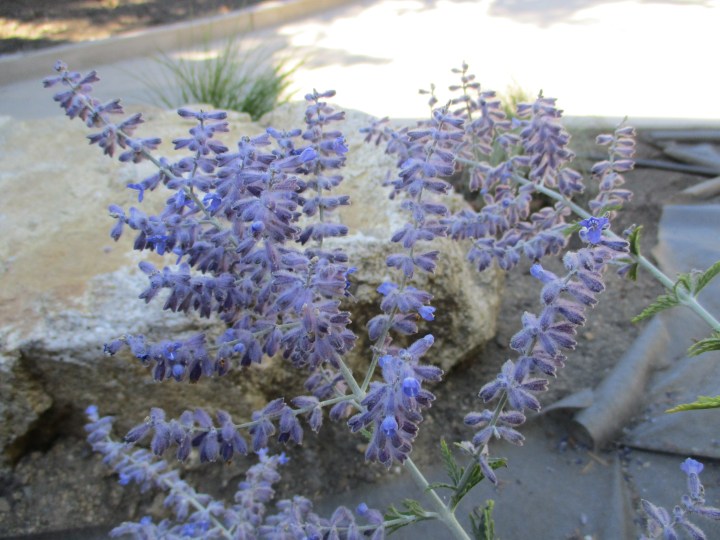
1. fernleaf yarrow, Achillea filipendulina, Most of these are white. A few are rusty red. A few are yellow like this one, which might be ‘Moonshine’. These did not show symptoms of heat stress right away, but have since gotten rather crispy. I could not find a picture like this one now. Fernleaf yarrow has been popular here for as long as I can remember because it supposedly does not need much water, although most get watered regularly. 2. Russian sage, Perovskia atriplicifolia, That sounds like ‘piroshki’. These and the rockrose #4 were 5 gallon plants, so are somewhat bigger than most other plants in the new landscape. They were not bothered by the change of the weather. Their faded denim blue flowers continue to bloom nicely. This is a plant that has been popular for a while, but that I have never grown. I tend to avoid trendy plants. However, my colleagues do not.
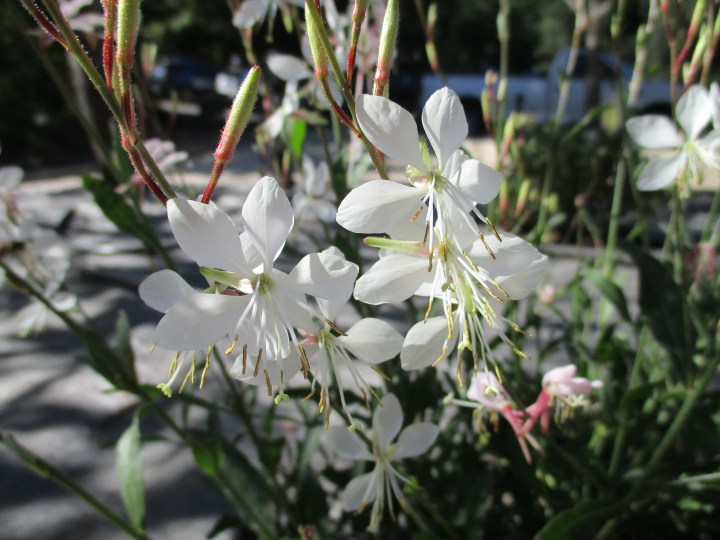
 3. gaura, Gaura lindheimeri, The common name is ‘white gaura’, but some are pink and some are darker pink that is almost red. I do not know if they are merely cultivars of ‘white’ gaura, or different specie. It seemed appropriate to omit ‘white’ from the name. Besides, that is how I learned it. This one can self sow enough to be an annoyance. Individual plants do not live very long, so a few feral seedlings can be selected to replace them.
 4. rockrose, Cistus cretisus, When I learned about rockrose back in the 1980s, we learned only two specie. One was white rockrose. The other was pink rockrose; and the pink rockrose did not look like this one. Now, there are too many to remember. Most do not have species name, but merely cultivar names. I really do not know if this really is Cistus cretisus. It just happens to look like it. I suppose I should have looked at the label.
 5. chocolate coreopsis, Coreopsis ‘Chocolate’, As I implied for #4, nomenclature is not what it used to be. It was standardized to simplify things, but is difficult to keep track of now with all the breeding and hybridizing, and botanists wanting to make a name for themselves by changing a name to something supposedly more accurate. I really do not know the species name of the chocolate coreopsis. It is known merely by the cultivar name.
 6. milkweed, Asclepias tuberosa, This one wilted rather badly in the warmth, but did not get roasted too much. The shriveled flowers in this picture are the worst of the damage. It is blooming more profusely now, and is developing strange seed pods. Milkweed is another trendy plant that caters to the butterfly gardening fad. I am not certain if I like the idea of planting something that is expected to get munched. It sure is colorful for now.
 This is the link for Six on Saturday, for anyone else who would like to participate:
https://thepropagatorblog.wordpress.com/2017/09/18/six-on-saturday-a-participant-guide/
 This is it; the big day. I will delay it no longer. I said that I would upgrade quite some time ago, but had not yet done so. https://tonytomeo.wordpress.com/2018/06/24/upgrade/
 This one is no fun to handle. It is just as prickly as it looks. Yet, it is the spiny foliage and blooms that make ‘Big Blue’ sea holly, Eryngium X zabelii ‘Big Blue’, so appealing. The knobby blue thistle flowers are centered on prominently flaring grayish blue bracts that look like metallic snowflakes. The intricately lobed grayish foliage contrasts splendidly with just about any darker green foliage.
 Flowers have a bigger and better agenda than coloring our gardens and homes. They bloom to get pollinated. Their color and fragrance are designed merely to attract pollinators. Less vain but more abundant blooms take advantage of the wind to disperse their pollen. Once pollinated, flowers fade and deteriorate as resources get diverted to the production of seed and fruit to contain it.
 Before I continue, I should mention that I have worked for some of the BEST horticultural professionals in the entire Universe! Seriously! I have worked for the single most excellent nurseryman EVER, and not one, but a FEW of the most excellent arborists EVER! YES, I am bragging! I can write about some of them another time.
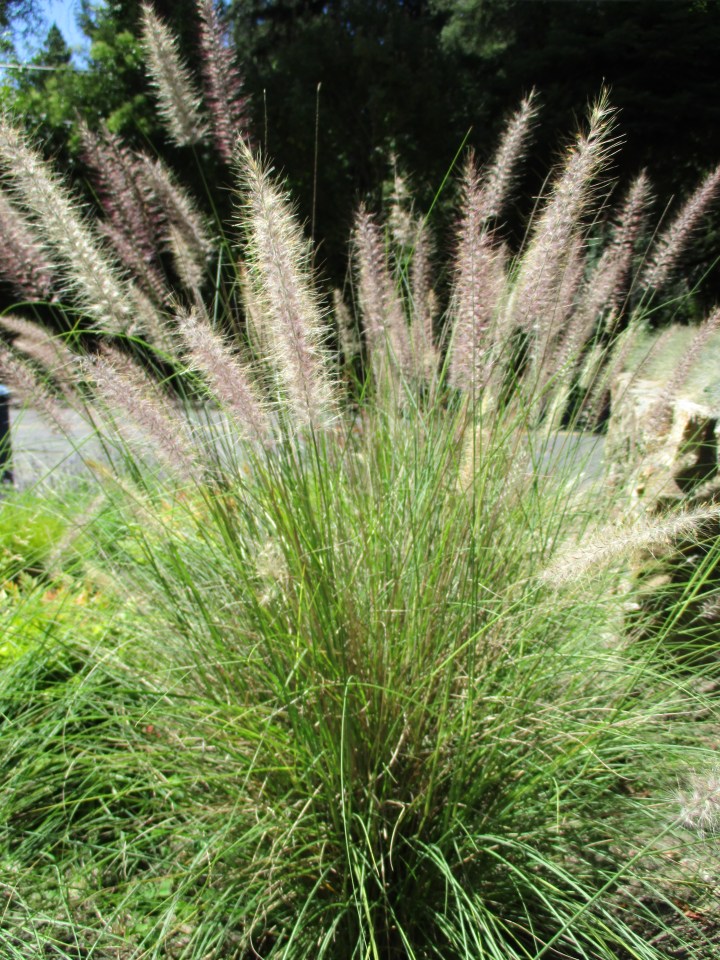 It was probably a good idea when it was introduced to California, but fountain grass, Pennisetum setaceum, became too much of a good thing for a few temperate regions in which it naturalizes and displaces native vegetation. Although it now works to inhibit erosion where it grows wild on the embankments of highway interchanges, it must sometime be mown because it is combustible.
 Plants are quite ingenious with their technology of exploitation of animals and people. Many get insects, birds, bats, spiders and anyone who is animated within their environment to disperse the plants’ pollen for them. Plants who prefer to not rely on wind, water or gravity to disperse their seed exploit a different range of animals to do so. They know how to compensate for their immobility.
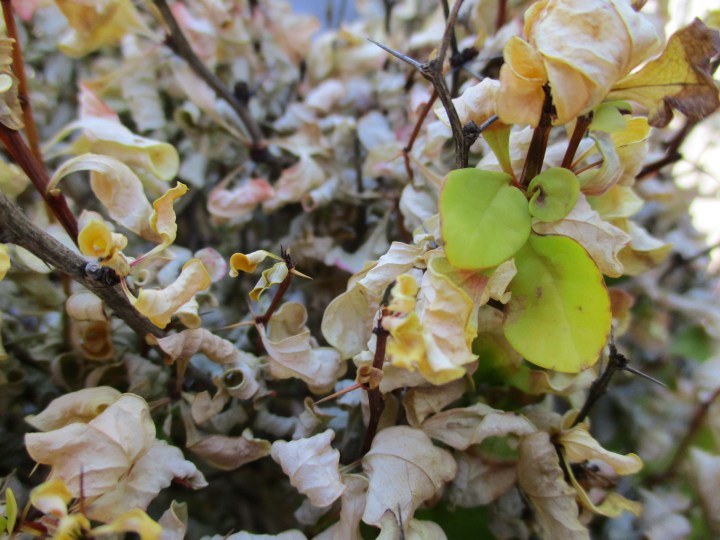 This really is the best climate here. Winters are just cool enough for many plants that require a bit of a chill, but not unpleasantly cold. Summers are just warm enough for most plants that need warmth, but the weather does not stay too unpleasantly hot for too long. Warm weather here typically lasts no more than a week, and is accompanied by light evening breezes and cooler nights. Minimal humidity typically makes the worst of the heat a bit more tolerable.


 This sort of weather pattern does not happen very often. Late spring is normally pleasantly warm, and the weather gets progressively warmer through summer, which typically includes a few unpleasantly warm days. It rarely gets too hot here, and when it does, it does not last for more than a few days, and tends to cool off at least somewhat at night. The air is normally arid. Humidity is uncommon in a chaparral climate.


