Mints have a sneaky way of migrating around a garden.
What most people who have grown the various mints remember about them is that they have a sneaky way of getting around the garden. They do not seem to be aggressive or weedy, but can be invasive with their subterranean stems nonetheless. That is why they are so commonly grown in pots, planter boxes or even pots sunken into the ground. Contained plants that get cut back at the end of winter every year look much better than unkempt plants that do what they want to anyway.
Once established, mint does not need any attention at all and only moderate watering. However, it performs much better with somewhat rich soil, regular watering and occasional grooming to remove old stems and spend flower stalks, (as well as getting cut to the ground in winter). Mints tolerate considerable shade or can be just as happy with full sun exposure.
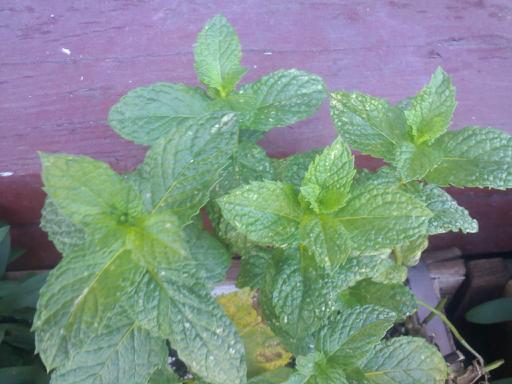
Spearmint, Mentha spicata, is probably the most popular mint, with rich green serrate leaves that are a bit smaller than those of the second most common mint, peppermint. Minute pale blue flowers bloom in vertical trusses at high as two and a half feet. Most of the foliage stays lower, about a foot deep. The leaves can be used for flavoring fresh from the garden or dried. Like all mints, spearmint is very easy to propagate by division of rooted stems.
California bay can work somethin like culinary sweet bay.
While the winter weather is still cool and damp, most of the herbs in the garden are not very impressive. Like vegetables though, herbs that are new to the garden should be planted as winter ends when no more frost is expected. Also like vegetables, some herbs are easier to grow from small plants or seedlings purchased from nurseries, and others are easier to sow directly from seed. Some are annuals or biennials. Others are perennials. Still others are woody plants.
Basil, cilantro and dill are commonly and easiest to grow from seed. Tarragon, sage, marjoram, mint and thyme are probably easier to grow from small plants found in nurseries. Chives, oregano, fennel and parsley are easy to grow by either means. Woody plants like rosemary, lavender and sweet bay can be grown either from small plants in the herb section of a nursery, or more substantial landscape plants.
All sorts of plants are grown as herbs to be used as seasoning, aroma (foliar fragrance) or even medicinally. Some are best grown strictly as herbs in an herb garden or incorporated into the vegetable garden because they lack visual appeal or because they eventually get cut and harvested. Others function quite well out in more refined landscapes.
Basil, cilantro, tarragon, sage, dill and marjoram are more utilitarian but less visually appealing herbs for the herb or vegetable garden, although some look good until they get harvested. Chives, mint, oregano, parsley and thyme look good enough for a landscape, and are not often harvested in quantities large enough to compromise their appearance. Fennel also looks good enough for the landscape, but then gets removed completely when harvested.
A few herbs are actually more often grown for their practicality in the landscape than in the herb garden. Thyme sometimes gets planted as a ground cover between stepping stones, since it is so compact and imparts its fragrance if trampled. Rosemary is actually a rather common ground cover where the soil does not hold enough moisture for more demanding plants. The various lavenders are nice ‘perennial’ shrubs. (‘Perennial’ shrubs do not last as long as woody shrubs.) Sweet bay is a nice small tree where space is limited, or can be shorn into a small hedge.
It seems that most herbs like good sun exposure and warmth during the summer, with well drained soil. Most do not need too much water once established. Only basil and parsley need regular watering. Chives and mint are not so needy, but do prefer to be watered regularly as well. Mint is commonly grown in pots because it can be somewhat invasive.
Aspidistra elatior, cast iron plant, is a foliar perennial. In other words, it is grown more for its lush and famously resilient evergreen foliage than for its bloom. The resiliency of its foliage accounts for its common name. Its bloom does not account for much. In fact, it is rarely seen. This is not because it is rare, but because it is not much to see. Such bloom is typically obscured by the lush evergreen foliage. Even if exposed, as in these pictures, it is not prominent. Individual flowers are tiny and dark, and do not extend much above grade. They seem to be designed for pollination by ants or other insects that might walk over them on the ground. In the picture above, one flower is blooming to the far left, another is beginning to bloom to the far right, and a third floral bud seems to be developing below that which is is beginning to bloom to the far right. Even the closeup of the far left bloom below is more weird than visually appealing. The floral form, texture and color suggest that they are intended to attract flies. I did not notice if the floral fragrance was consistent with that assumption, nor do I want to. I know what sort of fragrances flowers disperse to attract flies. However, I suspect that if such floral fragrance were notably objectionable, cast iron plant would be known for sometimes producing it, or not be quite as popular as it is.
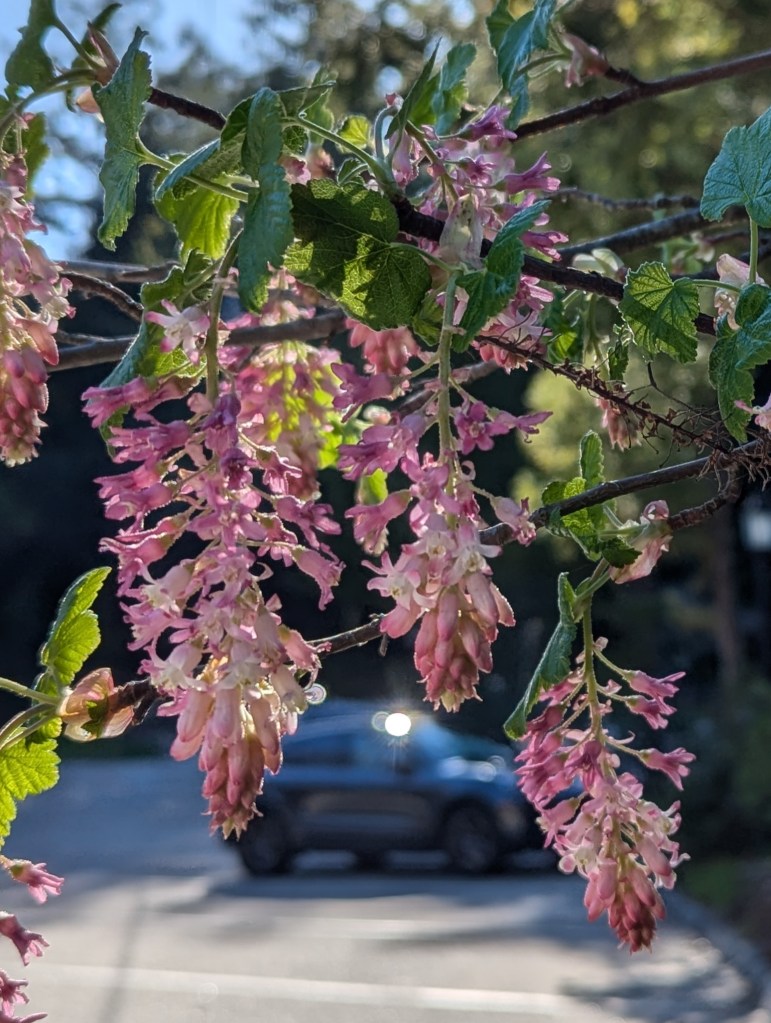
Its natural range extends from coastal Santa Barbara County to central British Columbia. Yet, red flowering currant, Ribes sanguineum, is elusive in the wild. It is more commonly observable within relaxed landscapes of native species. Individual specimens might not perform for more than a decade but can disperse seed. It behaves as if it is growing wild.
Mature specimens of red flowering currant can grow ten feet high and half as wide. Most stay lower. It is an understory species, so it tolerates a bit of shade. It may prefer shade to warm exposures. Young specimens may be wobbly enough to justify temporary staking. Removal of deteriorating old stems promotes more vigorous growth on fresh new stems.
Pendulous conical trusses of small pink flowers bloom by late winter or very early spring. Before anyone notices, birds are likely to take the few small currants that might develop. Small palmate leaves resemble those of scented geranium, and are somewhat aromatic. They turn yellow as they shed for autumn. Red flowering currant has a foresty character. It suits casual landscapes which border or merge into undeveloped areas.
Wildflowers may not be what they seem to be. California poppy, various lupines, various sages and several others are native species. Saint John’s wort, periwinkle, mustard and several others are not native. They are exotic but naturalized, so can proliferate as if they are native. In other words, several of the most familiar of wildflowers are invasive weeds.
In fact, some of the most invasive weeds were once more popular for their pretty flowers. These includes Saint John’s wort and periwinkle. Pampas grass, various brooms, yellow flag iris and Hottentot fig are more examples. Mustard likely originated as a home garden vegetable. Many grassy weeds were livestock fodder. Not many weeds were accidental.
Nonetheless, invasive weeds are here and established within local ecosystems now. By their simplest definition, weeds are merely unwanted vegetation. Native brambles qualify as invasive weeds as they invade home gardens. Because they are native, though, they are not invasive in the wild. Most of the most aggressive weeds just happen to be exotic.
Invasive weeds become invasive because of their various unfair advantages. Many lack pathogens that limit their proliferation wherever they are native to. Many lack competition from vegetation that they shared their natural ecosystems with. A few may actually prefer local climate to their natural climates. Weeds exhibit too much variety for generalization.
Although, generally, invasive weeds are accelerating their growth with warming weather. Most are proficient at growing faster than their competition and other preferable species. Several bloom and disperse seed before some deciduous species foliate. Weeds exploit resources before desirable species can. Several rampantly overwhelm their competition.
This is therefore a convenient time for weeding, before invasive weeds grow much more. Their roots will disperse more and be more difficult to pull from drier soil later. With more time, most weeds disperse more seed for subsequent generations. Diligence now might not eliminate all weeds for very long, but it helps. Later, weeds should be less abundant.
Tulip is the only single flower of these Six this Saturday. The other five are dinky flowers that are colorful in their natural profusion. Even tulip is more colorful with at least a few friends, as it bloomed in its landscape. Flowering quince shows only three flowers in this closeup picture, but it actually blooms more comparably to forsythia or spirea.
1. Tulipa X hybrida, tulip is of an assorted batch, but seems to be the same color as all of the others. Such batches typically contain a preponderance of varieties that happen to be overly abundant when they are mixed, but are not likely to be completely homogeneous.
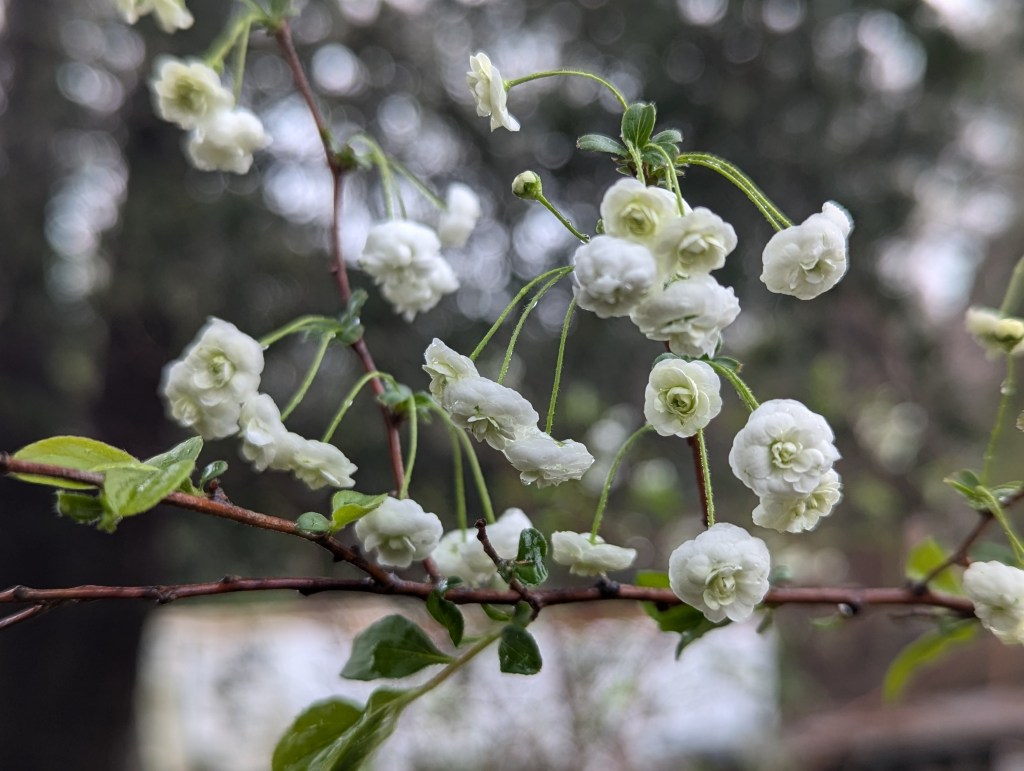
2. Spirea prunifolia, bridal wreath spirea could have bloomed more fluffily if it had been in a sunnier situation. This specimen has been in partial shade in the storage nursery for too long as it waits for reassignment to a real landscape. I remember it only as it blooms.
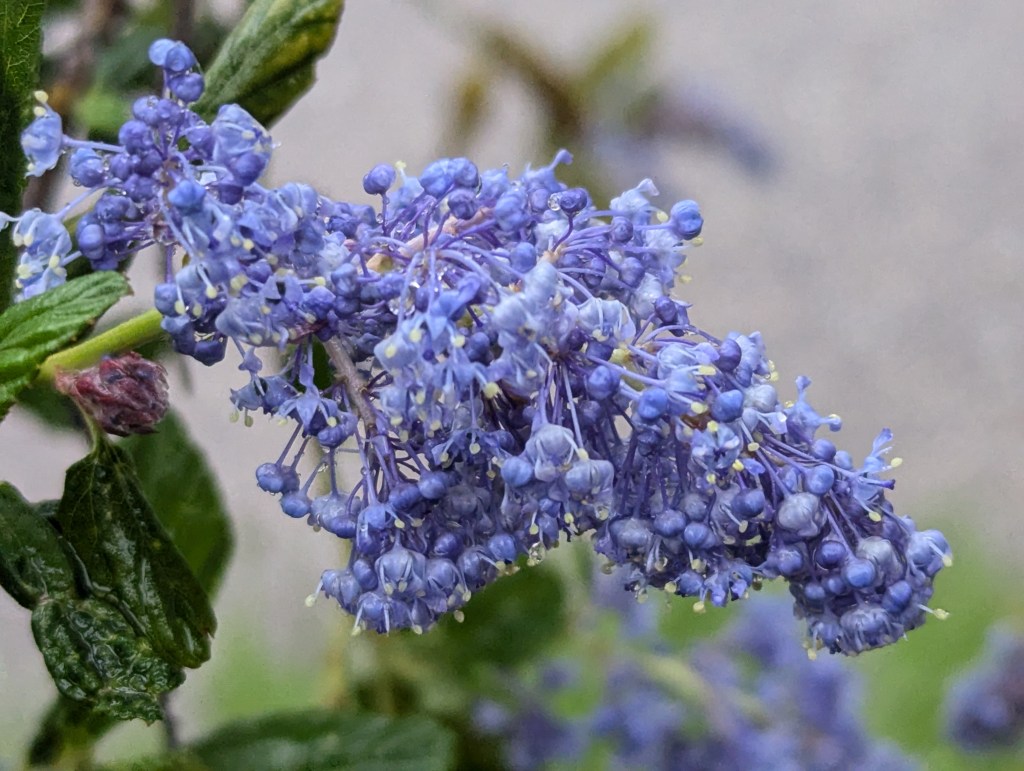
3. Ceanothus thyrsiflorus, California lilac is the same that I posted a picture of here two weeks ago, but neglected to remember until now. It is the only of these six that is native. It could have been installed intentionally into its landscape, but it more likely grew wild.
4. Chaenomeles speciosa ‘Orange Storm’ or ‘Double Take Orange’ flowering quince has a pair of cultivar names, which is two more than I can identify for the other five of my six. I can not determine if one is more correct than the other. It is pretty, but a bit overrated.
5. Forsythia X intermedia, forsythia was with the bridal wreath spirea and ‘Double Take Orange’ flowering quince in the storage nursery for a long time before assignment to the landscape that it now inhabits only last winter. It has not grown much, but blooms well.
6. Loropetalum chinense, Chinese fringe flower is pretty enough to be an illustration for the gardening column. I may feature it next week or the week after. If I do so, it must be within its bloom season. When it became a fad several years ago, I was not so keen on it.
Not many arborists or horticulturists are fond of the unremarkable but very popular London plane tree, Platanus X acerifolia. It soon gets too large for many of the tight situations it gets planted in, more than thirty feet broad and more than forty feet tall. Although it is among the most common of street trees, it can produce aggressive buttressed roots that displace sidewalks and curbs. Fuzz (tomentum) from the leaves is irritating to the skin or if inhaled.
Older trees that were planted prior to the development of disease resistant varieties are very susceptible to anthracnose and mildew, and are likely to infect other susceptible plants. Infected trees often get their foliage late in spring (after earlier new foliage shrivels and falls), or defoliate by late summer. Otherwise, the slightly raspy eight inch wide leaves seem sickly as they turn grungy yellowish brown in autumn.
Landscapers use London plane trees too commonly merely because they are so reliable. They tolerate most soils, smog, severe exposure (such as reflected glare from pavement) and a bit too much watering. Modern varieties are not quite as susceptible to disease. ‘Yarwood’ has large rounded leaves that are resistant to mildew. ‘Bloodgood’ is less susceptible to anthracnose. ‘Columbia’ is less susceptible to both diseases.
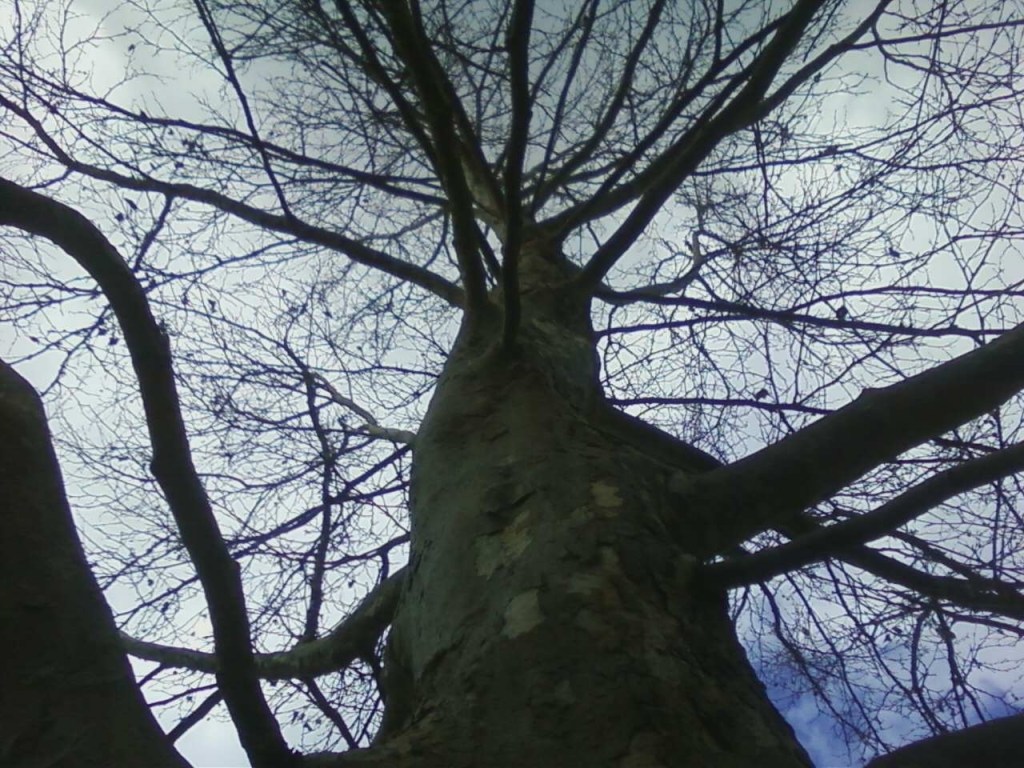
Large limbs and trunks with mottled gray and tan bark are rather sculptural while bare through winter. London plane happens to be conducive to annual pollarding, which makes the limbs even more sculpturally gnarly, and produces more vigorous growth with larger leaves that are less susceptible to disease.
Trees are the most significant components of the landscapes that they inhabit. They get larger than all other plants, and live for decades or centuries. Because inappropriate trees have such potential to cause such serious problems, and can be so difficult and expensive to remove, it is important to select trees that are appropriate to each particular application.
Size and form of trees when they mature are important considerations. Crape myrtles are small to midsized trees that fit nicely into tight spots, but are too dinky to be good street trees. London plane trees are more proportionate as street trees, but eventually displace sidewalks and curbs with their aggressive buttressed roots. Chinese elms can be good street trees, but need to be pruned regularly to maintain clearance. Red maples are a better choice because they get large enough without getting too big, have complaisant roots, and are easily pruned for adequate clearance.
Other features in the area can limit tree selection. Poplars and willows have aggressive roots that invade septic systems or old unsealed iron or terra cotta sewer pipes. Queen palms eventually reach utility cables, but can not be pruned to go around them. Any good shade tree can provide too much shade over solar panels. Partial shade from large trees or structures is a problem for most other trees, but is actually preferred by a few ‘understory’ trees like vine maples, Japanese maples and dogwoods.
Trees that are expected to provide shade through summer should probably be deciduous, like red oaks or silk trees, to allow warming sunlight through during winter, particularly close to the home. However, trees that should obscure unwanted views should be evergreen, like Southern magnolias or arborvitaes.
Some trees that need more attention than others are only appropriate where they will get the attention they need. Mexican fan palms are easy to care for while young, but eventually grow out of reach and need to be groomed by professional arborists. Of course, every tree is limited to particular climates. Various ficus trees that are common in nurseries in San Diego will not survive even a mild frost, which is why they are not available in San Jose.
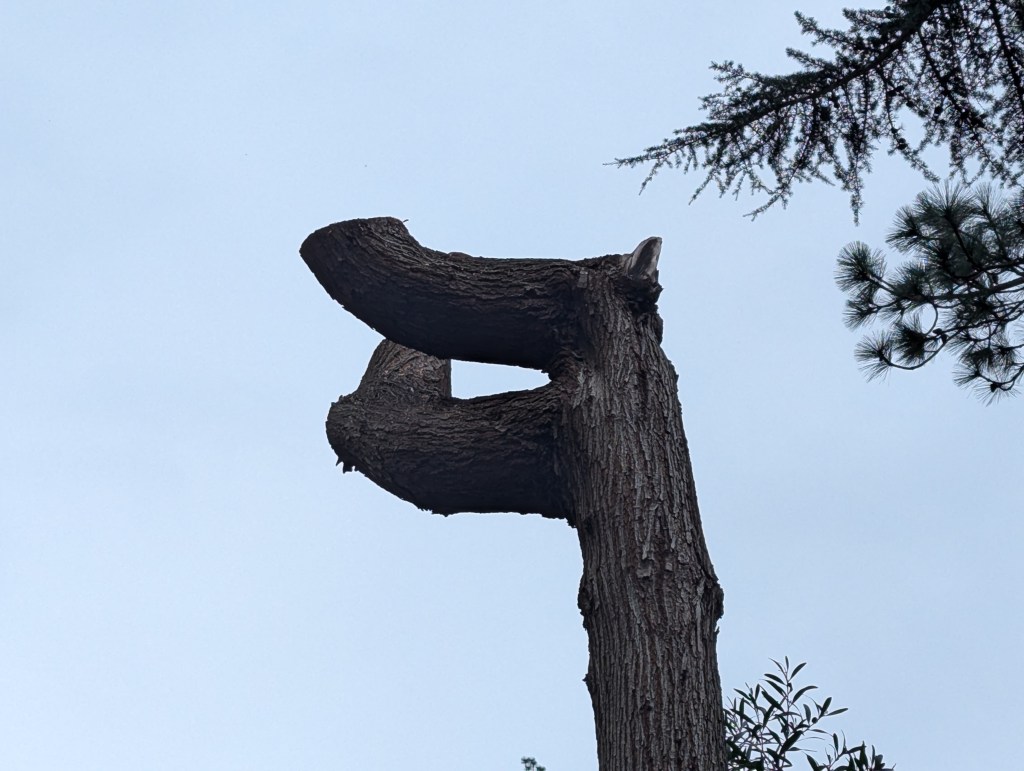
Actually, this does not even qualify as pollarding. It looks as if this tree, which was one of a few similarly damaged Acacia melanoxylon, black acacia trees, was in the process of being removed when the crew who was removing it left for the day. It would not have been so bad if they had returned to remove it and the others completely. They did not. This was the finished product. It and the others were almost twenty feet tall in this condition. They were about twice as tall prior. This sort of hack job is what gives pollarding a very bad reputation. It also demonstrates why proper pollarding should not be so vilified that arborists do not learn how to do it. Very obviously, this is not proper. Because they could not be salvaged, all of these trees were cut down a few days after I got this picture.
Pollarding can be done for a variety of reasons, and has been done for centuries in various cultures. It is still respected technique in many or most cultures. It stimulates vigorous growth that can be fodder for some types of livestock, including silkworms who consume the vigorous foliage of pollarded white mulberry trees. It can prevent some trees from producing troublesome pollen or fruit, such as old orchard olive trees that were retained as homes and their respective gardens were constructed around them. It can enhance autumn foliar color for some types of deciduous trees, such as the old Schwedler maples that were formerly common as street trees in San Jose. It stimulates growth of vigorous cane stems that are useful for basketry, fences, trellises or kindling. Locally though, it is considered to be as egregious as the technique pictured above, which is why no one here learns about it.






 Tony Tomeo