Tulip

A single tulip flower seems lonely.

As diverse as they are, popular varieties are a minority of countless hybrids of the genus. Most common and popular hybrid tulips qualify as the neo-species of Tulipa gesneriana. In other words, they are not an actual species. Most but not all are descendants of Tulipa suaveolens. More sustainable varieties of simple species are becoming more available.

The most popular of tulip are early spring bulbs that went into their gardens last autumn. Floral color ranges through pink, red, orange, yellow and white, mostly with dark centers. Their basal foliage is rather light green or perhaps almost grayish, with a rubbery texture. Most tulips stand singly on straight stems about a foot tall, but some can grow a bit taller.

Tulip bulbs enjoy organically rich soil with regular irrigation throughout their bloom cycle. They should get all the moisture they want from rain through their winter dormancy cycle. Tulip prefer a bit of chill in winter, so may not be as reliably perennial here as elsewhere. They are most spectacular in herds or large beds, but mix nicely with other spring bulbs. Simple tulips are among the most popular of cut flowers.

Grooming Deteriorating Bloom Conserves Resources

Daffodil are tidier with timely grooming.

Spring bulbs are now blooming, and some are already done. Summer bulbs will bloom a bit later, and some will continue until autumn. Annuals, perennials, shrubbery, vines and all sorts of other vegetation also bloom. Most simply shed their deteriorating flowers after bloom. Some may benefit from grooming to remove such flowers before they go to seed.

Grooming to remove lingering deteriorated flowers, or deadheading, is obviously neater. Flowers that continue to bloom are more prominent without their decaying predecessors. Camellias may not need such grooming, since their flowers fall away as they deteriorate. However, removal of fading flowers, before or after they fall, eliminates their mess below.

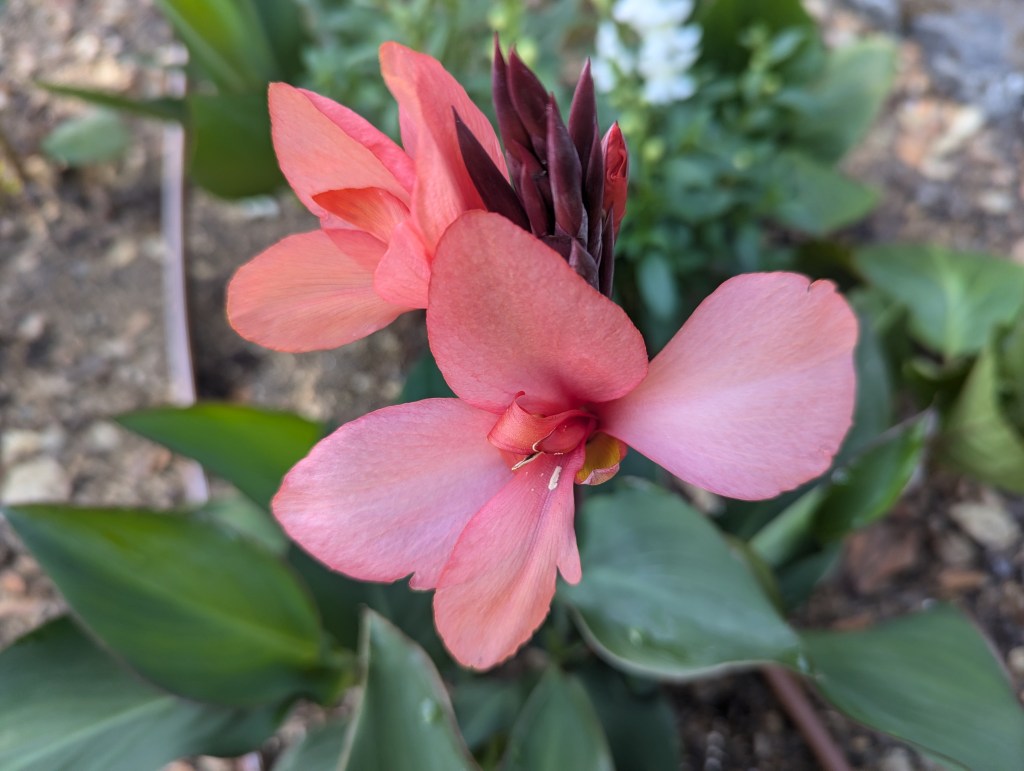
Perhaps more importantly, grooming to remove fading flowers conserves vital resources. Although most bulbs are sterile hybrids, some try to generate fruiting structures for seed. This consumes substantial resources. Removal of fruiting structures before they develop diverts resources to other growth. Canna diverts such resources into subsequent bloom.

For some species, grooming to remove fruiting structures stimulates subsequent blooms. After all, seed production is their priority, and the objective of bloom. If they perceive any deprivation of seed, they are compelled to produce more. Several dahlias bloom initially with single flowers. After grooming, the stems below branch for a few secondary flowers.

For a few potentially invasive species, grooming eliminates unwanted seed. Montbretia, which is famously invasive, is less so if deprived of its seed. African iris might disperse a few unwanted seed and get shabby without grooming. Summer snowflake and common grape hyacinth often disperse their seed. Both are too small and numerous for grooming.

Fortunately, summer snowflake and common grape hyacinth are true to type. Freesia are not. Without grooming, they can produce feral progeny that are similar to their ancestors. Such feral progeny are more prolific with seed for more of the same. Eventually, they can displace the desirable original varieties. Although more fragrant, they are not as colorful.

Six on Saturday: Pruning Apple Trees

This is a rather cursory Six for this Saturday, since Rhody and I are on vacation, pruning apple trees in Washington. I should do better next Saturday.

1. Malus domestica, apple trees, even after thorough pruning last winter, are a hot mess now. I prune a small herd of only eleven, but some of them are quite large. Several other assorted fruit trees remain in need of renovation nearby. A tenant maintains a few more.

2. Dormant pruning maintains and contains the otherwise rampant growth of the apple trees, and limits their otherwise messily excessive fruit production, but does not actually improve their visual appeal much. The most meticulously pruned trees will look twiggy.

3. Malus sylvestris, crabapple demonstrates why I am in a rush to prune the apple trees before their bloom and foliation. They are about to bloom, and apple trees bloom shortly afterward. I try to get here earlier each year, but always get here at about this same time.

4. Pyrus communis, pear is already beginning to bloom a slight bit more than crabapple. Fortunately, the pear trees are still somewhat small, and do not yet need major dormant pruning or renovation. I might prune back a few minor spires from one of the pear trees.

5. Prunus cerasifera, Myrobalan plum is in full bloom, but needs no pruning anyway. It is merely the understock of an unidentified stone fruit tree that was cut down years ago. It serves no purpose, but is too pretty in bloom to merely cut down without justification.

6. Arlo was waiting for us on the porch when we arrived. He lives at another house in the neighborhood, but visits neighbors for food and treats. He was not pleased when Rhody noticed that he was watching us. He did not exactly put much effort into hiding, though.

This is the link for Six on Saturday, for anyone else who would like to participate: https://thepropagatorblog.wordpress.com/2017/09/18/six-on-saturday-a-participant-guide/

Harlequin Flower

‘Tricolor’ (obviously) means ‘three colors’.

Even though bulbs for harlequin flower, Sparaxis tricolor, are no longer commonly found in nurseries when it is time to plant them in autumn, naturalized bulbs are somewhat common in some older gardens. Where winters are mild and soil does not get too dry and compacted, they are happy to slowly multiply and bloom every spring. They seem to be blooming a bit early this year, since they typically wait until later in spring. The upright narrow leaves resemble those of gladiolus, but get no taller than a foot. Each flower stems rises a bit higher to display a few flowers that are about an inch and a half wide. Each flower has a yellow center surrounded by a narrow rusty brown pattern, which is also surrounded by a third color; which is orange, red, pink or purple.

San Francisco Flower & Garden Show

(This is an old recycled article that includes very outdated information, some of which was omitted, but the website for the San Francisco Flower & Garden Show is the same.)

Bonsai, composting, palms, flower arranging and lawn alternatives, as well as rare, edible and drought tolerant plants; there will be seminars for almost every horticultural topic imaginable at “Life in the California Garden”, the 26th annual San Francisco Flower and Garden Show. Xeriscapes, contemporary garden design and water conservation; there will be something for anyone who enjoys any kind of gardening. A schedule of seminars and any other information can be found at www.sfgardenshow.com.

The most spectacular display will be the twenty gardens created by some of the most innovative local, and perhaps not so local, landscape designers and horticultural professionals. There will be everything from contemporary to traditional and functional to ‘artistic’ landscapes. Anyone who has been to a San Francisco Flower and Garden Show knows what ‘artistic’ can mean, but will be surprised nonetheless. 

Just about anything that can be done in the garden will be done at “Life in the California Garden”. Bee keeping, practical pest control and water management will all be there. “The Modern Homestead” designed by Star Apple Edible Gardens of Oakland will be a 6,000 square foot exhibit featuring aesthetic vegetable plantings and an elegant chicken coop, as well as beer and jam making demonstrations.

The Marketplace will include more than 200 vendors with all sorts of seeds, plants, tools, gifts, patio furniture, pottery and garden sculpture. Plants will range from orchids, dahlias, epiphytes, vegetable plants, cacti and succulents, to name a few. The Farmers’ Market will have flowers and produce available. Sproutopia will feature interactive gardening experiences and demonstrations for children.

Many very impressive bonsai will be exhibited by the prestigious Bonsai Society of San Francisco. Many of the bonsai subjects that are decades old have been returning to the San Francisco Flower and Garden Show for many years. There will also be bonsai demonstrations.

Horticulturists of the Western Horticultural Society will be available to discuss rare and recently introduced plants, as well as more traditional plants that are regaining popularity. Some recent introductions are not yet available in nurseries. California Garden Clubs will have representatives from many of the various horticultural associations, with information about membership.

Horridculture – High End

Gladiolus papilio from Skooter’s Garden makes my garden more special than any ‘high end’ garden.

What exactly does that mean?! Why should I care? My lack of concern seems to be directly proportionate to the intensity with which someone tries to impress upon me that I should be so concerned. A colleague from high school tried to tell me about a new television show about a so-called ‘landscaper’ in Michigan who is so extremely ‘successful’ that he also lives in a home in Florida for the winter. I suspect that both of his homes combined are worth about as much as a single home here, but I will just continue with this premise that he is successful. He does exclusively ‘high end’ work, which regularly involves moving huge boulders with old fashioned technology because that is what his ‘high end’ clients want. I needed to interrupt. The ‘high end’ nonsense annoyed me too much. So, they have huge boulders in their landscapes. Perhaps their landscapes were very expensive to install. Splendid! ‘High end’ spending is healthy for the economy. Why is this any of my business? I do not know. I am a horticulturist, not an economist. My garden contains rhubarb from the garden of my paternal paternal great grandfather, and Dalmatian iris from the garden of my maternal maternal great grandmother. That is horticulturally significant. ‘High end’ gardens seem to be more concerned with expenditure than with horticulture, as if spending more will somehow make it better. Do those who purchase ‘high end’ gardens actually work in them? Do they grow anything from the gardens of their ancestors? I know that some do, but I suspect that some do not. The primary purpose of their ‘high end’ landscapes is lavishness. I can not doubt that such landscapes serve such purposes more than adequately, but am nonetheless unimpressed by their typical lack of horticultural relevance.

Chinese Fringe Flower

Fringe flower is an early bloomer.

The simple species is notably distinct from its several popular modern cultivars. Chinese fringe flower, Loropetalum chinense, grows very slowly to about fifteen feet tall. Its simple evergreen foliage is exclusively light green. Its small and ribbony flowers are exclusively creamy white. Limber and arching stems can eventually overwhelm adjacent vegetation.

However, this simple species is now very rare. Popular modern cultivars are much more compact. Although a few can grow taller, most are no more than five feet tall. Most exhibit delightfully purplish or bronzed foliage. Individual leaves grow about an inch or two long. Floral color ranges through white, creamy white, pink, rosy pink, rich red and garnet red.

Chinese fringe flower has a woodsy style. Shearing or aggressive pruning compromises its naturally relaxed form. It is naturally an understory species, so is somewhat tolerant of partial shade. Bloom is most abundant as winter relinquishes to early spring. It continues sporadically throughout most of the year. Blooming stems can be handsome cut flowers, and tolerate forcing bloom.

Forcing Bloom From Bare Stems

Forsythia is ideal for forcing bloom.

Spring bulbs, with prechilling, were conducive to the technique of forcing bloom earlier. A few summer bulbs might still be responsive to it, although it is getting late for most. Now, it is about time for forcing bloom with certain dormant deciduous stems. Most are already beginning to bloom. Forcing bloom merely accelerates this process for cut flower stems.

Forcing bloom for dormant deciduous stems is actually simpler than for bulbs. It involves merely cutting stems that are about to bloom and bringing them indoors. The warmth of a home interior is what accelerates profuse bloom. Aridity of home interiors may accelerate the deterioration of this bloom. However, homes also provide shelter from wind and rain.

Witch hazel, flowering quince and forsythia are mostly done blooming locally. Otherwise, they are conducive to forcing bloom, and will be available next winter. Several flowering cherries and flowering plums are now about ready for forcing bloom. Redbuds are ready also, though some will be later. Flowering crabapples should bloom later in their season.

Several fruit trees are as conducive to forcing bloom as their fruitless flowering relatives. Their floral color and profusion are less extravagant only because of their breeding. Fruit is, after all, the priority. With planning, dormant pruning can involve leaving a few surplus stems to cut later. Then, cutting them about now should not compromise fruit production.

With precise timing, wisteria and lilac are conducive to forcing bloom. Technically, so are dogwood and several deciduous magnolias. They bloom relatively slowly though. A few flowers should therefore be blooming before collection of their stems. Evergreen species are less striking in bloom. Fringe flower and Oregon grape can perform elegantly though.

Forcing bloom is more popular where winters are cooler. This is partly because gardens lack floral color for so long through winter. Those who enjoy flowers are in more of a rush to bring some into their homes. Also, dormant vegetation is more reactive to warmth after colder winters. Warmth might not stimulate bloom as effectively after locally mild winters.