Onion

Onions grow easily from onion sets.

Leek, garlic, shallot and other species of the genus have more distinct growing seasons. Technically, onion, Allium cepa, is a cool season vegetable. It grows through winter to be ready for harvest before summer dormancy. Alternatively, it can grow through spring for a later summer harvest. In cool situations, it can grow through summer for autumn harvest.

Onions do not actually mature within a single season anyway. Most grow from onion sets which are simply small onions that grew from seed earlier. They simply finish growing for another season once plugged into a garden. Those that grow from seed in autumn might go dormant through the middle of winter. Spring is actually their second growing season.

The most popular onions are yellow or brown, red or purple, or white. Each type exhibits a distinct flavor. All develop a few hollow bluish green leaves that stand about a foot tall. Their foliage shrivels as they mature enough for harvest. They are useless if they bloom. Green onions are merely juvenile onions which have not yet developed distended bulbs.

Rotating Vegetables Should Enhance Productivity

Tomato plants are greedy for nutrients.

Warm season vegetables are beginning to replace cool season vegetables. Some types prefer to start earlier than others. A few might displace lingering predecessors before the predecessors finish. Timing is not everything, though. Location may be as relevant. If the garden did not move, some vegetables should. Many or most benefit from rotating crops.

Vegetable plants are innately greedy in regard to particular nutrients. They might deplete such nutrients from their soil within a few years. Some may not take that long, particularly within less than ideal soils. However, different types of vegetables deplete different types of nutrients. Rotating vegetable plants disperses and decelerates this nutrient depletion.

Tomato plants deplete their favorite nutrients. Therefore, new tomato plants should likely avoid soil that tomatoes formerly occupied. Corn can use such soil instead, and may not notice a deficiency of nutrients. After all, each craves something different. Beans can use the same soil afterward for the same reason. Rotating crops shares resources equitably.

Bell peppers are related to tomatoes, so deplete similar nutrients. Therefore, they should also avoid soil that tomatoes formerly occupied. All types of beans should similarly avoid soil that any type of bean utilized. Fortunately, warm season vegetables are unrelated to most cool season vegetables. What grew last summer is now relevant for rotating crops.

Nutrient depletion is not permanent, though. Rotating crops, while accommodating such depletion, also accelerates replenishment. For example, beans should not deplete much of what tomatoes crave. They instead replenish some of what tomatoes crave. Tomatoes, can therefore eventually return to where they grew before. After all, rotation goes around.

Warm season vegetables generally require more nutrients than cool season vegetables. That is because so many warm season vegetables are actually fruits that contain seeds. Most cool season vegetables are vegetative, without seed. Consequently, warm season vegetables are more appreciative of rotating. Cool season vegetables are more passive. Cool season vegetables do not grow long enough locally to deplete much anyway.

Six on Saturday: Eucalyptus

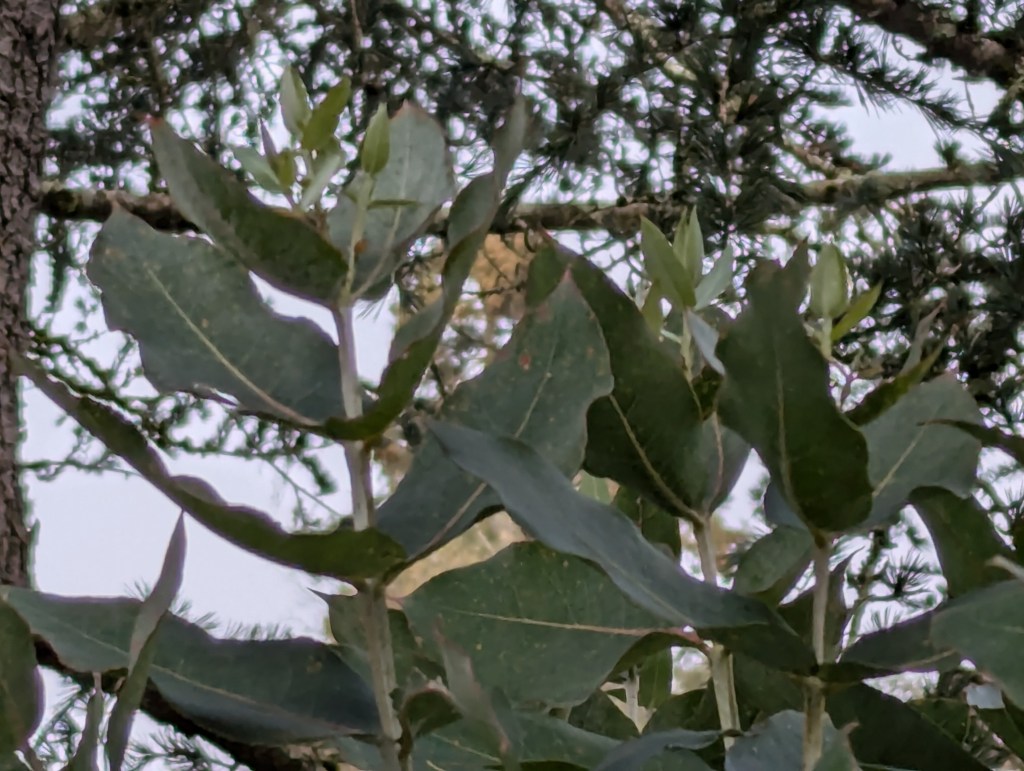
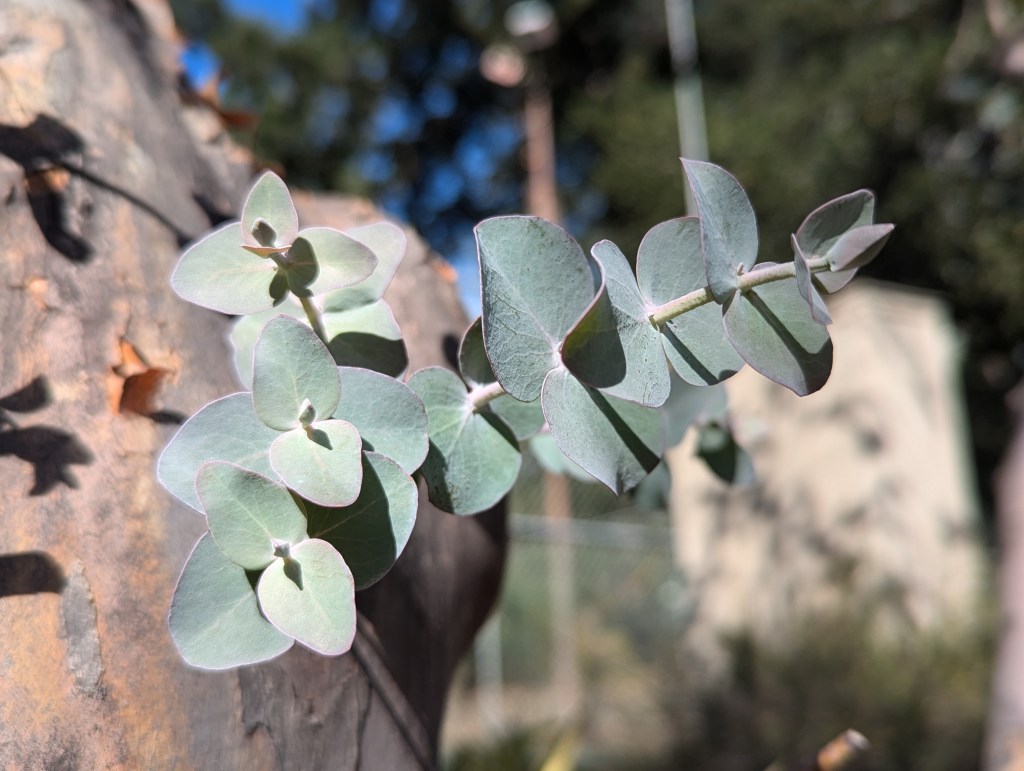
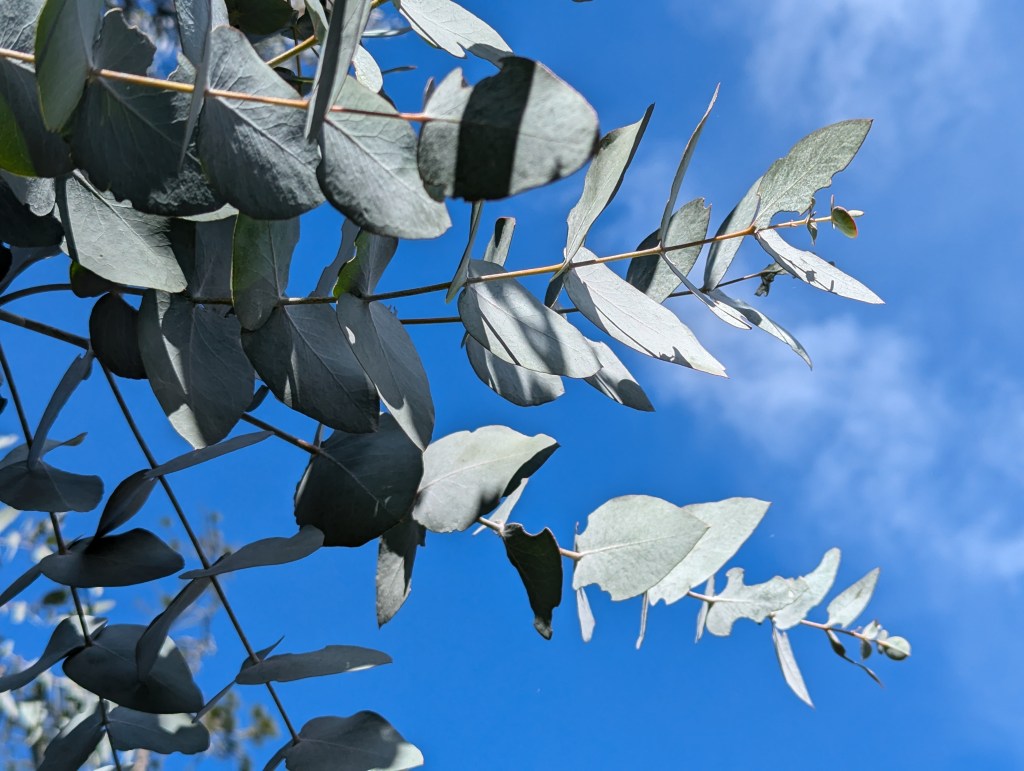
Eucalyptus has a bad reputation. Regardless, the worst of the genus and its only cultivar that I am aware of inhabit my gardens. Four less offensive species inhabit a landscape at work. Actually, several species of Eucalyptus are not only appropriate for home gardens, but are also naturally very well adapted to local chaparral climates. Their bad reputation is an unfortunate result of the bad behavior of merely one of hundreds of species, which happens to be the second of these Six. Eucalyptus camaldulensis, red gum allegedly also contributed to that reputation, but more so in Southern California than here, as it is rare locally. Half of these six show sessile juvenile foliage, rather than petiolate adult foliage. Pictures of high foliage were taken from significant distances.

1. Eucalyptus globulus ‘Compacta’, bushy blue gum is my least favorite eucalyptus, since it is a contrarily runty cultivar of an otherwise grand species, but here it is in my garden.

2. Eucalyptus globulus, blue gum is too grand for my garden, though, so can not develop a natural form. It is pollarded for its aromatic juvenile foliage, but has a few adult leaves.

3. Eucalyptus cinerea, silver dollar tree, which is not the same as silver dollar gum, may be confused with silver mountain gum, since their botanical names are interchangeable.

4. Eucalyptus pulverulenta, silver mountain gum is very distinct from silver dollar tree. I find their confusion to be annoying. Botanical nomenclature is designed for simplicity.

5. Eucalyptus sideroxylon, red ironbark grew from a small root sucker with merely a few roots. I got it from a stump in another landscape, and am impressed by its performance.

6. Eucalyptus citriodora, lemon gum is delightfully aromatic, and, as its name suggests, is rather lemony. Its foliage will soon be too high on lanky bare trunks to reach, though.

This is the link for Six on Saturday, for anyone else who would like to participate: https://thepropagatorblog.wordpress.com/2017/09/18/six-on-saturday-a-participant-guide/

Wild Lilac

Some wild lilac can grow quite large, but lives only about thirty years.

There are many different forms of wild lilac, Ceanothus spp., ranging from low sprawling ground cover types that get only about two feet deep, to dense shrubs that get a few feet tall and broad, to relatively open and irregular shrubs that are a bit larger. The largest can become a small tree with multiple trunks as tall and broad as twelve feet. Wild lilac flowers can be any shade of blue ranging from deep dark blue to soft pale blue. Only a few have white or pinkish flowers. Some wild lilacs have leaves that are glossy and round like nickels. Others have small but thick and roughly textured leaves, like bacon bits.

However, almost all bloom in early spring, are evergreen, and want well drained soil. Only a few lose their leaves where winters are cold. Most prefer infrequent irrigation or none at all, although some of the ground cover types like to be watered occasionally through summer. Wild lilacs do not like to be pruned, and really do not want to be shorn, so should be planted where they have room to develop their natural forms. Sadly, wild lilacs are not permanent, and typically die within ten years or so.

Pruning Cane Berries

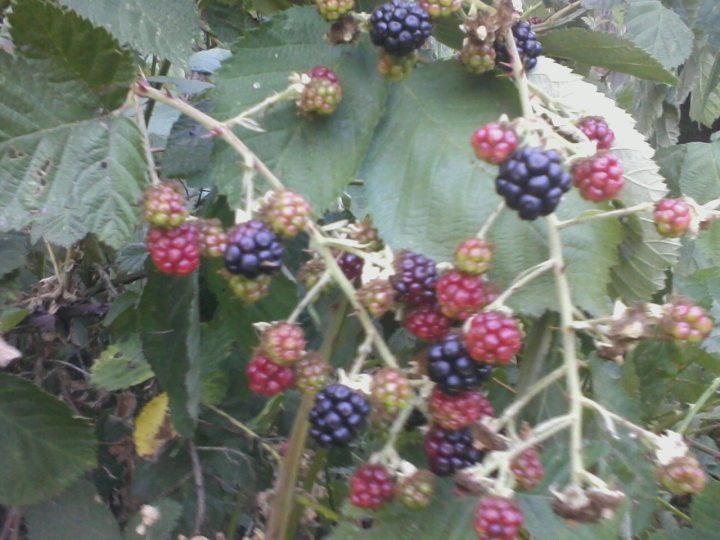
Their habit of overwhelming untended gardens gives blackberry canes a bad reputation. Their thicket like growth in their native habitats does not help. They are certainly not ‘low maintenance’ and need intensive specialized pruning later in the year. Yet, they become available with other bare-root plants this time of year for a reason. They make great blackberries!

New bare-root blackberry plants do not look like much when they are first planted, and do not produce berries in their first year. They will instead be busy dispersing roots and producing biennial canes that will produce berries the following year. Root barriers can prevent their aggressive roots from getting into neighbors’ gardens, particularly since south or west facing fences are just as practical for supporting trailing canes as trellises are.

‘Trailing’ types like ‘Marion’, ‘Boysen’ and ‘Olallie’ blackberries, which are also known as ‘boysenberry’, ‘marionberry’ and ‘olallieberry, are the most popular locally. ‘Erect’ types, like ‘Arapaho’, ‘Choctaw’ and ‘Navaho’ are more tolerant to frost, so are more popular where winters are colder. ‘Semierect’ types are hybrids of trailing and erect blackberries. 

In their second year, trailing and semierect canes that grew during the first year should be trained onto trellises, fences or wires. As their fruit gets depleted later in summer, these canes can be cut to the ground. Some of the new canes that developed through the season need to be trained onto the same supports to replace the older canes as they get removed.

There should be more than enough new canes. About ten to fifteen of the best canes of trailing types should be selected and pruned to about six or seven feet long. Semierect types need about half as many canes, and can be pruned about a foot shorter. Extra canes should be cut to the ground. A few of the smaller extra canes can be left through summer to be separated with roots as new plants during the following winter.

Side branches that grow from the pruned canes through late summer and early autumn should get pruned to about a foot long at the end of the following winter. New growth from these stubs will produce fruit during the following summer. The process of replacing the old canes with new canes can be repeated as the fruit gets depleted.         The process is similar for erect blackberries, but no support is needed. During the second year, canes should be cut to about two and a half feet tall in the middle of summer. Secondary branches from these canes should be cut to about a foot long in winter. As fruit gets depleted and replacement canes develop during the following summer, these mature canes can get cut to the ground. New canes then get pruned just like the older canes were.

More Sticks

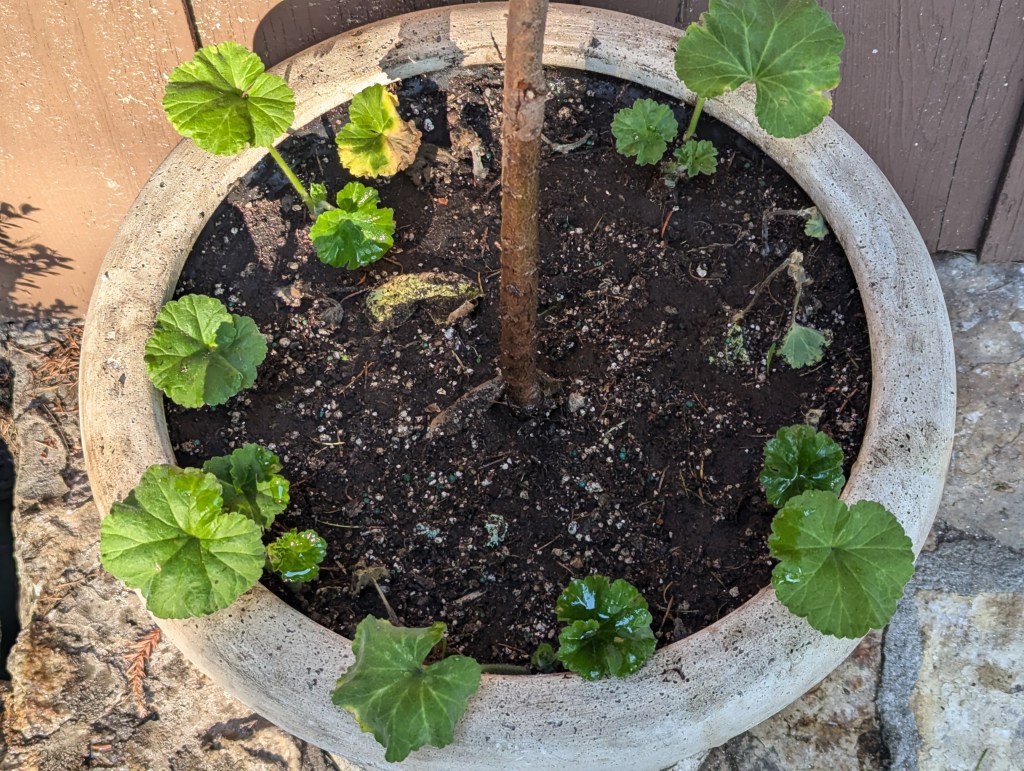
Horticulture involves many sticks. Almost all are pruning scrap. Very few become scions for grafting, like the stick of ‘Beurre d’Anjou’ pear that I wrote about last week. A few more become cuttings, like these white zonal geraniums, Pelargonium X hortorum. These cuttings were processed from scrap of the same that formerly inhabited their same pair of big pots. The original specimens performed well within their pots for a few years, but were about to become overgrown if they had been left to grow for another season. They could have been pruned back and left to regenerate. However, because small specimens of lemon cypress, Cupressus macrocarpa ‘Goldcrest’ were added to their large pots, it was easier and neater to simply remove them completely and replace them with eight cuttings in each of their two pots. These cuttings should grow nicely and perform well for a few more years. Then, they can either be cut back to regenerate, or replaced with cuttings processed from their own scrap after their removal. Such processes cost no more than a bit of time and effort. I have been doing the same with a weedier bright pink zonal geranium that I have been growing since I was in junior high school in about 1979. I acquired the original sticks from a neighborhood garden debris dump, and have been growing them ever since then. I brought them with me to every home that I lived in through college, and then brought them back here when I returned. I acquired a similarly weedy but orangish red zonal geranium in about 1993, and have been growing it since then also. Zonal geraniums are underappreciated for their simplicity, practicality and, most of all, their sustainability. Once they inhabit a garden, there is no need for them to ever leave.

Pacific Hound’s Tongue

Pacific hound’s tongue is reliably perennial.

Cat’s tongue might be a more fitting name. Pacific hound’s tongue, Cynoglossum grande or Adelinia grandis grows where it wants. It can grow from cracks in pavement, and then be difficult to remove. It grows easily through decomposed granite, gravel or wood chips. Yet, it is not readily available from nurseries, or as seed. It is sporadic in its native range.

Pacific hound’s tongue may be uncommon because it takes a few years to bloom well. It does not bloom for its first year from seed and then blooms thinly for its first few years. By its third year though, its resilient perennial taproot should be very established. Its foliage dies back soon after late winter bloom. It stays significantly longer with garden irrigation.

Bloom resembles that of forget-me-not, but relatively sparse and on vertical stems. Floral stems are about a foot tall, or can be two feet tall. They are more numerous in cultivation. The small blue flowers are less than half an inch wide. Foliage develops basal rosettes, which may prefer a bit of partial shade. The biggest leaves are less than six inches long, like a hound’s tongue.

Wildflowers On The Wild Side

Some wildflowers bloom in shady forests.

Warm season annuals are more varied than cool season annuals for one simple reason. Spring and early summer are the best time for bloom. Afterward, there is plenty of time for seed to develop, prior to cool winter weather. Obviously, most flowers want to exploit this schedule. This includes wildflowers, particularly in regional chaparral or desert climates.

Wildflowers are in more of a rush to bloom for early spring here because summer is arid. They could be more susceptible to premature desiccation later. They last longer and can bloom later in home gardens with irrigation. Actually though, not all wildflowers bloom for early spring. Some bloom for autumn or winter. A few bloom for summer, generally briefly.

There is no explicit definition for wildflowers. Western redbud and the various ceanothus are technically native wildflowers. Yet, they grow as large shrubbery or even small trees. Most popular wildflowers are annuals. A few are biennials or perennials. Some perennial sorts must mature for more than a year before they bloom well. Some are very persistent.

Technically, wildflowers should be locally native, and observable directly within the wild. Realistically, this expectation is unrealistic. Many of the most colorful, like perennial pea, are naturalized exotic species. Most wildflower seed mixes include random species from elsewhere. Some are regionally specific, but to other regions and very different climates.

California poppy and various lupine are the most popular and familiar native wildflowers. Douglas iris, yarrow and clarkia are about as practical for cultivated home gardens. Bush poppy and monkey flower more appropriate to rustic landscapes beyond home gardens. Many wildflowers need aggressive maintenance, such as cutting back after their season.

Seed of most annual and perennial wildflowers prefers to be in a garden by late autumn. It can then settle in through cool and rainy winter weather to grow and bloom about now. With watering after the winter rainy season, several might start now to bloom for summer. Some of the more sustainable species can disperse seed for another wildflower season.