Its unappealing common name is less common than its more agreeable botanical name. Lungwort does not sound as pretty, or at least as official as Pulmonaria officinalis. It is an evergreen perennial, although its foliage likely desiccates through summer. New foliage replaces it during cooler autumn weather. Lungwort prefers cool and moist partial shade.
Mounds of foliar rosettes grow no deeper than a foot. They often stay only half a foot high as they spread as wide as two feet. Their lowest rhizomes produce adventitious roots so that they can sprawl even farther. Such growth is easy to divide. Foliage of most cultivars exhibits pretty lighter green or silver spots or blotches. Some is almost completely silver.
Lungwort blooms mostly for late winter and early spring. Trusses of daintily small flowers hover barely above their basal foliage. The most popular sort blooms with pinkish purple flowers that mature to blue. Others bloom with purple, pink, purplish red or white flowers. Although foliage is healthier within partial shade, sunshine promotes profusion of bloom.
Annuals live for only one year. Biennials live for only two. Technically, all other plants are perennials. Horticulturally, this classification is much more specific. Generally, It does not include vegetation that qualifies as something else. Also generally, plants that qualify as perennial are herbaceous rather than woody. Of course, this is not as simple as it seems.
Palm trees that develop substantial trunks, for example, classify as herbaceous trees. So do arboriform yuccas, such as Joshua tree. Palms and yuccas that do not develop trunks can classify merely as perennials though. Different species of one genus could therefore classify very differently. Tree ferns may also qualify as herbaceous trees as they mature.
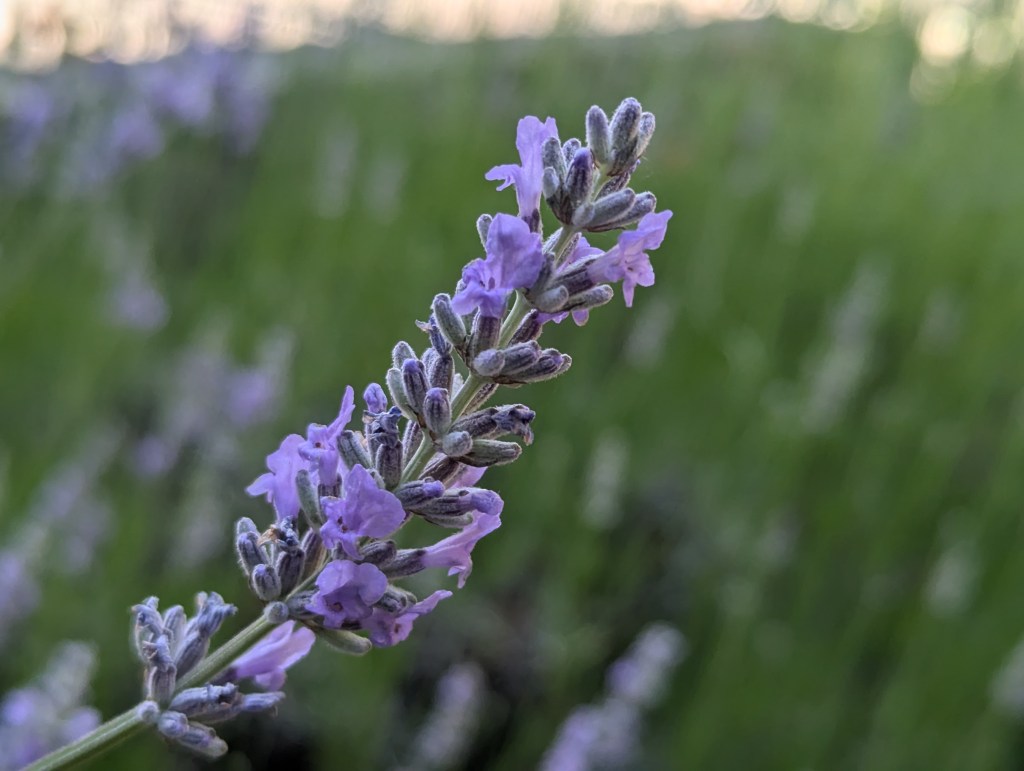
Many palms and yuccas, as well as agaves, bamboos and banana trees, are perennials. They might not seem as if they should be, since they can grow so large. Spring bulbs are more recognizable as perennials likely because of their small size. Lavenders and some salvia develop more woody stems than banana trees. They are perennials nonetheless.
Perennials are generally self perpetuating. Lavenders and similarly twiggy sorts may not not seem like they are, but they can be. Their lower stems that sprawl over the surface of the soil can grow adventitious roots. These adventitiously rooted stems can grow as new plants to replace the old. Herbaceous perennials are more overt about self perpetuation.
Lily of the Nile, for example, constantly produces new rhizomes to replace the old. It can do so indefinitely. Some may have done so longer than the oldest bristlecone pines have been alive. They do not retain old growth as evidence of their age. This self perpetuation is an advantage in home gardens. It facilitates both sustainability as well as propagation.
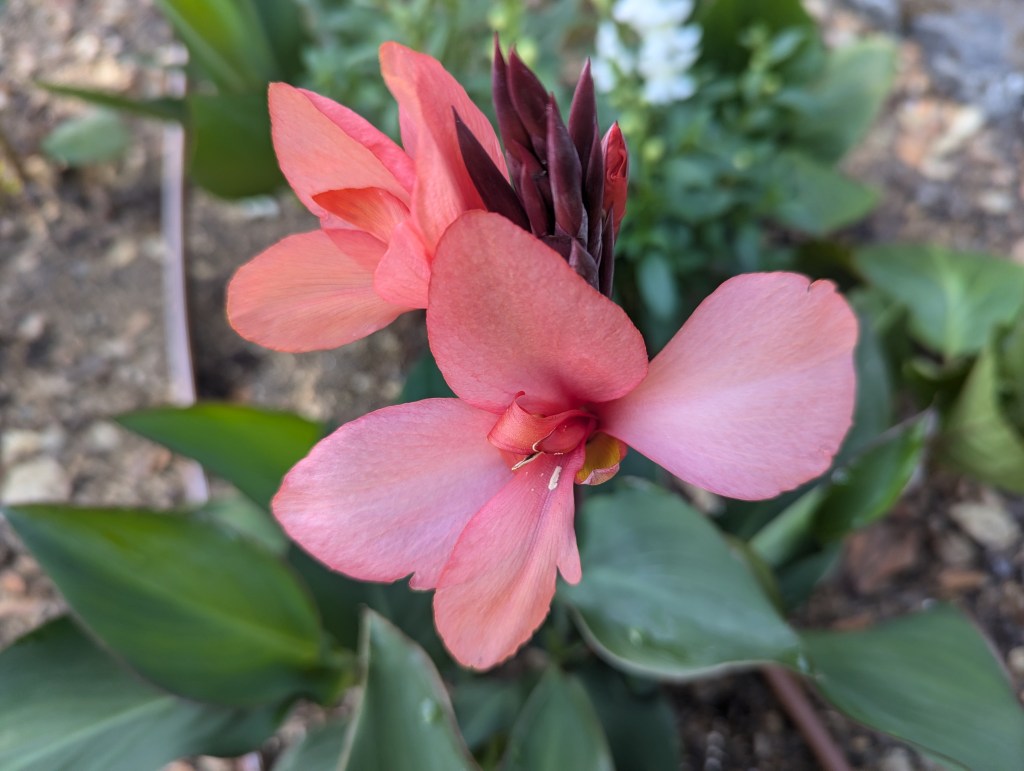
Lily of the Nile, Daylily, Kaffir lily and African iris are very simple to propagate by division. Once separated, either after bloom or while dormant, their rhizomes grow as new plants. Many perennials actually perform better after occasional division. It alleviates congestion by providing more space to grow and bloom. Canna and ginger rhizomes grow very fast. Canna may benefit from annual division.
Tangly Cottage Gardening was a primary destination of my vacation. I posted pictures of it last week. These are six more species that I received as gifts.
1. Acanthus spinosus, armed bear’s breech has the strangest common name of these six. Is the bear armed or just its butt? Regardless, I happen to like common Acanthus mollis, and had coincidentally been wanting to try this less common species as well. Now, I will.
2. Echinops ritro, globe thistle was a minor crop where I worked with cut flowers during the summer of 1986. I did not enjoy harvesting it then, but recently, I had coincidentally been wanting to add a single specimen to my garden. I just could not think of an excuse.
3. Helenium autumnale, common sneezeweed also has an amusing common name. I am unfamiliar with this species, although its botanical name somehow seems to be familiar. I got three distinct cultivars of it now! If we were not already acquainted, we will be now.
4. Brachyglottis greyi, daisy bush has a contrarily mundane common name. Many other species could easily qualify for its name. Somehow though, it makes it more compelling. Now, I want to see what makes it distinct from all other daisies, bushes or daisy bushes.
5. Leycesteria formosa, Himalayan honeysuckle or pheasant berry is yet another species that I had coincidentally been wanting to acquire. I embarrassingly did not recognize its name initially. I was told that I would find its flowers to be more appealing than its fruit.
6. Lupinus, lupine is regifted and unidentified. I do not know if it is annual or perennial. Because it was grown in a can rather than merely shared as seed as annuals should be, I suspect that it is perennial. I will find out. This one can contains several swell seedlings.
Like pampas grass, periwinkle and the ivies, English daisy, Bellis perennis, has a bad reputation as an aggressive weed. The primitive species with single white flowers with bright yellow centers is very difficult to eradicate once it becomes established in lawns. The first phase of bloom in early spring can be profuse enough to resemble thin patches of snow that appear as the weather gets warmer instead of colder.
Varieties that are sometimes found in nurseries are much better behaved and more colorful. Their red, pink or white flowers are typically double, and stand on stems about three inches high. Their rich green, inch and a half long leaves make six inch wide clumps that are compact enough to mix with other small perennials in borders, urns or large pots. Deadheading (removal of fading flowers) is a bit tedious for so many small flowers, but promotes continued bloom. English daisy is very easy to propagate by division.
If necessary, Oregon grape can be pruned to the ground now.
Spring has sprung; and winter has wenter . . . or whatever winter does to get out of the way of spring. Plants are more active now than at any other time of year. Deciduous plants that were dormant and bare through winter have already started to bloom and produce new foliage. Evergreen plants are now making new foliage to replace their tired old foliage that lingered through cold, wet and windy winter weather.
Frost is very unlikely this late. It is safe to sow seeds for all sorts of warm season vegetables and annual flowers, like beans, okra, zucchini, nasturtiums and sunflowers. It is likewise time to plant small plants for certain vegetables and flowers that are too slow to start from seed, like tomatoes, peppers, eggplants, petunias and impatiens.
Winter was the time to prune almost all deciduous plants (which defoliate) and many evergreen plants while they were dormant. However, pruning of plants that are susceptible to frost damage needed to be delayed until about now, even if they had been damaged earlier. Premature pruning would have stimulated new growth, which would have been even more sensitive to subsequent frost.
Any lavender starflower, bougainvillea, marguerite daisy or blue potato bush foliage that was damaged by earlier frost can now be pruned away. New foliage should already be appearing. Also, any mushy frost damaged leaves of giant-bird-of-Paradise and banana can be removed, and should be replaced by new foliage as the weather gets warmer.
The end of winter and beginning of spring is also the best time for any necessary severe restorative pruning of plants that can be damaged by frost, as well as many heartier evergreen plants. It is late enough to avoid frost, while early enough to take advantage of the first new growth phase of the season.
For example, lavender starflower that is both overgrown and damaged by frost can be pruned back to the main stems now, instead of merely shorn to remove damaged foliage. If pruned earlier, it would have not only been more sensitive to frost, but would have remained unsightly as long as weather remained too cool for it to regenerate new foliage.
It likewise can not be pruned much later without wasting most of the new spring growth that is presently developing, which would be very stressful and delay bloom. Pruning severely now will be unsightly for the least amount of time before new growth regenerates and blooms. It would also be less stressful, since it coincides with natural dormancy and regenerative cycles.
Privets, junipers, oleanders, photinias, bottlebrush and pittosporums that need restoration should also get it now, not because they are sensitive to frost, but so that they recover as efficiently as possible as weather gets warmer. Besides, bottlebrush, pittosporum and some other plants are susceptible to disease if pruned during winter, because pruning wounds are easily infected during rainy weather.
‘Meyer’ lemon was never my favorite lemon. However, when I grew citrus trees in the early 1990s, it was the most popular of forty or so cultivars. There really is nothing else like it. Relative to other lemons, its fruit is distinctively less acidic, more richly flavored, and sometimes ridiculously abundant. All other lemons are more sour but less flavorful. Besides ‘Meyer’ we grew ‘Lisbon’, ‘Eureka’, ‘Variegated Pink’ and ‘Ponderosa’. Of these four others, only ‘Ponderosa’ is not a mutant of ‘Lisbon’, although its comparably mild flavor and robust acidity suggest that it is. All four grow as small but upright trees. Only ‘Meyer’ naturally grows broader than tall, sort of like shrubbery.
‘Eureka’ lemon inhabits one of the landscapes at work, where it produces enough average lemons for those of us who know about them. I grew cuttings from it for my own garden, but am concerned that, since they are not grafted onto dwarfing understock, they could eventually grow quite large. I also grew an ungrafted cutting of ‘Ponderosa’ lemon for the same landscape at work that the ‘Eureka’ lemon already inhabits, because it happens to be at the Ponderosa Lodge. ‘Ponderosa’ lemon grows with an upright form, but because it naturally stays smaller than ‘Eureka’ lemon and its relatives, I am not too concerned about it growing too large.
‘Meyer’ lemon came to my garden like a stray cat. Well, it is a bit more complicated than that, but it involved about as much planning. The history of how it came to its previous home is too extensive to describe here. To be brief, I installed it into a garden a few years ago because someone wanted it there after previous unsuccessful attempts to grow the same. Then, it needed to be removed prior to the sale of the home. I did not know what to do with it, so brought it here. I canned it and set it aside until space becomes available for it. I really did not expect it to do much until then. I sort of hoped that someone else would want it for their garden, but after we had been through so much together, I also sort of hoped that it would stay here. Anyway, while I was busy ignoring it in its partly shady and less than ideal situation, I noticed that it had produced this single lemon for me over winter. Well, I suppose that it will be a permanent feature of my garden now.
Flowering quince and forsythia set a precedent. Bridal wreath spiraea, Spirea prunifolia, somehow became old fashioned too. All three are only beginning to regain popularity. All are deciduous, so defoliate for autumn and remain bare through winter. They then bloom spectacularly on bare stems for late winter or early spring. Foliage develops after bloom.
Bridal wreath spiraea, like forsythia, develops many upright and arching basal stems. Its stems can grow taller than eight feet, although they are typically a bit shorter. Removal of old stems after bloom promotes growth of new stems, which bloom better. Indiscriminate pruning ruins their naturally upwardly flaring form. A slight bit of partial shade is tolerable.
Almost all bridal wreath spiraea are of the cultivar ‘Plena’. Their double flowers are fluffy but tiny, between just a quarter and a half inch wide. The simple species, and the variety ‘simpliciflora‘ with single flowers, are rare. Regardless of floral form, floral color is limited to white. Foliage might develop yellow color for autumn where autumn weather is cooler.
Rain is less abundant and less frequent now that winter has become spring. Humidity is decreasing. Temperatures are increasing. Moisture within both the soil and the air is less abundant than it had been. Irrigation that discontinued as the rainy season began should resume soon. Only supplemental watering compensates for the increasing lack of water.
Warmer and drier weather does more than simply deprive vegetation of natural moisture. It also accelerates new growth of formerly dormant or partially dormant vegetation. Such growth requires more moisture as it becomes less available. Increasing day lengths with intensifying sunlight enhance this need for watering. Although natural, it all seems ironic.
This recent need for watering is progressive. Rain still sometimes interrupts it, but will be less frequent as spring progresses. Rain will be very unlikely after later spring. Humidity will continue to decrease as temperatures continue to increase. Watering frequency and volume must increase accordingly. They might not begin to decrease until after summer.
Soil composition and texture also influence the increasing need for watering. Organically rich soils retain moisture more efficiently than sandy soils, for example. Gravely soils that drain well may necessitate frequent watering, even if less copious. Potted plants require frequent watering because they can not disperse roots. Hanging pots require even more.
Furthermore, different types of vegetation need different or specialized types of watering. Fibrous but shallow roots usually need frequent watering, even if they do not need much. Species with deep roots usually need watering less frequently. Some of them need more significant volumes of water than others. Some vegetation prefers only minimal watering.
With all these many variables, there are no simple formulas to determine watering rates. Manual irrigation is easiest to monitor, but is also tedious. Automated irrigation, although less tedious, requires more diligent monitoring. For any particular type of vegetation, soil should not remain too dry for too long. Also, vegetation should not exhibit any symptoms from desiccation.