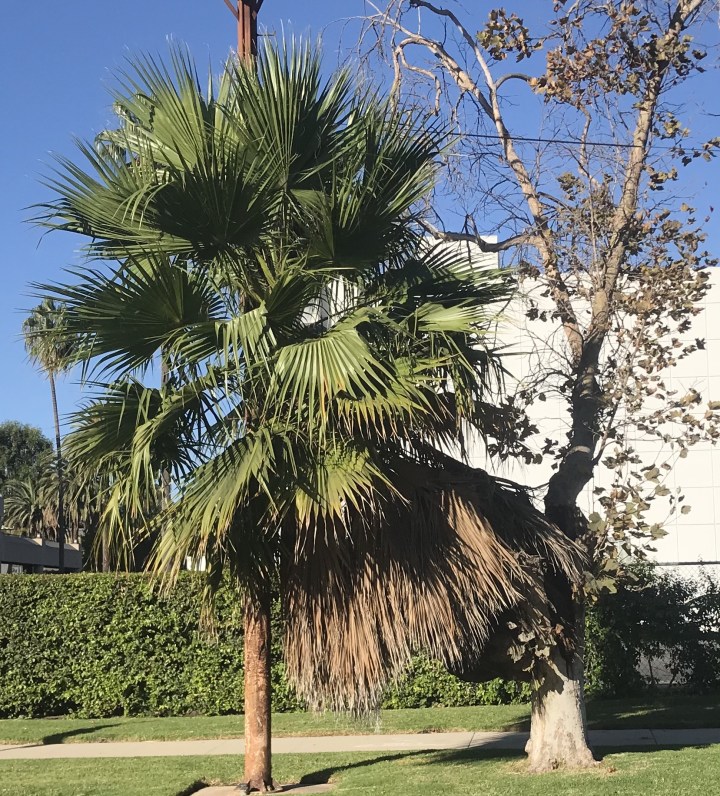
 A plant that clings to another plant for support without parasitizing it is an epiphyte. Some do it to get a bit more sunlight closer to the ceiling of a dense forest. Others do it to get up off of the forest floor to avoid competition with conventionally terrestrial plants. Maybe some just want to avoid grazing animals. It is often difficult to determine why plants do what they do.
Spider plants, ephiphyllums and many types of orchids, bromeliads and ferns are some of the more familiar epiphytes. Most do not actually cling to trees. They instead live in the crotches of limbs where debris from the foliar canopy above accumulates. Either way, they do not need much organic matter in which to disperse their roots, and some need none at all. Many collect what they need from the air and precipitation.
This is not about an epiphyte.
It is about a Mexican fan palm that thought it was epiphyte.
You might have though that the picture above depicts a common Mexican fan palm next to a surly London planetree. With closer inspection, you will notice that the palm lacks a trunk at ground level. The utility pole visible below the palm is not attached to it, and does not support it. Yet, the palm does not just hover there. It grew from a cavity in the London planetree.
Most of us know how many plants self sow in weird places. Sometimes they appear where they are welcome. Usually, they end up in pots with other plants, too close to pavement, or in rain gutters that have not been cleaned out enough. Of course, big trees commonly appear under utility cables. Once in a while something self sows in a decaying cavity of a tree.
Most of us have enough sense to remove self sown trees and plants that appears where they can not live for long without causing problems. Those of us who hire gardeners tend to trust and hope that the gardeners would exhibit the same sort of common sense. After all, that is part of what they are payed significant money for.
Unfortunately, Mexican fan palms are not epiphytic. They are just too heavy, even when young.

 One of the big four for mild climates, sweetgum, Liquidambar styraciflua, develops an excellent display of mixed yellow, orange and red, regardless of how quietly autumn tries to sneak in. Of the other three, Chinese pistache is more orange with less yellow, flowering pear is more ruddy, and gingko is only bright yellow. They all get very flashy color, but sweetgum just might be the flashiest.
 There may not be a good time to talk about it this year. The late warmth really put a damper on some of the autumn foliar color. Some trees are dropping their leaves as soon as they start to turn color, leaving only fading green leaves in their canopies. Only the most reliable trees for autumn color, sweetgum, Chinese pistache, flowering pear and gingko, are trying to make up for lost color.
 Perhaps I should see this movie. I hear that it is pretty lame. I sort of wanted to see it because it was filmed in Cambria, about thirty miles to the northwest of where Brent and I were in our last year of studying horticulture at Cal Poly in San Luis Obispo at the time. Yet, I never select movies. I always leave that up to whomever I am seeing the particular movie with. None of my friends ever wanted to see Arachnophobia. The one friend who you would think would want to see it because of where and when it was filmed wanted nothing to do with it. You see, Brent, the famous horticulturist and landscape designer who works outside where spiders live, is afflicted with Arachnophobia.
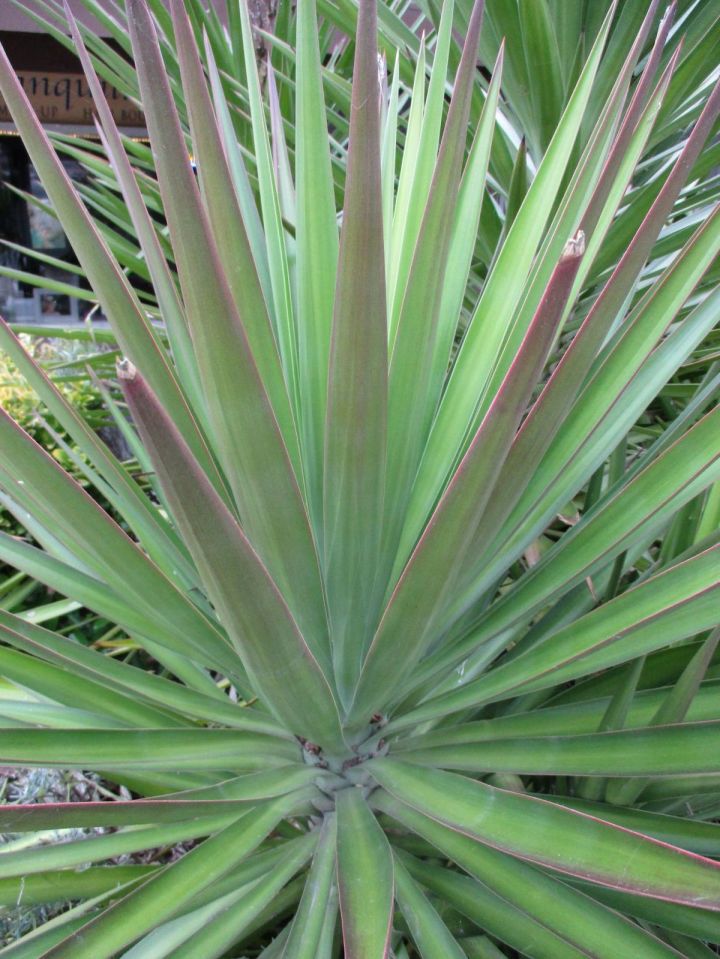 From a simple picture, Spanish bayonet, Yucca aloifolia, is indistinguishable from the common giant yucca. The narrow leaves are about two feet long, and flare upward and outward from terminal buds. Plump conical trusses of waxy white flowers with purplish highlights stand vertically just above the foliage. The main difference is that the leaves are more rigid than they appear to be, with nastily sharp terminal spines.
 There are many reasons why fireplaces and their chimneys are not such a safety concern like they were decades ago. Only a few modern homes are even equipped with them. Installation of a new fireplace is outlawed in many municipalities, even if a fireplace gets damaged by an earthquake, and should be replaced. Urban sprawl has replaced almost all of the orchards and woods that once supplied affordable fuel.
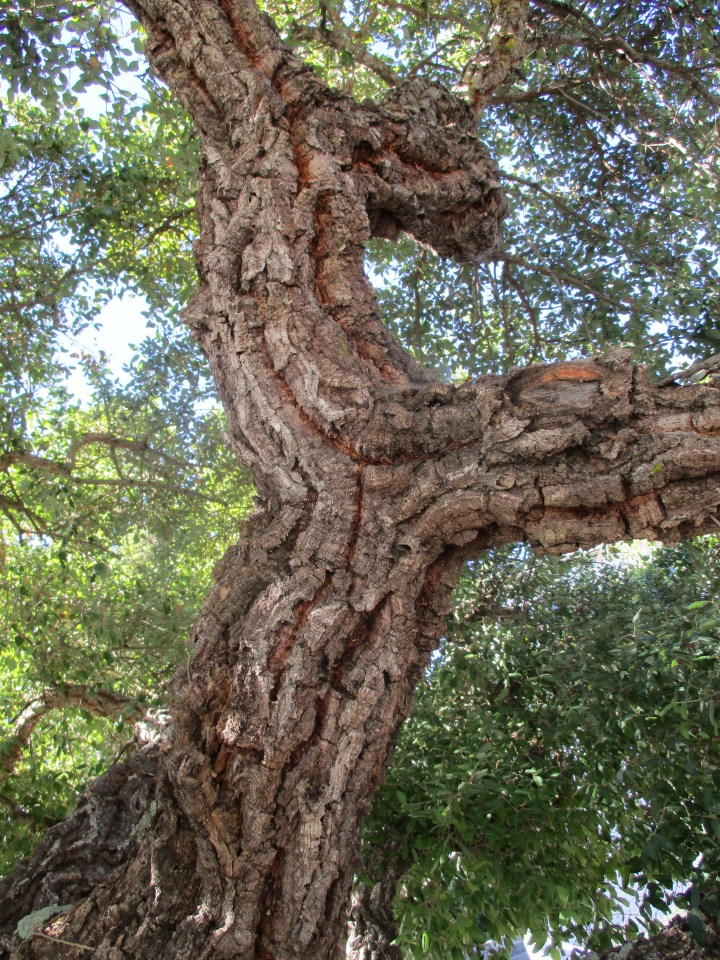 Like redwoods, the cork oak, Quercus suber, is a ‘pyrophyte’, which means that it survives forest fires that burn off competing vegetation. The trunks and main limbs are insulated with a very thick bark. Only the foliage and smaller stems burn off. After a fire, the upper limbs of cork oak regenerate new foliage while other less fortunate plants start over from their roots or seed at ground level.
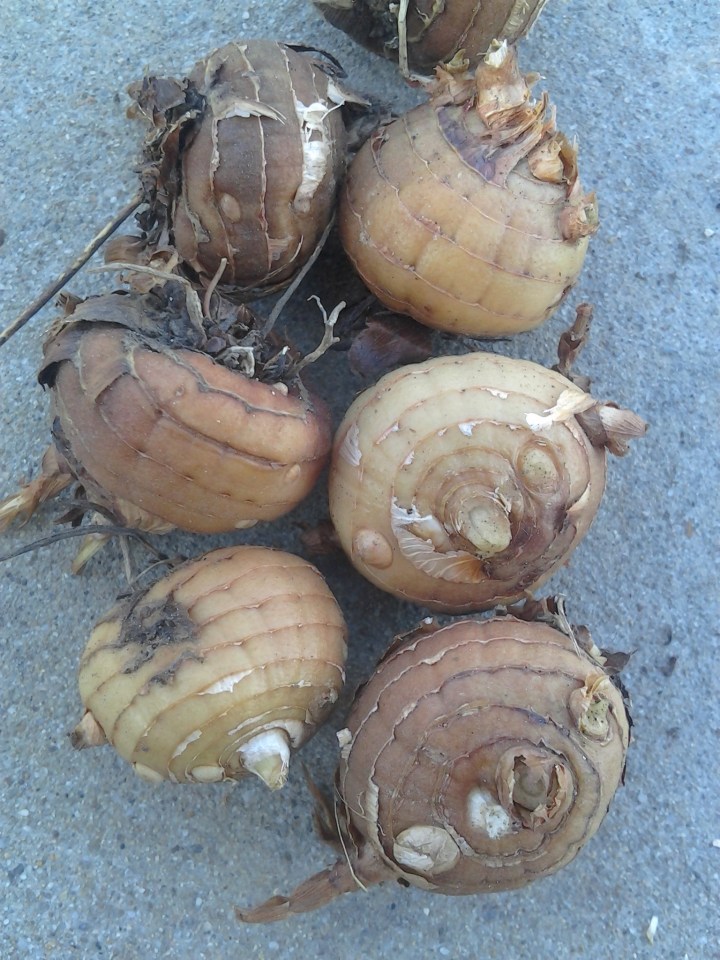 Of all the gardening chores, planting dormant bulbs is probably the least gratifying. All we do is dig a hole to the required depth and width, set a few unimpressively dormant bulbs with the correct orientation and spacing, and then fill the hole with the same soil that was removed from it. The process gets repeated until all the bulbs are planted. Soil amendment and fertilizer might be added.
