Horridculture – Common Names

Snowdrop is Galanthus nivalis. Snowflake is Leucojum vernum. Snowdrop is the rarer of the two. I have seen it only in pictures from other regions. The potential for consequences of its misidentification are therefore quite minimal. That is fortunate. I learned Leucojum vernum as snowdrop. Locally, no one ever corrected this transgression, probably because no one here was aware that it was a transgression. Most likely learned it the same as I did. Similarly, we learned heaths as heathers. Since heathers are very rare here, there is not much to compare heaths to. Fortunately, snowdrop, snowflake, heath and heather all have botanical names, which are universally the same everywhere. Well, at least they should be. During the past few years, I have noticed that the tree that I leaned as Eucalyptus pulverulenta is now Eucalyptus cinerea, and what I knew as Eucalyptus cinerea is now Eucalyptus pulverulenta. It is as if the two have simply traded names. Now that more information than ever in history is so readily available online, it is amazing what information is unavailable. I can confirm the identity of neither species of Eucalyptus! Many modern cultivars, particularly hybrids, lack species names between their genus name and cultivar name, as if such designations are no longer important. In that regard, their botanical names are no more defining than their common names. At least some of the common names are entertaining, such as pig face, pig squeak, chicken liver plant, brazen hussy, naked lady, twisty baby, mother-in-law’s tongue, sneezewort, shaggy soldier, corpse flower, sticky monkey flower, bear’s breeches, sticky willy, turkey tangle frog fruit, laurel-leaf snail seed, love in a mist, love in a puff, dead nettle, butter and eggs, teasel, fleabane and yesterday, today and tomorrow. Goodness, that is a big list, and it could go on.

Stock

Stylishly colorful stock is alluringly fragrant.

Marigold is a warm season annual that gets more popular later than earlier in its season. It is prominent for autumn but does not last for long into winter. Stock, Matthiola incana, is a cool season annual for the opposite extreme of the year. It is popular for late winter and spring but may not perform well into summer warmth. It is unreliable as a perennial here.

Stock bloom can be white, or rich shades or pastels of purple, red, pink, yellow or cream. Most bloom is double, but some is single. Floral fragrance is alluringly rich and complex. It resembles that of carnation, but is notably stronger. The narrow leaves are oblong with pastel grayish green color. Removal of deteriorating bloom promotes subsequent bloom.

Garden varieties of stock are quite different from florist varieties. For home gardens, most popular stock is relatively compact, and blooms freely. Florist stock is taller, and tends to bloom abundantly but at about the same time. In home gardens, florist stock may require staking if it grows as tall as three feet. Home garden stock may grow no taller than a foot.

Warm Season Annuals Start Early

Nasturtium grows best directly from seed.

Cool season annuals that started late last summer should be finishing soon. A few might have potential to continue as perennials. However, about as many are done or decaying. Now, warm season annuals, or summer annuals, should eventually start to replace them. If it seems early, it typically does for such bedding plants before their respective seasons.

Some annuals can not decide if they are cool season annuals or warm season annuals. Stock is actually a cool season annual but becomes more popular now for spring bloom. Wax begonias might have survived through winter to resume growth for another season. Primrose is a cool season annual that rarely gets too warm locally to continue blooming.

These indecisive annuals can actually be an asset to home gardens. Stock, for example, can replace old pansies while it is still too early for petunias. It compensates for cool and warm season annuals with more definite seasons. Petunias will be ready before stock is done. Some garden enthusiasts replace seasonal annuals for each of their four seasons.

Warm season annuals, like all annuals, are contrary to sustainability. Although many can perform as perennials, few actually do. Those that truly are annuals complete their entire life cycles within one year. Their main purpose is to provide floral or perhaps foliar color. Texture and form are also assets. Annuals are popular because they serve this purpose.

The most popular of warm season annuals grow from cell packs. Those that start earliest are already available, including wax begonia and lobelia. Petunia, impatien and annuals that crave more warmth will become available later. Four inch potted annuals are bigger than those in cell packs, but more expensive. They are even more expensive in quantity.

Many more varieties of warm season annuals are available as seed. Countless more are available online than from nurseries. However, seed requires more effort. Most must start early. Although most grow well in flats or cells, some prefer direct sowing. Sunflower and nasturtium are very vulnerable to the distress of transplanting. Seed is the logical option. Many seed are less expensive than six cell pack seedlings.

Six on Saturday: Scion Exchange

‘Beurre d’Anjou’ pear has been elusive. I visited the Scion Exchange of the Monterey Bay Chapter of the California Rare Fruit Growers to find scions, but none were unavailable. I got the few other scions and cuttings of the first three of these Six instead. That was two weeks ago. Some other deciduous vegetation is beginning to demonstrate that there was not much time to spare. Oddly, one banana tree did not bother with dormancy this year. It seemed to be comfortably sheltered.

1. Pomegranate, persimmon, caprifig, white mulberry and black mulberry cuttings are a bit too numerous to cite with their botanical and cultivar names. Most lack labels since I can identify them as they grow. They are plugged into the same can to occupy less space.

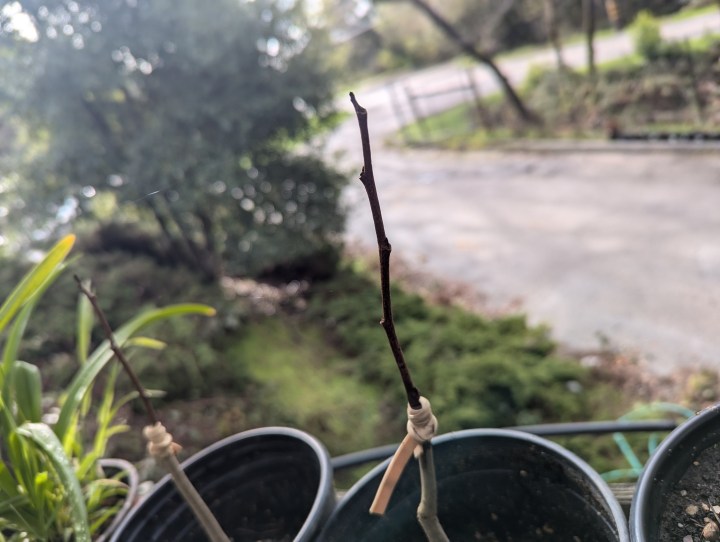
2. ‘Allegheny’ pawpaw scion is hopefully happily grafted onto seed grown understock. It is longer, with more buds than I would have preferred, but is rather thin. ‘Mango’ to the left is even dinkier. Three other small seed grown trees remain ungrafted without scions.

3. ‘Seckel’ and ‘Beurre d’Anjou’ pear were what I came for. I did not find ‘Beurre d’Anjou’ but this is ‘Seckel’. The quince understock is big enough for a pair of cleft grafted scions. Basal scraps from the scions were plugged as cuttings. Redundancy could be useful later.

4. Sambucus racemosa, red elderberry reminds me that winter dormancy will be ending soon for most deciduous plants. Grafting, bare root planting and dormant pruning must therefore be done sooner. Norway maple might be the last deciduous species to refoliate.

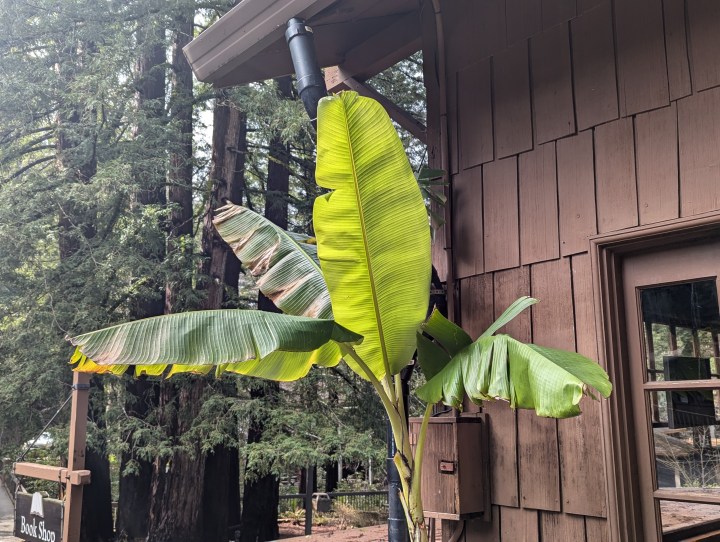
5. Musa acuminata, banana trees look so shabby after even minor frost that their foliage gets cut back. This unidentified specimen stayed nicely foliated under the eave and close to those uninsulated walls of the associated building, which happens to be a coffee shop.

6. This happens to be on the menu board of the coffee shop, which happens to be within view from where the banana tree that did not get frozen is situated. Another banana tree that is just a few feet away but unsheltered was deprived of the last of its frosted foliage.

This is the link for Six on Saturday, for anyone else who would like to participate: https://thepropagatorblog.wordpress.com/2017/09/18/six-on-saturday-a-participant-guide/

‘Minneola’ Tangelo

‘Minneola’ tangelo fruit is slightly tart like a grapefruit, but richly flavored like a Mandarin orange.

Of all the citrus that ripen about now in winter and early spring, oranges, lemons, limes, grapefruits and mandarin oranges (or mandarins or tangerines) are the most familiar. (A tangerine is merely a mandarin that was developed in the Americas.) Kumquats, blood oranges, sour oranges, citrons and many of the odd citrus hybrids that are less common are becoming more popular as their fruit becomes more available in markets, and their trees become available in nurseries. Except for the very popular ‘Meyer’ lemon, which is actually a hybrid of an orange and a lemon, the most popular citrus hybrid is likely the ‘Minneola’ tangelo, which is a hybrid of a grapefruit and a mandarin orange. Other tangelos remain somewhat rare.

Like all citrus, ‘Minneola’ tangelo has appealingly glossy evergreen foliage and fragrant flowers. They can be grown in containers if their roots are dug, pruned and planted again every five years or so. They like regular watering, good drainage and mulch. Aphids, mites or scale can become problematic. Suckers from below the graft should be rubbed off as they appear. (The graft union can be identified by the change in bark texture and color on the main trunk just a few inches above the roots.)

‘Minneola’ tangelo trees get a bit larger than mandarin orange trees, but not as large or quite as full as grapefruit trees. The bright reddish orange fruit has all the flavor of mandarin oranges, and is just as easy to peel, but unlike the majority of mandarin oranges, has few seeds, and can be left on the tree through spring. The fruit is a bit smaller than that of ‘Valencia’ orange, and has a distended bump where the stem is attached. Flavor develops best in warmer parts of the garden, particularly after warm summers.

Renee’s Garden Seed

‘Alaska’ is a popular variegated variety of nasturtium that is available from Renee’s Garden Seed.

There is no shame in growing nasturtiums. We all know how easy they are to grow, and that they can even naturalize. Some of us even consider them to be weeds. Some of us even know them as ‘dago pansies’! Yet, they are colorful, have an abundance of appealing foliage and never seem to have a bad day. Anyone who doubts this should look at Renee’s Garden Seed Catalogue online at www.reneesgarden.com.

Renee’s Garden Seed Catalogue is like a wine list of the finest nasturtiums, even though it also includes many of the more traditional types. ‘Buttercream’ is a new nasturtium this year that blooms with semi-double cream colored flowers! Pale yellow ‘Moonlight’ and bright scarlet ‘Spitfire’ are two climbing nasturtiums that get several feet tall.

Even those of us who primarily want to get vegetable and herb seeds will want to try some of the many unusual flowers, as well as some of the more traditional flowers that are available from Renee’s Garden Seed Catalogue. Besides nasturtiums, there are also many different kinds of sweet peas, sunflowers and morning glories. ‘April in Paris’ is an intensely fragrant sweet pea with large pale yellow flowers that become blushed as they mature. ‘Royal Flush’ is a new sunflower with bi-colored flowers in combinations of gold, dark red and brown. ‘Mailbox Mix’ morning glories have both clear blue and white flowers.  

Mixed seeds may not seem like a good idea for those of us who like organized gardens; but Renee’s Garden color coded vegetable seed mixes have a distinct advantage. The seeds of different varieties within a mix are dyed different colors so they can be separated if desired. It is like getting a few packets of different seed within each mix. Individual packets of seed typically contain more seeds than necessary anyway. (Not all mixes are color coded.)

(Outdated information has been omitted from this recycled article.)

Horridculture – Mail Order Glitch

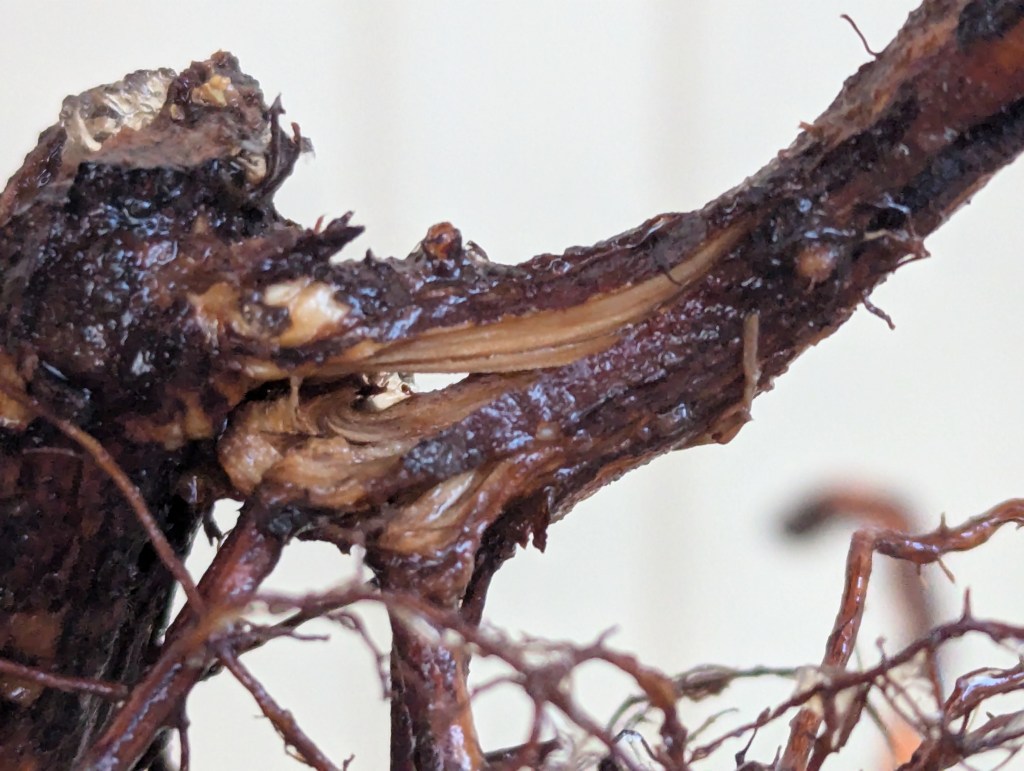
Of a dozen or so items of a mail order purchase that included various cane berries, mulberries, grapes and mayhaws, only a ‘Cumberland Black’ raspberry was less than exemplary. Unfortunately, it was majorly less than exemplary. It was broken at the base of its newest cane, just above where it extended from the older cane that the cutting was made from. If only it had not been broken, it would have been an excellent bare root specimen, with more roots than typical, and a substantial cane with several plump and turgid buds. I realize that it could either extend new canes from latent buds just below where it broke, or extend new roots from the base of the younger cane just above where it broke; so I should simply wait to see what it does. It could even do both, to provide me with two specimens for the price of one. However, I also realize that it could potentially do neither, but instead succumb to its damage. Regardless, its recovery from such damage should not be my concern. It is not in a condition that I intended to purchase it as. The provider should either provide a replacement, or refund what was paid for this particular item. Instead, I was instructed to wait to see if this damaged raspberry cane recovers. Well, at least I got a response. Perhaps that is all that is necessary. I am now more intent on keeping this raspberry cane alive, partly because I doubt that its purchase would be refunded if it succumbs to its damage, and partly because I would likely be to embarrassed to request such a refund if it becomes justifiable. Besides, as I mentioned, all other items of the purchase are of exemplary quality. I should be satisfied with that.

Canna

Cannas are as foliar as floral.

Not many summery bulbs provide as much immediate gratification as Canna. They grow very fast as soon as the weather begins to warm at the end of winter. They could become a bit too invasively vigorous for some situations. Canna are almost too easy to propagate by division. They probably perform better with annual thinning, preferably while dormant.

Dormant canna rhizomes are now available from nurseries. Potted specimens should be available a bit later. Canna, though, might be as available from friends or neighbors who grow too many. They crave frequent irrigation, and can inhabit riparian situations such as ponds. Although they are not too discriminating about soil, the prefer organically rich soil.

Canna foliage is about as lush and striking as its bloom. It can be green, various shades of bronze or variegated with white, yellow or bronze. Flowers can be thin and ribbony, or big and billowy. Floral color is various hues of yellow, orange, red, pink, or rarely creamy white. Flowers are commonly spotty or blotchy. Some canna grow higher than eight feet. Dwarf cultivars bloom splendidly without growing taller than two feet.

Summery Bulbs After Spring Bulbs

Many summery bulbs bloom only once.

Spring bulbs prefer an earlier start, and several appreciate a bit of winter chill. Summery bulbs, or summer bulbs or late bulbs, prefer a later start to avoid such chill. Most tolerate minor frost, but none benefit from it. If too early, some can start to decay while waiting for warmer weather. Some can grow prematurely, and perhaps incur damage from late frost.

Summery bulbs are in season now because they take a bit of time to grow. The potential for frost should be minimal as their foliage emerges above their soil. Once established in their first seasons, many could stay in their gardens indefinitely. They should be resilient to minor frost by their second seasons. Most that incur damage should recover efficiently.

However, many summery bulbs are not reliably perennial. Cannas and gingers can grow aggressively enough to become invasive. Gladiolus, though, may bloom half as much for subsequent seasons until none remain. Some who like to grow dahlias prefer to dig and store the tubers through winter. This is more likely to protect them from rot than from frost.

Incidentally, few summery bulbs are actually bulbs. Most are perennial rhizomes, corms, tubers or tuberous roots. Some, especially those that grow from tubers or tuberous roots, bloom longer. Those that grow from bulbs, corms and rhizomes mostly bloom only once. Succession planting prolongs their first bloom seasons, but they synchronize afterwards.

After their summer bloom seasons, most summery bulbs defoliate for a winter dormancy. This is actually why they are in season now. After all, winter dormancy is the best time for transplanting, division and thinning. Cannas and gingers could try to retain some foliage through winter. Cutting it all back might be easier than grooming it from new foliage later.

Dahlias might be the most popular of summery bulbs. Cannas and gingers are likely the second most common. Alliums and old fashioned tuberous begonias are becoming more popular. Tuberous begonias are not so easy to grow, though. Crocosmias are too easy to grow, and are invasive. Alocasias and colocasias provide colorful and boldly big leaves.