Insect Pathogens Prefer Less Biodiversity

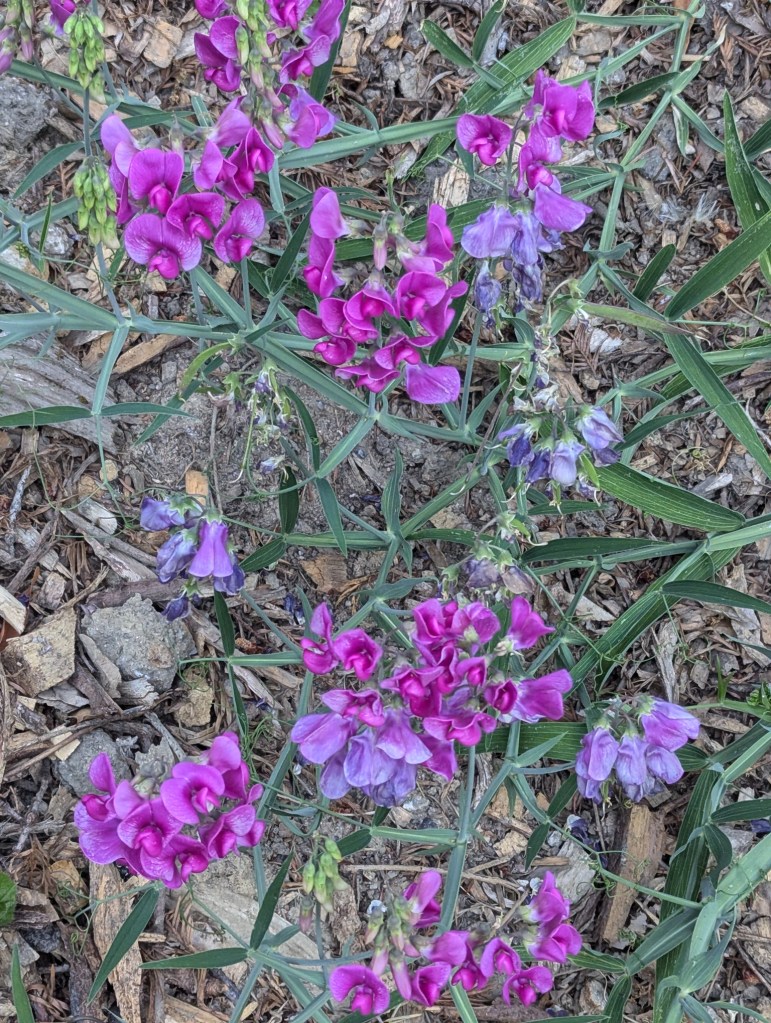
Wildflowers and even weeds promote biodiversity.

Weeds grow, bloom, disperse seed and die a natural death without much trouble. This is especially frustrating while insect pathogens destroy desirable vegetation. Weeds seem to be more resilient to insect infestation and damage. Many actually are. They use nature to their advantage. Cultivation of desirable vegetation interferes with natural biodiversity.

Those who enjoy gardening do not want to consider it to be unnatural. Nonetheless, it is. It involves many exotic species that are not natural components of regional ecosystems. Breeding to improve their performance unnaturally compromises their vigor. They rely on unnatural irrigation and perhaps fertilization. They sustain many exotic insect pathogens.

Most species within home gardens could not survive for long without cultivation. Several that can unfortunately become invasively naturalized. In the process, most that benefited from breeding revert to a feral status. Some eventually enjoy more biodiversity in the wild than in cultivation. They rely on naturally beneficial insects to mitigate insect pathogens.

Insect pathogens are quite often more problematic than weeds. However, generally, they are less problematic than they were years ago. This is partly a result of improvements of modern horticulture. Strangely though, it is also partly a result of sloppier gardening. Old fashioned monoculture for big areas is passe. Biodiversity became an incidental benefit.

More species of vegetation sustain more insect species. This might not have qualified as an advantage years ago. Now, garden enthusiasts are more aware that some insects are predatory of others. Predators may not eliminate all insect pathogens, but they often limit infestations. With adequate limitation, damage is likely to be tolerable or inconspicuous.

This is one of two primary reasons that insecticides are less common now. Besides their potentially hazardous toxicity, they are simply less necessary. When they are necessary, modern insecticides target more specific insects. They can kill pathogens without hurting beneficial insects. Vegetation that too frequently needs insecticides becomes unpopular.
What Is This IV?!

Rotheca myricoides / Clerodendrum myricoides ?

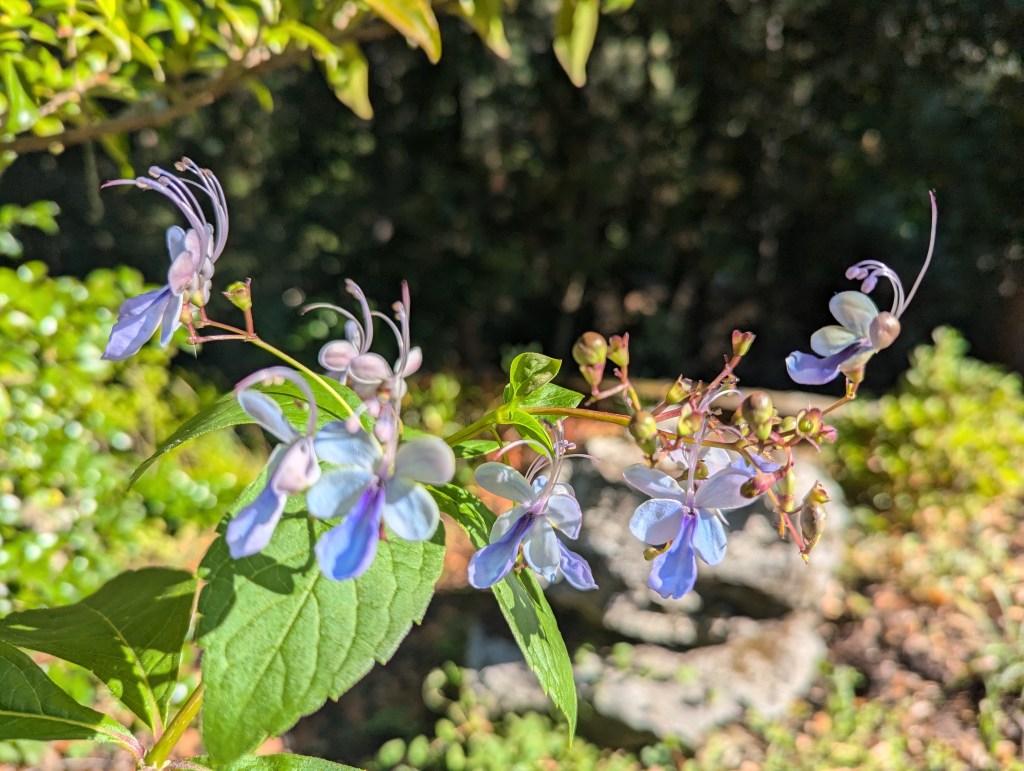
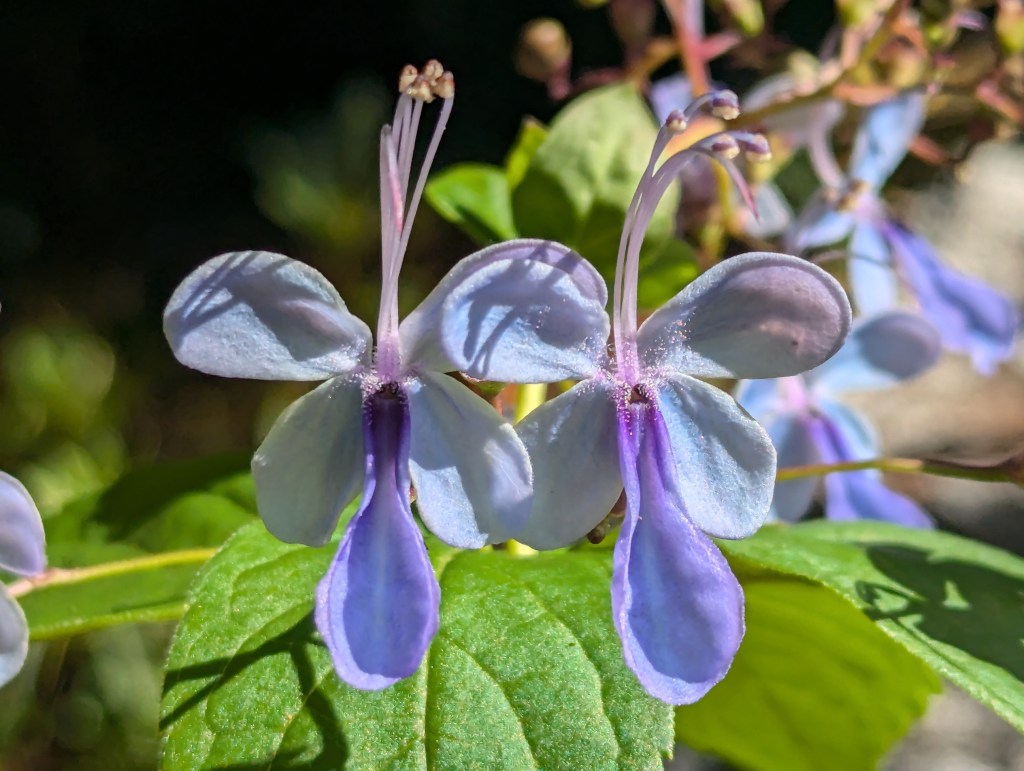
It is not a species of ivy. ‘IV’ is merely its Roman numeric designation as the fourth species that I am unable to identify since I started assigning numeric designations to them. So then, what is it? I suspect that it is likely Rotheca myricoides, which is alternatively known as Clerodendrum myricoides. ‘Ugandense’ is a cultivar name that, in typical modern tradition of botanic nomenclature that violates the simple standards of botanic nomenclature, now seems to be an acceptable species name in conjunction with either genus name. Its common names include butterfly flower, blue butterfly plant and blue butterfly bush, although the latter sounds more like a cultivar of Buddleia. I have not actually confirmed its identity, and I have no idea how it got into one of our landscapes. It grew under the carcass of a Brunfelsia pauciflora, yesterday, today and tomorrow, which did not survive my meager attempt to salvage it from compost. I can only assume that it arrived, most likely as an ungerminated seed, with the now deceased yesterday, today and tomorrow. It initially grew quickly with only two straight canes about four feet tall. I would have pulled it as a weed, but was intrigued by it. It did not grow much this year, but instead took time to branch, and is now taking time to bloom with these few intricate flowers on top. I am now pleased that I did not pull it as a weed. If it really is butterfly flower, it can get a bit taller than it already is. So, because it grew in front of an exemplary sasanqua camellia, I will likely relocate it to a more appropriate situation during its winter dormancy. I am fond enough of its sky blue flowers to propagate a few more copies of it.

The delicate pastel blue flowers are prettier up close.

Second White

How did this get in here?!

Lily of the Nile had previously been exclusively blue at work. Many from undoubtedly several different sources had been added to the landscapes for the past century or so, but, until recently, none were white. Even within a large and likely original colony, where genetic variability is evident among specimens that were added from different sources, or that grew from seed over the years, all bloomed monochromatically blue. I added the first white lily of the Nile only a few years ago. They are a significant herd of the same cultivar that I grew from only seven original pups that I acquired in the early 1990s. They are separate from the other lily of the Nile, in a neat row in front of the White Garden of el Catedral de Santa Clara de Los Gatos. They are not as fancy as they sound of course, and bloom with only a few flowers in the partial shade there, but they were supposedly the only white lily of the Nile. However, I recently found this other white lily of the Nile within the large and very established colony that provided many lily of the Nile for other landscapes. It could have grown from seed, and finally matured enough to bloom. I suspect that it merely reverted, as lily of the Nile sometimes does. I suppose that I should be pleased with it, but I am not so certain. It is almost intrusive, both to the exclusivity of the single white cultivar, and also to the exclusivity of the monochromatically blue colony. I have noticed within other old landscapes that, once one pup blooms white, others can follow its example. The same applies to a pup that blooms blue within a white colony. I may tag this particular pup for removal after bloom.

Six on Saturday: Homey

Almost nothing is purchased for my garden. Not much more is purchased for work. Just about everything is recycled from somewhere else, along with its history. Consequently, the landscapes are as homey as my home garden is. It is often difficult to not brag about it a bit too much. It is gratifying that others can enjoy so much of what I have enjoyed in my garden. For Six on Saturday, though, I will be brief with my descriptions of these few flowers that bloomed last week. Half are angel’s trumpets. Half are white. Of course, it is no coincidence that white is my favorite color. I requested pruning scraps of single white angel’s trumpet and white orchid cactus. Even if recycling, I may be somewhat selective. It all works out well.

1. Gladiolus papilio, butterfly gladiolus that was budded last week bloomed this week. It makes its landscape feel delightfully homey for me. I should have gotten a better picture.

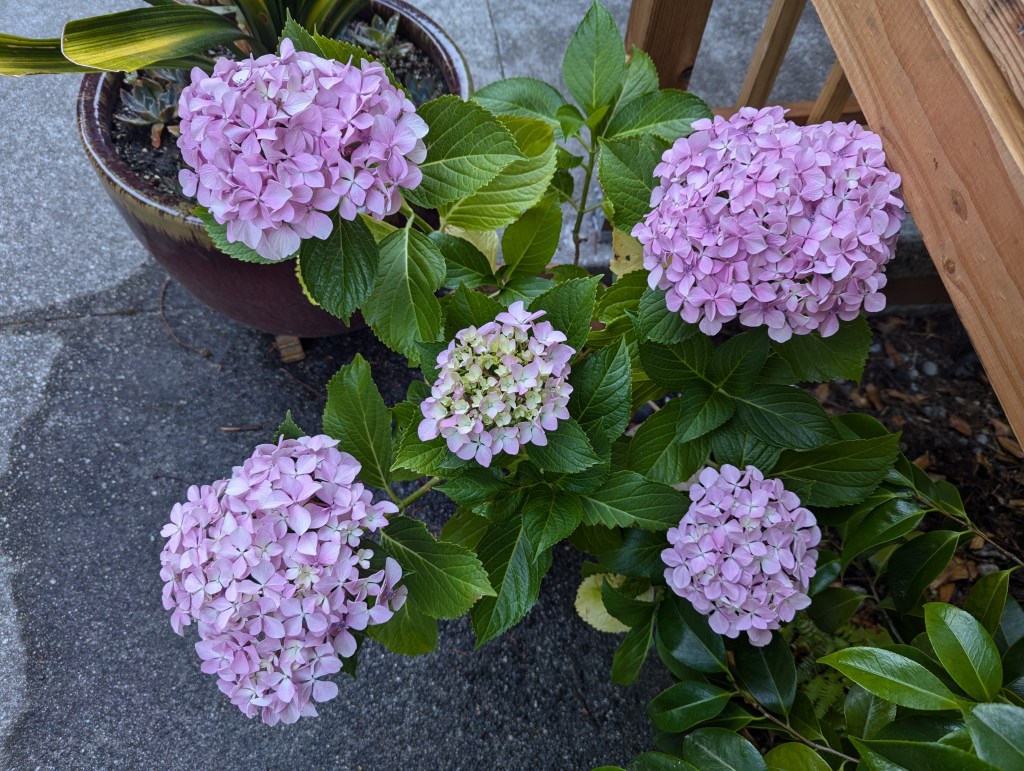
2. Hydrangea macrophylla, bigleaf hydrangea, like so much of what blooms here, came from another garden, then bloomed too well in recovery to not move out to a landscape.

3. Brugmansia, angel’s trumpet of an unidentified cultivar remains unidentified, but is a bit more obviously pink than any other color. Perhaps its cultivar name is not important.

4. Brugmansia candida, angel’s trumpet with fluffy double white flowers is what started all this fuss about angel’s trumpet. Yellow ‘Charles Grimaldi’ was the second acquisition.

5. Brugmansia, angel’s trumpet with single white flowers is an unidentified cultivar that I got merely because I like its single white flowers, but is not so great for the landscapes.

6. Epiphyllum, orchid cactus with clear white flowers remains as unidentified as most of these Six. Like all of these six, it also has important history that makes its garden homey.

This is the link for Six on Saturday, for anyone else who would like to participate: https://thepropagatorblog.wordpress.com/2017/09/18/six-on-saturday-a-participant-guide/

Shore Juniper

Shore juniper is a ground cover that can cascade splendidly.

Like so many other junipers, the old fashioned shore juniper, Juniperus conferta, is recovering from decades of a bad reputation. Through the 1950’s and 60’s, junipers had been so overly common and were so commonly planted where space was insufficient for their mature size that just about anyone who enjoys gardening now likely knows how irritating prickly juniper foliage can be, or how to remove overgrown junipers. I prefer to blame the icky tam junipers for this.

Now that they are actually regaining popularity, junipers seem to be commanding more respect; perhaps with the exception of tam junipers, which are just as useless now as they ever were. Junipers that grow into small trees are getting planted where they can be appreciated for their sculptural forms. Shrubby junipers are being employed as informal barriers where they do not need to be pruned for confinement. The shore juniper, like other low growing or creeping junipers, is a practical ground cover. Mature shore junipers spread about six feet wide without getting deeper than a foot. The finely textured bluish green foliage is actually a bit more bristly than it first appears, with small pine needle shaped leaves. The soft berries are lighter grayish blue to purplish black. ‘Emerald Sea’ has greener foliage that seems to be a bit more lax. ‘Blue Pacific’ has denser and more bluish foliage.  

Container Gardening

These containers are almost completely obscured by their contents.

Container gardening is one of those trends that I could do without in my own garden. Even though I know that it is actually very practical for several reasons, I prefer to grow as much as I can directly in the ground because I do not want to take care of contained plants. However, even with only minimal potted plants around my garden, the steep embankment above my driveway has reminded me of one of the many reasons why people like to grow plants in large or hanging pots, elevated planters or window boxes. There are just so many plants that look so good cascading out of containers.

The lily-of-the-Nile that I planted on top of part of the embankment to hold the soil together actually look really cool leaning over the top edge, and would look just as good in large planters. The smaller ‘Peter Pan’ lily-of-the-Nile is more proportionate to smaller urns. Since these do not hang over the edges too far, they look even better mixed with more pendulous plants like trailing rosemary, verbena, ivy geranium and dwarf periwinkle. Upright plants like fuchsia and smaller types of New Zealand flax in the middle of mixed plants add good contrasting form. Dracaenas (Cordyline spp.) were traditional vertical accent plants of Victorian gardening.

Low planters and pots, as well as many hanging pots, are very often best outfitted with traditional cascading annuals like lobelia, sweet alyssum, petunia, portulaca and my favorite, nasturtium. Even if annuals that do not cascade are the central features of mixed planters, cascading plants around the edges really maximize the show by spreading even more flower color over the exteriors of the containers. Colorful perennials like fibrous begonias, busy Lizzie, campanula, fleabane, scaevola and dusty miller may not cascade as well as the annuals, but add width, and probably cascade adequately for ‘artfully’ designed pots that are too appealing to obscure completely.

In sheltered lanais and porches, spider plant, burro tail and wandering Jew are classic solitary perennials for hanging pots. What orchid cactus lacks in form and foliage, it makes up for with bold flowers.

The largest pots and planters can benefit from simple ground covers like shore juniper and English ivy, perhaps dressed up with flowering annuals. Gazanias can provide their own flowers, so can instead be dressed up with the colorful and textural foliage of blue fescue or another grassy perennial. Asparagus densilforus has such bold texture and form alone that it does not necessarily need the color of annuals.

P II

Hibbertia scandens

P was for pea last Sunday. Although the spelling has not changed since then, this is a different topic now, so is not actually a sequel. P just happens to also be for the floral fragrance of Hibbertia scandens, which, to some, resembles that of what tomcats do to designate their territory. Its several common names are no more appealing. It is known as golden guinea vine, climbing guinea flower and twining guinea flower. Rather than possibly offending others of Italian descent, I refer to it simply as snake vine. Contrary to its several other common names, it is not actually from the Guinea Region of Western Africa, but is instead from Eastern Australia and New Guinea. Incidentally, New Guinea is no more affiliated with Western Africa than it is with descendents of Italian Immigrants in America, or plump rodents who identify as pigs of the Andes Mountains on the West Coast of South America. I got a few cuttings of snake vine at the end of last September. One cutting is growing quite nicely. Another took time to bloom with this single flower that looks like Carl Junior did not quite beat the train. Its floral fragrance is almost disappointingly unobjectionable. I suspect that more are necessary to be perceptibly fragrant. From my limited experience with the species, I remember than only a profusion of bloom produced merely a slightly objectionable fragrance. Like so much of what I grow here, I have no idea of what to do with these new snake vines. Fortunately, they are more docile than the white perennial pea that I mentioned last Sunday, or the cup of gold vine that I mentioned earlier. Eventually, I should be able to accommodate some within at least one of the many refined landscapes at work. If so, I will not put enough of it within the same situation to generate annoyingly objectionable floral fragrance. Nor should any individual specimen be allowed to grow large enough to do so. I would be more tolerant of a slight bit of such fragrance within my home garden only because I happen to be fond of this species now that I have reacquainted with it.

Sawara Cypress

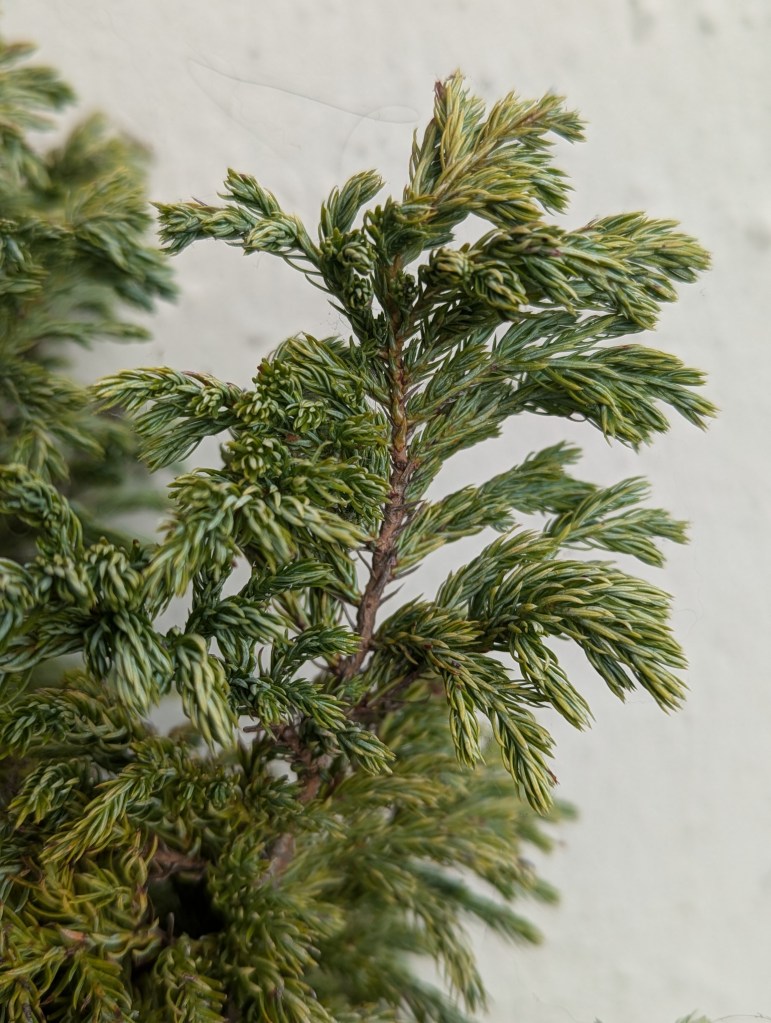
Sawara cypress cultivars are relatively compact.

It is difficult to imagine Sawara cypress, Chamaecyparis pisifera, as a timber tree. Within its native range in Japan, it can grow as tall as one hundred and fifty feet. Its trunk can be six feet wide. It is no surprise that it grows slowly though. Its more familiar types rarely grow taller than ground floor eaves. Only the oldest and biggest are nearly thirty feet tall.

Sawara cypress cultivars are uncommon, and some are rare. Among them, ‘Boulevard’ is less uncommon. It has feathery bluish foliage, and can grow eight feet tall. Supposedly, it can eventually grow nearly three times as tall. ‘Filifera Aurea’ has bright yellowish foliage on limber cord like stems. It supposedly gets taller, but it is typically lower and mounding.

Although its cultivars are more diverse, Sawara cypress resembles compact arborvitaes. Its densely evergreen foliage has a similarly soft texture. Its bark is similarly ruddy with a similarly fibrous texture. Individual scale leaves are less than a sixteenth of an inch long. Sawara cypress classifies as the false cypress because it is not of the genus Cupressus.

Electrical Cables Necessitate Arboricultural Atrocities

Trees can not mix with electricity.

Electrical cables are hazardous! There is no need to elaborate. That is why high voltage electrical cables are either subterranean or aerial. Subterranean electrical cables remain safely out of reach underground. Aerial electrical cables remain safely out of reach about thirty feet above ground. However, electricity is always dangerous regardless of location.

Excavation can inadvertently expose subterranean electrical cables. Pruning large trees can similarly involve minimal proximity to aerial electrical cables. Home gardening rarely involves such deep excavation. However, it commonly involves arboriculture, or pruning, of big trees. When it does, the most eager of garden enthusiasts must know their limits.

Clearance pruning eliminates obstructive vegetation. Ideally, it prevents it from becoming obstructive before it does so. It is useful for roadways, walkways and chimneys, and also protects roofs from damage. Yet, it sometimes necessitates the service of professionals. For example, pruning trees over major roadways is likely too hazardous for anyone else.

Pruning trees over high voltage electrical cables is even more hazardous. However, it is also necessary. That is why electrical service providers employ professionals to perform such tasks. Unfortunately, proper arboricultural technique is not a priority. Reliability and safety of electrical service are. It is efficient, but can severely damage any involved trees.

What is worse is that such damage is also dangerously close to utility cables. Corrective procedures also require the services of specialized arborists. Utility service providers do not assume any associated expenses. Removal might be more practical than salvage for the most severely mutilated trees. Salvage of decapitated palm tree trunks is impossible.

Selection of appropriate trees can limit such problems in the future. With few exceptions, palms are inappropriate within aerial utility easements. Almost all grow only upward with solitary terminal buds. Conversely, some large shrubbery is conducive to pruning to stay lower than cables. So are a few compact trees. Several stay lower than cables naturally.

P

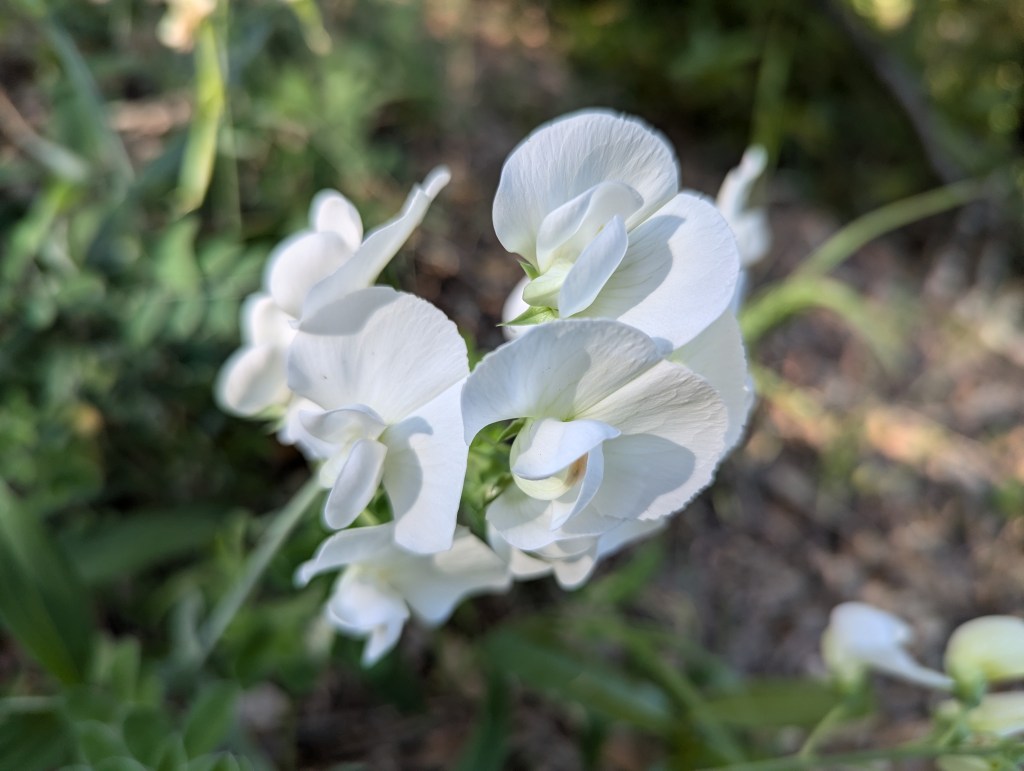
This dinky floral spike was all I needed to identify this as white Lathyrus latifolius.

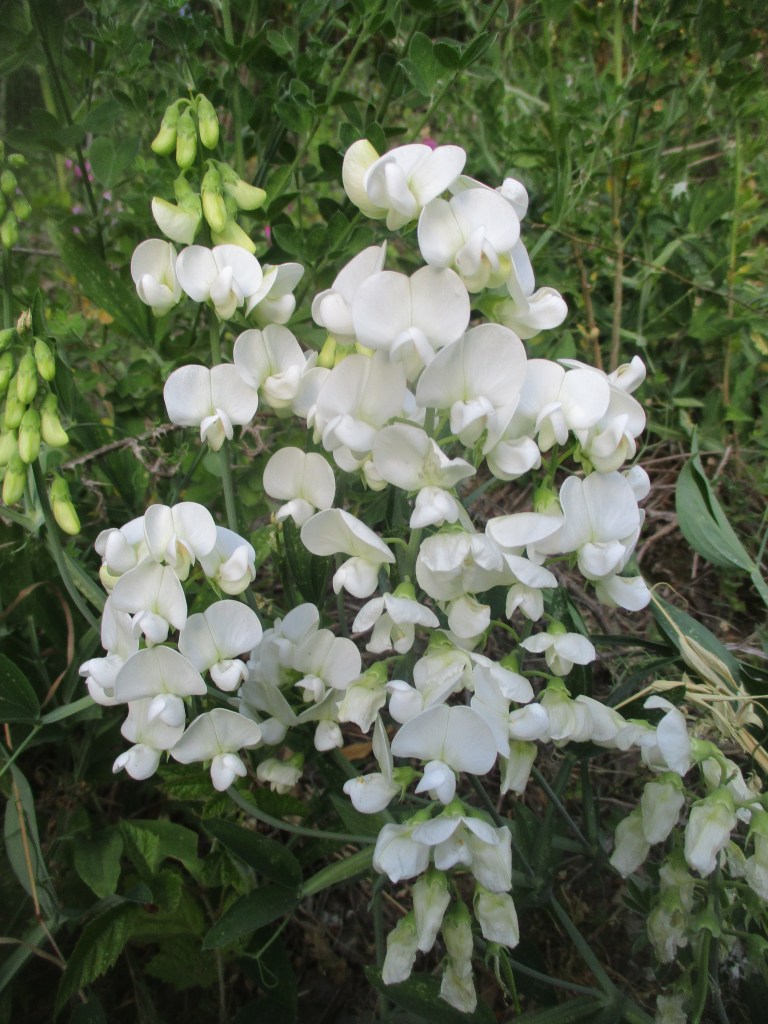
P is for pea, or more specifically, perennial pea, or Lathyrus latifolius, which does not begin with P, but that is not the point. Perennial pea is a naturalized exotic species here. Within our landscapes, it is difficult to kill. I suspect that it is just as difficult to kill outside of the landscapes, although I have not tried. After all, it is quite pretty, and does not seem to be too invasive beyond situations that it finds to be favorable. Trying to kill what grows beyond the landscapes here would be futile anyway, since there is so much more of it beyond the boundaries of what we have access to. However, I would not want to add any to areas where it is not already established and interfering with local ecosystems. That leaves me with a dilemma. I just acquired a perennial pea that I want to grow more of, but there is no place to grow it. Almost all of the perennial pea here blooms obnoxiously bright purplish pink. Very few bloom lighter pink with a swirly pattern. About as few bloom white. I am told that perennial pea can bloom red, but I am getting to suspect that such red is what I consider to be obnoxiously bright purplish pink. Anyway, I found a perennial pea that blooms white a several years ago, and grew several copies of it. I shared all the copies until none were left. I thought that I could always return to the original source for more. Unfortunately, the source was buried under debris that was removed from a mudslide two winters ago. What a bummer! I had been watching for white perennial pea since then. Then, last Wednesday, I saw it! It was not much, since only one floral stalk was beginning to bloom, but it was enough for identification. I got a good bit of its upper taproot and stems for many cuttings. The base of the taproot remains as a more permanent source if I need it, and if nothing happens to it. I am so pleased with this acquisition, even though I have no idea of what to do with it, like so much of what grows out there.

This is a better picture of the original stock from three years ago.