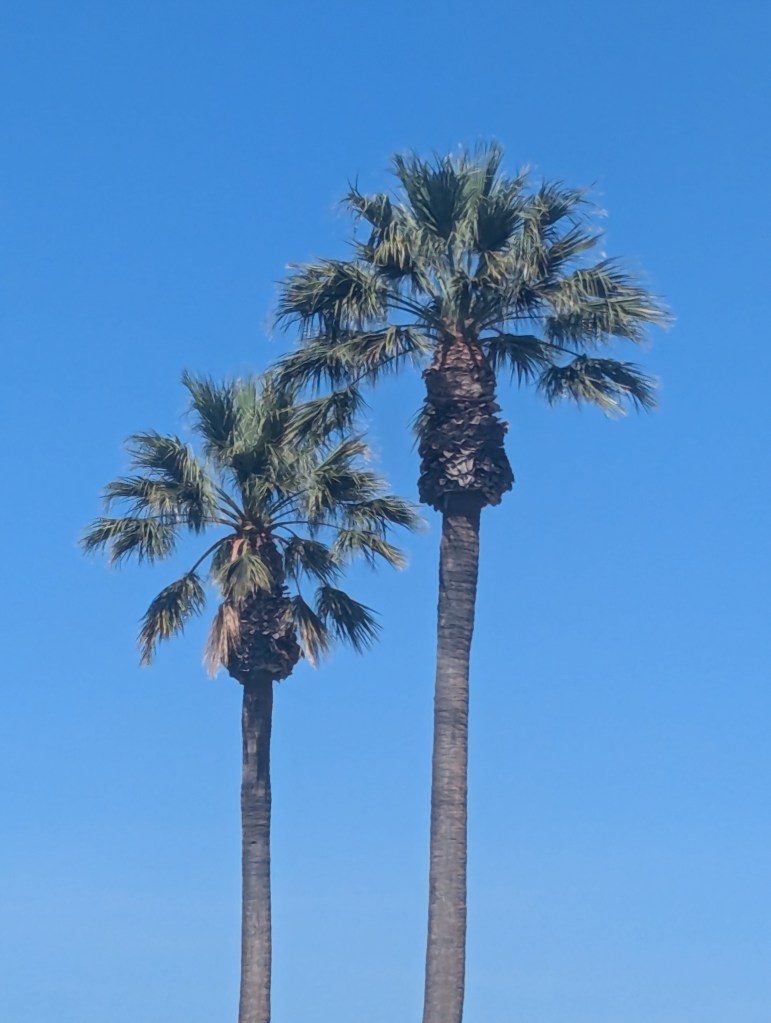
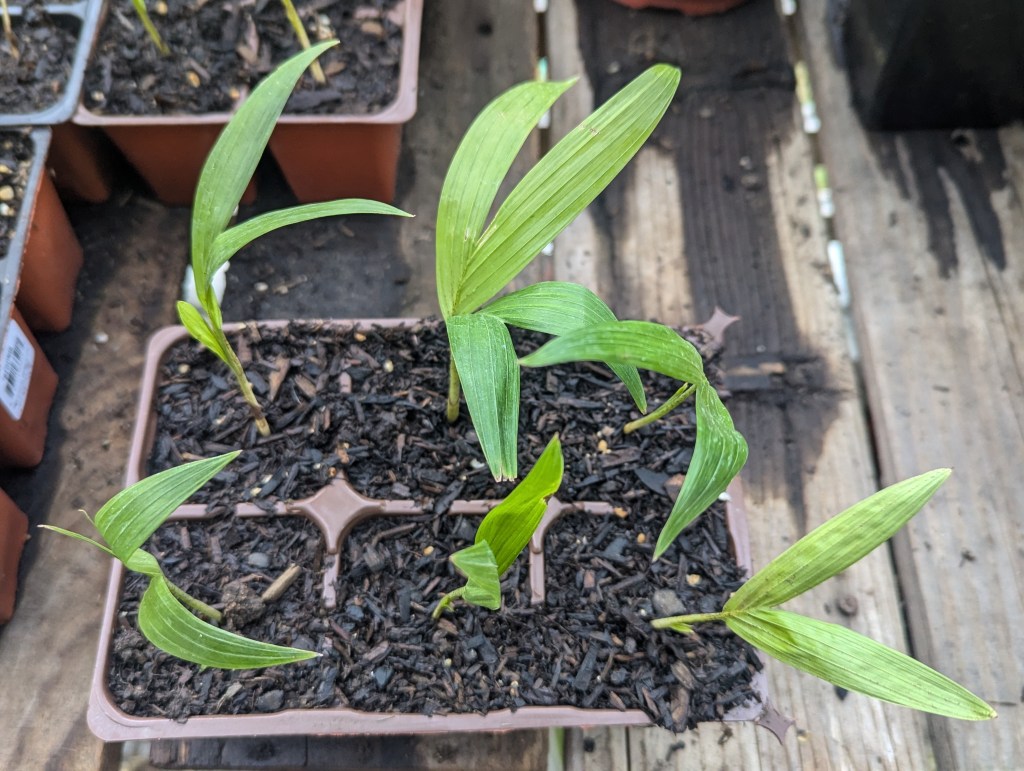
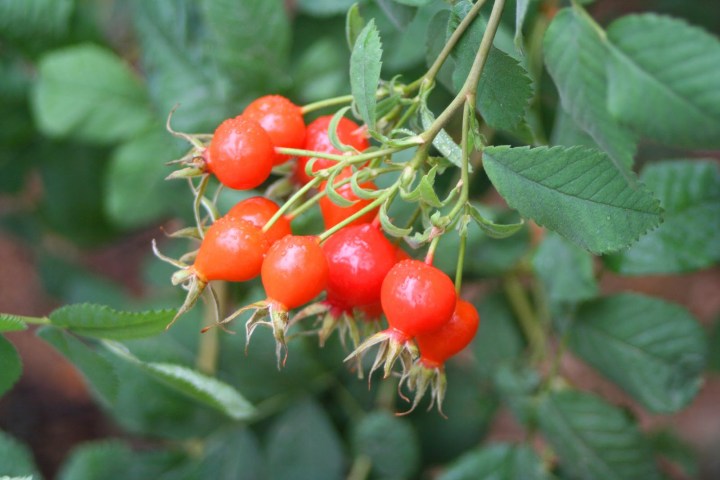
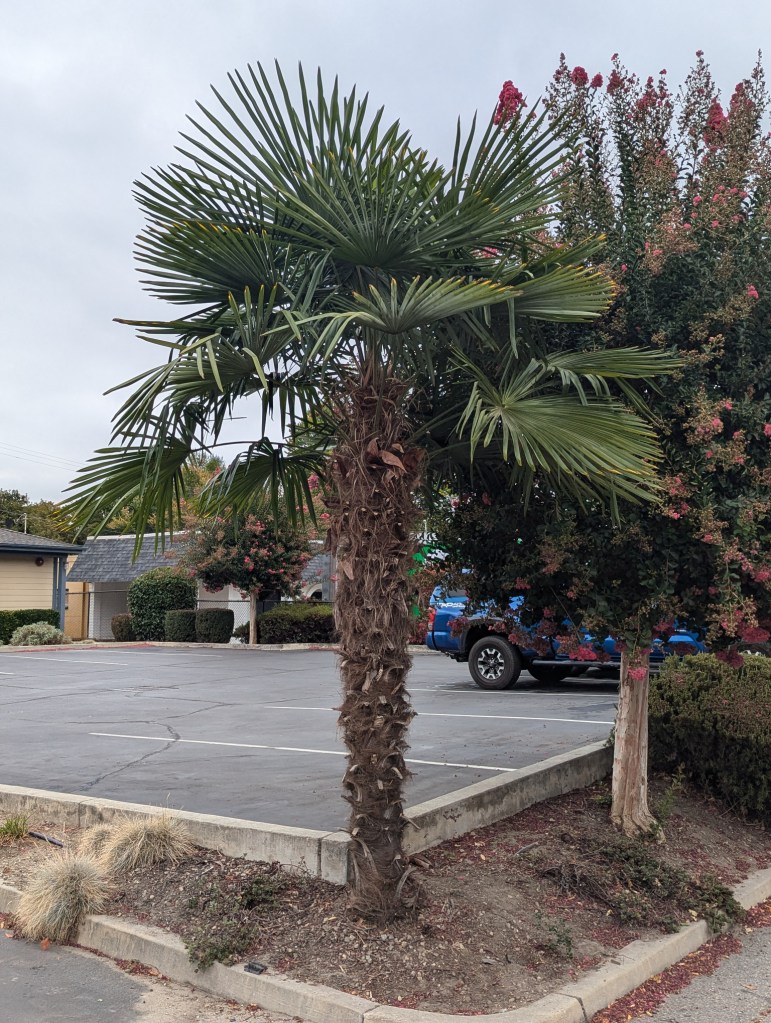
California fan palm, Washingtonia filifera, is the only palm that is native to California. It is naturally exclusive to very distinct ecosystems, though. It inhabits isolated riparian oases of the Colorado Desert. Some also inhabit the Mojave Desert and the Sonoran Desert. It prefers arid warmth. Unfortunately, it may not perform as well within milder climates here.
Otherwise, it is a stately palm that is more adaptable than most are to formal landscapes. It resembles Mexican fan palm, but is shorter and stouter, with a fluffier canopy. It tends to stand straighter, with neatly bare gray trunks. Groomed trees rarely retain petiole stubble. Alternatively, they are handsome, although combustible, with full beards of dried leaves.
California fan palm grows about fifty feet tall, and taller in the wild. Its canopy may be ten to fifteen feet wide. If flattened, its fronds, or complete leaves, might be more than ten feet long. Stiff petioles, with rigid and sharp teeth, are a bit more than half of their total length. The species name filifera describes filaments that hang from the clefts of fronds, and new bud growth.
Palm trees qualify as trees only because of their size and form. The most familiar sorts here develop trunks, and many grow quite tall. The smallest houseplant palms can grow as tall as dwarf citrus trees. Mexican fan palm can grow nearly a hundred feet tall. Palms are monocots, though, so are not actually woody. Technically, they are herbaceous trees.
Palm trees share this distinction with several other herbaceous trees. Banana tree trunks are just tightly rolled leaves. Tree ferns elevate their growth on roots that grow downward through rotting stem growth. Neither banana trees nor tree ferns can generate branches. Sago palms, cabbage trees and arboriform yuccas develop branches, but without wood.
Some palm trees develop a few trunks, but almost none develop branches above grade. Date palms can, but rarely branch. Doum palms typically branch, but are extremely rare. Any other branching palm trees are either aberrative or not really palm trees. Palm trunks do not grow wider as they grow taller. Adventitious roots can become buttressed, though.
All palm trees are evergreen, with either pinnate or palmate foliage. Feather palms have pinnate foliage. Each leaf consists of a central rachis that supports many narrow leaflets. Fan palms have palmate foliage. Each leaf radiates from the terminus of its stout petiole. Both basal leaflets of feather palms and petioles of fan palms are typically horridly spiny.
Since palm trees can not branch, they are not conducive to pruning to direct their growth. Their big but solitary terminal buds grow only upward and maybe away from shade. Any that reach high voltage cables can not go around, so necessitate removal. Clearance for overhanging obstacles is a major consideration for situating new palms. Some grow fast.
While unconducive to directional pruning, most palm trees benefit from grooming. Only a few shed their old foliage naturally. Most get shabby by retaining it. Many, particularly fan palms, eventually become combustible or infested with rodents. However, some may be visually appealing with neat beards of old foliage. Only arborists can groom large palms.
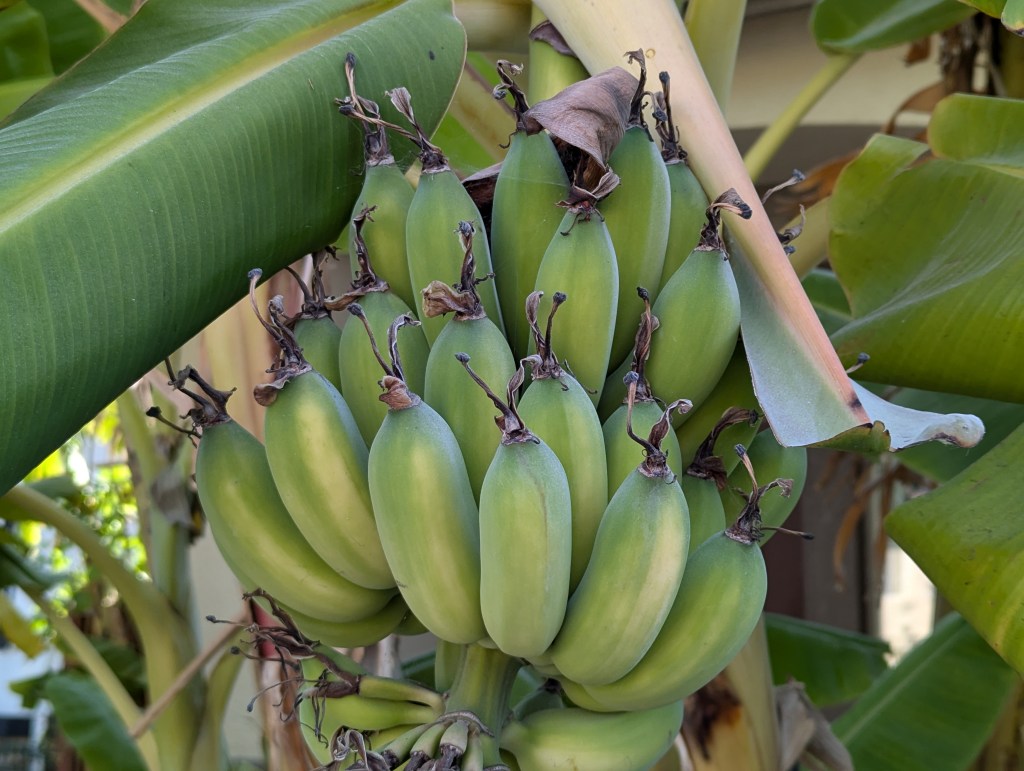
Karpooravalli bananas after removal of their edible male flowers below.
Pronunciation is only slightly easier than when I first tried to read it. Spelling still necessitates cheating, which I do not feel at all guilty about. Karpooravalli is a big name! I must get acquainted with it though, since it will likely be with me for the rest of my life.
Yes, it is another cultivar of banana, which is something else that I do not feel at all guilty about. I have no intention of retaining all of the other twenty or so cultivars that are already here. In the future, I will likely give away most of them to colleagues, without retaining pups. I actually already have plans to install at work the two that are least likely to produce edible fruit, and never grow either in my own garden again.
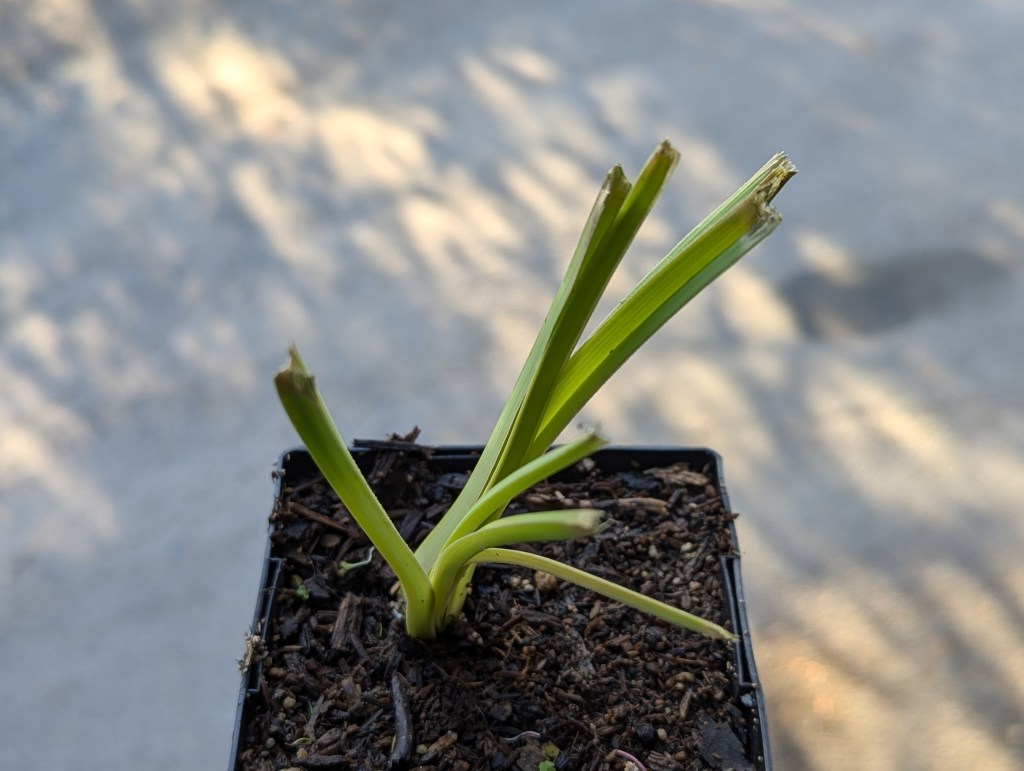
Karpooravalli banana pups
These four new pups of Karpooravalli arrived last Monday, just two days after eight unidentified pupping pups and a single pup of ‘Blue Java’ which is also known as the ‘Ice Cream’ banana. Like these previously most recent acquisitions, as well as another ‘Blue Java’ pup and another unidentified pup that were acquired together last year, these four pups of Karpooravalli are from a private garden. All of the other cultivars here are from nurseries, and most were tissue culture plugs that never actually grew in soil.
That is the dilemma. Cultivars from nurseries are expendable. I can give them away without retaining any copies and not miss them. However, cultivars from private gardens have history, even if I am unaware of it. They are important to someone.
I can give away the recently acquired pup of ‘Blue Java’ only because another pup of it from another important source is already established here, and I knew when I took it that it would not be staying. Also, I can give away almost all of the other unidentified pups that came with it because there are already too many to retain. However, I will retain at least one of them because I know that the cultivar was important to the person who shared it. Likewise, I will retain my first copy of ‘Blue Java’ and the unidentified pup that came with it because they are important to the person who shared them.
Karpooravalli is fortunately one of the more reliably productive cultivars here, and provides sweet fruit with remarkably rich flavor. It is gratifying to know this now because I will grow it for as long as I can tend the garden. This particular Karpooravalli is very important to the person who grew it in her garden for a few decades before sharing it with me, so it is important to me now. I know that I will eventually need to share it with others as it multiplies in the future, but I will prefer to share it with those who respect its importance.
Before I was in kindergarten, I acquired my rhubarb from my paternal paternal great grandfather, and my Dalmatian iris from my maternal maternal great grandmother. Both are growing well in my garden now, and always will. I acquired my common lily of the Nile and the first of my common zonal geranium a few years later. Much of what inhabits my garden now has been with me for many years. Yet, I acquired my first Japanese iris, persicaria and goldenrod as recently as late last winter from Tangly Cottage Gardening. Perhaps it is never too late to start another important tradition.
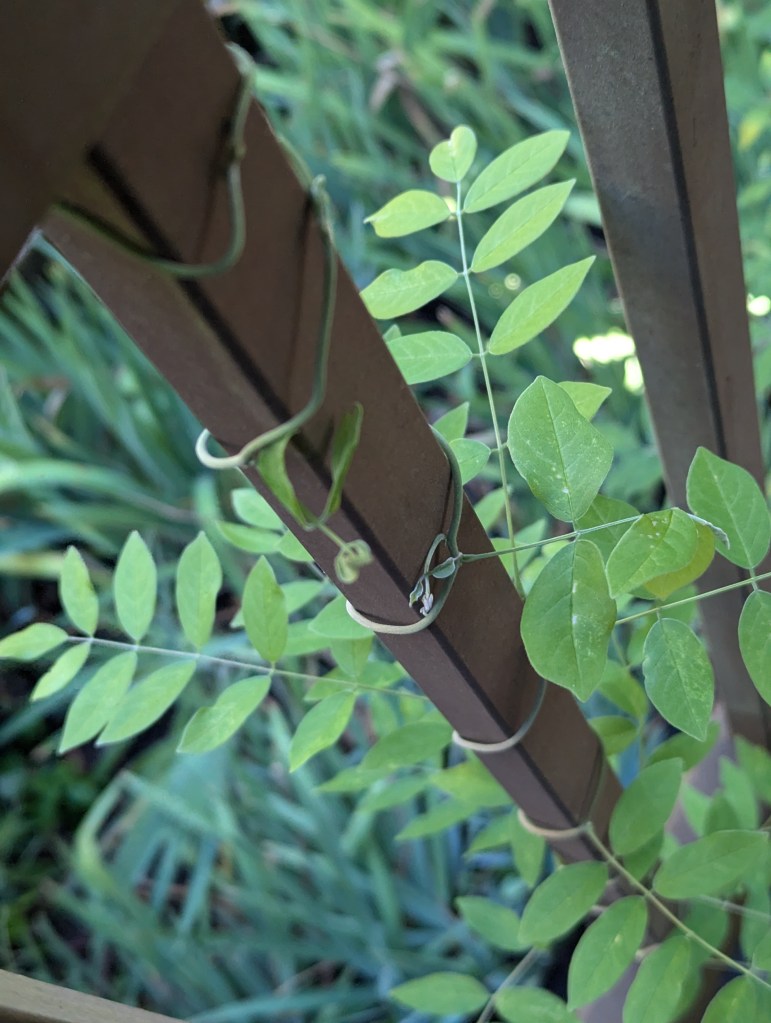
Chinese wisteria is an aggressive vine! A few that have gone wild near here have climbed high into redwoods, or spread over large areas of forest, or both. Some may have been planted intentionally, and then been abandoned. Some may be feral. Japanese wisteria may have potential to do the same, and perhaps some have already done so without being recognized as a different species from more common Chinese wisteria. Both species are spectacular while blooming within refined landscapes, but can be difficult to accommodate within the often neglected or partially forested landscapes here. That is why I am so pleased to try the much more docile American wisteria, Wisteria frutescens. I do not remember the name of this particular cultivar, but it blooms with bluish lavender floral color that is comparable to that of the more traditional Chinese wisteria. Like Chinese wisteria, other cultivars can bloom white or more purplish, and supposedly even pink, although I have yet to see even pictures of it blooming pink. It is not as spectacular, primarily because it is so much more docile, so does not grow nearly as large. Also, the floral trusses are relatively short, stout, and cylindrical in form, so protrude more rigidly outward like bottlebrush bloom, rather than more pendulously like the familiarly elongated and conical floral trusses of Chinese wisteria, or the more elegantly elongated floral trusses of Japanese wisteria. Kentucky wisteria, Wisteria macrostachya, is supposedly quite similar, but blooms later with more bluish color, rather than lavender. ‘Clara Mack’ is a cultivar that blooms white. After I see how American wisteria performs here, with its traditional wisteria colored bloom, I would also like to see how ‘Clara Mack’ Kentucky wisteria performs here. It could be a delightfully docile alternative to traditional Chinese wisteria for the White Garden.
This is not about a machine that makes copies. It is five pictures of copies and a machine that Rhody could make very good use of.
1. Citrus paradisi ‘Marsh’ grapefruit was doing well until some sort of caterpillar that ate much of the foliage off of the passion fruit vines found it. This is an ungrafted cutting, so could eventually grow into a humongous shade tree if it survives this late without leaves.
2. Santolina virens, lavender cotton needed to be removed from one of the landscapes. I did not want it all to go completely, but none of it was salvageable, and I had not grown copies of it earlier. Happily, I found that this single dinky copy somehow got left behind.
3. Kniphofia uvaria, red hot poker is one of those common perennials that I had wanted to grow, but never did. Fancy cultivars are now more common than the common simple species. Finally, I managed to acquire three pups from an old and abandoned landscape.
4. Archontophoenix cunninghamiana, king palm, or bangalow palm or piccabeen palm, is one of the popular palms of coastal Southern California that I would like to grow here. Naturally, but just as naturally without any plans, I procured about two dozen seedlings.
5. Musa acuminata ‘Golden Rhino Horn’ banana pups have grown like weeds since their arrival last June, and now, one of this pair is generating either another pair of pups very closely together, or a single pup that is already extending its first frond away from its tip.
6. Rhody is a terrier. In other words, he is terrestrial. Instinctively, he wants to dig in the earth. His type was bred for pursuit of terrestrial vermin, such as gophers. They need no excuse to dig, of course. Furthermore, Rhody requires no justification for his technique.
As their coarse, foot wide basal clumps of foliage turn yellow and start to die down, the solitary two foot tall stalks of money plant, Lunaria annua, develop open clusters of flat, inch wide seedpods that resemble coins. The thin outer casing and seeds within fall away as soon as these coins ripen, leaving tan, tissue paper thin discs that are ideal for dried flower arrangements. Seeds self sow reliably enough to naturalize where conditions are right, but not aggressively enough to be noxiously weedy. Money plant does not need good soil, and wants only a bit more water than related mustard and wild radish. Their small, purple or white flowers that bloom in spring look like radish or mustard flowers but are not as colorful.
Rose hips are pretty fresh, and can alternatively be dried.
The problem with an abundance of bloom by lily-of-the-Nile over the summer is that all the spent blooms need to be plucked about now. Fortunately though, not all of the spent blooms need to go to compost or greenwaste. The stalks and floral trusses (the clusters of short flower stems on top of the stalks) can actually become interesting ‘dried flowers’, even though the real flowers are long gone.
Many years ago, my neighbor took many of the lily-of-the-Nile stalks that I plucked from my front yard, plucked off the seed capsules, and hung the empty stalks upside down until they dried and turned tan. Being the artistic sort, she added them to other dried flowers and foliage, and arranged them in a large vase (which I think is pronounced as ‘vahz’). Over the years, we found that we can actually let them dry in the garden if we first remove the seed capsules which would otherwise weigh them down and bend the stalks.
Since my artistic neighbor liked these lily-of-the-Nile flower stalks so much, I brought her other dried flower stalks to see how or if they could also be useful. We found that flower stalks from New Zealand flax were just as interesting and even more striking; and some types make rather tall stalks. The large seed capsules from Eucalyptus ficifolia function like modern substitutes for small pine cones.
There are many other plant parts that can be dried and used with dried flowers as well. Cut bird-of-Paradise leaves become sculpturally twisted as they dry. Petioles (leaf stalks) of windmill palm become simple but striking straight black sticks. While still green, the palm leaves can be cut with scissors into interesting shapes less than six inches wide (larger cutouts disfigure). Some native iris produce large seed capsules that split open as they dry, to reveal bright orange or red seeds within. Money plant is actually grown for its dried seedpods instead of for flowers of foliage.
Even bare stems can be added to dried flower arrangements. Both manzanita and madrone have gnarly stems that turn black or dark brown once cut. Fig has contrastingly thick and curving white or gray stems. Bamboo can be cut into sections of any desired length and stripped of foliage. Heavenly bamboo (Nandina spp.) has shorter canes with a corky texture. Realistically, there are no rules for what works well with dried flowers. Anything that looks good is worth trying once.
Straw flowers, statice (Including sea lavender), lavender, globe thistle and yarrow are some of the more traditional dried flowers. Cat-tails and pampas grass flowers can work as well in large arrangements as they did decades ago, but should be sprayed with hair spray to keep them from shedding. (Cat-tails can actually be very messy if they happen to explode.)
Although spray paint is much too synthetic for those of us who prefer dried flowers to look natural, it also works well to keep pampas grass flowers and cat-tails from shedding while adding serious color. Some people enjoy the potential for unnatural colors enough to spray paint other dried flowers and plant parts that do not need to be sprayed with a fixative.
Palms take commitment. Some of the most popular grow too big for their situations. Most grow so tall that only arborists can maintain them. None are conducive to pruning to limit their natural height. Individual palm trunks rely on their single terminal buds, which grow only upward. Diversion is not an option for any palm that encroach into electrical cables.
Windmill palm, Trachycarpus fortunei, is one of the more complaisant of palms. It can not grow around utility cables, but otherwise does not grow obtrusively big. Young trees can grow fast to fifteen feet tall, but then grow slowly to double their height. Only a few elderly trees grow as tall as forty feet. Their foliar canopies are generally less than ten feet wide.
Trunks of windmill palms are distinctively shaggy. Pruning dead fronds as closely to their trunk as possible promotes a neater appearance. Because growth decelerates with age, trunk shag is typically wider higher up. Trunks are about half a foot wide, but seem twice as wide since they are so shaggy. Gathering seed from pollinated female trees is simple.
Deadheading, or the removal of deteriorating bloom, is contrary to the purpose of bloom. It conserves resources for subsequent bloom or vegetative growth. It neatens associated vegetation. Deadheading is certainly justifiable. However, it eliminates most seed before it can develop. Seed is the priority of bloom. Gathering seed can be a good compromise.
Techniques for gathering seed are as variable as bloom and subsequent seed. For some popular annuals and perennials, it is as simple as deadheading. Their seed develops as fast as their bloom deteriorates. Seed is easy to shake from dried stems of rose campion, campanula and columbine. Cut stalks of lily of the Nile must dry for their seed to mature.
Gathering seed from vegetable fruits can be a bit more complicated. Some are mature as soon as their containing fruits ripen. For example, seed from ripe chile peppers are ready for drying and storing immediately. However, zucchini must mature too much to be edible for its seed to finish developing. Furthermore, squash seed is likely to not be true to type.
This is often a consequence of cross pollination from other varieties of the same species. Progeny of very different parents inherit genetic qualities of both parents. Similarly, many extensively bred varieties exhibit reversion. Their progeny can be more similar to distant ancestors than direct parents. Reversion may be progressive through a few generations.
Reversion is less likely among hybrids only because most hybrids are sterile. Gathering seed from them is generally either futile or impossible. Some hybrid canna develop seed capsules that contain no viable seed. Seedlessness is an advantage of seedless hybrid watermelon. Viable seed of the few hybrids that could produce it is wildly unpredictable.
Most mutations, such as variegation or dwarfism, are not inheritable. Seed of variegated Kaffir lily therefore grows into unvariegated specimens. Some seedlings mature through a juvenile phase prior to bloom. This is why avocado seedlings grow so lean without fruit in their first few years. Ultimately, gathering seed is most practical for simple wildflowers, annuals, perennials and some vegetables.