P

This dinky floral spike was all I needed to identify this as white Lathyrus latifolius.

P is for pea, or more specifically, perennial pea, or Lathyrus latifolius, which does not begin with P, but that is not the point. Perennial pea is a naturalized exotic species here. Within our landscapes, it is difficult to kill. I suspect that it is just as difficult to kill outside of the landscapes, although I have not tried. After all, it is quite pretty, and does not seem to be too invasive beyond situations that it finds to be favorable. Trying to kill what grows beyond the landscapes here would be futile anyway, since there is so much more of it beyond the boundaries of what we have access to. However, I would not want to add any to areas where it is not already established and interfering with local ecosystems. That leaves me with a dilemma. I just acquired a perennial pea that I want to grow more of, but there is no place to grow it. Almost all of the perennial pea here blooms obnoxiously bright purplish pink. Very few bloom lighter pink with a swirly pattern. About as few bloom white. I am told that perennial pea can bloom red, but I am getting to suspect that such red is what I consider to be obnoxiously bright purplish pink. Anyway, I found a perennial pea that blooms white a several years ago, and grew several copies of it. I shared all the copies until none were left. I thought that I could always return to the original source for more. Unfortunately, the source was buried under debris that was removed from a mudslide two winters ago. What a bummer! I had been watching for white perennial pea since then. Then, last Wednesday, I saw it! It was not much, since only one floral stalk was beginning to bloom, but it was enough for identification. I got a good bit of its upper taproot and stems for many cuttings. The base of the taproot remains as a more permanent source if I need it, and if nothing happens to it. I am so pleased with this acquisition, even though I have no idea of what to do with it, like so much of what grows out there.

This is a better picture of the original stock from three years ago.

Sweet Spot

Saccharum officinarum ‘Pele’s Smoke’ sugarcane

‘Pele’s Smoke’ sugarcane has grown enough for installation into the landscapes. I am not certain how happy they will be here through winter, but we will find out. Frost is mild here, but is supposedly enough to kill them to the ground. I expect that. Even if they do not die to the ground, I would prefer to cut them down by the end of winter regardless. Survival of their basal growth is more of a concern. I want them to regenerate next spring. It is difficult to imagine a species as vigorous as this being so vulnerable to the locally mild frost, but all the information that I find about it insists that it is marginal here. There are so many canned specimens that it would be no problem to shelter some through winter to replace any that do not survive in the landscapes. Later, if they get depleted, it would be no problem to take cuttings from those in the landscapes in autumn, and shelter them through winter to put back into the landscapes in spring. However, that is just too much unnatural intervention for me. If they are not happy here, they I do not want to force them. I enjoyed growing them while I did. I got the cuttings from grooming a specimen in Brent’s garden. I was not very careful with them, and did not process them very efficiently because I knew that I would get more than I could accommodate. Ultimately, after sharing a few with friends and neighbors who are aware of the risks, thirty new specimens remain here. Fifteen are in #1 can, including the first three that were just installed into the landscapes. Another fifteen are in four inch pots, which is annoying one less than a full flat of sixteen.

Six on Saturday: Glad

Butterfly gladiolus will not bloom for a while. Abyssinian gladiolus may not bloom at all. Hybrid gladiolus, though, are already finishing. I got these few pictures while I can, and will likely get pictures of butterfly gladiolus as they bloom later. I am glad to do so. They are my favorite gladiolus. They are more like wildflowers than overly bred hybrids. Also, they are very reliably perennial. I hope that the Abyssinian gladiolus perform also. They are also supposedly reliably perennial, but are not in a very good situation here. I should relocate them, perhaps closer to where the butterfly gladiolus are so happy. The hybrids are earning my appreciation too. I was not aware that they had potential to be perennial.

1. Gladiolus papilio, butterfly gladiolus is my favorite, because it is from Tangly Cottage Gardening, is approved by Skooter, is reliably perennial, and it blooms like a wildflower.

2. Its foliage is rather grassy, which is more compatible with other wildflowers than wide leaves of more garish hybrid gladiolus. The corms multiply and migrate quite efficiently.

3. Gladiolus murielae, Abyssinian gladiolus is my second favorite, even while it is not so much to see. It is a gift from a neighbor. It should bloom for autumn, but I have doubts.

4. Hybrid gladiolus are the most colorful, but are not reliably perennial. However, these and two others have been blooming well here for several years, and actually multiplying.

5. This orange with yellow hybrid gladiolus was one of the first two to bloom again after a few years of producing only foliage. The yellow gladiolus joined them a few years later.

6. This purple hybrid gladiolus is the other of the first pair to resume bloom, although it does not multiply as much as the yellow gladiolus that resumed bloom a few years later.

This is the link for Six on Saturday, for anyone else who would like to participate: https://thepropagatorblog.wordpress.com/2017/09/18/six-on-saturday-a-participant-guide/

Thrift

Thrift performs well in coastal climates.

When I see common thrift, Armeria maritima, in nurseries now, I wonder what such a diminutive perennial would be useful for. Their densely compact mounds of narrow evergreen leaves rarely get more than four inches deep, and take their time spreading to less than a foot wide. Then I remember how thrift visually softened the straight edges of my father’s brick patio and retaining walls, and fit so nicely into the tight spots. If allowed to do so, thrift creeps slowly over edges of pavement and stepping stones, but is not too eager to overwhelm them.

If it eventually gets overgrown, thrift is easily cut back to the edge of pavement at the end of winter, and will green over its raw edge by spring. The bits and pieces that are left over from cutting back the edges can be plugged back into other areas and will eventually develop roots if initially watered regularly. Once established, thrift stays healthier if allowed to dry somewhat between watering. Bald spots that may naturally come and go as mature plants die out in the center and then regenerate fill in faster if outer edges get cut back.

The dense round clusters of tiny flowers stand above the foliage on bare stems about four to eight inches high. The flowers are almost always bright pink, but are sometimes white or reddish pink. Bloom is most profuse in spring and may continue sporadically all year. 

Many Pruning Techniques

Proper pruning enhances performance rather than compromise it.

If gardeners can reach it, they will most likely shear it. They do not mind if it was intended to be a shade tree, a flowering shrub or even a sculptural succulent. Few will take the time to prune and groom properly. Ironically, formal hedges that actually need to be shorn are rarely shorn properly! 

Most of us fortunately are not gardeners, but merely enjoy our gardens. We know the importance of proper pruning, and that various plants need different pruning techniques. The main difficulty is determining which techniques are best for each type of plant in our gardens.

Shearing is primarily for hedges; which by the way, should be slightly narrower up high, and slightly wider down low in order to optimize sun exposure to all parts. Generally, plants that are grown for their flowers, fruit or natural form should not be shorn regularly.

Fruit trees and modern roses need the most specialized pruning while dormant in winter, so are not recommended for ‘low maintenance’ gardening. Their specialized pruning thins out superfluous growth, concentrating resources for fruit and flower production. Pruning also removes suckers (from below graft unions) and the ‘four Ds’; which are Diseased, Damaged, Dying and Dead stems. 

Most trees eventually need some sort of pruning to direct their growth. Limbs that are too low need to be pruned away to maintain adequate clearance from roadways, sidewalks, chimneys, roofs and anything else that they should keep their distance from. Lighting, road signs and views from cars coming out of driveways should not be obstructed. As larger trees mature, they eventually need the attention of professional arborists to maintain their health, stability and structural integrity.

Small trees like Japanese maple, Hollywood juniper and pineapple guava look much better with selective pruning and thinning to expose their natural forms. If they become obtrusive, such trees are very often pruned back for confinement. They should instead be pruned to direct their growth up and out of the way, so that lower obtrusive stems get removed, and upper growth can develop naturally.

Nandina, abelia, various bamboos, old fashioned lilac and other plants that produce new stems from the ground benefit from another type of thinning known as ‘alternating canes’. This involves cutting older canes to the ground as they begin to deteriorate or become overgrown. Alternating canes without any other pruning allows nandina to keep its distinctive foliar texture, and abelia to develop its distinctive arching branch structure.  

Not Ocotillo

Echinocereus engelmannii, hedgehog cactus?

Ocotillo, Fouquieria splendens, was the species that I intended to procure as Rhody and I walked out and into the desert that surrounded the home we lodged at northwest of Phoenix at the end of last April. I had seen it from the roads on the way there. I should have stopped to procure cuttings or small specimens while I had the chance. Furthermore, I should have stopped for cuttings or small specimens as we left without procuring any earlier. It is a fascinating species that I am completely unfamiliar with.

Hedgehog cactus, Echinocereus engelmannii, is all I procured instead. At least I believe that it is this particular species. I really do not know for sure. A few species of the genus are native to the area. This species just happens to be the most common among them, and its description seems to conform to my observations of this specimen. Other species bloom with floral color that is different from that which I observed with a few remaining shriveled floral carcasses. Most other species exhibit different foliar patterns or textures with their spines. This particular species is distinctly more unappealing than the others, but I got it.

Now, I have no idea of what to do with it. First, I should probably wait to see if it survives. The bits that I got might have been a bit too fresh to root before they rot. I suppose that I should remove the developing fruit to divert resources to vegetative growth and root development. I thought that they would abscise naturally after bloom, in response to the distress of separation from the original specimen. I would prefer natural abscission to unnatural intervention. Pruning wounds from such intervention might promote rot while the cuttings are already vulnerable to rot from below.

Little Leaf Sage

Little leaf sage has little flowers.

Its common name is both simple and descriptive. Little leaf sage is a literal translation of its botanical name, Salvia microphylla. However, several of its most popular cultivars are actually hybrids with other species. Also, they are more popularly but inaccurately known as Salvia greggii. Most lack their species name between their genus and cultivar names.

Little leaf sage is a small and generally evergreen shrubby perennial. Mature specimens are about three or perhaps four feet tall. They are a bit wider, and some can slowly widen by dispersing little rhizomes. Their little leaves are less than an inch long and delightfully aromatic when disturbed. Where winters are cooler, frost might initiate partial defoliation.

Bloom is most abundant for late spring or early summer, and again for autumn. Sporadic bloom can continue throughout most of the year. A few flowers may even bloom through winter. Floral color ranges through red, white and pink, as well as peachy and rosy pink. Coppicing old growth at the end of winter promotes replacement with new basal growth.

Layering Can Copy Favored Flora

Ivy can grow roots almost anywhere.

Seed is the most familiar method of propagation. However, some popular plants produce no viable seed. Some produce seed that is genetically very different from its parents. For many plant varieties, only vegetative propagation reliably produces similar copies. Such copies can grow from division, cuttings or layering. They are genetically identical clones.

Layering is uncommon for nurseries because it is generally insufficiently productive. It is unpopular for home gardening because it seems complicated. It is actually more reliable for many species than cuttings are. Also, layering is quite practical if merely a few copies are sufficient for home gardening. Realistically, it is not as complicated as it seems to be.

Layering is simply the development of roots where stems lay on the soil. All sorts of flora does it naturally without intervention. For example, ivy vines notoriously develop roots as they extend over the ground. Tips of raspberry canes develop roots where they leap over to reach the ground. These rooted tips grow replacement canes that repeat this process.

With a bit of intervention, several species that do not commonly layer can do so also. For some, it can be as simple as pressing a lower stem into moist soil. Application of rooting hormone to exposed cambium accelerates layering for most. Gouging into the underside of the buried portion of stem exposes its cambium. Tip growth must remain above grade.

For most species, the buried portions of layering stems should be a few inches in length. Extra stem length is no problem. Actually, if stems are long enough, they can be situated into their permanent locations. Stems can layer right below grade, but they prefer to be a few inches deeper. While their roots develop, they require irrigation for evenly moist soil.

The few inches of foliated tip growth above grade sustains actively layering stems. Also, remaining intact cambium provides sustenance from the original plant. Only a few stems can layer simultaneously, but that is enough for most gardens. Hydrangeas, azaleas and camellias layer quite easily. Pines, oaks and eucalyptus do not. Layers should develop quite a few roots before separation.

Going Bananas! II

‘Double Mahoi’ banana pup with pups

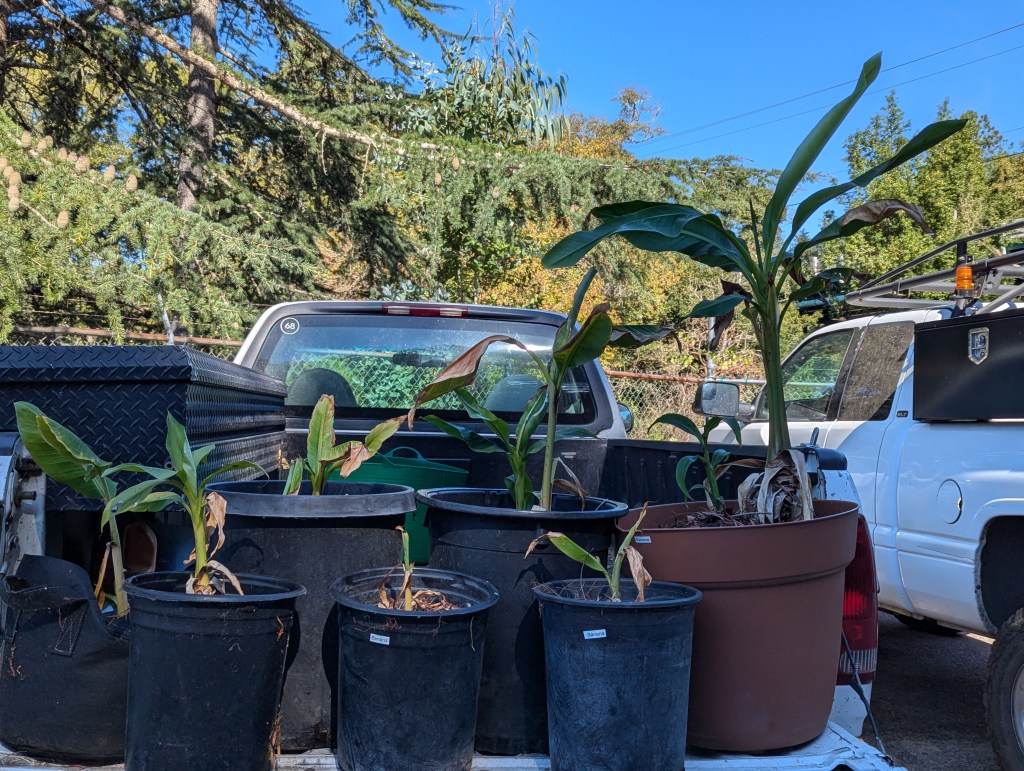
‘Double Mahoi’ banana has been tediously slow. Although I now know why, I am disappointed with its development so far. After the primary pup that I split from the original last year got frosted over winter, I noticed that its central bud survived and was barely beginning to recover. Then, it stopped. I mean, it did nothing for several days or maybe more than a week, even though the weather was warming. Also, the foliage remained pale, as if it had just emerged. Because it was stagnating for so long as the weather was warming, at least one of its leaves got scalded in the middle. Then, because I gave it a bit too much soluble fertilizer, its leaves got bad tip burn. I suspected that it was up to something while seemingly inactive, but did not really know. Finally, the tip of its first pup appeared. Then another appeared, and then a few more! While still just a pup, it had an entire litter of eight pups, which is four times ‘Double Mahoi’, and I do not know if it is finished. Of course, eight pups sharing resources do not grow fast. Also, the tip burn continued as the pups initially emerged, which likely inhabited growth for a while. For now, I can only give them plenty of water, and refrain from giving them more fertilizer. They have good exposure, but I will move them under saran if the weather gets too warm for such small pups to be so exposed. I doubt that all eight pups will survive, but I would have been pleased with merely one. Of course, the one original pup will not survive the process of diverting its resources to its pups, but that is an acceptable consequence of getting a bit more than expected.

Original ‘Double Mahoi’ pup not much more than a month ago

Big Lemons

Ungrafted ‘Eureka’ lemon

All but two of the forty or so cultivars of citrus that I grew in the early 1990s were grafted onto the same dwarfing shaddock rootstock. Only ‘Meyer’ lemon and ‘Seville’ sour orange were not grafted, or ‘on their own roots’. ‘Meyer’ lemon naturally stays compact enough to not need a dwarfing rootstock. it was our most popular cultivar. ‘Seville’ sour orange supposedly grows about as large as the various dwarfed sweet orange with or without a dwarfing rootstock, as if the rootstock does nothing to limit its ultimate size. It was our least popular cultivar.

‘Eureka’ lemon, ‘Lisbon’ lemon and ‘Sanguinelli’ blood orange grow larger than any of the other grafted dwarf citrus that we grew. ‘Eureka’ lemon is actually a variant cultivar of ‘Lisbon’ that produces fruit throughout the year, which is a desirable attribute within home gardens. ‘Lisbon’ lemon may seem to be a bit more productive, but only because it produces all of its fruit within a more defined season, which can be a desirable attribute for orchard production. Otherwise, ‘Eureka’ and ‘Lisbon’ lemons are indistinguishable from each other, and grow quite tall. ‘Sanguinelli’ blood orange grows about as large, with a nearly identical upright form, but with a softer foliar texture.

Without dwarfing understock, ungrafted ‘Eureka’ and ‘Lisbon’ lemon trees can grow as big as small shade trees, and produce more fruit than they can support against gravity. Their broken limbs are a horridly thorny mess to clean up. ‘Sanguinelli’ blood orange trees can grow about as large, although they support the weight of their fruit more efficiently, and any debris that they generate, hopefully from pruning rather than breakage, is not so objectionable to handle.

So, I should have known better than to plug a bunch of ‘Eureka’ lemon cuttings. As cuttings, they lack dwarfing understock. I shared more than half with neighbors, who have been warned. About fourteen remain. One is more than enough.