Clearance Pruning Directs Obtrusive Vegetation

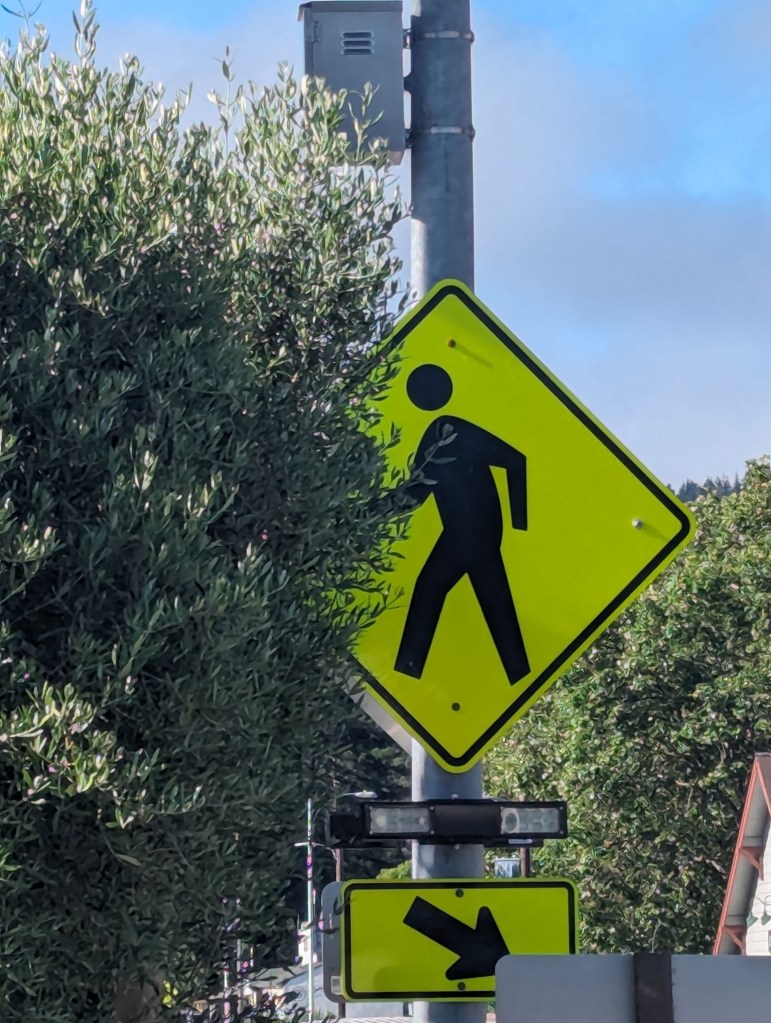
Traffic signs must always remain visible.

Pruning techniques are very diverse to serve various purposes. Dormant pruning during winter concentrates resources for spring or summer growth. Hedging or shearing merely contains growth. Thinning or grooming removes superfluous growth to enhance sunlight diffusion. Clearance pruning directs new growth that might otherwise become obtrusive.

There are too many distinct pruning techniques to mention. Some, such as shearing and thinning, are mutually exclusive. Shearing actually initiates the sort of congested growth that thinning eliminates. Techniques such as dormant pruning and clearance pruning are mutually compatible. After all, almost all pruning is less stressful with winter dormancy.

Clearance pruning merely becomes a concern now as spring growth becomes obtrusive. Much of the worst require professional assistance. Only arboricultural professionals can safely prune trees away from high voltage cables. Such cables are extremely hazardous! Utility services generally try to arrange such procedures before major problems develop.

However, arboricultural professionals are necessary for other clearance pruning as well. Many trees are simply too large or hazardous for anyone but professionals. Some extend over roadways that need clearance for the largest of trucks. Some extend over chimneys that could ignite vegetation that gets too close. Many simply extend beyond a safe reach.

Street trees seem to require the most clearance pruning. They must be a specified height over any roadway, as well as over any sidewalk. Also, they must not obstruct street signs or views for cars backing out of driveways. Ideally, their interference with light from street lamps should be minimal. Vegetation that is closer to buildings presents other concerns.

Besides chimneys and exhaust vents, roofs also need clearance. Stems and foliage are abrasive as they move in any wind. They collect debris that causes rot and clogs gutters. Furthermore, walkways and navigable areas are more efficient with adequate clearance. Clearance pruning should direct growth away from any obstruction, rather than contain it.

Perennial Annuals

New Guinea impatiens (with ivy geranium) from last year.

Annuals complete their entire lifespans within a single year.

Perennials survive for more than a single year.

Biennials grow vegetatively during their first year, and then bloom, disperse seed and die during their second year, but that is another story.

Most species that are appreciated as annuals here actually have potential to be perennials, even if only short term perennials. They are only replaced annually because it is easier than maintaining them through their dormant season.

For example, busy Lizzy is a warm season annual that gets installed for spring and replaced with cool season annuals for autumn. However, if cut back and sheltered from frost, it can survive through winter to perform for the following spring and summer. Actually, it can survive perennially like this for quite a few years, and as it ultimately deteriorates, it can replace itself with its own cuttings or layered stems.

Brent did this with New Guinea impatiens from last year. He neglected to replace them for winter (which is quite brief there), and then noticed that they resumed growth as winter ended. Now, they are huge and even more spectacularly florific than they were last summer.

The picture above shows where I camp out in his backyard when I go to Southern California. Most of the white bloom to the right is actually ivy geranium that cascades below the New Guinea impatiens, but most of the white bloom to the left is New Guinea impatiens above ivy geranium. (White on white was not quite as monotonous when each of the two species maintained its distinct form last year.)

Small terrace at the western margin of the garden.

This other pair of potted dwarf Alberta spruce surrounded with the same New Guinea impatiens above, with a close up below, flanks the steps to a small terrace at far western margin of the garden.

These New Guinea impatiens are huge because they resumed growth from last year.

Arrest

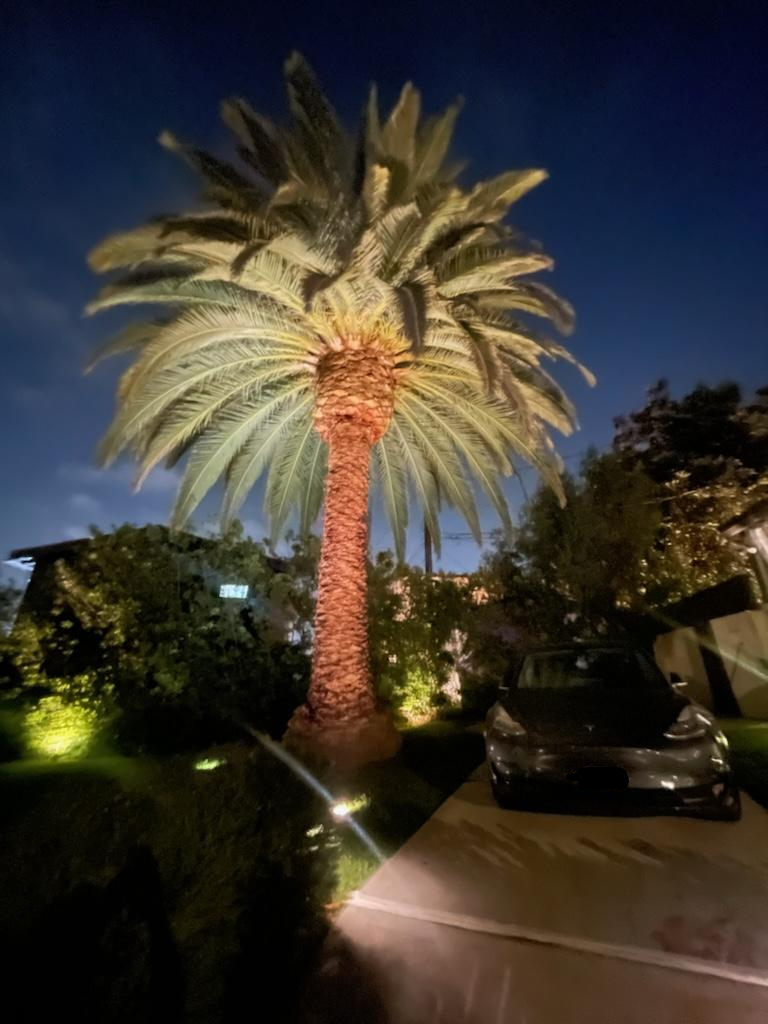
Phoenix canariensis, Canary Island date palm

“Put your hands in the air!

That is what this uplit Canary Island date palm seems to be responding to. It seems to be surrounded by police, with their spotlights aimed at it as they proceed with an arrest. It actually seems to be guilty, although it might merely be humiliated.

Brent is a renowned landscape designer in the Los Angeles region. I know that I should not question his work. After all, aside from all the other unusual horticultural work that I do, my primary work is supposed to be on the farm. I merely grow the material that Brent’s crews assemble into their landscapes. I know that Brent knows what he is doing, and his clients appreciate it very much. I just do not quite get it.

Although I happen to be fond of Canary Island date palms in other peoples’ landscapes, I do not think that I would want one in my own garden. I would prefer a fruiting pair of date palms. Even that is a stretch. They occupy significant space, and probably would not produce good fruit here anyway. Even if such palms inhabited my garden, I know that I would not want them uplit like this. Such trees seem to be embarrassed or annoyed about being kept up late. They really deserve to get some sleep at night like everyone else.

Uplighting became popular in the 1970s. By the time that Brent and I were in school, and he was studying landscape design, lighting of various colors had become popular. I can remember a landscape in his Parents’ neighborhood that was done up like a horror movie with red lights. Another was done up like a circus with various tacky colors. Eventually, white lights became most popular, although colorful lights are not completely unpopular.

Six on Saturday: Crosswalk

A crosswalk connects a rose garden at work to a fancy perennial and annual bed across a narrow road. As much as I would like to maintain certain standards within both of these two distinct gardens, neither is perfect. Each is inhabited by something that should be of the other. One stays because of its justification for being there. The other stays because I can not easily separate it from the roots of what moved in over it, and because we sort of like it there now. Anyway, I added another picture from Arizona a month ago, and one of Brent’s useless pictures, just because they are too pretty to discard without sharing here.

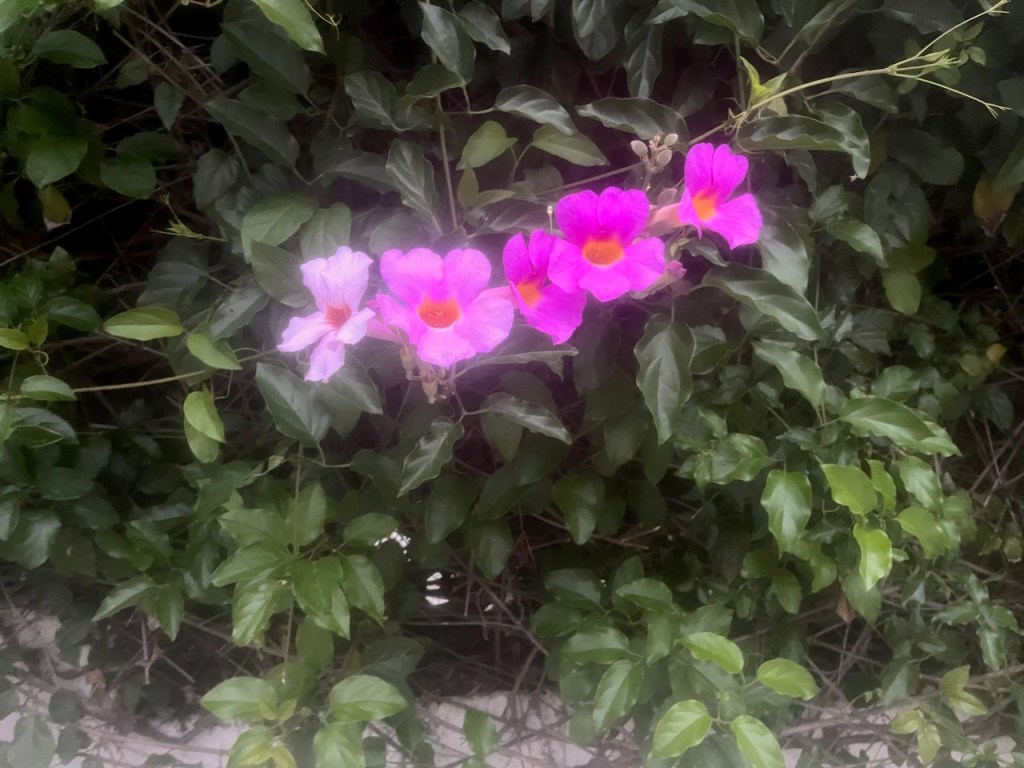
1. Distictis riversii, royal trumpet vine demonstrates that, no matter how much he wants to get one of his pictures into his local Canyon News, Brent does not provide a good one.

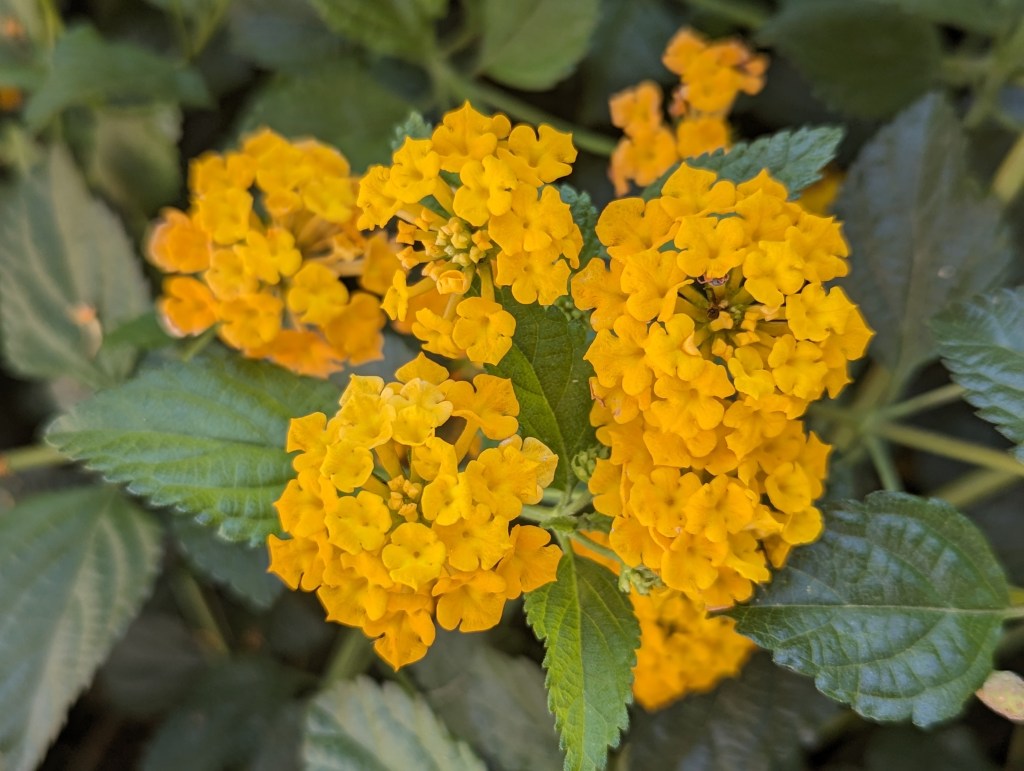
2. Lantana camara, which is known simply as lantana, bloomed within the same garden as the orange cultivar of last Saturday; so this picture is from a month ago near Phoenix.

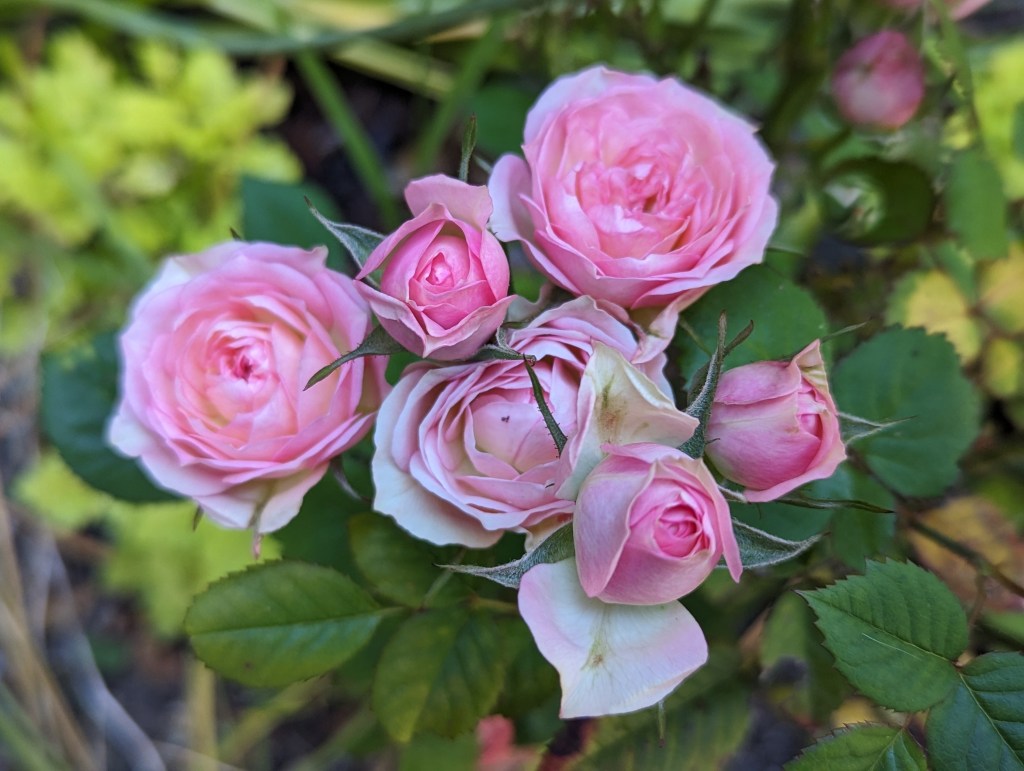
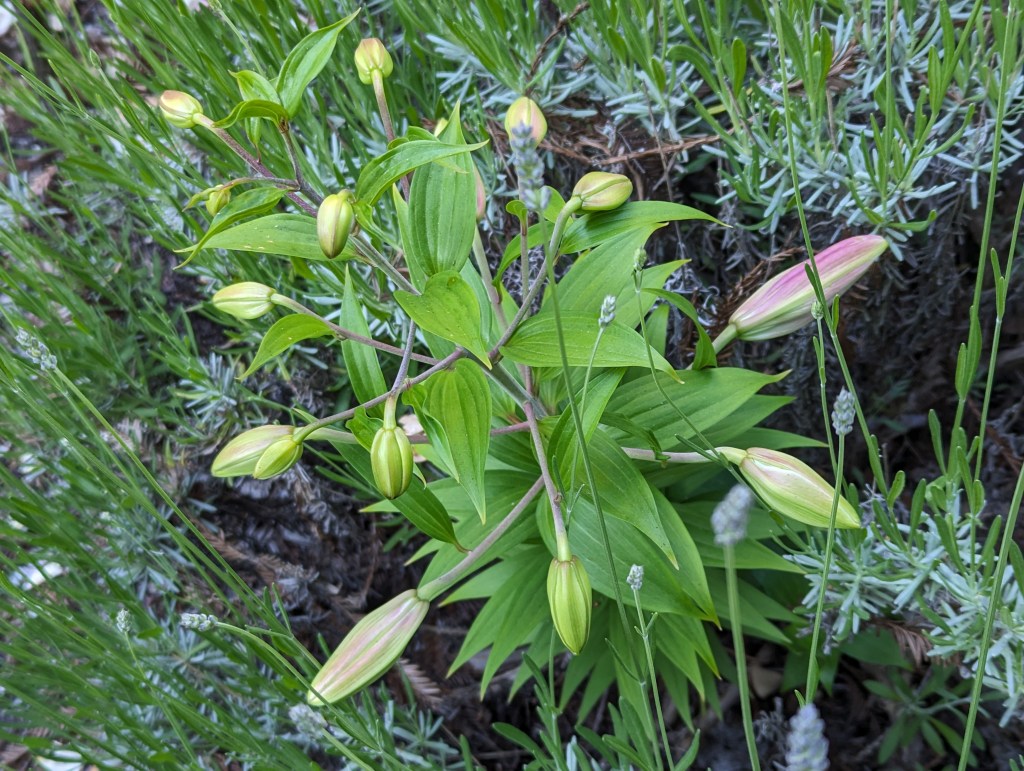
3. Rosa, which is an unidentified miniature rose, is designated as the lily rose because of its stubborn occupancy of a former lily colony within a garish perennial and annual bed.

4. Although pretty, it really should be in the rose garden across the road. I can not move it over there, because of its sentimental significance for the person who installed it here.

5. Lilium, which is an unidentified Oriental lily, is designated as the rose lily because of its stubborn occupancy of a former perennial and annual bed that is now a rose garden.

6. Although pretty in bloom, it really should be with this colony of abundant lilies, which I shared a picture of last Saturday, in a garish perennial and annual bed across the road.

This is the link for Six on Saturday, for anyone else who would like to participate: https://thepropagatorblog.wordpress.com/2017/09/18/six-on-saturday-a-participant-guide/

Hall’s Honeysuckle

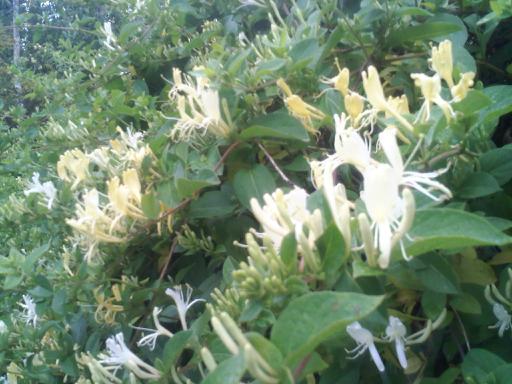
Hall’s honeysuckle climbs aggressively by twining.

The unrefined twining vines of good old fashioned Hall’s (Japanese) honeysuckle, Lonicera japonica ‘Halliana’, seem to fit in so naturally with lilacs, hydrangeas and bearded iris; the sort of plants that grow in grandma’s garden. Grandma may need help controlling it though, since it can climb more than twenty five feet, and get overgrown and invasive. It is best pruned back to main canes or to the ground annually at the end of winter. Even though it is evergreen, it drops some of its foliage and looks rather tired by the end of winter anyway.

Just as the fragrance of the earlier spring blooming flowers gets depleted, Hall’s honeysuckle begins to bloom with its own distinct sweet fragrance, attracting bees and hummingbirds. Bloom is typically most abundant in spring, and followed by sporadic bloom until autumn. Fluctuations of weather or watering can cause subsequent phases of abundant bloom during summer. The pale white tubular (and bisymmetrical) flowers fade to pale yellow that is perhaps the color of French vanilla ice cream. The simple light green leaves are about two inches long. A few leaves on the most vigorous vines may be lobed.

Every Species Of Vine Is Distinct

Bougainvillea does not cling to its support. It merely leans on it, or must be tied.

Harvesting grapes from a pear tree last summer reminded me why it is so important to control the grape vines this year. Without proper confinement to the fence below, the grape vines had climbed into and overwhelmed the pear tree above. My neighbor who witnessed the consequences of my lack of diligence in the garden, and helped me with the harvest, mentioned that the ‘grape tree’ was more productive than the vines had been when properly maintained during the previous year. I was embarrassed about my transgression nonetheless.

My colleague in Southern California has no problem grooming the many different kinds of vines that adorn arbors, trellises, walls, fences and railings in his garden. I certainly could not let him find out that I was vanquished by my single grapevine, which he refers to as ‘Dago wisteria’. I probably remind him of how important it is to control his vines more often than I am offended by racial slurs.

The trick is to select vines that are appropriate to each particular application. Vines for small, light trellises must be relatively complaisant, like lilac vine, pink jasmine, Carolina jessamine or clematis. Aggressive vines like wisteria, grape (the ‘other’ wisteria) and the larger trumpet vines need hefty trellises or arbors. Brambles and scrambling plants like bougainvillea and climbing roses do not actively climb, so need to be tied or ‘tucked’ into their supports.

Some of the seemingly innocent vines can actually become somewhat aggressive. Mandevillea, potato vine and star jasmine have wiry stems that seem harmless enough, but can eventually tear apart lattice or light trellises. Perennial morning glory and passion vine are potentially invasive. Trailing nasturtiums and annual morning glory really are as innocent as they look, so are nice small annual vines where space is limited. I prefer pole beans though.

Vines like Boston ivy, Virginia creeper and creeping fig that attach to their supports with roots or discs (modified tendrils) are too destructive for most applications in home gardens. They are fine on unpainted reinforced concrete buildings and concrete walls, such as the retaining walls and sound walls of freeways, but will ruin paint, siding, stucco and shingles. Unlike the other vines, these lack colorful bloom. Boston ivy and Virginia creeper produce remarkable fall color though, but then defoliate revealing bare stems through winter.

Algerian and the various English ivies are good ground cover plants that will become climbing foliar (without showy blooms) vines if they reach support. Unfortunately, they root into their support like creeping fig does, so have limited practicality. Honeysuckle is an aggressive vine that can also double as a ground cover.

Horridculture – Graffiti

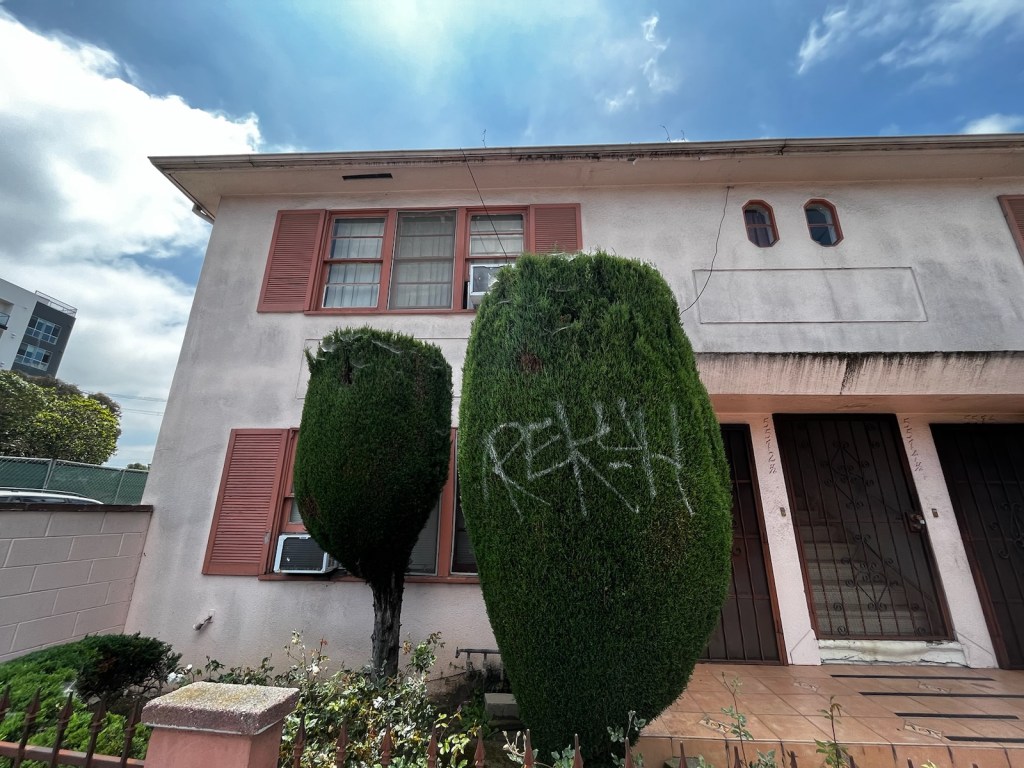
Is this some sort of abstract art?!

This picture is all sorts of wrong! Brent sent it to me from Los Angeles. He has a habit of sending obnoxious pictures such as this.

Firstly, why would anyone install Italian cypress in such pointless situations?! The specimen to the left is centered on a prominent window. It is an unsightly obstruction to the window, and would be just as unsightly and obstructive to the window above if only it had not been so severely disfigured. Although the larger specimen is a bit farther from the window, it is just as unsightly, obstructive and pointless.

Secondly, why would anyone disfigure Italian cypress by topping them like this?! It would be more practical to remove them if their naturally upright form is undesirable for this particular situation. Then, some other preferable vegetation could be installed instead, or perhaps nothing at all.

Thirdly, why would anyone maintain these already disfigured Italian cypress like this?! Just remove them already! They are unsightly! Seriously, someone obviously puts quite a bit of effort into shearing them so systematically. Are they that important?! Does someone actually like these pathetic trees in this pathetic condition?! Am I missing something here?!

Finally, or fourthly, how could someone make this situation any worse by defacing the larger of these two Italian cypress with graffiti?! Seriously, that takes a bit of effort also. Cut the trees down already! Why do these trees not simply die of embarrassment?! Is this supposed to be some sort of conceptual or abstract art?! Is this here merely to see what sorts of reactions it gets?! Can anyone even read what that graffiti says?! Perhaps it translates to “PLEASE CUT THESE TREES DOWN!” This picture leaves me with way too many unanswered questions. Well, if nothing else, these sad Italian cypress were strangely entertaining.

Carob

Carob eventually develops gnarly branch structure.

John the Baptist survived in the Wilderness of Judah by eating locusts and honey. These locusts could have been large orthopteran insects, such as grasshoppers. However, they were more likely fruits of locust trees, such as carob, Ceratonia siliqua. Both possibilities are both nutritious and kosher. The insects got their name from resemblance to the fruit.

That was almost two millennia ago, and more than seven thousand miles away. Carob is much more popular than grasshoppers here and now. Unfortunately though, within home gardens, the fruit is more of a mess than an asset. Male trees are not messy like females, but produce objectionable floral fragrance. Monoecious trees are both messy and stinky.

Mature trees develop broad canopies that are generally less than thirty feet high. Trunks and main limbs eventually become sculpturally gnarly. Densely evergreen foliage is very shady. Pinnately compound leaves are olive drab, glossy and four to seven inches long. Female orchard cultivars should be fruitless without a pollinator, but are rarely available. Besides, it is impossible to know if a male tree is within pollination range.

Microclimates Are Distinct From Climates

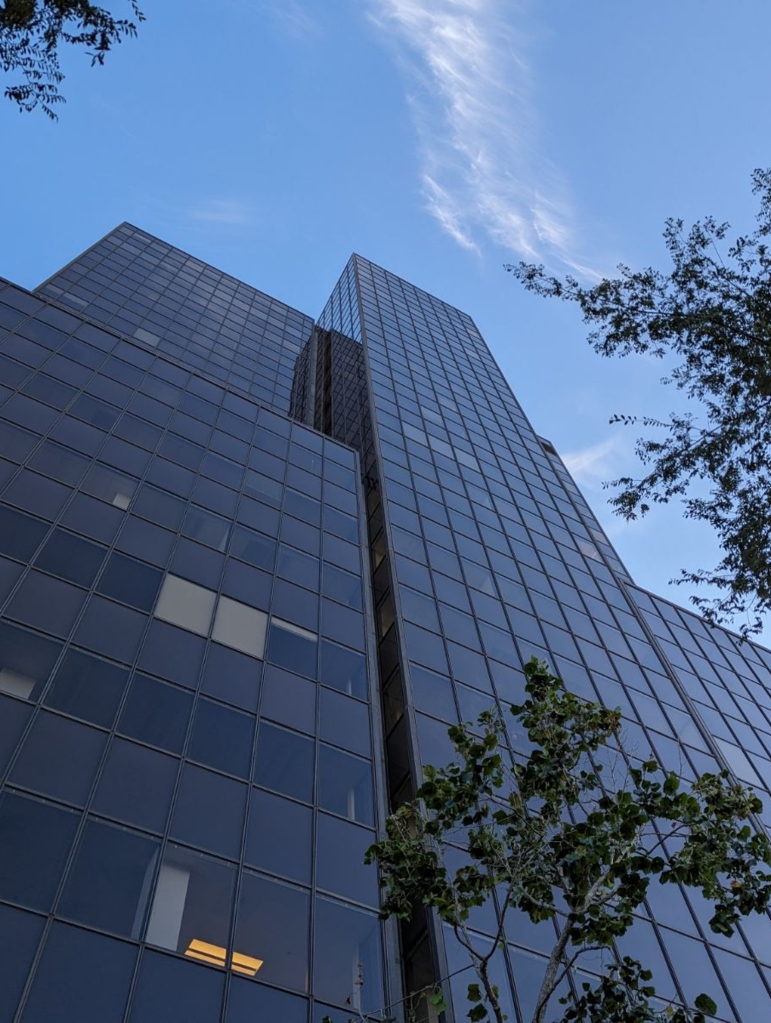
Larger buildings inevitably produce larger microclimates.

Climates and geology are why cinema and television industries are so established here. Cinema evolved in Niles before relocating, with the evolution of television, to Hollywood. The diversity of local climates, geology and associated scenery was the primary appeal. Farmers of all sorts had already been exploiting such climates as well as microclimates.

Climate is a regionally prevalent pattern of weather. Mediterranean or chaparral climates are prominent locally. Coastal, desert and alpine climates occupy other relatively nearby regions of California. Variations of geology influence weather, which determines climate. This comprises mountains, valleys, various altitudes and proximity to the Pacific Ocean.

Microclimates, as their designation suggests, are small climates within big climates. With such a mix of climates here, microclimates might be difficult to distinguish. Some climate zones of steep coastal hillsides are very narrow, for example. Yet, if they are distinct from those for higher and lower elevations, they are climates. Microclimates are even smaller.

For microclimates, exposure is as relevant as endemic climates. Such exposure can not change climate, but modifies its influence. For example, large eaves and warm walls can provide localized shelter from frost. Southern slopes of hilly terrain are likely a bit sunnier and warmer than northern slopes. Buildings and fences shade garden area to their north.

Many microclimates, such as those that involve terrain or forest shade, are natural. They are generally less dynamic than unnatural microclimates. Forest shade changes only as fast as associated trees grow or die. Only major disruption, such as fire or timber harvest, accelerates such slow change. Terrain may not change significantly for millions of years.

Unnatural microclimates are more dynamic and unpredictable. Taller modern homes and fences shade more within adjacent gardens. Skyscrapers can extend their shadows into gardens a few blocks away. Conversely, some can reflect sunlight to adversely increase heat and glare. Expansive and unshaded pavement likewise increases ambient warmth.