Big Lemons

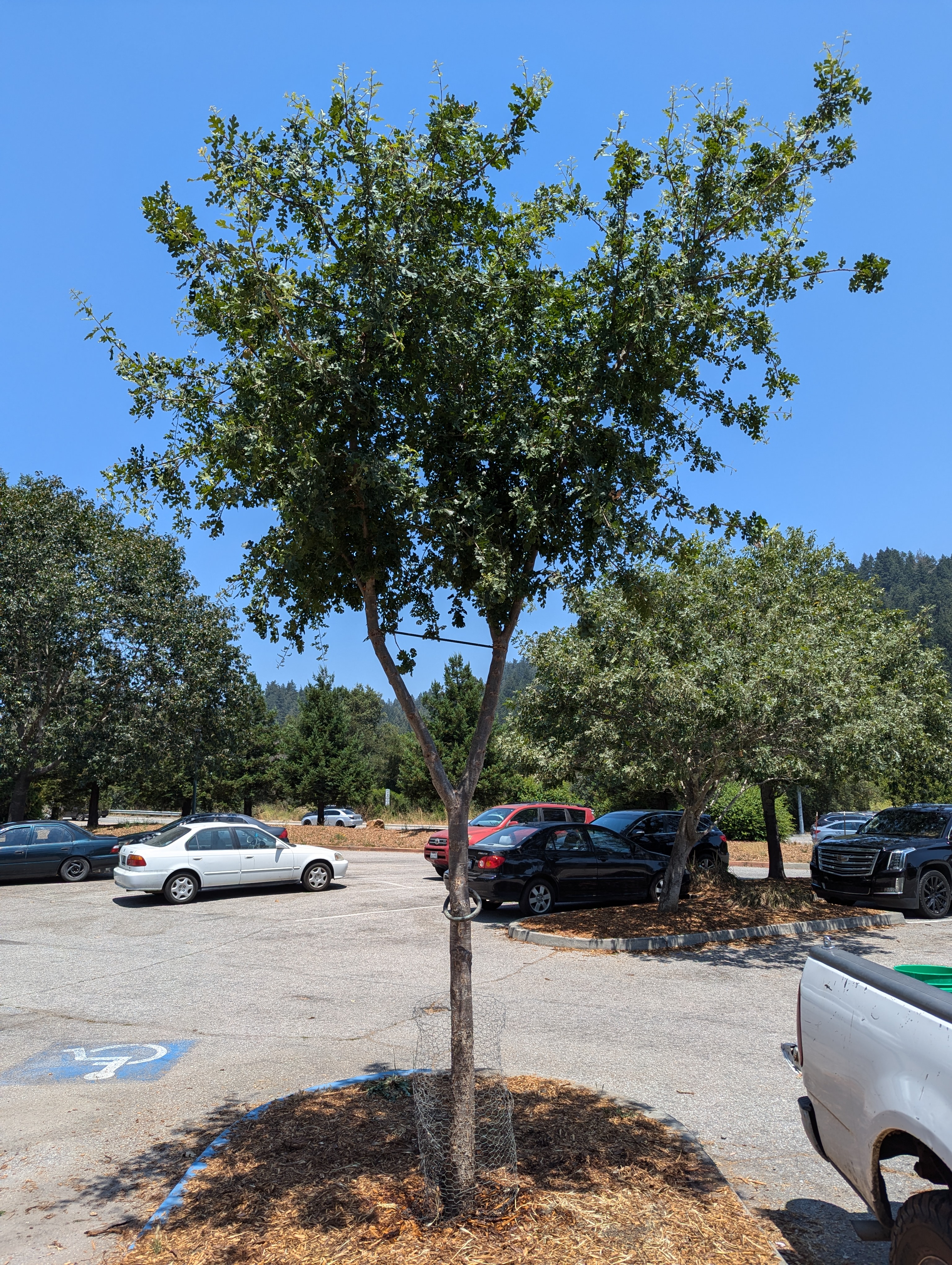
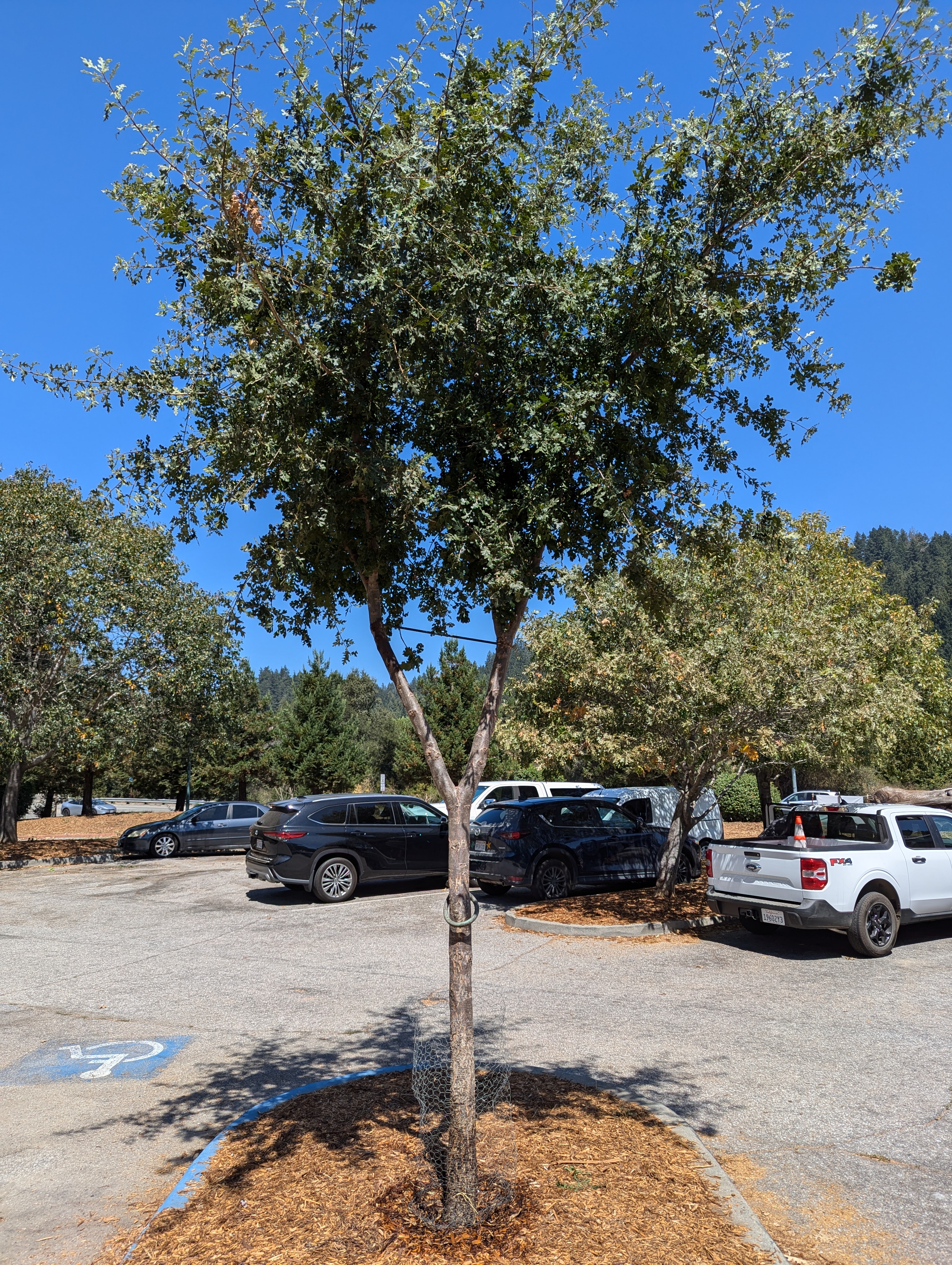
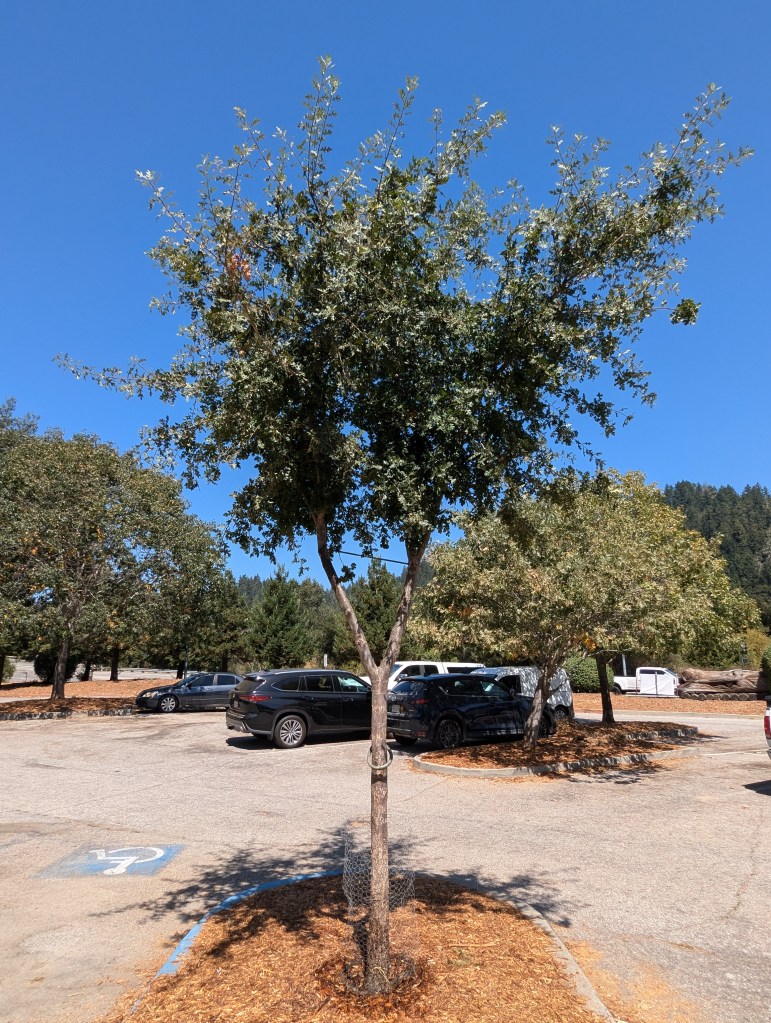
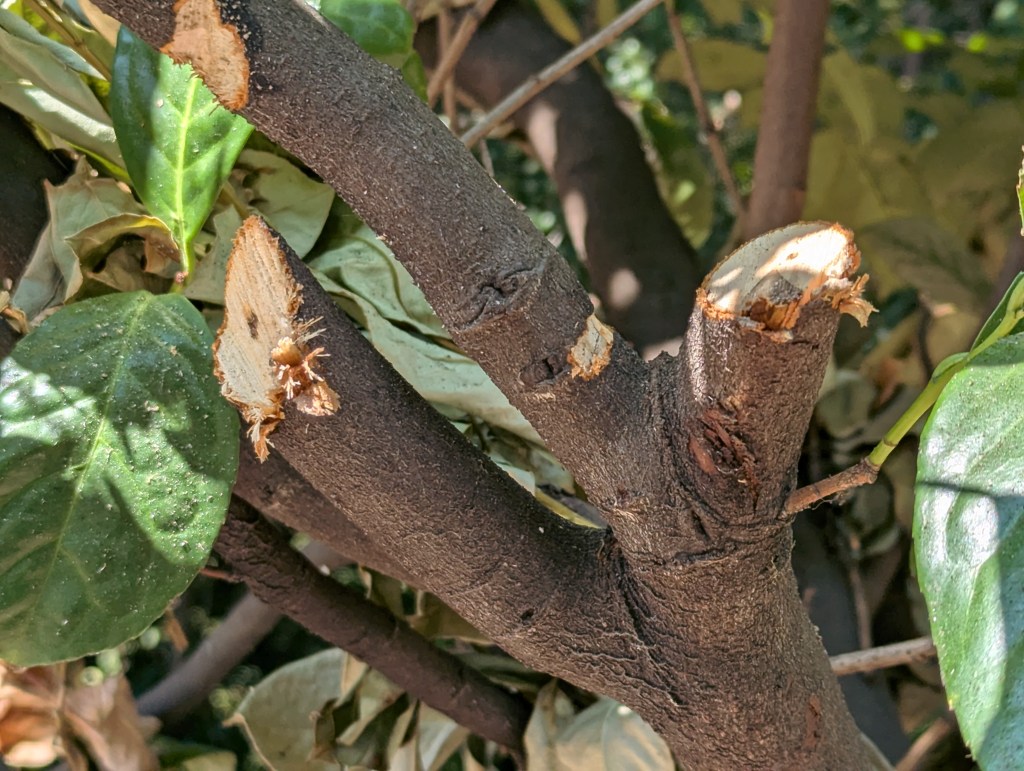
Ungrafted ‘Eureka’ lemon

All but two of the forty or so cultivars of citrus that I grew in the early 1990s were grafted onto the same dwarfing shaddock rootstock. Only ‘Meyer’ lemon and ‘Seville’ sour orange were not grafted, or ‘on their own roots’. ‘Meyer’ lemon naturally stays compact enough to not need a dwarfing rootstock. it was our most popular cultivar. ‘Seville’ sour orange supposedly grows about as large as the various dwarfed sweet orange with or without a dwarfing rootstock, as if the rootstock does nothing to limit its ultimate size. It was our least popular cultivar.

‘Eureka’ lemon, ‘Lisbon’ lemon and ‘Sanguinelli’ blood orange grow larger than any of the other grafted dwarf citrus that we grew. ‘Eureka’ lemon is actually a variant cultivar of ‘Lisbon’ that produces fruit throughout the year, which is a desirable attribute within home gardens. ‘Lisbon’ lemon may seem to be a bit more productive, but only because it produces all of its fruit within a more defined season, which can be a desirable attribute for orchard production. Otherwise, ‘Eureka’ and ‘Lisbon’ lemons are indistinguishable from each other, and grow quite tall. ‘Sanguinelli’ blood orange grows about as large, with a nearly identical upright form, but with a softer foliar texture.

Without dwarfing understock, ungrafted ‘Eureka’ and ‘Lisbon’ lemon trees can grow as big as small shade trees, and produce more fruit than they can support against gravity. Their broken limbs are a horridly thorny mess to clean up. ‘Sanguinelli’ blood orange trees can grow about as large, although they support the weight of their fruit more efficiently, and any debris that they generate, hopefully from pruning rather than breakage, is not so objectionable to handle.

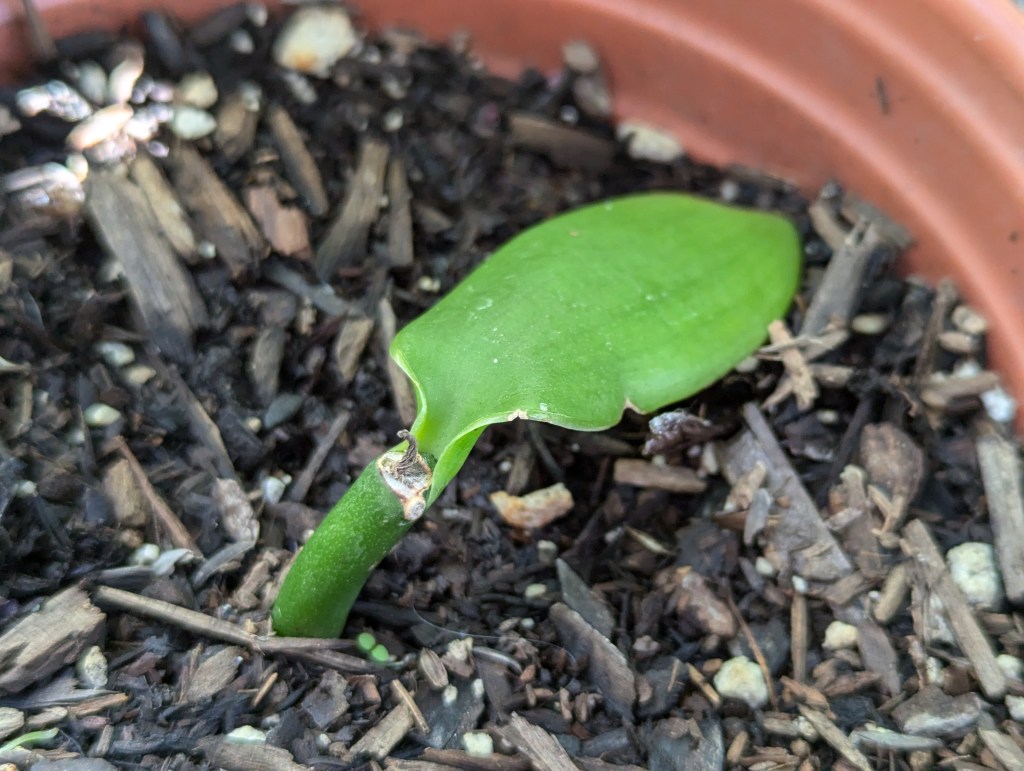
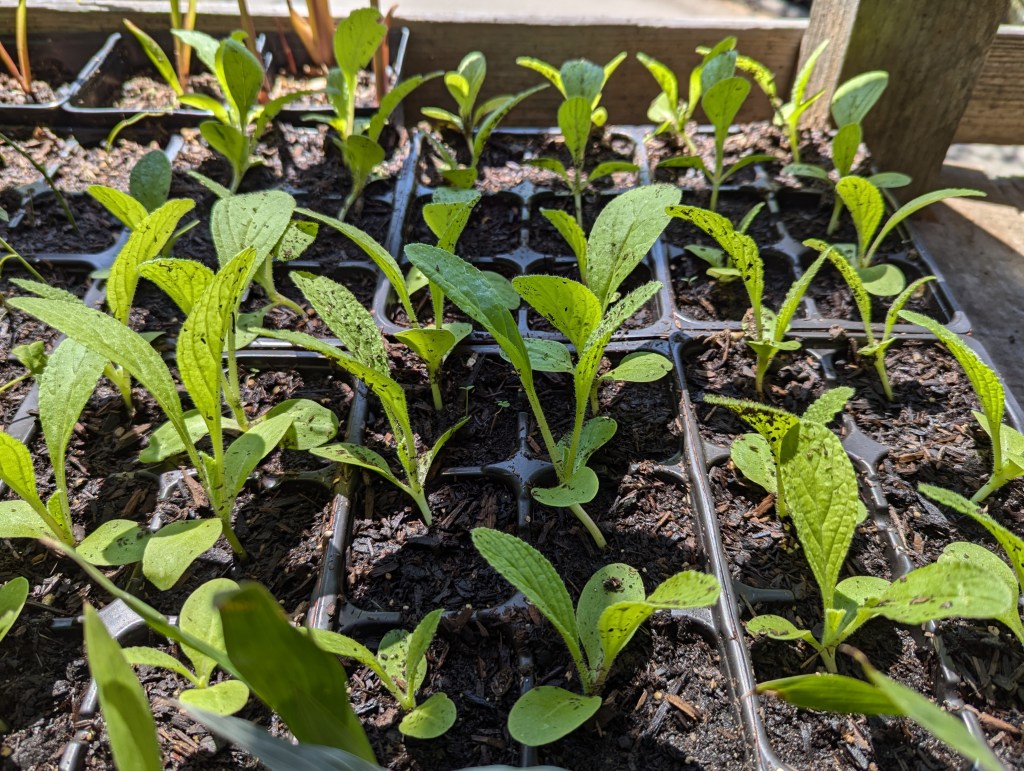
So, I should have known better than to plug a bunch of ‘Eureka’ lemon cuttings. As cuttings, they lack dwarfing understock. I shared more than half with neighbors, who have been warned. About fourteen remain. One is more than enough.

Six on Saturday: Surprise

Surprise is a town northwest of Phoenix that I encountered between late April and early May. These six are different sorts of horticultural surprises which I encountered at work.

1. Platycerium bifurcatum, common staghorn fern, Tillandsia usneoides, Spanish moss and two other unidentified species of Tillandsia combined for a surprisingly compelling epiphytic platter. The staghorn fern is from Brent’s garden. The Spanish moss should be fuller as it grows. The two unidentified Tillandsia should be displaced as the fern grows.

2. Brugmansia X cubensis ‘Charles Grimaldi’ angel’s trumpet is no surprise. A picture of it posted here last Sunday. Its richer than typical yellow floral color is a surprise though. It is also from Brent’s garden, and was from one of his projects years ago. Brugmansia X candida ‘Double White’ and Brugmansia suaveolens ‘Single White’ both bloom nearby.

3. Brugmansia, angel’s trumpet of an unidentified cultivar demonstrates why the yellow floral color of ‘Charle’s Grimaldi’ is so surprising. Both were about the same pale peachy color last year, with the same fragrance. I thought that they may be the same. Obviously, but actually surprisingly, they are not. I do not know what it is, but I know what it is not.

4. Persicaria amplexicaulis ‘Firetail’ arrived here with Persicaria bistorta ‘Superba’ and perhaps Persicaria affinis ‘Dimity’ from Tangly Cottage Gardening early last April. I can not distinguish the cultivars, which is why I do not know if they include ‘Dimity’. It was a surprise to see ‘Superba’ bloom immediately after relocation. ‘Firetail’ is a surprise now.

5. Mimulus guttatus, seep monkey flower is blooming with surprising abundance where the stream from Redwood Springs flows into the drainage pond. The location should not be a surprise since, as its common name implies, this species prefers damp situations. It is surprising only because I somehow neglected to observe so much bright yellow earlier.

6. Rosa, rose of an unidentified cultivar would not be so surprising if I were not aware of how it got here. Someone who does not work in the landscapes removed it from where it was obstructing access to one of his projects. I saw it in his pickup as he was about to discard it. I am surprised that it survived, blooms well and seems to be a hybrid tea rose.

This is the link for Six on Saturday, for anyone else who would like to participate: https://thepropagatorblog.wordpress.com/2017/09/18/six-on-saturday-a-participant-guide/

Clematis

Clematis like warm air but cool soil.

Like the big bark of a little terrier, the big and boldly colored flowers of large-flowered hybrid clematis seem to be more than their delicate vines should be able to produce. Almost all of the many modern varieties bloom with flowers that are at least three inches wide; and some have slightly ruffled double flowers. Their rich, deep, and sometimes two toned shades of red, blue, purple or pink, as well as white seem too opulent for their simple wiry stems that may climb to only six feet or so. The dark green compound leaves grab harmlessly onto light trellises, stakes or lattice.
Although the foliage and flowers want sunny exposure, clematis roots do not like warm soil, so appreciate generous mulching.  Some people like to give them a wide rock to disperse their roots under, or plant them next to large pots that sit directly on the soil. I planted mine on the north side of the northwestern corner of the house where the soil was always shaded, and allowed it to climb around the corner onto an iron banister on the west side.

Clematis want to be watered and fertilized regularly, and well drained organically rich soil. They should be pruned rather aggressively in winter while they seem to be dead, but are really just dormant.

In The Zone

Climate is regional.

We all know how excellent the local climate is for gardening. As we travel around the area though, we also realize that there is more than one climate. Locally, there are at least three of the standardized ‘Sunset’ garden zones, with several more within only a few miles. There are countless microclimates too.

Elevation, terrain, latitude and the proximity of the ocean or large bodies of water all influence the climate. Even though the Santa Cruz Mountains are not very high, they sometimes get snow on top because higher elevations are a bit cooler. When the Summit and Santa Clara Valley floor are cold in winter, the slopes in between are not quite as cold because cold air drains away downhill. The areas closest to the San Francisco Bay stay much cooler through summer because of the insulating quality of the water. 

More localized variables like forests, lakes, direction of slopes and infrastructure affect microclimates. Older neighborhoods with mature trees are shadier and cooler than newer neighborhoods with smaller trees. The west facing slopes to the east get warmer than the east facing slopes to the west. In Downtown San Jose, tall buildings create cool and shady microclimates to the north; and some reflect enough solar radiation to significantly warm areas to the south and west.

It is important to know what climate zone any particular garden is in to be able to select appropriate plants. Besides that, it is important to know the microclimates within the garden to know where each plant will be happiest. Tropical plants that would be happy in Los Angeles might succumb to even mild local frosts. However, plants that might succumb to frost if too exposed may be safe in sheltered microclimates.

Generally, Campbell, most of San Jose, southern Sunnyvale, northeastern Cupertino, northeastern Los Gatos and Union City are all within Sunset Zone 15. Most of Saratoga, southwestern Los Gatos, southwestern Cupertino and Mission San Jose are in Zone 16. Santa Clara, Alviso, Milpitas, northern Sunnyvale and western Fremont are in Zone 17.

None of these zones are too severe. Because of the marine influence of the San Francisco Bay, Zone 17 can actually be relatively boring and not so great for plants that want winter chill or summer warmth. Zone 16 is very similar to Zone 15, but comprises hillside thermal belts where cold air drains away in winter, and also gets a bit warmer in summer. Above and below Zone 16, Zone 15 gets cool enough for plants that want winter chill, but may not get warm enough in summer for plants that crave heat. The Sunset Western Garden Book not only describes the climate zones in detail, but also specifies what zones every plant is adaptable to.

Victim of Gravity

Nature is messy.

What goes up must come down. This elderly and deteriorated Shreve oak may have taken more than a century to go up, and then suddenly came down within only a few seconds. Unfortunately, it was not at all graceful about doing so, as it landed on this unoccupied cabin and a nearby bay tree. The cabin can be repaired. The bay tree needed to be removed with the fallen Shreve oak. Nature is messy like that. Some might say that it is also inconsiderate. Regardless, it can be difficult to live and work with. Most of our landscapes are adjacent to natural ecosystems. All are dominated by big natural trees, including coastal redwood, which is the tallest species of tree in the World. Even if none of the big trees are directly within some of the landscapes, some of such trees are big enough to drop debris or limbs within landscapes that are significant distances away; or worse, they can fall into the landscapes. As much as we try to limit such risks, nature, besides being messy and potentially inconsiderate, is also generally unpredictable. However, one of only a few aspects of nature that is always reliably predictable is gravity.

Nasturtium

Feral nasturtium is yellow or orange.

Most consider nasturtium, Tropaeolum majus, to be a warm season annual. Some might consider it to be a cool season annual. A few press its tender stems into moist soil to root and continue growth as a perennial. Plants that bloom for summer can disperse seed for winter bloom. Plants that bloom for winter can likewise disperse seed for summer bloom.

Because they replace themselves so readily, they may seem to be perennial. In actuality, plants from one season, whether warm or cool, may not last long in the next. Seed might be sneaky about spreading. Trailing nasturtiums might naturalize in riparian ecosystems. Nasturtium seedlings are available in cell packs, but do not grow as vigorously as seed.

Nasturtium bloom is diverse shades and tints of yellow, orange and red. Varieties bloom with particular colors within that range, although few are true to type. Their feral progeny bloom only bright orange and bright yellow. Their tender growth does not get much more than one or two feet deep. Trailing varieties can climb as high as first floor eaves though. Nasturtium leaves are almost circular like those of water lilies.

Feral Vegetation Inherits Natural Advantages

Feral alyssum is limited to white.

Most vegetation within home gardens is better than it was naturally in the wild. For many, systematic selection isolated the best from average populations. Selective breeding and hybridization improved many others. Some are too genetically compromised by breeding to produce viable seed. Feral progeny of those that are not demonstrate the divergences.

Such feral progeny are generally not true to type. They are, to varying degrees, more like their ancestors than their direct parents. Some can revert directly to a natural state in the first generation. Some do so slower through a few generations. Feral progeny of hybrids are still hybrids but may be more primitive. Many hybrids produce no viable seed though.

‘Jewel Mix’ nasturtium, for example, blooms with many shades of yellow, orange and red. Several are pastels. Some are dark enough to be almost brown. A few are bicolors. Their progeny though, blooms with less light, dark and red colors. Bloom becomes exclusively bright yellow and orange as feral plants replace originals. It reverts to more natural color.

That is because nature is efficient. By human standards, innately unnatural breeding and selection improve plant life. They produce better fruits, vegetables, flowers and anything that grows on plants. However, they interfere with natural function such as reproduction. Seedless limes, which are preferable within home gardens, would go extinct in the wild.

Plants that revert to more natural feral states are merely trying to survive. Sterile pampas grass is only sterile because it is exclusively female. Naturalized Andean pampas grass can pollinate it from a distance, though. Their hybrid but nonsterile feral progeny may be as invasive as their Andean parent. They are detrimental to their ecosystem, but survive.

Not all feral flora grows from seed. Seedless and thornless honeylocust are grafted onto wild honeylocust understock. Seedy and thorny suckers can grow from such understock below its grafts. They commonly develop after removal of original grafted trees. By some standards, they become aggressively invasive. By other standards, they are sustainable.

Reveille

Angel’s trumpet, Brugmansia X cubensis ‘Charles Grimaldi’

Summer has been slow to arrive. Now, some flowers that have been waiting for a bit of warmth to bloom are ready to make up for lost time.

These angel’s trumpets are fortunately silent. Even prior to full bloom, so much bloom looks silly with such minimal foliage.This picture is a few days old; so they are in full bloom by now. More foliage will develop as the summer progresses.

This particular cultivar is the common ‘Charles Grimaldi’, with splendidly fragrant single yellow flowers. Two other cultivars are blooming nearby. One is somewhat less vigorous, with single white but perhaps less fragrant flowers. The other is more compact than ‘Charles Grimaldi’, with double white and comparably fragrant flowers.

All were grown from cuttings, and have potential to grow like weeds. Six more of the cultivar with double white flowers were added to another landscape nearby. Several of both cultivars with white flowers are developing in the nursery, and will need homes either in the landscapes or neighbors’ gardens by next year. Another cultivar in the nursery may bloom with mildly fragrant single pastel orange flowers in the next few days, but we will not know until it actually does so. We have not seen it bloom yet. It could actually be another copy of ‘Charles Grimaldi’.

Daylilies are beginning to bloom now also. Like angel’s trumpet, they seem to have been waiting a bit longer than they wanted to, so are ready to bloom simultaneously in atypical profusion. I hope that such profusion does not compromise subsequent bloom, since they continue to bloom throughout summer and until frost. Also like angel’s trumpet, daylilies are so easy to grow and propagate that there has been no incentive to acquire more cultivars than the three or so that are already here.

Six on Saturday: No Rhododendrons

Rhody’s rhodies were spectacular in bloom. This year, I refrained from posting too many pictures of them by posting none at all. I thought that I might get a few at the end of the season; but now find that the few that remain are either shabby or difficult to get a good picture of. There is plenty of other bloom though, even without exploitation of the warm season annuals. Now that daylilies are blooming, they will continue until autumn. Roses continue at least as late, but bloom in phases since most are partially shaded. All but one of these six species were recycled, although one was recycled by remaining where it was.

1. Daylily is not actually a lily. With all the bickering amongst botanists, its classification remains vague. This surplus from thinning a congested colony now borders the iris bed.

2. White climbing rose that was removed from the garden of a renovated cabin has been relocated to el Catedral de Santa Clara de Los Gatos, where merely white flowers bloom.

3. Rose lily that was plumply budded for Six on Saturday two weeks ago is now finishing. It recycled itself from a previous froufrou garden as the rose garden was installed over it.

4. Carpet rose was originally too close to a walkway, so was relocated to a wide roadside embankment. I am none too keen on carpet rose, but it is appropriate for its application.

5. Easter lily that was left from a wedding at el Catedral de Santa Clara de Los Gatos was added to the perennials across the road, but could have remained with the white flowers.

6. Unidentified hybrid tea rose, which had the color but not the form of ‘Double Delight’ before it began to fade, blooms in the rose garden, which was installed over the rose lily.

This is the link for Six on Saturday, for anyone else who would like to participate: https://thepropagatorblog.wordpress.com/2017/09/18/six-on-saturday-a-participant-guide/